Epsom and Ewell Times

ISSN, LDRS and IMPRESS logos

Spelthorne’s thorny property problems spelt out

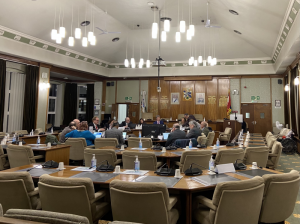
Spelthorne Borough Council audit committee on March 23, 2023. Credit: Emily Coady-Stemp

Following the report on Woking’s woes we have Emily Coady-Stemp from LDRS report on another sister Surrey borough’s woes over property investments:


Spelthorne’s former leader says “hand on heart” he still believes the borough council’s commercial property investments were “utterly legal”. The councillor said the authority had taken legal advice on the decision to purchase the buildings but raised concerns about other councils with high borrowing costs.

Image: Spelthorne Borough Council audit committee on March 23, 2023. Credit: Emily Coady-Stemp

Councillor Ian Harvey (United Spelthorne Group, Sunbury East), who was leader of Spelthorne Borough Council at the time three commercial properties were bought outside of the borough in 2017/18, was responding to a public interest report carried out by its auditors. He told a meeting of the borough council’s audit committee on Thursday (March 23) his first question at the time the possibility of buying properties came up was: “Is it legal?”
He said the advice given at the time by the council’s KC was that it was legal, and that the decision had “repeatedly been determined to be legal subsequently”.

The report, publicly released in November, claimed the council had “acted unlawfully” in its decision to buy properties outside of the borough, and set out five recommendations for the authority.

At a December meeting of the council, councillors agreed the recommendations set out in the KPMG report, and Thursday’s meeting was an update on the action plan to come about from that.

The current council leader, Cllr John Boughtflower (Conservative, Ashford East) said in December the council “should not have any difficulties” accepting the recommendations, because of changes to processes at the council and issues that had been addressed since the purchases.

Cllr Harvery asked auditors at Thursday’s meeting, who were presenting their report into the 2017/18 accounts, if they had assessed the council’s risks “compared to some other spectacularly investing local authorities for example, Slough, Croydon, Thurrock”. He also asked about comparisons to Woking Borough Council, where the current administration has warned an effective bankruptcy may be declared, saying they had “borrowed more than we have without any surety of repayment”.

Later in the meeting Cllr Harvey said: “I can say hand on heart that we were assured, and I still believe, it is utterly legal. And if what we did was illegal then what a lot of other councils have done, and spectacularly failed, at was far, far more illegal.” He claimed the difference in legal opinions was because KPMG had “relied on a much more junior barrister within the same chambers who came up with a dissenting view”.

Cllr Lawrence Nichols (Liberal Democrat, Halliford and Sunbury West) said though the advice was taken from a “very well qualified QC”, it amounted to 19 words of legal advice for more than £200million of expenditure in 2017/18. He also questioned the diversity of the council’s property portfolio and the advice sought from how to manage commercial properties. He told the meeting: “I do think we out to be more realistic about diversification. We are in the office business, whether it’s an engineering company or a dental practice, that’s not the issue. It’s the office market we’re in, so that’s our diversification risk.”

In response to an expected £60m of rental income dropping to £46m for next year, which Cllr Nichols said was a “massive change of direction”, the council’s chief accountant Paul Taylor said £7m rent guarantee income had been released and would be going into the council’s revenue budget.

The meeting heard that a new group head of assets had recently started at the council and that a “fully worked up action plan” would come to the committee’s next meeting in July. Spelthorne’s chief executive, Daniel Mouawad, said the nearly half a decade turnaround in the audit report for 2017/18, the last stage of which was the public interest report, was “by any measure” a “remarkably poor turnaround”. But he added that nearly a year’s delay could be “directly attributed to the actions of one individual Spelthorne councillor” which was currently being investigated under the members code of conduct.

When asking a question on this individual, Cllr Harvey was cut off by the chair, his wife Cllr Helen Harvey (United Spelthorne Group, Sunbury East), though officers did confirm they would revert with a response on the cost of the delay caused by the councillor concerned.

KPMG representatives confirmed an “adverse conclusion” would be issued in relation to the “value for money arrangements” for the 2017/18 accounts, the same as in the 2016/17 accounts where recommendations and weaknesses raised were “still in place in the 2017/18 period”.

The meeting also heard that a review into the council’s borrowing carried out by the Department for Levelling Up, Housing and Communities should be coming to an end this week

In response to a public question on the review, the chair said the council was not “privy to the terms of reference or have any expectations to receive the final report within any given period”.

It was hoped this report would also come to the next committee meeting in July, though Terry Collier, the council’s deputy chief executive, said it had been hoped there may be a draft report available by Thursday’s meeting.


Waking to Woking’s woeful debt

Woking Council

Epsom and Ewell Times has followed the finances at this sister Surrey borough. We all should perhaps be concerned and learn lessons from a County borough that can get in such a mess. In contrast Epsom and Ewell Borough Council has been balancing its books for years. At the end of the day where will the money come from to save Woking? Local Democracy Reporter Chris Caulfield reports:


The dire financial future of Woking Borough Council was laid bare with senior figures warning of the “significant risk” of it effectively going bankrupt as its cash reserves run dry.

The council’s executive committee met on Thursday March 23 to hear an update on its financial strategy. It was told of the budgeted shortfall of £9.5m for the next financial year and the swingeing cuts coming as it moved to provide only the minimum levels of services – those it must provide by law.

Woking Borough Council’s financial disaster is the product of years of heavy borrowing to pay for a failing investment portfolio. The previous administration had hoped this would generate income but instead it has saddled the local authority with annual interest repayments of more than £60m a year while only generating £38.5m. 

Councillor Dale Roberts is now the portfolio holder for finance on the council. He said it had gone to the government seeking to lower the minimum amount it can set aside to repay its loans and has been searching for further  “restrictions on expenditure necessary to address the budgeted shortfall of £9.5m for 24/25. He added: “Both of which relate to the ongoing and significant risk of issuing a section 114 notice.”

Councils can not go bankrupt. Instead, they enter what is known as being under section 114 notice and means they cannot make new spending commitments.

He also said the council would seek to try to fund “transformational projects” through any capital receipts.  Cllr Ian Johnson (Lib Dem, Mount Hermon) said: “It shows a stark issue, the deficit next year is £9.5million based on current numbers,  and yet our services expenditure is just under £45m. So that’s a 20 per cent difference. So we need either cost savings or revenue generation to be able to cover that gap of 20  per cent.Because the £62million interest payments we are making at the minute could well go up given today’s interest rate rises.

“Its unaffordable at the present level. We know that DLUHC (the Department for Levelling up, Housing and Communities) have been in the office talking to us for the last couple of months. Until we get their report as well we won’t be able to be definitive in where we’re progressing with any of the business we’ve got including talking to the government  about our debt levels and how we might be assisted in reducing the interest payments we make.”

DLUHC was not expected to return any decision until the start of the new political year in May. Cllr Dale Roberts said:  “The enormity of the task ahead of us for next year, the affordability of the borrowing, the degree that we have to find savings are deeply concerning.”

Cllr Stephen Dorsett (Con. Pyrford)  asked about the possibility of future savings if council was already operating at “statutory spend only” – that is for services the council is legally obligated to provide. Cllr Roberts said: “Even costs savings cost”.

Leader of the council Anne Marie Barker said: “We’re having to put controls on day to day spend and just keep a very tight rein on everything. We’ve got our balanced budget for the year by using reserves but going forward that £9.5m next year, and more than that the following year, we do need to do a fundamental review of what were doing and how were doing it. It’s the only way we can make those budgets balance, the reserves aren’t going to last forever.”

Related reports:

Would you want to live in Woking?

Woking up to a very big debt problem


Surrey lands largest EV charging contract in UK

electric vehicle charging points

Surrey County Council and Connected Kerb have agreed a contract to support the rollout of thousands of electric vehicle chargepoints across the county in the coming years. The contract, the largest in the UK to date, will release up to £60million of investment for Connected Kerb to install public EV chargepoints across the county. The aim will be to install thousands over the next five years and Connected Kerb have been licensed to operate the chargepoints for 15 years from installation.

Image credit: Andy Hughes.

Increasing the number public chargepoints in Surrey will support residents who would like to switch to an electric vehicle (or already have done), but do not have a driveway to be able to install a chargepoint at their home. Through this contract, chargepoints will be installed at convenient on-street locations in residential areas and key locations in the community such as on high streets and public car parks.

Connected Kerb will install a mix of chargepoints, depending on location, to suit all needs. This will include slower 3kW and 7kW chargepoints, as well as fast 22kW chargepoints and, where suitable, rapid chargepoints. Their product range includes free-standing and wall-mounted chargepoints, which will cater to those with accessibility needs.

The partnership will see a rapid rollout of on-street charge points, with ambitious plans to install hundreds of charge points within the first year It aims to make one in five of the EV charging bays more accessible to drivers with disabilities, in recognition of the need to make EV adoption a practical reality for the 2.35 million blue badge holders on UK roads[i].

The recent Net Zero Review, published by the Government’s advisor Rt Hon Chris Skidmore MP, highlighted the opportunity for local authorities to take a leading role in the rollout of charging infrastructure. The partnership between Surrey County Council and Connected Kerb supports the delivery of ambitious EV charging infrastructure rollouts at the scale and pace needed to meet targets set by the government and to keep pace with rapidly growing EV adoption – up 40% in 2022 compared to 2021.

Throughout the contract, Connected Kerb will be identifying suitable on-street locations, using residents’ suggestions made through our online map, and approaching public sector and community land owners across the county to identify other suitable locations for public EV chargepoints, including local car carks, NHS sites and educational establishments.

Marisa Heath, Cabinet Member for Environment, Surrey County Council, said: “We know that emissions from transport are a significant proportion of our carbon footprint in Surrey, so supporting residents to switch to an electric car is essential to helping us achieve our aim of being a net zero county by 2050.

Many residents don’t have access to driveways to charge EVs at home, so a comprehensive network of high-quality, reliable and accessible EV chargepoints is essential to supporting the needs of our local communities.

We’ve been working with Connected Kerb for almost a year, as part of our pilot phases that have seen us install over 100 chargepoints across Surrey over the last two years. We’re delighted this contract will enable us to speed up the roll-out of further chargepoints and expand our network in the coming years.”

Chris Pateman-Jones, CEO of Connected Kerb, said: “If one local authority can deliver such a significant boost to the UK’s charging network, just imagine what we could achieve by 2030 if every city, county, and combined authority was empowered to do the same. The recent Net Zero Review was clear – local authorities can become the driving force behind the rollout of charging infrastructure across the country, and our partnership with Surrey County Council is case and point.

“If local authorities are the door to a clean transport future, then charging networks like Connected Kerb are the key, providing the tools and expertise needed to unlock the transition at the pace and scale required to reach net zero. Although the Government’s estimate of 300,000 chargers by 2030 may feel ambitious, it’s eminently possible – and necessary – to achieve; this deal proves it.”

In addition to the EV chargepoints, the contract will delivery significant value to Surrey residents through Connected Kerb’s social value projects. These will cover a range of initiatives including working with local educational centres to provide industry support to pupils interested in learning about EV chargepoints, providing employability support to vulnerable young people, as well as supporting a number of charities within the county.

  • The contract enables up to £60million of investment to provide public EV chargepoints across Surrey
  • Chargepoints will be installed at on-street locations as well as on other suitable public sector and community organisation managed car parks
  • Partnership underlines findings of the recent Net Zero Revies which highlighted local authorities as the key to reaching the UK Government’s 300,000 chargepoint target

Planning or pantomime? Councillors press pause on Plan.

Imagined housing etsate on Horton Farm Epsom

Epsom and Ewell council voted to “pause” its controversial Local Plan last night, with one Residents’
Association (RA) councillor leaving the meeting after suggesting it was about “forthcoming elections
rather than planning policy”. The length of the “pause” has not been specified.

Local elections are due to take place on 4 May.

Councillor Alex Coley (Residents’ Association, Ruxley Ward) told the council: “Considering this motion on its merits, I feel that a more appropriate location might be the Playhouse around Christmas time.” “We seem to be debating the forthcoming elections rather than planning policy”, he added, suggesting that the pause “ultimately changes very little”. Cllr Coley then told the council: “I will leave you now to your debate.”

The motion to pause the Local Plan was put forward by councillor Eber Kington (Residents’ Association, Ewell Court Ward) and six other RA councillors. Cllr Kington said that a pause would acknowledge “the strength of public feeling” on the Plan, enable a reassessment of brownfield sites, and provide the opportunity to look at options that do not use Greenbelt land at all. He added: “We have to take notice of what residents are telling us, through whatever means they choose.”

The public consultation on the Draft Local Plan ended on Sunday (19 March) with around 1,500 responses. A petition calling to “Keep Epsom and Ewell Greenbelt” has also reached 10,000 signatures, which is thought to be the greatest response to a petition in the borough’s history.

Campaign group Epsom Greenbelt held a protest to “Welcome Councillors” outside of last night’s meeting, and were calling for “Green not greed”.

Councillor Bernie Muir (Conservative, Stamford Ward) said she had “no option” but to vote for the pause, despite believing that “nothing in this motion will actually stop this plan from going ahead in the end”.

The pause was discussed in light of expected changes to government planning legislation, including updated guidance on Greenbelt development and how to calculate housing need.

One part of the motion states: “Under the existing legislation Local Planning Authorities are being required to draft Local Plans on the basis of out of date, 2014, data that does not reflect Epsom and Ewell’s housing need, as shown in more recently available 2018 data.”

Councillor Peter O’Donovan (Residents’ Association, Ewell Court Ward) said that pausing was not an option because the government had not given at timeframe for its legislative changes. He added that without an up-to-date Local Plan, there was a danger of inappropriate development, and said: “we need to continue on our current strategy, to protect the borough, to produce a plan that protects our Greenbelt.”

Councillor Kate Chinn (Labour, Court Ward) said that there was a huge need for housing in the borough, particularly social and affordable housing, but that there should be no development on the Greenbelt until every other option had been exhausted. She said that Labour councillors would be voting to pause the Plan.

Councillor Julie Morris (Liberal Democrats, College Ward) said: “There’s really quite a divide, isn’t there, amongst the ruling group?” She said: “We should have been much more clear about the direction that this document was going in, and that’s the problem you’ve got now – you are now having to do a U-turn because it was all kept secret for quite a long time and the public are not happy, understandably.”

Cllr Morris said that it was difficult to know whether to vote for the motion, especially when it did not include any endpoint for the pause, but said that it was the right thing to do on balance.

Councillor Steven McCormick (Residents’ Association, Woodcote Ward) had five minutes to respond to the points raised because, as chair of the Licensing and Planning Policy Committee, he had led the development of the Local Plan. He said that the proposed pause was reliant on the idea that the government would publish changes
to planning policy in May, but that some legislation change may not come until 2024.

Cllr McCormick added that the motion to pause the Plan would create “huge uncertainty” and said: “the best thing for protecting the Greenbelt is to progress”. Cllr McCormick voted against the pause.

The council voted to pause the Local Plan by a clear majority, with four councillors ( RA Cllrs Dallen, O’Donovan, McCormick and Nash) voting against the pause and Cllr Williamson abstaining.

The text of the motion is HERE.

See editorial.


Ruse within a ruse?

Yesterday the full Council of Epsom and Ewell voted to pause the process of the Local Plan. Cllr Eber Kington (RA Ewell Court) proposed an emergency motion to delay the next stage for the Government’s latest position on housing targets to be clarified. Expected some time after the local elections on 4th May.

Cllr Eber Kington
Cllr Eber Kington

His arguments for the motion included the protection of the Green character of the Borough. He observed that the draft Local Plan conceded the need for using Green Belt to accommodate a proportion of the 5400 houses planned for. Yet, the Government’s target is over 10,000. Therefore, Green Belt encroachment for the lower figure is a Green Light for Green Belt development for the higher figure.

He said that more work needed to be done on how brownfield sites could be used to provide the housing requirements.

In an unusual intervention Cllr Alex Coley (RA Ruxley) described the proceedings of the Council meeting as a pantomime. He argued that the timetabling of the Local Plan process is one for managerial direction and that Councillors were playing politics. Fitting his description of the proceedings he then made a somewhat dramatic exit stage left in a bit of a huff.

Cllr Peter O’Donovan (RA Ewell Court) opposed his ward colleague. He stressed the need for a new Local Plan. Delay would mean the Borough’s resistance to inappropriate planning applications would be weakened.

All opposition Councillors (Conservative, Liberal Democrat and Labour) spoke for the motion. After Cllr Bernie Muir (Conservative Stamford) called for the ruling Residents Association to be “kicked out”, she and her Party were targetted in responses by RA Councillors. Firstly, Cllr Jan Mason (RA Ruxley) suggested Cllr Muir had not long lived in the borough “just five years”. On a dubious “point of order” Cllr Muir corrected this: “12 years actually”.

Cllr Mason struggled on to make her point. A journey into a time nearly 50 years ago when the Council bought Longrove hospital land, thus preventing a 5000 housing development from taking place. Cllr Muir would not have known that, she said. Cllr Mason relied on this 1974 purchase to prove that the RA ruled Council do care about the Green Belt.

This brief spat passed and it was Cllr Kington in his reply to the debate who said that the Conservative Government should be “kicked out”. This was because the Government insist on using 2014 figures to determine housing need when much lower numbers are yielded by a 2018 analysis.

Cllr Steve McCormick (RA Woodcote and Chair of the Licensing, Planning and Policy Committee) opposed the motion. He relied on the ability of the Council to respond to the public’s views and amend the draft during the next 5 of the processes’s 7 stages.

There were a significant number of empty chairs in the Council Chamber for this important meeting. Four Councillors voted against Cllr Kington’s motion. It was carried by a large majority.

The motion passed is HERE in FULL.

This confusion in large part arises from Michael Gove MP and Secretary for Housing Development etc signaling an end to compulsory and centrally set housing targets. First indicated as long ago as May 2022. Then unstated when the Government confirmed its targets remained and then reinstated just a few months later. But no regulations or legislation have been introduced that lift the compulsion of the targets from local government planning obligations.

Cynical observers suggest that Gove’s manoeuvres are a ruse to quell the flames of rebellion in the Tory shires and avoid defeats in upcoming local elections. Will we see actual legal change after 4th May?

In Epsom and Ewell was walk-out man Cllr Coley right to hint that the pre-election motion to delay is also for political gain?

A ruse within a ruse?

“That which we call a ruse by any other name would smell as bad.”

Time will tell if words are matched by action.


Motion to pause Local Plan process

The motion passed by an extraordinary meeting of the Epsom and Ewell Borough Council on 22nd March 2023:

Proposer Cllr Eber Kington
Seconder Cllr Christine Howells

This Council notes that:

  1. Extensive green areas, especially the green belt, and the absence of high-level development in our urban areas makes Epsom and Ewell a distinctive, green and an excellent place to live.
  2. Under the existing legislation Local Planning Authorities are being required to draft Local Plans on the basis of out of date, 2014, data that does not reflect Epsom and Ewell’s housing need, as shown in more recently available 2018 data.
  3. The Government’s recently proposed legislative changes to the planning process, whilst welcome in several aspects, are not yet enacted and the current legal position has not changed.
    These factors suggest that a pause in progressing the Draft Local Plan in its current form would provide an opportunity to assess the Government’s draft proposals as well as the 2018 data on housing need in the borough.
    This Council therefore agrees that:
    i. Other than for the purpose of analysing the responses of the public consultation to capture residents’ views and any new information, the Local Plan process be paused to enable:
    a) further work on brown field sites, including information arising out of the Regulation 18 consultation
    b) further options to be considered that do not include green belt sites
    c) an analysis of Epsom and Ewell’s required future housing numbers based on 2018 data
    d) a clearer understanding of the Government’s legislative intentions in regard to protections for the green belt and the current mandatory target for housing numbers.

ii. Write to the MP for Epsom and Ewell calling on in him to use his influence to get the Government to abandon its use of 2014 data to calculate housing need and accept that all planning and housing policies must reflect the latest data if they are to be effective as well command the respect of the people they affect.


Education assessment delays making parents sick

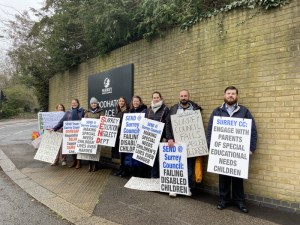
Parents protesting outside Surrey County Council headquarters in Woodhatch Place, Reigate Credit: Emily Coady-Stemp

A mother claims Surrey County Council “makes her sick” as she says delays to assessing her son’s special educational needs are causing “a lot of stress”.

At a protest held outside the authority’s Reigate headquarters, the mother, along with others, called for change at the council in how Surrey’s children with additional needs are treated.

Image: Parents protesting outside Surrey County Council headquarters in Woodhatch Place, Reigate. Credit: Emily Coady-Stemp

Anna Sutherland, protesting for the fifth time outside the Woodhatch Place building, said parents being sent down the tribunal route, as they are if they want to appeal against a council’s assessment of their children, “put a lot on families”.

She claimed the education, health and care plan (EHCP) issued to her 11-year-old son by the county council was “unlawful” but that because she knew the law, and knew what he was entitled to, she would “get there in the end”. Ms Sutherland told the LDRS: “This makes me ill. Surrey council make me sick.”

With her 9-year-old daughter’s EHCP also up for an annual review soon, Ms Sutherland feared she may have two tribunals on her hands. On previous protests, cabinet members on Surrey County Council have come out to talk to the parents present, but did not on Tuesday (March 21).

When the group of parents decided to attend the council meeting taking place that morning, they were told they could only do so if they left their placards in the building’s reception downstairs.

Ms Sutherland said many families with children with additional needs had “a lot to deal with in the first place” and additional chasing of EHCPs, tribunals and school places was “a lot to put on families”. Saying many families also had to work, may also have neuro-diverse conditions themselves and the “huge impact” on a parent’s mental health of going through a child’s diagnoses she said the parents at the protest were representing a “much huger group”. She added: “On top of the stress they put on you, then having the additional strength or the additional drive to protest, a lot of families just can’t do that.”

Clare Powdrill said delays to the EHCP process for her son had led to her spending more than £30,000 in two tribunals, both conceded by the council the day before the hearing. She said: “I am protesting because Surrey County Council have seriously let my son down.” Another parent, Charlotte Lewis, also said EHCP processes had been delayed “at every step” and timelines not been met by Surrey County Council. She said: “Many parents are being forced into a lengthy and expensive appeals process which is usually won but can delay children’s access to an education by years in some cases. ”

A council spokesperson said: “We are not able to comment on the details of any individual children, but we can confirm that all current EHCPs were updated in line with statutory timescales to enable children’s transition to the next phase of their education. If a parent is unhappy with the content of their child’s updated plan, we would urge them to contact their case officer as soon as possible, so that any issues can be resolved.

“We always aim to resolve disagreements without families needing to go through a tribunal process, however, they do have the right to do so, and if it remains the view of the local authority that the latest education health and care plan accurately reflects a child’s needs and the provision required to meet their needs, then, in these rare cases the tribunal is the appropriate route to resolve the dispute.”


Surrey Council’s ULEZ talks ongoing with TfL

Ulez sign

Surrey councillors have confirmed written communications are ongoing with Transport for London over the impact of the ULEZ expansion. Surrey County Councillor Robert Evans (Labour, Stanwell and Stanwell Moor) asked cabinet members at a full council meeting on Tuesday (March 21) to confirm that the mitigations the council was calling for would be followed up with the chancellor.

He claimed previous attempts to extend the Transport for London (TfL) Oyster card zone 6 in several Surrey boroughs had “floundered” because central government would not underwrite potential losses to the train companies.

Image: Ultra Low Emission Zone, Stonebridge Park. Credit: Will Durrant/LDRS

Cllr Evans called on Surrey’s cabinet to “work with TfL and the Mayor of London to make sure that Surrey residents get the health benefits of this, but don’t get negative impacts if ULEZ comes into operation.”
The zone, which sees drivers of older, more polluting cars charged £12.50 per day to enter it, is due to expand to cover all of greater London from August.

The ULEZ currently covers central London and its expansion will see it border several Surrey districts and boroughs including Spelthorne, Elmbridge and Epsom.

In response to TfL’s plans to extend the zone, Elmbridge councillors previously called for the Oyster Card Zone 6 to be expanded further, highlighting the difference between public transport in London and in Surrey.
Cllr Evans said schemes in Bristol, Coventry, Birmingham and elsewhere had seen the government “pick up the bill for a scrappage scheme”.

The council’s cabinet member for transport, infrastructure and growth, Cllr Matt Furniss, (Conservative, Shalford) confirmed face-to-face meetings had been requested with TfL, but said he was “disappointed to say it only took the threat of legal action to get transport London to respond.” He said the council did “ask the government regularly for additional funding” and would be talking to them about the impact of the planned extension.

Meeting documents showed a virtual meeting took place between with TfL, county council officers and Elmbridge Borough Council officers on February 21.

A written response was received from TfL as a follow up to the meeting on March 7, which was being looked at and a response drafted from the council. The documents said: “The council is committed to delivering a greener future, but it must be done in a practical and sustainable way. …..The impact of an expanded ULEZ on many Surrey residents and businesses will be significant, and we will not stand by and watch that happen with no mitigation offered.”

During the meeting, Cllr Evans also reminded the scheme had been brought about by Boris Johnson, during his time as Mayor of London. Former Prime Minister Mr Johnson was London Mayor between 2008 and 2016, and announced the introduction of the world’s first ULEZ in London in 2015. It was introduced from April 2019.

A written response was received from TfL as a follow up to the meeting on March 7, which was being looked at and a response drafted from the council.

Cllr Buddhi Weerasinghe (Conservative, Lower Sunbury and Halliford) said he was supporting a campaign by residents to get Ashford and Sunbury stations, among others in Spelthorne, added to Zone 6. He also highlighted the needs of the expanding Shepperton Studios that he said had been put in a letter to government regarding its work force needing to travel to and from the studios by train.


Life savers installed across the Borough

defribbiltator in action on man

Epsom & Ewell Borough Council have worked in partnership with national charity Community Heartbeat Trust to install 12 new 24/7 defibrillators across the borough. The project was delivered with funding secured via the Community Infrastructure Levy (CIL).

Defibrillators are designed to be used by members of the public with no previous experience in the event of someone going into cardiac arrest. They can, and do, save lives. The new defibrillators have been installed in the following locations:

  • Market Place, Epsom
  • Ebbisham Centre, Epsom Square, Epsom
  • Town Hall (Rear entrance)
  • Harold Bell Solicitors, 174 Kingston Road, Ewell
  • St John’s Parish Centre, Station Approach, Stoneleigh
  • Auriol Park Café, Salisbury Road, Worcester Park
  • The Parade Dental Practice, 177 Kingston Road, Ewell
  • Ruxley Chemist, Ruxley Lane, Ewell Court
  • Horton Pharmacy, Pelman Way, Epsom
  • Horton Country Park, Horton Lane, Epsom
  • Londis Convenience Store, Hollymoor Lane, Epsom
  • NISA Convenience Store, Ruxley Lane

Councillor Barry Nash, who put forward the CIL bid, said, “After a lot of hard work by all involved, I am so pleased the defibrillator project has now been completed.

“I’d like to thank our partners from the Community Heartbeat Trust who shared their expertise with us, provided and installed all the defibrillators across the borough and will continue to provide a post-rescue counselling service.”

Councillor John Beckett, Chair of the Environment and Safe Communities Committee, added, “You never know when a medical emergency may occur. Time can be extremely limited and having the right equipment on hand will save lives.

“The installation of these 12 new defibrillators will ensure the borough is prepared and our community is safer.”

Image: Evacuationchairs – Own work. CC BY-SA 4.0


Cllr McCormick’s own answers on Local Plan

Cllr Steven McCormick (RA Woodcote Ward) Chair of Epsom and Ewell Borough Council’s Licensing, Planning and Policy Committee writes for the Epsom and Ewell Times to answer many of the questions being asked about the Draft Local Plan. The views are his own and do not necessarily reflect the position of the Council.


Below are FAQs and items from the Epsom Green Belt group page and other sources.  

The responses below are my own view and do not reflect that of EEBC or officers.

What is the Greenbelt and why should it be protected?

The Green Belt of land encircling London has protected by law since 1938 to keep urban sprawl in check, preventing towns from merging together and promoting the recycling of derelict land.

These purposes remain as important as they ever were, but now we know that retaining these areas is also critical in slowing and reducing the impacts of climate change, reducing flooding, reducing air pollution and providing essential habitats for wildlife.

Reply 

Green belt exists throughout the country and is a barrier to prevent urban sprawl in planning terms.

  • Isn’t it prohibited to build on Greenbelt Land?

Other than for very limited uses, Greenbelt Land is protected by law from development. It isn’t permitted to build housing on Greenbelt Land except in ‘Exceptional Circumstances’.

Reply

It has heavy protections but very special circumstances must be shown before development can be approved.  In our draft local plan we do not have enough housing supply with brownfield or urban developments and have had to consider including green belt sites.  

An alternative is to build higher and denser in our brownfield/urband sites.  This has a downside of likely very tall buildings and a reduction in affordable housing delivery.  

Is there any Greenbelt Land that it is OK to build on?

Some land in the Greenbelt has buildings on already, or has sites where buildings used to be. This is called ‘Previously Developed Land within the Green Belt’. Without considerable remedial work, this land doesn’t support much wildlife and is suitable for development.

  • Are there exceptional circumstances that require building on the Greenbelt now?

No. The Borough can continue to meet the historical trend of growth in housing need (225 homes / year) through development of Brownfield sites only.

Every year Epsom & Ewell Borough Council, as with all other Councils nationwide, have a housebuilding target. As with many other Councils, the target has not been met each year. Whilst it would be difficult (but not impossible) to meet a 576 house target each year, this is a normal situation both in Epsom & Ewell and across the country. It is not exceptional.

The Draft Local Plan states that this is exceptional to justify their plans to build on the Greenbelt.

Reply

The historical trend is not what local plans are driven to achieve by central government.  The start point is based on the standard method, which our draft local plan achieves 52% of that need.  

Yes there is a consultation on various aspects of the NPPF but at this point in time our target remains based on the 2014 ONS data.  As is shown by the recent response from the planning inspector to MVDC it is not current policy, it is consultation and we have to progress on what we have in front of us and that which is currently law.  

Furthermore each year a council doesn’t meet its housing delivery target they have to justify to central government the reasons for this and the plans to address this.  The council runs a risk of being designated which means we loose our local planning control and a central government inspector takes over.  

Exceptional circumstances are shown via an evidence based approach to a draft local plan.  This is what we have done.  The end goal is to get a new local plan adopted and to do that it has to stand up to scrutiny and challenge.  

  • Were Clarendon Park, Livingstone Park, and Manor Park built in the Greenbelt, and if so, what’s different about these proposals?

All these estates were built on the sites of the old cluster of hospitals. These were Previously Developed sites within the Greenbelt, therefore developing these sites did not have a detrimental impact on environment and wildlife.

Reply

These were sites in the green belt.  They had to prove the previously developed land situation to show very special circumstances existed to develop in the green belt.  

Further evidence was provided to support the development in the green belt of these sites.

  • There’s an area of Greenbelt on the Local Plan map that isn’t on the Priority Development list of 9 sites, does this mean it is safe from development?

No. All sites bordered in green on the map have been put forward for potential development. If the Council includes any Greenbelt sites on the Priority list, all other Greenbelt sites are at risk of future development.

Any site may be included in a future iteration of the current Local Plan, could be included by the Planning Inspector in the course of their review of the current Local Plan, or could be included in future Local Plans.

Reply

As part of the process a call for sites was made which is a requirement of the local plan process.  All sites put forward by landowners and developers have to be evaluated for viability and whether they can deliver housing.

Some sites are more deliverable than others.  

Some sites are not viable I.e the development costs would be too much.

Some sites proposals may be amended to make them viable or deliverable.

The next stage of consultation, regulation 19, March 2024 will see a more detailed draft local plan put forward for a further six week public consultation.  

Additional sites may come forward between now and then.  

  • Does the Draft Local Plan meet the need to supply affordable housing for lower paid workers and the homeless?

No. Although the plan discusses building 40% ‘affordable housing’ on Greenbelt land and 30% on Brownfield land, this housing may not actually be affordable to those in need.

The definition of ‘Affordable Housing’ in the National Planning Policy Framework is houses sold at a 20% discount to their market value. In Epsom, the average property sold over the last 12 months was £630k, to an average property sold as ‘Affordable Housing’ would cost about £510k. This is well out of reach of most people in need of housing in the Borough.

Reply

The Housing and Economic Delivery Needs Assessment (HEDNA) describes the requirement for affordable units across the plan period.  The number is circa 670 per year.  To start describing cost of housing in the way above is misleading.    There are other options, First Home scheme, social rent scheme, shared ownership schemes to help residents get a home.

Over the last 2 years the borough provided 12 affordable units.  

The borough spent approximately £1.5m on overnight homeless accommodation for our residents.  This is not sustainable.

This needs to change.

The draft local plan is seeking to deliver 30% affordable from brownfield and 40% from green field developments.  

  • Is it permissible to submit a Local Plan which doesn’t meet the full housing need calculated under the government’s ‘Standard Method’, and can it be approved?

Yes. Many other boroughs have done so or are planning to do so such as Mole Valley, Elmbridge, with Worthing Council recently got its Local Plan approved by Inspector with only meeting 25% of its target.

Reply

MVDC have had a response from the planning inspector to make progress.  

Submitting a plan with numbers significantly below the target will likely yield the plan being found unsound, thrown out, forced to re-do or the planning inspector does it for us.  

Epsom has a number of 5400 of 10,368, 52% of the target.  

  • I’ve been told that Mole Valley had their request to remove Greenbelt from their Local Plan rejected by the Planning Inspector, is this true, and if so how does it affect the Epsom & Ewell Local Plan?

    Mole Valley is in the difficult position of having originally submitted a Local Plan to the planning Inspector which included developing Greenbelt. A number of Councillors were voted out of office as a result and the new Councillors are trying retrospectively to amend the submission. There appear to be significant hurdles to doing this.

    Despite that, the Inspector has offered to pause the examination to give time for new Government legislation to be issued (see FAQ 10, below) which may support their case for a change to the submitted plan. It looks like Mole Valley has been offered a lifeline for their challenge.

    The implications for Epsom & Ewell are:
    a. It is better to exclude Greenbelt from the initial Local Plan submission to the Planning Inspector that to try to change the submission later.
    b.The Planning Inspector recognises the likelihood that changes to the National PlanningPolicy Framework will strengthen the case for excluding Greenbelt from development.

    There is no reason to push ahead with a flawed plan that destroys precious Greenbelt.

Reply –

The planning inspector responded to the request stating –

She wishes to make it clear that there has not been a change in Government policy. Rather, the Government is currently consulting on a draft NPPF. Until Government policy is changed (expected in Spring 2023), the Inspector will continue to examine the submitted Plan against current Government policy, contained in the NPPF 2021. She therefore cannot recommend MMs predicated on draft Government policy that may or may not come into effect in its draft form.

The full document can be found here – https://futuremolevalley.org/wp-content/uploads/2023/02/ED57-Inspectors-Note-23-Reply-to-Councils-Note-31-on-Removing-Green-Belt-Sites-from-the-Local-Plan.pdf

  • I heard that the Government is going to abolish the mandatory housing target and no longer require Local Authorities to review Green Belt for housing. Is this true?

Yes, The National Planning Policy Framework specifically states that, with suitable justifications (such as protecting Greenbelt), the full housing target need not be met.

The government intends to implement many of its proposed policy changes by May 2023.

Policy changes include a change to emphasise that the standard method for calculating housing need is “advisory”, removal of the requirement for councils to continually demonstrate a five-year housing land supply, and new lines that stress councils are not required to revise Green Belt boundaries or build at densities out of character even if they are set to miss their house building targets.

Emerging policies do carry substantial weight in planning decisions, therefore at least 20 Councils have already withdrew or paused their Local Plan process, citing the upcoming policy changes. Therefore it is entirely up to EEBC if they would want to be against Central Government policy and continue pushing for large housing development on Green Belt.

Reply

The government has said they are going to consult on possibly changing the housing number calculations.   Until they do and change the law and related policies we have to proceed under the current requirements.  

MVDC has had a response from their planning inspector saying exactly that.  

Until the regulations, policy and law changes we have to use what is currently in place.  

  • The roads into Epsom are already overcrowded, particularly at peak times. What are the plans to address the additional traffic from all the new housing?

According to the 2011 census, there is an average of over 1.5 cars per household in Surrey. That equates to 2,300 new cars from proposed building on the Greenbelt Horton Farm alone.

There are no obvious ways to build new roads or expand existing ones.

No infrastructure plans have been put forward to show how this increased traffic will be managed. Expect long queues!

Reply

Infrastructure is a consideration once the high level draft local plan has been published.  The council works with infrastructure delivery partners after regulation 18 to determine what new additional infrastructure may be required and needed to support the proposals.  

Infrastructure Delivery Partners rarely come to the table before a draft local plan is published.  

  • It is difficult to get my child into primary school / secondary school as there aren’t enough places. If the proposed houses are built, will I still get a school place for my children?

Local primary and secondary schools are either full or near to capacity.

No plans have been put forward for building new schools or expanding existing ones. No land has been allocated for this either. There is no guarantee of a school place and no priority for existing residents.

Reply

Similar to the roads section above.  

  • I see there are plans to build new sites for Gypsies / Travellers. How many will there be and where will these be located?

Regulations require Borough Councils to provide for the Traveller community. The Council has proposed putting 10 traveller sites on the Greenbelt Horton Farm site.

No explanation has been provided for why they are proposed to be located in a single area or on a Greenbelt site.

Reply

Further detail will be provided in the next stage of the draft local plan.  Comments from the consultation will be considered, the next stage of how these sites maybe implemented will be further detailed.  

  • Why is the housing target so high?

The short answer is that it doesn’t need to be.

Here’s some maths to show why…

The actual population growth of the Borough over the last 10 years has been 5,798, an average of 580 people/year (Source: Draft Local Plan para 1.39).

There are 2.58 people in an average household in the Borough (Source: Draft Local Plan para 1.39).

If growth continues at this rate, there would be a need for 225 new homes to be built each year.

The target included in the Draft Local Plan is for 576 new houses per year. This is based on a ‘Standard Method’ (Source: Housing and economic needs assessment – GOV.UK (www.gov.uk)) which uses a household growth projection from 2014 as a starting point.

The more up-to-date 2018 household growth projection is considerably lower than the 2014 projections, reflecting more recent real growth figures.

This is then increased by 40%, based on the current high cost of housing in the Borough, to give an even higher housebuilding target than the inflated 2014 based figure.

As a result, the quoted housing target is more than 2.5x the need based on the historic population growth in the Borough.

Reply

The housing target is set by central government via the standard method using 2014 ONS data.  

Even with with the standard method number our draft local plan is currently showing a 52% delivery of housing supply.  5400 vs target of 10,368.

  • There seem to be lots of sites within Epsom’s urban area that are vacant, run down or underutilised, could these be developed for housing instead of the Greenbelt?
    Yes.
    Some of these sites have already been earmarked by the Council for development, but many haven’t.

    The National Planning Policy Framework (which contains mandatory guidance for preparing the Local Plan) para 141 states that before concluding ‘exceptional circumstances’ exist for developing on Greenbelt, the strategy must:

    a) make as much use as possible of suitable brownfield sites and underutilised land; and
    b) optimise the density of development… including… a significant uplift in minimum density standards in town and city centres and other locations well served by public transport.’

    There are lots of sites across Epsom town / urban areas which are not being put forward for use in the Local Plan or appear to be underutilised (for instance the Council’s proposals for the town hall site don’t meet the minimum density requirements they set in policy S3).

Reply

The Epsom Town Masterplan is due to complete at the end of March and will input into the next stage of the draft local plan.  The site area will be reviewed, optimised with options coming forward to members for a steer/view.  

  • Does the Borough have to build houses on Greenbelt Land to meet the housing target?

No. In fact it is only permitted to build on Greenbelt in ‘Exceptional Circumstances’.

The National Planning Policy Framework specifically states that housing targets need not be met if it would require building on the Greenbelt (para 11 note 7).

Reply

Similar to an item above.  If we are unable to deliver all our housing from brownfield or urban sites we have to consider green belt.  Some green belt sites have been put forward during the call for sites which have been evaluated.  A small number of these are considered viable at this point and could deliver housing.  

  • The Ashley Centre Local Plan display states that development will be ‘Located away from areas of flood risk’. How has Horton Farm been selected for development as it regularly gets flooded?

‘Horton’ roughly translates from Old English to ‘muddy farm’. Both the Environment Agency flood maps and Epsom & Ewell Borough Council’s own 2018 Flood Risk Assessment show that Horton Farm is at high risk of flooding from surface water (because there is clay just below the surface) and in practice it is often flooded. A ‘Critical Drainage Area’ runs through the site.

The Draft Local Plan appears to ignore the flood risk assessment and only considers flooding from rivers.

If the Greenbelt Horton Farm is built on, there is a significant risk that it will result in increased flooding into West Ewell and Ewell Court.

Source: Epsom & Ewell Borough Council Strategic Flood Risk Assessment 2018, Figure 108. Brown areas are in the highest category of flood risk.

Reply

The Ashley Centre Local Plan, read the display boards showing key items of the draft local plan in the Ashley Centre.

Any site being put forward would still need to submit a full and thorough planning application which may include flood risk evaluation and mitigation.  

The draft local plan does not get into that level of detail so the statement that it ignores the flood risk assessment is misleading at best.  

  • I’m told the Council has spent £1m on preparing this plan. Would it be expensive to change direction now?

The money that has been spent is largely on reports that were required to be prepared whatever direction the plan went in.

The earlier changes are made to protect the Greenbelt, the cheaper it is to make those changes.

Reply

All funds spent on the local plan have been shown in LPPC and S&R committees.  

Yes there are consultants involved to prepare reports and evidence as we don’t have that skillset;  this is not unusual and many other boroughs adopt the same approach.  

It has to be understood that there is a large body of evidence behind the local plan.  Adding or removing sites from the spatial strategy itself has a knock on of recreating that evidence.  

The decision point on changes to the spatial strategy and which sites are in or out has no relevance on cost.  The work still needs to done, the evidence still needs to be created.  

If the plan is paused then the evidence base may need to be re-worked depending on the length of pause.  

  • How will developing the Greenbelt land affect wildlife?

The Greenbelt land is a vital habitat, providing food and shelter for hundreds of species of mammals, birds, amphibians and insects as well as native trees and flowers.

As an example, Horton Farm supports roe deer, bats, greater spotted and green woodpeckers, sparrowhawks, house sparrows, stag beetles, song thrushes, hedgehogs, common toads, and other priority species.

Reply

Any planning application coming forward would have to consider the environmental impact.  The updated policies coming forward in our draft local plan are up to date and current on once adopted would help structure applications coming forward.

What follow are questions I was asked at the Bourne Hall and Ashley Centre drop in sessions.  

Q:  Why aren’t residents at and around the proposed sites being communicated with?  In the same way as when a planning application is lodged, impacted households get informed.  

A: The planning application approach typically has limited effectiveness and a broad communications approach to all borough residents was selected.

Q:  Residents only just heard about this because of the Ashley Centre display boards.

A:  This was the goal of the boards in the Ashley Centre factored with social media, Borough Insight, Libraries and other outlets.  

Q:  Is this the only chance we have to input?

A:  It is stage 2 of a 7-stage process.  This is the first consultation piece.  

Q:  Infrastructure.  Where is it in the plan(s)?

A:  At this stage infrastructure delivery partners rarely come to the discussion table at such an early stage.  This is part of the motivation to get our draft local plan published to kick start those discussions.  There are sections in the draft local plan document on infrastructure but they are high-level at this stage.  

Q:  Why are we putting the green belt forward?  

A:  Based on the brownfield and urban sites that have come forward via the call for sites we are very short of our housing number target/start point of 10,000+  We either intensity our brownfield and urban sites by building higher or we consider green belt sites that have come forward.  

Q:  Why are only 90 homes in the Town Hall allocation?  

A:  The Epsom Town Masterplan is due to complete in March and will inform the draft local plan into Regulation 19.  It is expected this number would increase significantly especially given the steer from council to move to 70 East Street.  

Q:  Where does it stop?  After this local plan do we get asked for more housing by the government?  

A:  A very good question, at this point based on what we know, come 2040 we may be challenged again to deliver more housing.  

Q:  Mole Valley has paused and removed all its green belt.  Why can’t we do the same?

A:  In theory we can however Mole Valley are at a very different stage.  Pausing at this point would be to wait and see what the outcome of the consultation, mainly on housing numbers.  Our draft local plan currently proposes to deliver 52% of the housing number.  Any update on housing numbers would only beneficial to us if that number came down significantly   In the meantime we need to progress.  

The planning inspector has just replied and told MVDC that they can’t remove green belt via the major modiciations method and that a pause is possible but they should consider not protracting the examination.  

Q:  As these sites are in the draft local plan is that it?  

A:  No, the process flows through to Stage 7 and even then a planning application is still required.