Epsom and Ewell Times

5th February 2026 weekly

ISSN, LDRS and IMPRESS logos

Surrey’s new rail link to Heathrow?

Hsr Proposed Route (Image Heathrow Southern Rail)

Plans for a new railway connecting Surrey to Heathrow and beyond have resurfaced as the track’s backers welcomed government support for a third runway at the airport. The line, called the Heathrow Southern Railway (HSR), is a privately financed proposal to link towns in Surrey to one of the world’s busiest airports.

If built, it would operate between Heathrow and London Waterloo via Staines. There would also be direct trains from the airport to Woking and Guildford, before carrying on to the south coast. Heathrow Southern Railway said it also would provide for an extension of the Elizabeth Line to Staines.

Baroness Jo Valentine, the group’s chairperson, said: “The UK Government has set a bold agenda for growth with its support for a third runway at Heathrow Airport. Our railway enhances that growth by increasing connectivity and reducing surface emissions. These benefits accrue with a two runway airport but will be enhanced with an additional runway. We look forward to working with all partners to make this a reality.”

Mark Livock, chief executive, added: “The new Government has expressed interest in finding ways to harness private sector finance in making the delivery of major infrastructure schemes more affordable. Heathrow Southern Railway has a depth of experience in creating opportunities for private investment that could deliver tangible benefits to the UK, and southern rail access to Heathrow would positively transform public transport connectivity to Europe’s busiest airport.”

The group estimates that the new route would cut about millions of road journeys – with many of those from the M25. They added: “Our construction plans minimise the impact on neighbouring communities by providing a route mainly in tunnel and using only electric trains. Unlike the previous “Airtrack” proposals, HSR avoids level crossings in the Egham area.”

An HSR spokesperson said: “Our proposed route starts at Heathrow’s Terminal 5 station and is intended to run mainly in tunnel and be electrified to minimise environmental impact. It rises to the surface to connect to the existing railway near Staines and Virginia Water.”

Related reports:

Heathrow expansion reaction

“Blocks away” from airport expansions

Hsr Proposed Route (Image Heathrow Southern Rail)


Elections Delayed as Surrey Faces Uncertain Future of Local Government Shake-Up

Surrey and Epsom Councils

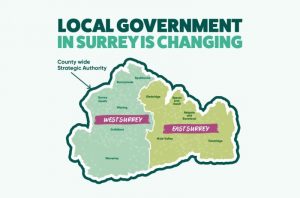
Surrey residents will have to wait an extra year to vote in the county elections following the government’s decision to postpone the polls from May 2025 to May 2026. The delay comes as part of a sweeping local government reorganisation that will see the biggest structural shake-up in fifty years. However, concerns are mounting over the rushed timetable, the fate of council debts, and the financial burden that could fall on responsible local authorities.

Reorganisation at Speed

The government’s drive for local government reform is progressing at an accelerated pace, with councils required to submit interim proposals by 21 March 2025 and finalised plans by 9 May 2025. The reform aims to replace Surrey’s current two-tier system – where Surrey County Council oversees borough and district councils – with unitary authorities that will consolidate power at a higher level.

Under plans being considered, a directly elected mayor could manage strategic services such as policing, fire and rescue, health, and education. However, uncertainty remains over whether the new unitary system will feature a single authority covering all of Surrey’s 1.2 million residents or two to three smaller councils.

Who Pays the Price?

A key source of controversy is the issue of existing council debts, particularly in boroughs such as Woking, Spelthorne, and Runnymede, which have amassed a combined debt exceeding £3 billion. Woking has already declared effective bankruptcy, with Spelthorne and Runnymede under government scrutiny.

Local leaders across Surrey are voicing their objections to any attempt to spread the financial burden of these debts across councils that have maintained responsible fiscal management.

Councillor Richard Biggs, leader of Reigate and Banstead Borough Council, said: “Our view remains that plans should not support any restructuring of local government boundaries based on ‘redistributing’ the debt of other authorities.” His council, along with others, has worked to maintain financial stability while continuing to provide additional services beyond statutory requirements.

The Residents’ Association and Independents Group at Surrey County Council has strongly criticised the government’s approach, arguing that it is forcing through change with “zero funding” while suggesting that costs could be covered by selling off council-owned assets. Group leader Councillor Catherine Powell raised concerns that the government expects local authorities to fund reorganisation through “capital receipts,” which could mean selling buildings currently used to deliver essential services.

Opposition to Election Postponement

The Surrey Leaders Group, a forum representing the county’s borough and district councils, has already voiced opposition to the decision to delay elections. Chair of the group, Councillor Hannah Dalton, (RA Epsom and Ewell for Stoneleigh ward), warned that the proposed reorganisation could remove decision-making from local communities and lacks clarity on how existing debts will be handled.

“There is a real risk that new authorities will be set up to fail,” said Cllr Dalton, highlighting the potential for new unitary councils to inherit substantial financial liabilities without sufficient funding or support from the government.

A Distracted Local Government

Critics argue that the rapid timeline for reorganisation is an unwelcome distraction at a time when councils are struggling with increased demand for statutory services, including social care and housing. Concerns have also been raised about the practicalities of implementing a new financial IT system for the newly formed authorities, given that Surrey County Council’s recent system overhaul has been plagued with problems.

With just weeks to prepare draft proposals and a final deadline in early May, councils across Surrey are left scrambling to determine the best way forward. The government’s insistence on a rapid restructuring without clear funding commitments has left many questioning whether the changes will deliver better services—or simply create further financial and administrative chaos.

For now, Surrey residents must wait for further clarity on how their local government will be reshaped, and more crucially, who will bear the cost of these sweeping changes.

Related reports:

Political furies over Surrey election postponement

Surrey County Council election delay stirring up a storm

What might local government reorganisation mean for Epsom and Ewell?

All change! Epsom and Ewell Borough Council approaching its final stop?

Surrey’s Conservative leader wants to postpone May’s poll reckoning

Tiers to be shed if Epsom and Ewell loses its Borough Council?


Citizens Advice Epsom & Ewell Delivers Crucial Support Amid Rising Cost-of-Living Pressures

Montage CAB office and an advice session and banner

Citizens Advice Epsom & Ewell (CAEE) has revealed the scale of its impact over the past year, with thousands of local residents receiving support on a range of pressing financial and social issues. From benefits and debt advice to housing support, the charity continues to be a lifeline for many struggling to make ends meet.

A Year of Helping the Community

Figures released by CAEE highlight just how vital their work has been. In 2024 alone, the organisation:

  • Assisted 3,394 people with 10,233 issues
  • Made 12,406 client and third-party contacts
  • Secured £1,022,934 in additional income for clients

For January 2025, the demand for support has surged even further:

  • 560 people received help in just one month
  • 1,036 issues were handled
  • £159,670 in extra income was secured for struggling households

The most common concerns among residents remain benefits, tax credits, housing, and debt, reflecting the ongoing financial pressures facing families in Epsom & Ewell.

Expanding Outreach in 2025

With the rising cost of living continuing to bite, CAEE is set to expand its energy outreach programme to better reach underrepresented communities. The initiative aims to provide guidance on energy bills, debt support, benefit checks, and energy-saving advice, ensuring that vulnerable individuals can access the help they need.

The charity is also distributing funds from the Household Support Fund until March 2025, offering financial aid to those on low incomes. Residents struggling with essential costs are urged to get in touch before the deadline.

Making a Real Difference

Beyond statistics, the impact of Citizens Advice is best illustrated through the experiences of those they have helped. One such case involved a vulnerable client living in unsuitable accommodation, battling rent arrears and struggling with multiple health concerns.

With extensive support from CAEE, she was able to:

  • Repay her rent arrears
  • Secure a move to a more suitable ground-floor flat
  • Receive medical and financial assistance
  • Successfully challenge a dispute through the Energy Ombudsman

This intervention not only improved her living conditions but also stabilised her finances, demonstrating the charity’s commitment to holistic, long-term support.

Financial and Social Impact

CAEE’s work delivers significant savings to public services, including:

  • £186,802 in NHS savings by reducing demand on mental health and GP services
  • £550,131 in savings for the Department for Work and Pensions by helping people stay in work
  • £326,078 saved for housing providers by preventing evictions

In total, their advice and interventions generated a staggering £3.85 million in value for the local economy.

Looking Ahead: Advocacy and Research in 2025

Beyond direct support, CAEE also plays a key role in influencing policy and addressing systemic issues. In 2025, they will continue to campaign on critical concerns such as:

  • The cost-of-living crisis
  • Housing shortages and homelessness prevention
  • Debt, including rising council tax arrears
  • Access to health and disability benefits

A key event on the horizon is Citizens Advice Data Insights, taking place on 25th February 2025, where experts will discuss how accumulated debt is preventing people from rebuilding their lives.

Support Your Local Citizens Advice

With demand for services higher than ever, Citizens Advice Epsom & Ewell is calling for public support. Running the service costs over £100 per client per year, and donations play a crucial role in ensuring free advice remains available.

Residents can contribute by donating as little as £10 a month, helping to sustain a vital service that continues to transform lives across the borough.

For free, confidential advice, visit CAEE at The Old Town Hall, The Parade, Epsom, or call 0808 278 7963.


Surrey County Council election delay stirring up a storm

Cars driving under election delay sign

Surrey County Council Elections Postponed Until 2026 Amid Local Government Reforms

In a significant move reflecting the evolving landscape of local governance in England, the British government has decided to postpone the Surrey County Council elections, originally scheduled for May 2025, until May 2026. This decision aligns with the government’s broader devolution agenda, which seeks to streamline local government structures by transitioning from a two-tier system to single-tier unitary authorities.

The government’s devolution white paper, Power and Partnership: Foundations for Growth, published in December 2024, outlines an ambitious plan to decentralize power from Westminster to local regions. A key component of this strategy is the reorganization of existing two-tier local government areas into unitary authorities, each serving populations of at least 500,000 residents. The white paper states:

“Local government reorganisation: We will work with individual areas, inviting proposals from all remaining two-tier areas and those unitary councils where there is evidence of failure or their size or boundaries may be hindering their ability to deliver sustainable and high-quality services to their residents.”

This restructuring aims to enhance efficiency, improve service delivery, and provide clearer accountability by consolidating responsibilities previously divided between county and district councils. The government asserts that such a model will lead to: “Better outcomes for residents, save significant money which can be reinvested in public services, and improve accountability with fewer politicians who are more able to focus on delivering for residents.”

Surrey’s Inclusion in the Devolution Priority Programme: Surrey has been selected to participate in the first wave of the government’s Devolution Priority Programme. This inclusion necessitates a comprehensive review and potential reorganization of the county’s local government structure.

Tim Oliver, (Conservative) Leader of Surrey County Council, expressed his support for the initiative, stating: “Now we’ve received confirmation that Surrey is in the first wave of local government reorganisation and devolution priority programme, we will develop a business case for reorganisation and submit a draft to government in March.”

To facilitate this process, the government has decided to postpone the local elections scheduled for May 2025. This postponement allows the council to focus its resources on developing and implementing the reorganization plan without the immediate pressures of an electoral cycle. Oliver emphasized the practical benefits of this delay: “The resource and time that would have been spent on elections for a soon-to-be-abolished council can now be directed to working on the best possible outcome of reorganisation for Surrey.”

The decision to delay the elections has elicited mixed reactions across the political spectrum. Helen Maguire, Liberal Democrat MP for Epsom & Ewell, criticized the move: “The decision to allow this Conservative-led council to postpone the election and silence the voice of our community is scandalous.” She further contended that the postponement serves political interests. Maguire also highlighted concerns about the council’s performance, citing issues such as “endless potholes,” cuts to local frontline services, and shortcomings in supporting children with special educational needs. She concluded: “Democracy delayed is democracy denied, and the people of Epsom, Ewell, Ashtead and Leatherhead must be allowed to decide who they think is best to lead Surrey County Council through this time of significant change.”

The Labour Group of councillors in Epsom and Ewell, however, welcomed the postponement of the elections. Cllr Kate Chinn (Court Ward) stated: “Those who are calling for the elections to go ahead need to explain why we should vote again for an authority with just a year to go. It would be a costly and unnecessary exercise.”

Surrey County Labour Party also expressed support for the devolution plans. Cllr Robert Evans commented: “This is good news for the people of Surrey as it will open the doors for more local decision-making as the government has agreed to devolve additional powers to new unitary authorities and regional mayors.” Evans emphasized the need for modernisation: “Surrey County Council was formed in 1889 so the world is very different now. The population of Surrey has more than doubled since Victorian times and much of what was Surrey then is now in London. The boroughs and districts were formed more than fifty years ago and don’t serve the same purpose as they might have done then.”

Cllr Robert King added: “In Surrey, we have a two-tier system which means service delivery can be confusing. Add to that we have 12 headquarters, 12 chief executives, dozens of deputies and more than a thousand councillors. A top-heavy system of local government does not serve our communities as well as it should.”

Jonathan Carr-West, Chief Executive of the Local Government Information Unit (LGIU), acknowledged the mixed reception of the announcement within the sector: “Councils were given 16 working days to put their applications together… Countless hours were spent by council staff and elected members who worked incredibly hard over the Christmas period to meet this deadline.” Carr-West emphasized the need for transparency in the decision-making process: “It is essential that we understand more about the decision making process around this as there will undoubtedly be some places that feel they have been marched up the hill and then marched down again having spent considerable amounts of time and political capital getting to this point.”

Financial Implications and Debt Concerns: A significant aspect of the reorganization involves addressing the financial disparities among Surrey’s councils. Several boroughs, such as Woking and Spelthorne, are grappling with substantial debts due to ambitious investment strategies.

Woking Borough Council declared effective bankruptcy in 2023, burdened by debts exceeding £2 billion from failed large-scale projects. Spelthorne Borough Council faces over £1 billion in debt from investments in commercial properties. In contrast, Epsom and Ewell Borough Council has maintained prudent financial practices, consistently balancing its budgets and avoiding unsustainable debt levels. This disparity raises concerns about the equitable distribution of debt in the proposed unitary authority. Residents of fiscally responsible boroughs like Epsom and Ewell question the fairness of assuming responsibility for the substantial debts incurred by other councils.

Councillor Tim Oliver has advocated for central government intervention to address these financial challenges: “The Labour Government has set up their agenda in the white paper and that is to create Mayoral Strategic Authority (MSA) across England… If you don’t reach an agreement locally, then they will legislate. It’s going to happen. It’s better that we try to control or have some influence over what happens rather than have it imposed on us down the line.”

Future Steps and Considerations:

The postponement of the Surrey County Council elections provides a window for detailed planning and consultation regarding the proposed reorganization. The council is expected to submit a draft business case for reorganization to the government in March, with a full proposal to follow in May. The government will then evaluate these proposals, conduct consultations with affected bodies, and make decisions on the future structure of local government in Surrey.

Throughout this process, maintaining transparency and engaging with residents will be crucial. Tim Oliver sought to give assurances: “I can be absolutely clear that, throughout this process, our vital work supporting residents will continue—services will be delivered and we will still be here for those who need us most—until whatever new council is fully established to take on that delivery.”

The debate over the postponement underscores broader concerns about governance, fiscal responsibility, and democratic accountability. As the reorganization progresses, the challenge will be to ensure that reforms deliver tangible benefits for Surrey’s residents while preserving democratic integrity and local representation.

Related reports:

What might local government reorganisation mean for Epsom and Ewell?

All change! Epsom and Ewell Borough Council approaching its final stop?

Surrey’s Conservative leader wants to postpone May’s poll reckoning

Tiers to be shed if Epsom and Ewell loses its Borough Council?


Surrey Police hikes its Council tax share

Lisa Townsend, Surrey Police and Crime Commissioner. (Credit: Surrey County Council live stream)

Surrey Police’s share of council tax bills will leap over £335 a year for the average Band D households. Lisa Townsend, Surrey Police and Crime Commissioner (PCC) said the 4.3 per cent increase was needed to “maintain the level of service”. 

Ms Townsend told the Surrey Police and Crime panel the government “absolutely expects” PCCs to raise council tax precepts  by the maximum £14 to cover the police officer wage increase (set nationally) and inflation.  

The annual charge will increase from £323.57 in 2024/25 for a Band D property to £337.57 in 2025/26. 

The commissioner told the panel even with the precept increase and the use of some reserves, the Force will still need to find £3.6m of savings this year and over £15m for the three years after that.

Although the commissioner said Surrey Police is one of the fastest-improving forces in the country, she stressed the increase in funds was needed to “keep us where we are”. Surrey Police has more than doubled its charge rate, with an additional 3,500 offences being prosecuted, according to the PCC. Ms Townsend told the panel the increase is “against a backdrop of a massive increase year on year which our financial resources can’t keep up with”. 

Reports state the cost to operate the Force has increased by £23.2m compared to 2024/25, meaning Surrey Police have to make a saving of £3.6m this year. Ms Townsend argued if the precept was not increased, police services would have to be cut and “achievements would be at risk”. 

The news comes as 59 per cent of people said they would pay more to support Surrey police in the PCC’s online survey. Over 3,200 people voted in the online consultation which asked them if they would be willing to pay an extra £1.16 a month to support policing teams, based on the average Band D property. 

But members of the Surrey Police and Crime Panel voted against the proposed increase in a meeting on February 3. Four councillors opposed the tax hike, four were in favour and one person abstained- leaving the chair of the meeting to cast the deciding vote which was found to be against. 

“There is no doubt that all members want to support the police,” said Cllr John Robini, chair of the meeting. “However, we hear time and time again how our community is struggling with finances.” Yet, there were not enough votes to veto the proposal and the panel accepted the Commissioner’s precept of 4.3 per cent to come into effect.


“I’ve got people in my ward who can’t afford to pay their bills and feed their kids,” Cllr Richard Wilson said. “This squeeze above inflation is going to take more of their pay…and make it more difficult to support their families.” 

Raising the council tax above inflation levels (currently around 2.5 per cent), councillors questioned whether this was an acceptable strain on residents. Kelvin Menon, Chief Financial Officer for the PCC, said: “We have a lot of historic inflation we have to cope with and cover.”

The PCC’s report details recruiting officers can be a challenge with high living costs in Surrey, contributing to over 11 per cent of posts vacant. Increased use of technology by criminals has also led to a growing demand for technological forensic services, with almost all crimes having a digital element to them, according to the report.


Criminal car park QR codes wrong on many levels

Scammers have targeted Guildford car parks (image Google)

Fake QR codes, used to scam motorists into giving away their bank and card details, have been found in Guildford car parks.

The scam codes have been placed on payment machines, signs or barriers  in an attempt to defraud people into thinking they are making genuine payments, Guildford Borough Council has warned.

Not only are the unsuspecting drivers handing over private details to the scammers but they are also putting themselves at risk of collecting a fine for not having a valid parking ticket.

The council has issued a warning  to help people from getting caught out and said it does not use any QR codes at its car parks – so if you see one it’s a scam.

Lead councillor for commercial services, Councillor Catherine Houston, said: “We are aware of the increase in QR code parking scams across the country and I want to reassure residents that our teams regularly inspect our car parks to keep them safe and free from fraudulent activities.

“Criminals are becoming increasingly sophisticated in their methods so if you do spot a QR code in one of our car parks, please don’t scan it; report it to the council instead.

“By raising awareness of such scams, we help to protect drivers from being misled so that residents and visitors can use our car parks in confidence.”

Once scanned, the codes take people to a fake website that asks for credit and debit card information, mimicking genuine payment providers.

The council has now placed signs within all its car parks explaining to only use the  RingGo app and to not use any QR codes found. 

It has also pledged to remove any codes found with its enforcement team carrying out daily checks.

Scammers have targeted Guildford car parks (image Google)


Online Fraud in Epsom & Ewell: Call for an Online Crime Agency

Old lady at home computer. Criminal at another computer.

Online fraud, particularly through fake retail websites, has become a significant issue both nationally and within our local community of Epsom & Ewell. Recent data underscores the pressing need for enhanced measures to protect consumers from these deceptive practices.

The Local Impact

In the 2023/24 financial year, Surrey reported 1,276 cases of online shopping fraud, resulting in losses totaling £848,000.his equates to an average loss of approximately £665 per victim. These figures highlight the substantial financial impact on residents and the pervasive nature of online fraud in our area.

National Perspective

Across the UK, online shopping scams are alarmingly prevalent.n the year leading up to October 2023, there were 71,894 reports of such scams, with total reported losses amounting to £106.8 million.he average loss per victim was £1,486, indicating that the financial repercussions can be devastating.

Current Policing Resources

The primary body for reporting fraud in the UK is Action Fraud, the national reporting center for fraud and cybercrime. Reports submitted to Action Fraud are analyzed by the National Fraud Intelligence Bureau (NFIB), which then disseminates information to relevant police forces for investigation. However, the increasing volume and sophistication of online fraud cases have strained existing resources, leading to calls for more specialized approaches.

The Proposal for an Online Crime Agency

Helen Maguire, Liberal Democrat MP for Epsom & Ewell, is advocating for the establishment of a dedicated Online Crime Agency. This agency would focus exclusively on combating online fraud and related cyber crimes. The proposed agency aims to:

  • Specialized Focus: oncentrate resources and expertise specifically on online fraud, ensuring more effective prevention and enforcement.
  • Enhanced Coordination: acilitate better collaboration between various law enforcement bodies, technology companies, and financial institutions to address the multifaceted nature of online scams.
  • Victim Support: rovide dedicated support to victims of online fraud, guiding them through reporting processes and helping them recover losses where possible. P Maguire emphasizes the urgency of this initiative, stating, “Victims in Surrey have been left short-changed and vulnerable to opportunistic fraudsters. We urgently need action. The previous Conservative government completely failed to act. They were asleep at the wheel when it came to online fraud.”

Maguire argues the establishment of a specialized Online Crime Agency could play a pivotal role in safeguarding consumers. By focusing dedicated resources and fostering collaboration across sectors, such an agency holds the promise of mitigating the impact of online fraud on our community.


Epsom & Ewell households drowning as water bills rise?

House being drowned in water with pound signs

Epsom & Ewell Residents Face Sharp Water Bill Hike as Regional Disparities Emerge

From April 2025, households in Epsom & Ewell will see a substantial increase in water bills, with Thames Water implementing a 31% rise. This means an additional £151 annually per household, increasing the average bill from £488 to £639. The rise places Thames Water among the highest increases across England, sparking significant concern among local residents and political representatives. Thames Water provides water and waste water services.

Local MP Slams Government’s Inaction

Helen Maguire, the Liberal Democrat MP for Epsom & Ewell, has criticised the government’s failure to regulate water companies more effectively. In a statement, she said:

“This is an outrageous bill rise. Instead of tackling Thames Water or taking them to task, the Government has given them free reign – and residents in Epsom & Ewell are paying the price. It’s a disgrace that water companies have been able to hike our bills – a third of which goes on servicing debt – while they fail to fix leaks and pollute our rivers and streams like the River Mole and the Hogsmill.”

Maguire and the Liberal Democrats have urged the government to introduce a single social tariff to support vulnerable customers struggling to meet rising water costs.

Neighbouring Areas See Water Bill Decrease

In stark contrast, Sutton and East Surrey Water (SES Water), which serves areas including east Surrey, West Sussex, west Kent, and parts of south London, will reduce water bills by 2%, bringing the average bill down from £254 to £249. The decrease raises questions about why some suppliers are able to manage costs effectively while others, like Thames Water, continue to impose steep increases.

SES Water has not provided a detailed explanation for the reduction, but such adjustments typically stem from operational efficiencies, regulatory decisions, or improved cost management. SES provides water only services.

Where Thames Water Stands in the Rankings

According to a national comparison of 22 water companies, Thames Water ranks 5th in terms of the highest increase, making it one of the worst affected companies for bill hikes. The highest increase recorded is from Southern Water, while Sutton and East Surrey Water sits at the bottom of the list with the only decrease.

Continued Concerns Over Water Pollution

The significant bill increase for Thames Water customers comes amid growing concerns about water pollution in the region. In 2024, the River Mole suffered over 2,000 additional hours of pollution compared to 2023, worsening environmental and public health risks. Critics argue that rather than prioritising investment in infrastructure improvements, Thames Water’s rising bills are being used to manage corporate debt and executive pay.

Thames Water on the Brink of Collapse

The sharp rise in Thames Water bills comes as the company teeters on the edge of financial collapse. The UK’s largest water supplier, responsible for 15 million customers, has been struggling under a £15 billion debt burden and recently warned it could run out of money by May 2025. In an attempt to stabilise its finances, Thames Water had sought approval from the regulator, Ofwat, to impose a 59% bill increase over the next five years, far exceeding the 31% increase ultimately permitted this coming year. Meanwhile, the government has ruled out a public takeover of the company, despite growing concerns that a full-scale collapse could lead to severe service disruptions. The situation has reignited calls for tighter regulation of the water industry, with critics arguing that customers should not be forced to foot the bill for corporate mismanagement

What Can Residents Do?

With these price hikes looming, residents are encouraged to explore available financial assistance options. Social tariffs, designed for low-income households, may offer some relief, though the inconsistency in eligibility criteria across different water providers remains a pressing issue.

Social tariffs are discounted water rates designed to assist low-income households in managing their water bills. Thames Water offers a social tariff program called WaterHelp. This scheme provides up to a 50% discount on annual water bills for eligible customers. Eligibility is determined by comparing the customer’s water bill to their net household income and considering the number of occupants in the property. If the water bill exceeds 5% of the household’s net income, the customer may qualify for the discount.

Additionally, Thames Water participates in the WaterSure programme, which caps bills for metered customers who meet specific criteria. To qualify, customers must receive means-tested benefits and either have a medical condition requiring increased water use or have three or more children under 19 living at home. For the 2024/25 period, the bill is capped at £471, ensuring that eligible customers do not pay more than this amount, regardless of actual water consumption.

These programmes aim to make water services more affordable for vulnerable customers, especially in light of rising water bills. Residents are encouraged to contact Thames Water directly or visit their website to assess eligibility and apply for these support schemes.

Local campaigners continue to push for greater accountability from water companies and regulatory bodies. The debate over water affordability, pollution control, and corporate responsibility is likely to remain a key issue for Epsom & Ewell residents as the April 2025 changes approach.

Related reports:

Surrey’s LibDem MP majority take on Thames Water

Thames Water’s reputation going down the drain

Thames Water left human waste to fester

Thames Water rebate


Heathrow expansion reaction

Heathrow shown with a third runway over the M25 (image Heathrow)

Heathrow has been given the go ahead to press forward with plans for  third runway that will bring in hundreds of thousands of extra flights to the West London airport every year, the Chancellor has announced – but questions remain about how deliverable the project will be.

The airport has long pressed for a third runway. The plans  in the past have involved demolishing the mediaeval village of Harmondsworth and its neighbours Sipson and  Harlington.

Feasibility studies have also been carried out about re-routing the M25 through a tunnel under the new northern runway and the enormous infrastructure project is supposed to be built while the country meets its environmental targets.

Heathrow has welcomed the Chancellor’s announcement today that the Government is backing a third runway –  and would be inviting proposals to be brought forward by the summer. 

The government has already tightened legal pathways against any plans, cutting the number of appeals allowed from three down to just one.

Opponents, including the London Mayor’s office, MPs and campaign groups however,  argue a third runway won’t bring in hoped-for economic benefits but will raise “serious environmental and health concerns”.

The Mayor of London, Sadiq Khan, said: “I remain opposed to a new runway at Heathrow Airport because of the severe impact it will have on noise, air pollution and meeting our climate change targets.

“I will scrutinise carefully any new proposals that now come forward from Heathrow, including the impact it will have on people living in the area and the huge knock-on effects for our transport infrastructure.

“Despite the progress that’s been made in the aviation sector to make it more sustainable, I’m simply not convinced that you can have hundreds of thousands of additional flights at Heathrow every year without a hugely damaging impact on our environment.”

Stanwell Moor is the Surrey village at the end of Heathrow’s southern runway. 

Residents there have grown used to jet engines flying overhead. So much so,  that some regard the noise made from incoming planes a respite compared with the roar when taking off.

The Stanwell Moor Residents’ Association, in a statement published on its website, said: “What is different this time is that easterly alternation planning application will go ahead regardless of the airport expansion and would lead to more flights over our village; and secondly, the Government are likely to reform planning to speed up the approval for expansion. 

“We will be ready to represent the village with a list of demands that put residents first.”

The Government said it would issue a full assessment of any expansion plans through the Airports National Policy Statement.

It said the project must represent value for money and that it, plus any associated service transport costs, will be financed through private funding to “ensure that a third runway is delivered in line with our legal, environmental and climate objectives.”

Paul Beckford, policy director at the HACAN clearskies group said: “The announcement today will disappoint the thousands of residents whose communities will be destroyed by a third runway and the millions who will be exposed to increases in noise and air pollution.

“Labour have set four tests that any airport expansion must pass in order to be approved and we believe that Heathrow’s current plans are simply not compatible with those tests.

“The Government believes that it can achieve both growth and meet its climate targets but this decision puts both of those ambitions at risk.

“Expanding the UK’s largest emitter of carbon in a forlorn hope of increasing GDP at some point in the future without a credible plan to deliver zero emission aviation is a folly of the highest order.”

The Liberal Democrats issued a statement from its MPs saying the third runway would jeopardise the UK’s climate commitments and will have a significant negative impact on local communities and human health. 

The hundreds of thousands of extra flights to-and-from Heathrow, they said, will increase the risk of health conditions including heart disease, strokes and mental health issues. 

MP for Esher and Walton Monica Harding said: “A third runway at Heathrow would have a profound impact on our climate, health, and communities. With a lack of clarity on the economic benefits and costs to the taxpayer, along with serious environmental and health concerns, the Government must urgently address these questions.” 

Others, such as the Chartered Institute of Logistics and Transport UK were quick to praise the announcement but cautioned the importance of prioritising environmental concerns. 

Its chairperson, Paul Le Blond, said “Any expansion strategy must prioritise public transport integration, leveraging existing transport hubs and accommodating new rail links. 

“The development should include modernised terminals and new gateway facilities for both the northern and southern perimeters. Crucially, all environmental impacts—including noise, local air quality, and greenhouse gas emissions—must remain within statutory limits.

“Whilst the expansion would be privately funded through passenger and shipping revenues, government support through policy frameworks and strategic rail investment will be essential to unlock private sector investment.”

Related reports:

“Blocks away” from airport expansions

Surrey village to suffer a lot more Heathrow flights

Chance for Epsom and Ewell’s say on Heathrow flights


Parliament’s sting in the tail for Epsom and Ewell WASPIs lamented by local MP

Waspi protestors outside Parliament

Helen Maguire, the Liberal Democrat MP for Epsom & Ewell, has expressed her disappointment after a parliamentary vote on compensating WASPI (Women Against State Pension Inequality) claimants failed to gain cross-party support. Maguire, who voted in favour of the bill, said she was “proud” to back the proposal, which sought to address what she described as a “gross injustice” affecting thousands of women in the constituency and across the UK.

The bill was introduced following an independent report that concluded that many women born in the 1950s had suffered an injustice due to a failure by successive governments to properly inform them of changes to the state pension age. However, the measure failed to secure enough support in Parliament, with Conservative and Labour MPs voting against it or abstaining.

What is the WASPI Campaign?

The WASPI campaign was formed in 2015 to highlight the plight of women born in the 1950s who were affected by changes to the state pension age. Prior to reforms enacted by the Pensions Acts of 1995 and 2011, women in the UK could retire at 60, while men retired at 65. The government decided to equalise the pension age for men and women, eventually raising it to 66 for both. However, many women argue they were not adequately informed about these changes in time to make necessary financial adjustments.

The Parliamentary and Health Service Ombudsman (PHSO) found that the Department for Work and Pensions (DWP) failed to communicate the pension changes properly, leading to significant hardship for many women who had planned their retirements based on the previous system.

Local Impact and Political Response

According to data from the House of Commons Library, 5,420 women in Epsom & Ewell are believed to have been affected by these pension changes. Many have reported financial distress, as they were forced to continue working or adjust to an unexpected delay in receiving their pensions.

Speaking after the vote, Maguire criticised both Labour and Conservative MPs for failing to back the compensation plan. “For years, senior Labour representatives and even the Prime Minister himself pledged to deliver fair compensation to those impacted by changes these women had no control over. They made a conscious political choice to break that promise and ignore the findings of the independent watchdog,” she said.

“For Conservative and Labour MPs to fail to back these women is an immense disappointment. All they are asking for is fairness,” Maguire continued. “I, alongside my fellow Liberal Democrat MPs, will continue to stand up for the WASPI women at every turn and keep fighting until they get the justice that they deserve.”

The Wider Debate

The issue of state pension reform has been contentious for years, with successive governments arguing that the changes were necessary to ensure the long-term sustainability of the pension system. The government has so far resisted calls for direct compensation, citing fiscal constraints, but campaigners argue that the lack of proper notification has left many women financially disadvantaged through no fault of their own.

The failure of the bill to progress means that WASPI women and their supporters will need to continue pressing their case in Parliament and beyond. With growing political pressure and the findings of the PHSO still pending further action, the fight for compensation is likely to remain a key issue in the coming months.

For now, Maguire has pledged to keep up the pressure, but with the major parties unwilling to back compensation at this stage, it remains to be seen whether justice will be delivered for the thousands of affected women in Epsom & Ewell and beyond.


New artwork takes centre stage at Epsom Playhouse

Epsom Playhouse bar mural

During January two new murals were completed at Epsom Playhouse. The murals are part of a series of vibrant public art installations across the borough. Championing the 40-year history of Epsom Playhouse, the large-scale mural in the theatre’s foyer showcases the variety and breadth of creative people who have contributed to the fabric of Epsom Playhouse’s history over the last four decades. The second mural and new photographic exhibition in the downstairs bar celebrates famed British Jazz singer and a trailblazing performer, Evelyn Dove. Championing the roaring 1920s and the Art Deco period, the large-scale installation reflects the era that Dove was at the peak of her performing career. 

The latest murals were created in collaboration with residents. Epsom & Ewell Borough Council, and specialists in community art Positive Arts, consulted with residents during the Christmas lights switch on in the Ashley Centre in Epsom, at Bourne Hall in Ewell and members of Girlguiding Division Epsom also kindly shared their thoughts on the design of the main foyer mural.   

Both murals have been fully funded via the Arts, Culture and Heritage UKSPF 2024/25 allocation and contribute to the council’s overall vision for curating art projects that build pride with local community stakeholders, nurture creative talent and raise the profile of our borough’s rich heritage.

The murals are the last in a series that have been painted across the borough.

So far, working with Positive Arts and community groups, Epsom & Ewell Borough Council has created the following murals:

Upper High Street, Epsom – with GLF Schools

Alleyway behind Epsom Square – with Members of Girlguiding Epsom Division

Between Miles Road and Stones Road, Epsom – with GLF Schools

Near Clandon Close, Stoneleigh – with We Power On

Epsom Playhouse opened in 1984 as part of the development of The Ashley Centre and since opening has hosted a wide and varied programme of events featuring both professional and community productions.

Commenting on the newly installed artworks, Councillor Clive Woodbridge (RA Ewell Village), Chair of the Community and Wellbeing Committee said,

“These new murals use a vibrant palette of colours, and I am sure will draw plenty for interest from residents, who’ll be impressed to see how this much-loved community venue has been revived!

The foyer mural illustrates visually how important regional theatres are in bringing arts and creativity to local areas for the benefit of local communities”

The refurbishment of Epsom Playhouse also supports Epsom & Ewell Borough Council’s new Arts, Culture and Heritage Strategy which outlines its commitment to nurturing creative talent and to creating a thriving and inclusive creative and cultural outreach programme within the borough.

Related reports:

Epsom Playhouse £1.50 per ticket fee from 1st April

Epsom Playhouse gets a 40 year uplift

A blast celebrates 40 years past of Epsom Playhouse

Our Star shines on Epsom Playhouse

Image: Epsom Playhouse bar mural


“Blocks away” from airport expansions

Flight over a town

So called “blockers” to major transport projects will be cleared in a move that looks set to curb challenges to Heathrow and Gatwick Airport expansions, the Government has announced.

The Prime Minister wants to curtail legal challenges to major decisions in what the Government describes as “unarguable cases” they say can cause “years of delay and hundreds of millions of cost to projects that have been approved by democratically elected ministers.”

Instead, the legal system will be overhauled with campaigners given just one attempt at a legal challenge for “cynical cases lodged purely to cause delay rather than three”. It comes after reports the chancellor Rachel Reeves said she was prepared to face down critics of plans to expand Heathrow Airport and Gatwick –  arguing economic growth outweighed other concerns.

The Government has said this would balance the need for ongoing access to justice against what it describes as a “challenge culture” where small pressure groups obstruct decisions taken in the national interest. Prime Minister Keir Starmer said: “For too long, blockers have had the upper hand in legal challenges – using our court processes to frustrate growth. We’re putting an end to this challenge culture by taking on the NIMBYs and a broken system that has slowed down our progress as a nation. This is the government’s Plan for Change in action – taking the brakes off Britain by reforming the planning system so it is pro-growth and pro-infrastructure. The current first attempt, known as the paper permission stage,  will be scrapped. 

“Primary legislation will be changed so that where a judge in an oral hearing at the High Court deems the case Totally Without Merit, it will not be possible to ask the Court of Appeal to reconsider. To ensure ongoing access to justice, a request to appeal second attempt will be allowed for other cases.”

What the airports say

Heathrow has said it would wait until formal plans before commenting but that it strongly believed in its “vital role for the UK economy” and its long-held  belief that expanding capacity at the UK’s hub airport was critical for economic growth.

A Heathrow spokesperson said: “Heathrow is the best-connected airport in the world. That competitive advantage for UK plc already enables over £200bn of British trade annually. But growing the economy means adding capacity at the UK’s hub airport which is full. That’s why we’re planning to unlock capacity by improving and upgrading our existing infrastructure, while also looking at potential options to deliver a third runway at Heathrow in line with strict tests on carbon, noise and air quality.”

Stewart Wingate, CEO of London Gatwick said: “We can be a major part of the Government’s drive for growth. We are already contributing over £5.5billion to the UK economy and supporting over 76,000 jobs, but unless we can access greater airport capacity the UK will miss out on opportunities to enhance global connectivity and unlock further opportunities for trade, tourism and job creation. Bringing our Northern Runway into routine use, through a £2.2 billion privately financed, shovel-ready investment will create 14,000 jobs and generate £1 billion a year in economic benefits. 

“The project, which is due for government approval early next year, could be operational by the end of the decade. We have put forward a strong and compelling case focused around making best use of our existing infrastructure, minimising noise and environmental impacts and meeting the four ‘tests’ for airport expansion set by Labour.”

The average legal challenge takes about 18 months to resolve and more than half of of all major infrastructure decisions were taken to court.

Campainers will not rest

Paul Beckford, the chairperson of the HACAN clearskies campaign group challenges the notion that expanding the airport would bring the craved-for growth.

He says that at best it could bring in £3.3bn over 60 years and that 75 per cent of passengers using a third runway would likely be transfer passengers “who contribute nothing to the economy”. He also said that Heathrow expansion would not be in a vacuum and instead “suck growth” from the regions.

Government’s own figures show that a third runway  at Heathrow would suck growth from the regions, citing Department for Transport Aviation Forecasts that suggested “expansion at Heathrow would see 170,000 fewer flights per year from regional airports than if expansion does not take place”.

Mr Beckford said: “Local communities around Heathrow represent nearly a third of all people across Europe exposed to levels of aircraft noise that harms their health. If Heathrow were to expand the Government would expose over two million people to increases in noise pollution in spite of a deepening evidence base of the negative health impacts, particularly at night. Such expansion would increase the emissions of the country’s single largest source of carbon by around 9million tonnes per annum, which is incompatible with the UK’s climate targets. 

“It would be a failure of duty for any Government to put the health of their citizens at risk in the forlorn hope of generating growth when we know that the business case is marginal at best and 75 per cent of passengers using any third runway would contribute nothing to the UK economy.” 

Sally Pavey, who chair the CAGNE group that opposes expansion of Gatwick airport call the government’s decision a disgrace that ignored public opinion in order to build a new runway by stealth. She said: “If this story is true it opens the door to us communities concerned about the decline in our wellbeing to benefit the shareholders of Gatwick Airport. Any airport expansion shows a lack of understanding and priority placed by this government towards global warming and yet we see the signs constantly on the news of flooding, fires and rising temperatures.  

“Aviation is one of the biggest polluters this planet suffers and yet a new runway would add extra carbon a year plus greenhouse gases, and there are no true decarbonising factors that will reduce this as with more planes comes more CO2 and noise.  CAGNE has been at the forefront of opposing this new runway due to the lack of infrastructure, lack of workers, decline in air quality and unbelievable increase in noise as Gatwick would be as big as Heathrow today.  

“Gatwick already has serious issues with noise and yet we were not allowed to include the modernisation of airspace that Gatwick is reliant upon to reach its economic growth goals with two runway operation. This is just one of the reasons we will be legally challenging a decision to allow a new runway at Gatwick. We have already started to fundraise to legally challenge a decision to allow two runway operations  as there were so many flaws in the evidence provided by Gatwick at the DCO hearings, this news story, if factual, is just another reason to challenge a new runway decision.”


Surrey Uni making self-driving cars safer

Waymo self-driving car

With self-driving cars expected to hit British roads next year (2026), a new motion forecasting framework developed by the University of Surrey and Fudan University, China, promises to make autonomous cars both safer and smarter.  

Researchers have combined their expertise to create RealMotion – a novel training system that seamlessly integrates historical and real-time scene data with contextual and time-based information, paving the way for more efficient and reliable autonomous vehicle technology. 

Dr Xiatian Zhu, senior lecturer at the Centre for Vision, Speech and Signal Processing and the Insitute for People-Centred AI at the University of Surrey and co-author of the study, said: 

“Driverless cars are no longer a futuristic dream. Robotaxis are already operating in parts of the USA and China, and self-driving vehicles are expected to be on UK roads as early as next year. However, the real question on everyone’s mind is: how safe are they?  

“While AI operates differently from human drivers, there are still challenges to overcome. That’s why we developed RealMotion – to equip the algorithm with not only real-time data but also the ability to integrate historical context in space and time, enabling more accurate and reliable decision-making for safer autonomous navigation.” 

Existing motion forecasting methods typically process each driving scene independently, overlooking the interconnected nature of past and present contexts in continuous driving scenarios. This limitation hinders the ability to accurately predict the behaviours of surrounding vehicles, pedestrians and other agents in ever-changing environments. 

In contrast, RealMotion creates a clearer understanding of different driving scenes. Integrating past and present data enhances the prediction of future movements, addressing the inherent complexity of forecasting multiple agents’ movements. 

Extensive experiments conducted using the Argoverse dataset, a leading benchmark in autonomous driving research, highlight RealMotion’s accuracy and performance. Compared to other AI models, the framework achieved an 8.60% improvement in Final Displacement Error (FDE) – which is the distance between the predicted final destination and the true final destination. It also demonstrated significant reductions in computational latency, making it highly suitable for real-time applications. 

Professor Adrian Hilton, Director of the Surrey Institute for People-Centred AI, said: 

“With self-driving cars reaching British roads imminently, ensuring people’s safety is paramount. The development of RealMotion by Dr Zhu and his team offers a significant advance on existing methods. By equipping autonomous vehicles to perceive their surroundings in real-time, and also leverage historical context to make informed decisions, RealMotion paves the way for safer and more intelligent navigation of our roads.” 

While researchers encountered some limitations, the team plans to continue its research to further improve RealMotion’s capabilities and overcome any challenges. The framework has the potential to play a critical role in shaping the next generation of autonomous vehicles, ensuring safer and more intelligent navigation systems for the future. 

About the Surrey Institute for People-Centred AI (PAI) 

Taking a different approach to much AI activity in the UK, the Surrey Institute for People-Centred AI puts the needs of individuals and society at the very heart of everything it does: we believe that the starting point for AI should be people rather than technology.   

This people-centred approach drives our research and enables us to design AI technologies and systems that are ethical, responsible, and inclusive. The pan-University Institute brings together Surrey’s core AI-related expertise in vision, speech and signal processing, computer science, and mathematics, with its domain expertise across engineering and physical sciences, human and animal health, law and regulation, business, finance and the arts and social sciences. With this distinctive approach, PAI builds on Surrey’s track record of collaboration with industry, the public sector, government and other relevant institutions to develop solutions to shared challenges. 

Image: Waymo self-driving vehicle. Credit Grendelkhan CC by SA 4


Parents lose trust in Surrey state “school family” admission priority

Campaigners outside Long Ditton Infant school. (Credit: Emma Pericas Sims)

A Surrey suburb is up in arms as an ‘oustanding’ secondary school could change its admissions, making it more tricky for local children to get a place. 

Consultation for the new admissions for September 2025 at Hinchley Wood School, in Esher, ends on Wednesday 22 January. If approved, the academy school would prioritise students who attend the schools within its own trust- Hinchley Wood Primary School and Thames Ditton Junior School- leaving Long Ditton  St Mary’s Junior School and Claygate Primary School lower down the pecking order.

But parents of Long Ditton St Mary’s Junior are furious their child could lose a place at the only local state school in the area. Children who attend Long Ditton St Mary’s Junior School have traditionally gone to Hinchley Wood Secondary School, but the admission changes could see local students deprioritised from their closest high school and forced to go elsewhere. 

The ‘outstanding’ Ofsted-rated school frequently comes as one of the top places in Surrey. Ben Bartlett, CEO of Hinchley Wood Learning Partnership Trust, said he had “massive sympathy” for those worried about the proposed changes and understood parents always want their child to get into the “best” school. 

An academy trust, Hinchley Wood School is legally and financially one organisation so it shares resources  such as safeguarding, SEND provision, disadvantaged learners and educational subjects like French, Music and P.E with trust schools. Mr Bartlett argued giving the two primary schools priority keeps children and their parents “in the Hinchley Wood [trust] family”.

Mr Bartlett and Co-Headteacher Ms Maria Cachia explained keeping students in the trust means any safeguarding information or education can be easily transferred as schools have “shared values and strategic aims”.

Now, parents say they are having to decide whether to send their children to the Ofsted-rated ‘good’ Thames Ditton primary school to have a better chance of going to Hinchley Wood, or to send them to the ‘outstanding’ Long Ditton St Mary’s Junior. One dad said it was like “you’ve got a gun to your head from the local state school”.

Shaya’s son goes to Thames Ditton Infant School. He said his family has been  “torturing ourselves for eight months” to decide which junior school to send him to in the hopes of getting a good secondary school place which could have a “profound impact” on his longterm future. Shaya said: “We’re being forced to choose whether to prioritise our son’s immediate educational means at the sacrifice of his long-term education.” 

Shaya, who lives less than 1km away from the secondary school, said: “The withdrawal of the catchment area clearly demonstrates the Trust wants to prioritise children who do not live locally over local children, and its own financial health.” But the senior leadership at Hinchley Wood argued it would not be fair for children attending a primary school within the Trust to not proceed to the secondary school just because they live out of the catchment area. 

Antony Warren, parent of two children at Long Ditton St Mary’s Infant School, said it is “wholly unfair” for the academy to change its admissions suddenly. He said: “We moved, we invested significant life savings into our house and in the community as a whole [so] we knew we were in the catchment area.”

If children do not get accepted into Hinchley Wood Secondary, the next nearest school could be in Kingston where the council has no obligation to accept Surrey pupils. While the Long Ditton students could  walk down the road to the secondary school, they may have to get the bus for 30-45 minutes to Esher High or a Kingston school. “I pay my taxes,” said Antony, “I feel my children deserve the right to go to their local state school.”

For many of the young children their first years of education were riddled with Covid and lockdowns, leading to disrupted education and interrupted friendships. Some children now struggle with anxiety and stress, which many parents fear will be exacerbated if the kids start new secondary schools out of the local area where they will not know anyone. 

A tight and close-knit community, parents said the Dittons and Hinchley Wood are entangled together with sports teams and extracurricular groups. Preventing children from going to the local secondary school fractures these ties and uproots them from their social connections.

“It’s just not right that a multi-academy trust can just wield its power and prioritise their own schools for their own benefits for their own financial gains [and] totally disregarding the needs of the local community,” said Annette Whymark, who has a son in Year 4. Annette and her husband James Whymark started the action group to spread the word in the Thames Ditton community. 

The campaign group, made up of around 65 parents, feared changing the admissions could disperse children into Surrey and Kingston, causing a ripple effect on school admissions. Parents understood those at Hinchley Wood and Thames Ditton primary schools will be in favour of the admissions change because “they want to do what is best for their children”. However, they emphasised it as “grossly unfair”. 

Some argued that the Hinchley Wood’s consultation is “financially driven” because it prioritises the primary schools within their trust by encouraging parents to send their children to that school. By increasing the pupil number, the school will get more funding from the government. 

Mr Bartlett disagreed the consultation was motivated by financial gain, and stressed the student admission number for the two primary schools was actually being lowered in line with a falling birth rate. 

Based on school admission data from Surrey County Council, Mr Bartlett and Mrs Hogan told the LDRS there would be a “minimal” impact in the number of students from Long Ditton entering the school. The CEO said the area was “blessed with a spread of fantastic schools” from Esher to Kingston, where children can frequently get local buses to school. 

“This is a genuine consultation and no decision has been made yet,” said Mr Bartlett. After the consultation finishes, the responses will be read and considered by the governors and trustees for the school. 

Monica Harding MP for Esher and Walton, said she was concerned about the impact of the proposed admission changes and has shared these with Ben Bartlett. She said: “I have urged HWS to explore alternatives that better serve local families. I will continue to speak with the leadership at HWS on this issue. 

“I have also raised these issues in both meetings and written correspondence with the DfE and Surrey CC. The DfE assured me that they are taking these concerns seriously and will “monitor and work with the trust and Surrey County Council to ensure no schools are made vulnerable by such changes if they occur.”

“I am very aware of the anxiety these proposals are causing parents, and I remain committed to advocating for solutions that keep the best interests of our children at the forefront and ensure all of our local schools are thriving. I encourage all parents to participate in the consultation process to help ensure the final decision reflects the needs of our community.”

“I also recognise that local schools are facing huge financial strain and that they are all challenged to deliver high-quality education without commensurate funding. I will continue to push the Government hard to provide the resources necessary for our children to have the best possible education.”

Campaigners outside Long Ditton Infant school. (Credit: Emma Pericas Sims)


New homes planned for Ashtead

Wates Development’s outline plans for up to 270 homes near the M25 in Ashstead (image Wates Development)

Hundreds of new homes could be built in Ashtead if newly submitted plans to Mole Valley District Council are approved. Wates Developments and its partners, Vistry Group, have submitted outline plans for up to 270 homes, of which about 40 per cent will be affordable.

The proposals, which still need to go through the planning process, also include a community centre that could become a children’s nursery. Nearby schools are said to be under-subscribed, with vacancy rates expected to grow in some areas, according to planning documents submitted to the council. The documents suggest that the new homes could help boost pupil numbers in local schools.

John Tarvit, director of planning for Wates Developments, said: “We have an exciting vision for this site to create a sense of place and community, with landscape-led design that incorporates a variety of green spaces. Our proposals will help encourage social interaction, provide safe and attractive streets, encourage sustainable travel choices, and maximise biodiversity. We’re proud that this will be a high-quality, net-zero development that reduces carbon emissions and enhances the resilience of the development to a changing climate. All new homes will be lean, clean, and green.”

The land, south of Ermyn Way, has been allocated for residential-led development by the council. The developers state they are “committed to creating a distinctive and responsive new neighbourhood, offering a good range of house sizes and types.

“The proposed development will enhance the existing local community and deliver a range of benefits for people in Ashtead in addition to the much-needed new homes.”

In addition to the housing scheme, the developers are proposing a community building with the potential for a children’s nursery, 30 acres of open space, and a children’s play area. At this stage, the plans are in outline format, but the developers have said that buildings will vary across the site, reaching up to a maximum of three storeys, although the majority will be two storeys.

The developers believe this approach will “create a varied roofscape, define marker buildings and add to the visual richness” of the project. They have also indicated that details such as the sizes of the homes, in terms of bedrooms, and the layout of the development are yet to be finalised.

Wates said the site currently consists of arable agricultural fields just north of the M25 and within walking and cycling distance of both Ashtead and Leatherhead. It is also already well connected to bus services. As part of the pre-planning process, Wates held meetings with nearby schools, including Trinity Primary School.

The planning statement noted: “At the meeting, the applicants were informed that the school is well below pupil capacity and referred to the same position at other local schools. It was explained to the applicants that local schools are accepting pupils who might not otherwise meet their selection criteria.” It added: “It was confirmed that Greville School currently has capacity and in the coming years will likely have greater capacity as there are significant spaces available in the reception year.”

Homes would be built on the western side of the site to create “a clear distinction between residential development and the eastern section within the retained green belt.” The final layout will be determined through discussion with the council.

Wates Development’s outline plans for up to 270 homes near the M25 in Ashstead (image Wates Development)


New family mediation in Epsom

Family mediation

Relate Mid and East Surrey Launches New Family Mediation Service

Relate Mid and East Surrey is thrilled to announce the launch of its new family mediation service, designed to help families resolve conflicts peacefully and constructively. This service reflects our commitment to offering practical, affordable solutions for families in our community.

What Is Mediation?

Mediation is a process where an independent, professional mediator helps families work through disagreements over parenting, property, or finances following separation. Unlike court proceedings, mediation focuses on collaboration, ensuring all parties have a voice and reach mutually beneficial solutions. It’s quicker, less stressful, and often far less expensive than legal action.

How Mediation Helps

Mediation provides a structured and supportive environment where families can address issues such as parenting arrangements, property division, and financial agreements. It is quicker, less stressful, and significantly cheaper than going to court, allowing families to maintain control over their decisions.

Key Benefits:

  • Helps you make arrangements about parenting, property, and money.
  • Is less stressful than going to court.
  • Saves you money as it’s usually much cheaper than being represented in court.
  • Puts your child’s interests first.
  • Helps you move on quickly to the next stage of your life.

Debbie Holden, Chief Executive of Relate Mid and East Surrey, explains:
“Family mediation is about empowering people to create solutions that work for everyone involved. Our mediators guide families through difficult conversations, ensuring children’s needs remain at the forefront while reducing the emotional and financial burden of conflict.”

Flexible and Affordable Options

Our new service includes private assessment meetings and joint mediation sessions, tailored to meet each family’s unique needs. We offer a sliding scale of fees to ensure affordability, with additional support through the Family Mediation Voucher Scheme, providing up to £500 for child arrangement cases.

Key Features:

  • Child-inclusive mediation to give children a voice in the process.
  • Rapid appointments, often within a week.
  • A focus on long-term solutions that foster positive co-parenting relationships.

Join Us for Family Mediation Week

Family Mediation Week (27–31 January) highlights the importance of mediation in resolving family disputes. We encourage families to explore how this service can support them during life transitions.

More information can be found at:
https://relatemidandeastsurrey.co.uk/family-mediation/

Contact Us

To book a mediation session or learn more, contact us at:

Image – illustration only.