Epsom rail passengers urged to travel only if essential as extreme heat disrupts services
23 June 2026
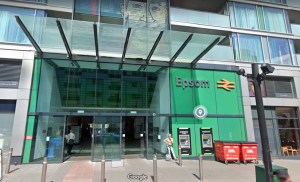
Rail passengers using Epsom station are being urged to avoid all but essential journeys on Wednesday and Thursday as extreme heat is expected to bring disruption across Surrey’s rail network.
Southern, which runs services through Epsom towards London Victoria, Sutton and Dorking, has warned that it will operate a reduced timetable as trains are required to run more slowly in the exceptional temperatures.
The warning also applies to South Western Railway services from Epsom towards Wimbledon and London Waterloo. SWR has told passengers to check before travelling on Tuesday and to make journeys on Wednesday and Thursday only where absolutely necessary, warning that services may be altered or cancelled at short notice.
The Met Office has issued a rare Red Extreme Heat Warning covering much of southern and central England. Conditions are expected to be most severe on Wednesday 24 June and Thursday 25 June, with very high daytime temperatures and little overnight relief.
Southern’s parent company Govia Thameslink Railway said fewer trains would operate across its Southern, Thameslink and Great Northern networks, with journeys taking longer and trains likely to be busier.
Passengers are being advised to consider postponing trips until later in the week, or to travel earlier or later in the day where possible.
South Western Railway has issued similar advice for its network, including routes serving Surrey. Its current travel notice says that hot weather may lead to short-notice timetable changes and cancellations between Tuesday and Thursday.
The disruption is linked to the effect of extreme heat on railway infrastructure. Steel rails expand in high temperatures and can buckle, while overhead wires, signalling equipment and train systems can also be affected.
Network Rail says rails in direct sunshine can be substantially hotter than the surrounding air temperature. It may therefore impose temporary speed restrictions during the hottest parts of the day to reduce the risk of track damage and keep services operating safely.
Jenny Saunders, Customer Service Director for Southern, Thameslink, Great Northern and Gatwick Express, said passengers should think carefully before travelling.
She said: “With such extreme temperatures forecast, we have to run fewer trains, more slowly to keep services safe.
“I’d really urge our customers to think about what’s best for them and to travel only if absolutely necessary on Wednesday and Thursday.”
Passengers who do need to use trains are advised to allow extra time, carry plenty of drinking water, use sunscreen and wear a hat. They should also have a backup plan in case their service is delayed or cancelled.
Southern has said that passengers with tickets dated Tuesday 23, Wednesday 24 or Thursday 25 June who decide not to travel may be eligible for a full refund from their point of purchase.
SWR also advises customers to carry water, avoid standing on exposed platforms in the middle of the day where possible, and leave the train at the next station if they feel unwell so that assistance can be arranged.
Epsom passengers should check the Southern and South Western Railway journey planners shortly before setting out, as the position may change during the day.
Southern, Thameslink and Gatwick Express passengers can check updates through the operator’s website or National Rail Enquiries. South Western Railway passengers can check its live journey planner and service updates online.
The advice is likely to affect commuters, visitors travelling into London, and passengers heading towards Surrey’s towns and leisure destinations during what is expected to be one of the hottest periods of the year.
Epsom Derby Day drew its biggest crowd since 2022 as The King and Queen joined more than 28,000 racegoers at Epsom Downs on Saturday 6th June.
The Jockey Club confirmed that 28,557 people attended Betfred Derby Day, a marked improvement on last year’s modern low and part of a two-day Derby Festival attendance of 48,261.
That total was 10,662 higher than last year, an increase of 28%, and will be seen by Epsom Downs Racecourse as evidence that the first year of its five-year revival plan has made a positive start.
However, the Derby Day figure remained below the 40,000-plus crowd that had been hoped for in some pre-meeting reporting and well below the historic crowds once associated with Britain’s most famous Flat race.
The 2025 Derby Day crowd had fallen to just 22,312 in the paid enclosures, described by the Racing Post as the lowest number in modern history. This year’s figure therefore represents a recovery of more than 6,000 on Derby Day, but not yet a return to the scale of attendance seen in earlier decades.
The Jockey Club said there had been a sold-out Queen Elizabeth II Stand and Grandstand Enclosure, with thousands more across the racecourse, DerbyFest and The Hill.
The presence of Their Majesties gave the day added national profile. The King and Queen arrived after attending the wedding of Peter Phillips and Harriet Sperling in the Cotswolds, and their attendance was widely reported by national racing and news outlets.
The weather was less helpful. Rain fell overnight and for much of Saturday, with the ground officially changing from good-to-soft to soft before the Derby. The Guardian’s live coverage described the event as rain-soaked, and images from the day showed racegoers sheltering under umbrellas.
On the track, Christmas Day won the 247th running of the Derby, ridden by Ronan Whelan and trained by Aidan O’Brien. The victory gave O’Brien a record-extending 12th Derby win and his 50th British Classic success.
The race was not without controversy. Favourite Benvenuto Cellini, also trained by O’Brien, finished the race but was later declared a non-runner after a stewards’ inquiry found that he had been denied a fair start when his hind leg became caught in the stalls.
For Epsom, however, the wider question was whether the meeting itself could begin to recover its place as one of the great public sporting occasions of the year.
The Jockey Club has embarked on a £6 million, five-year plan to revive the Derby Festival. This year’s changes included increased prize money, free admission for under-18s, free parking, the new DerbyFest area on The Hill, entertainment partnerships and efforts to reconnect the event with the local community.
Ahead of the meeting, Epsom Downs general manager Jim Allen said more than 22,000 people had registered for DerbyFest over the two days, and that the racecourse was expecting more than 60,000 people across the Festival.
The final total of 48,261 fell below that aspiration, but still marked a substantial improvement on 2025. The Jockey Club’s own post-event assessment was upbeat.
Jim Allen said initial feedback on the changes to the customer experience had been “extremely positive”. He said selling out the standside enclosures in advance was testament to the continuing appeal of the race and to the work of the Epsom and wider teams.
He added: “Clearly the weather did not get the memo, but ultimately when you run an outdoor event in this country, you are always slightly in the lap of the gods.”
Mr Allen described 2026 as “year one of a five-year journey” and said the racecourse would be guided by customer feedback before making decisions for future years.
The Jockey Club’s use of open-top buses and community-facing measures formed part of the attempt to restore the Derby’s traditional local character. At present, however, no published figures appear to isolate the effect of those buses or say how many additional attendees came specifically through local community group involvement.
The fairest conclusion is therefore that the 2026 Derby was neither a full return to former glories nor another year of decline. It was a measurable recovery: helped by royal attendance, a stronger entertainment offer and sold-out principal stands, but held back by rain and still some distance from the crowds Epsom once took for granted.
For a racecourse seeking to rebuild the Derby as both a world-class sporting occasion and a people’s festival on the Downs, Saturday was a step forward. The test will be whether that recovery can be sustained — and expanded — in 2027 and whether a change of day in the week should be tested.
April and May proved to be unusually busy months for Surrey Police and community safety partners in Epsom and Ewell, with a mixture of high-profile investigations, anti-social behaviour enforcement, retail crime initiatives and public engagement events.
The most significant policing story of the period centred on a reported serious sexual assault in Epsom during the early hours of 11 April. Surrey Police launched a major investigation following a report that a woman in her twenties had been assaulted after leaving a town centre nightclub. Extensive enquiries were carried out, including CCTV examination, witness interviews, forensic work and house-to-house enquiries. By mid-April, Assistant Chief Constable Sarah Grahame stated that investigators had not found evidence to support the offence as originally reported, although enquiries remained ongoing. The case attracted national media attention and prompted public demonstrations in Epsom town centre. Surrey Police repeatedly appealed for witnesses and urged the public not to speculate while investigations continued. (The Guardian)
The incident also led to a substantial police presence in the town as officers dealt with protests and concerns regarding public disorder. Local community leaders and elected representatives called for calm and urged residents to allow the investigation to proceed without interference. (The Guardian)
Away from the headlines, Surrey Police continued its borough-wide campaign against anti-social behaviour and organised criminality under the “Safer Epsom and Ewell” initiative launched earlier this year. The partnership between Surrey Police and Epsom & Ewell Borough Council has focused on tackling anti-social behaviour, serious organised crime and repeat offending in known hotspot locations. (Epsom and Ewell Borough Council)
Police teams also continued operations targeting nuisance and criminal use of motorcycles. According to local policing priorities published during the spring, officers have been using specialist teams, covert tactics, anti-social behaviour powers and multi-agency interventions to tackle riders involved in criminality and public nuisance. The strategy includes cooperation with housing providers and the use of borough-wide Public Space Protection Order powers. (Surrey Police)
Retail crime remained a major priority throughout April and May. Surrey Police’s Epsom Safer Neighbourhood Team reported that its zero-tolerance approach to shoplifting and offences against retailers was continuing to produce results. The initiative includes rapid investigation of known offenders, direct cooperation with retailers and remote CCTV operators, and proactive arrests aimed at reducing repeat offending in the town centre. (Surrey Police)
The wider “Safer Epsom and Ewell” operation reported notable results during the spring period. Police indicated that the partnership had led to more than 150 arrests, over 90 charges and the closure of ten county-lines drug networks, highlighting the continuing focus on organised criminal activity affecting local communities. (Facebook)
Community engagement remained a significant feature of local policing. Officers held a series of “Meet the Beat” events during April and May, including sessions in Epsom town centre, Ruxley Lane and at Epsom Hospital, giving residents opportunities to discuss local concerns directly with neighbourhood officers. Police also conducted public engagement work connected with violence against women and girls in the Ashley Centre area. (Surrey Police)
Latest published neighbourhood crime statistics continue to show violence and sexual offences, shoplifting and anti-social behaviour among the most frequently reported categories in parts of the borough. In Epsom & Ewell East, violence and sexual offences and shoplifting remained the most commonly recorded offences during March, the latest month for which detailed neighbourhood figures are available. (Police.uk)
Residents wishing to report crime can contact Surrey Police via 101 for non-emergencies or 999 in an emergency. Information can also be passed anonymously through Crimestoppers on 0800 555 111.
The Epsom and Ewell Times will continue to monitor local crime trends, policing initiatives and community safety developments throughout the summer.
University of Surrey Staff Member Seriously Injured in Alleged Crossbow Attack
23 June 2026
A member of staff at the University of Surrey has been seriously injured following an incident on the University’s Manor Park campus in Guildford.
The University confirmed that the incident occurred at approximately 9.50am on Thursday morning. Surrey Police attended the scene and arrested a man shortly afterwards.
In a statement provided to the Epsom and Ewell Times, a University spokesperson said:
“At approximately 9.50 am this morning, an incident took place on our Manor Park campus. Police attended and a man was arrested. A member of our campus safety team was seriously injured and is receiving medical care. The police are not looking for anyone else in connection with this incident. Surrey Police are leading the investigation and we are giving them our full support.”
Subsequent statements issued by Surrey Police and national media reports indicate that the injured man, who is in his 50s, is a member of the University’s campus safety team. He was taken to hospital with serious injuries following what police describe as a crossbow shooting. A 21-year-old former University of Surrey student was arrested at the scene on suspicion of attempted murder and remains in police custody.
Chief Superintendent Jon Groenen of Surrey Police said officers were not seeking anyone else in connection with the incident and that a full investigation is under way. Police have appealed for witnesses or anyone with relevant information to come forward.
The incident took place at the University’s Manor Park campus, which includes student accommodation, teaching facilities and the Surrey Sports Park. Despite a significant emergency services presence, the University campus remained open during the police response.
The condition of the injured staff member has not been updated beyond police confirming that his injuries are serious. The University has said it is providing full support to the police investigation.
Anyone with information is asked to contact Surrey Police quoting reference PR/45260065706 or to contact Crimestoppers anonymously.
Updated release from Surrey University: We have been informed that our colleague is now in a stable condition and our entire community is relieved to hear this news. We wish him a full and speedy recovery.
“We also want to take this opportunity to thank our Campus Safety team. They responded with professionalism and courage to this incident, and their commitment to keeping this community safe is something we are deeply proud of. Our thoughts are with all of them
LibDem vote kept RA’s Dalton in power — but Cllr Freeman faces questions over his own political past
23 June 2026
The two Liberal Democrat councillors at Epsom & Ewell Borough Council appear to have played the decisive role in keeping Residents’ Association leader Cllr Hannah Dalton in her Council leadership role despite the dramatic collapse of the RA’s electoral position in the new East Surrey Unitary Council elections.
At the Borough Council’s annual meeting, Dalton survived a leadership challenge from former Residents’ Association councillor, now Independent, Alex Coley, by the narrowest possible margin — 15 votes to 14.
The arithmetic of the vote suggests that at least two RA councillors backed Coley against their own group leader. Equally significant, had just one of the two Liberal Democrat councillors voted with the wider opposition bloc, Coley would have been elected leader.
The Liberal Democrat councillors, College Ward councillor Julian Freeman and Stamford Ward councillor Alison Kelly, backed Dalton.
Their decision has attracted attention because the Residents’ Association’s dominant local position has been severely weakened following the East Surrey Unitary Council elections, in which the RA was effectively wiped out, retaining only two successful candidates.
Asked by Epsom and Ewell Times why he supported Dalton, Cllr Freeman said he objected to politicians leaving the group under whose banner they were elected.
He stated: “I do not support people who are elected as a representative of one political group and then decide to turn their back on those that voted for them. This is something that is happening with increasing regularity on the council at present.”
However, that explanation prompted questions about Freeman’s own political history.
Material reviewed by Epsom and Ewell Times records that in 2006, while a councillor in the London Borough of Sutton, Freeman resigned from the Liberal Democrat group and sat as an Independent councillor. A published council decision notice recorded: “Resolved: To note that Councillor Julian Freeman has resigned as a member of the Liberal Democrat Group and will sit as an Independent Councillor.”
When asked to explain the apparent inconsistency, Freeman disputed the comparison.
He replied that there was an “important distinction”, stating: “I was not approved as a candidate at the time due to an internal dispute with a ward colleague and stood as an independent at the following election. At no point did I willingly decide to change parties as this was not my decision.” He added: “Your facts are wrong as I did not leave during my term of office.”
After EET provided him with evidence of the Sutton council record showing him resigning from the Liberal Democrat group and continuing as an Independent councillor, Freeman refined his position, replying: “You can see that this was towards the end of my term of office and for just one full council meeting following deselection as a future candidate.”
Freeman also told EET that the decision to support Dalton was taken jointly between himself and Cllr Kelly. Kelly separately confirmed that account, stating that the leadership vote position followed discussions between the two councillors.
In a further explanation of his thinking, Freeman said he felt “some sympathy for Hannah (Dalton) and Clive (Woodbridge) in losing their seats” and argued that removing Dalton with just ten months left as leader would amount to “rubbing salt in the wound and would achieve nothing of substance.”
The narrow vote leaves unresolved questions about the future direction of politics at EEBC. Since the last Borough Elections there have been seven councillors who have changed their party or group affiliation. The Residents Association losing five councillors and the Liberal Democrats two out of four and those two both having been leaders of the LibDem Group on the Council.
Dalton remains leader — but only just. The voting numbers suggest a council chamber in which party loyalties and traditional group boundaries are under strain, with dissension inside the Residents’ Association itself and two Liberal Democrat votes proving decisive to the survival of an administration whose wider electoral base has been sharply diminished.
May’s heat infuses Epsom and Ewell Council Chamber with leadership closely contested
23 June 2026
On one of the hottest days of the year, with councillors and guests in Epsom Town Hall using agenda papers as improvised fans, Epsom & Ewell Borough Council held what was in effect the beginning of its final chapter — the Annual Council meeting that will oversee the borough’s last year before abolition under local government reorganisation.
The evening of 26th May combined civic ceremony, nostalgia, political tension and procedural wrangling, culminating in a knife-edge vote for Council leadership and a heated row over the Council’s constitution.
Councillor Lucy McIntyre (RA) was elected Mayor for what will be the borough’s final mayoral year, with veteran Independent councillor Julie Morris chosen as Deputy Mayor.
McIntyre, among the younger and longer-serving members of the chamber, described the appointment as “particularly special because this borough really has always been my home”, speaking movingly of family ties, her late brothers, and the borough’s impending disappearance into the new East Surrey Council.
“This will be the final mayoral year of Epsom and Ewell in its current form, as we know it,” she said. “It makes it even more of an honour and a privilege to serve you all.”
Her chosen charities include Fab for Epsom & Ewell, Girlguiding Epsom District and Sunnybank Trust, with ten principal events planned during the roughly ten months remaining before the borough’s end. “The countdown has already begun,” she told the chamber, “because after all, it’s the final countdown — so let’s make it unforgettable.”
Outgoing Mayor Councillor Robert Leach offered a characteristically humorous farewell, reflecting on a year that took him from the Derby and Buckingham Palace to community groups, Ukrainian refugees, disability charities and opening Primark.
“It has been a great honour to be the mayor of the borough for the last year,” he said. “This was a position I had not expected and… not one that I sought.” He praised the borough’s “more than 100 charities and voluntary groups”, remarking that a mayoral visit “means so much to the people”, and expressed hope that some civic role might survive local government reorganisation.
But the political temperature rose sharply when councillors turned to the appointment of Council Leader.
Councillor Hannah Dalton (RA), the incumbent leader, was nominated by Councillors Liz Frost and Christine Cleveland. Frost urged members to back continuity in the borough’s final year.
“This… is going to be the last year of the council,” she said. “It is really, really important that we all pull together… and leave the council in a good position.”
Cleveland praised Dalton’s work through “very turbulent times” in local government and added: “It would be really nice to end our time in Epsom with a female leader of the council as well.”
The challenge came from Independent councillor Alex Coley, once a prominent Residents’ Association figure before breaking away from the ruling group.
Nominating Coley, Councillor Kate Chinn (Labour Court) launched a stinging critique of the outgoing year.
“Last year this council agreed strategic priorities,” she said. “It’s safe to say these did not go according to plan.”
She referred to “a committee meeting where the leader of the council [was] absent from a vote to fund a strategic priority” and another where “an RA CIL (Community Infrastructure Levy) bid was proposed and not voted through by the RA members.”
“If the leader stays the same, these priorities will not be worth the paper they are written on,” she argued. “We need a new leader… one who will deliver and work across all political groups… As long as this ship is still afloat, we must look after it. But it’s time for a new captain.”
The most striking intervention came from RA Councillor Kim Spickett.
Visibly framing her choice as a painful one, she revealed the intensity of lobbying behind the scenes.
“The choice today… has been very difficult for me,” she said. “I’ve had a lot of calls, I’ve had a lot of messages, and I’ve had a lot of pressure put on me. I’m not happy about it. It’s made me very sad.”
Declaring pride in the borough and its people, she nevertheless backed Coley as the person to steer the authority through its closing months.
“We need the proven leadership of a councillor who’s dedicated to delivery and puts outcomes first… somebody I’m proud to call my friend.”
“Delivery is what we need to set this community up for success… and I believe Alex will deliver.”
The vote that followed demonstrated just how finely balanced the chamber had become.
Dalton survived — but only narrowly.
The official tally: 15 votes for Hannah Dalton, 14 for Alex Coley.
Having retained the leadership by a single vote, Dalton struck a conciliatory note.
“Being leader is never easy, and you’re not going to take everybody with you all of the time,” she said. “I’d say the last year to 18 months has been the hardest it has ever been.”
She acknowledged the challenge of leading a Residents’ Association group that, she insisted, operates without a formal whip: “Whatever they do say, they do not have a political whip, and they discuss everything.”
In remarks that reflected the strains of both local government reorganisation and evident political divisions inside the chamber, she appealed for unity.
“We’ve got to deliver a lot. We need stability. We need to get to the end of next March in one piece, without ripping each other apart, or leaving this council in a really bad way.”
“We’ve been here for 90 years, we’ve done an incredible job together. Let’s keep it together, just for the last ten months.”
If the leadership contest exposed the chamber’s political fault-lines, the next item — approval of the Council’s constitution — produced a procedural clash that left tempers noticeably frayed in the overheated room.
Mayor McIntyre announced that a late proposal concerning the constitution would not be accepted, ruling that substantive constitutional changes required proper routing through the Standards and Constitution Committee, officers, or a formal motion process.
Councillor Chris Ames (Labour) objected fiercely.
“As might have been predicted, the administration has sought to close down debate about this,” he said.
“We’re going to be asked to agree a constitution that we should know is defective.”
Denying that he had proposed a constitutional amendment, Ames said he had merely sought to highlight concerns. “The usual procedural shenanigans that we get here doesn’t surprise me one bit,” he said. “It’s absolutely disgraceful. It’s the typical corruption of this administration.”
Councillor James Lawrence (Independent) followed with his own criticism, citing what he said were deficiencies in the complaints process as described across the Council’s constitution, operating framework and website.
He argued that a councillor complaints procedure was either missing or unclear, describing a complaint against him that had remained unresolved for months.
But when Lawrence attempted to continue, the Mayor curtailed him.
“The meeting this evening is for a civic event,” she said, directing him instead toward the processes set out elsewhere in the Council framework.
Lawrence pushed back, asking: “Can you point in the constitution why I can’t speak?”
The exchange carried a certain irony: debate was being restricted on the basis of the meeting’s civic character while the approval of the constitution itself remained a formal agenda item before members.
When the vote finally came, the constitution was approved 15 votes to 9.
The meeting then moved on to committee appointments and other routine business without further fireworks.
Yet for a council entering its final year of existence, the evening had already revealed much: pride in civic tradition, uncertainty about the future, visible political strains — and a leadership retained by the narrowest of margins in a chamber made short-tempered by heat, history and the approaching end of the borough council era.
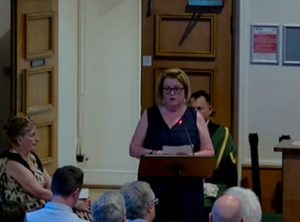
Image: Cllr Kim Spickett addresses the Council – Epsom and Ewell Borough Council YouTube
.
.
.
Epsom pensioners lost £148,000 in fraud as laundering network sentenced
23 June 2026
Two elderly Epsom siblings lost around £148,000 after being repeatedly pressured into paying for unnecessary home repair work, as members of a criminal money-laundering network were sentenced at Guildford Crown Court.
The Epsom victims were among those targeted in a wider operation spanning Surrey, Essex and London between February and September 2019, according to Trading Standards investigators.
The case concluded this week with sentences being handed down to five defendants following a lengthy investigation involving Buckinghamshire and Surrey Trading Standards, Essex Police and the National Trading Standards Regional Investigations Team. Authorities said the network laundered a total of £331,223 taken from victims.
At the centre of the operation was Lee Cross, 54, originally from Romford, who was convicted of fraud and money laundering offences. Prosecutors said Cross provided banking infrastructure used to move and conceal criminal proceeds through numerous business accounts operating under different trading names, including “A-Z Repairs”.
Cross was sentenced to eight years and seven months’ imprisonment.
Others sentenced were:
• Sorise Richardson, 45, Romford – 12-month community order with rehabilitation activity requirement • Zoe Hoskyn, 40, Hornchurch – two-year suspended sentence and 12-month rehabilitation order • Jason Walker, 35, Blackburn – two-year suspended sentence and 180 hours’ unpaid work • Pauline Walker, 70, Romford – 22-month suspended sentence
Trading Standards said victims were commonly approached by unsolicited callers claiming urgent repairs were needed to their properties. Homeowners were allegedly persuaded to pay substantial sums for unnecessary, poorly executed or uncompleted building works. Some were asked to fund equipment such as cranes and scaffolding that investigators said were never needed or supplied.
In Epsom, investigators said two elderly siblings were repeatedly pressured into paying for external works to their home that “didn’t need to be done”.
Amanda Poole, Buckinghamshire and Surrey Trading Standards Assistant Director, said: “Today’s sentencing marks the final step in bringing these fraudsters to justice, and most importantly, means the man at the heart of this operation — Lee Cross — will be behind bars.”
She added: “Today’s sentences are also a testament to the vital, diligent work undertaken by our Trading Standards officers, and those of our partners, in protecting our residents from harm.”
Lord Michael Bichard, Chair of National Trading Standards, said the case showed how organised criminals exploited elderly and vulnerable people, sometimes extracting “life-changing” sums for unnecessary or poor-quality work.
He said: “The harm caused by this type of fraud goes far beyond the money stolen, often leaving victims robbed of their confidence, independence and peace of mind.”
Trading Standards advises residents to be cautious of unsolicited traders, avoid agreeing to work on the spot, obtain multiple written quotations, and avoid paying cash or large sums upfront for building work.
Epsom boxer Amelia, 12, wins National Schools title
23 June 2026
A 12-year-old boxer from Epsom has brought home the town’s first National Schools boxing title in 15 years after a series of dominant performances at the England Boxing National Schools Championships.
Amelia O’Hagan, of Epsom Boxing Academy, claimed gold in the Class A 44kg category after progressing through Surrey, Southern Counties and the national finals.
Having qualified through the county and regional stages, Amelia faced London champion Davene Asabere of Newham’s Fight for Peace club in the quarter-finals.
Coach Joe Harding described Amelia’s performance as explosive from the outset. Starting at high tempo, she used fast attacks to head and body to control the bout, before forcing a stoppage early in the second round after a sustained assault left her opponent unable to continue.
The championships then took Amelia north to Newcastle for the semi-finals and finals weekend.
In the semi-final she met Midland Counties champion Hollie Browne of Black Country Boxing Club. Determined to improve on last year’s runner-up finish, Amelia produced what her coaches described as a controlled and disciplined display.
Using speed, footwork and sharp combinations, she repeatedly caught the taller opponent with attacks to head and body before moving safely out of range. After three rounds of sustained pressure and tactical boxing, Amelia secured a unanimous 5-0 points victory to reach the final.
There she faced local favourite Imogen Paylor of Felling ABC, champion of Tyne, Tees and Wear and a boxer with significantly more competitive experience.
According to Epsom Boxing Academy, Amelia again began strongly, attacking with body-to-head combinations and forcing her taller opponent backwards. The second round saw more sustained exchanges, with Amelia’s footwork and ring movement proving key.
Knowing the final round would bring an all-out response from her opponent, Amelia maintained the pace, countering effectively and finishing strongly. The judges awarded her a second unanimous 5-0 victory, crowning her National Schools Champion for 2026.
The success marks Epsom’s first National Schools “Golden Gloves” champion since Charlie Eastwood, who won the title 15 years ago and later added further national honours.
The victory also secures Amelia a place on the England Boxing National Development Pathway.
Joe Harding, head coach at Epsom Boxing Academy, said: “This girl is an amazing talent and at 12 years old this is only the start. She is hard-working and determined and I’m certain she will go on to represent her country.
“We have come close several times since starting our new Epsom club four years ago, with several silver and bronze medals, so bringing home the Golden Gloves with Amelia was a little emotional, to say the least.”
Epsom councillors handed key roles on East Surrey’s new Shadow Council
23 June 2026
The newly elected East Surrey Shadow Authority met for the first time on Wednesday 20 May, taking another formal step towards the creation of the new East Surrey Council due to replace existing county, borough and district councils on 1 April 2027.
The meeting marked the transition from the former East Surrey Joint Committee arrangements to the newly elected “shadow authority”, following this month’s elections to the new unitary council covering Elmbridge, Epsom & Ewell, Mole Valley, Reigate & Banstead and Tandridge.
With the Liberal Democrats holding a working majority on the 72-member authority after the May elections, councillors confirmed leadership and cabinet appointments that will oversee the transition year.
Councillor Steve Wotton was confirmed as Leader of the East Surrey Shadow Authority, with Councillor Kirsty Hewens appointed Deputy Leader.
Of particular local interest, two councillors representing Epsom & Ewell secured places in the shadow cabinet.
Councillor David Buxton, a Liberal Democrat councillor from Epsom & Ewell, was appointed Cabinet Executive Member for Adult Social Care and Health — one of the most substantial service portfolios in local government, covering responsibilities that currently account for major areas of county council expenditure and public concern.
Councillor Julian Freeman, LibDem also from Epsom & Ewell, was appointed Cabinet Executive Member for Housing. The appointment places an Epsom representative at the centre of housing policy discussions as the new authority prepares to assume responsibilities from existing councils amid continuing pressures around affordability, development and future planning arrangements across East Surrey.
The full cabinet allocation agreed by the authority included:
Steve Wotton – Transformation, Digital and People
Kirsty Hewens – Economy and Regeneration
Andrew Burton – Finance and Resources
Ashley Tilling – Children’s Services and Education
David Buxton – Adult Social Care and Health
Andrew Matthews – Transport, Highways and Infrastructure
Bradley Nelson – Strategic Planning and Growth
Julian Freeman – Housing
Abhiram Magesh – Leisure, Culture and Communities
Claire Malcomson – Climate, Environment and Waste
The cabinet roles are presently shadow positions linked to the local government reorganisation programme and will operate in that form until the new authority formally assumes full powers in April 2027.
The meeting also approved governance arrangements for the shadow council, endorsed initial transition priorities, and designated interim statutory officers to steer the authority through its establishment phase.
Among the appointments, Adam Chalmers, currently Chief Executive of Elmbridge Borough Council, was designated Interim Head of Paid Service. Nikki O’Connor, Assistant Director of Finance (Corporate) at Surrey County Council, was appointed Interim Chief Finance Officer, while Daniel Bainbridge, Head of Legal and Governance (Monitoring Officer) at Elmbridge, became Interim Monitoring Officer.
Speaking after his appointment, Cllr Steve Wotton said: “This is a significant moment as we work to bring services together under a single organisation. Our priority is to ensure residents see the benefits of the new East Surrey Council – one that is responsive, well run and able to deliver high-quality services from April 2027.”
He added: “We recognise the scale of the task ahead, but also the opportunity for a fresh start to shape a council that reflects and serves our communities.”
The new East Surrey Council forms part of Surrey’s wider local government reorganisation, under which the county’s existing councils are to be abolished and replaced by two large unitary authorities – East Surrey and West Surrey.
Until April 2027, existing county, borough and district councils will continue running day-to-day services. The shadow authority’s role is to prepare the structures, governance and leadership arrangements for the incoming council.
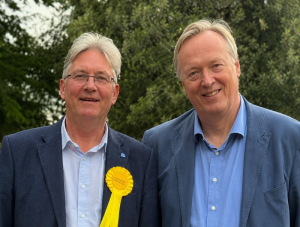
Photo right to left: Julian Freeman and David Buxton
Epsom Council Rainbow Centre secrecy row deepens over “pre-election silence” advice
23 June 2026
Epsom and Ewell Borough Council’s attempt to justify refusing answers to Epsom and Ewell Times before May’s elections has itself become the subject of a fresh transparency dispute.
The Council has now disclosed, following a Freedom of Information request, that the decision to rely on Section 2 of the Local Government Act 1986 (prohibition on Council promotion of political parties) involved the Council’s Chief Executive, Monitoring Officer, senior corporate and communications officers and Cllr Neil Dallen (RA Town), Chair of Strategy and Resources.
Yet the Council simultaneously claims it holds no legal advice, governance advice, briefing or equivalent guidance explaining why Section 2 supposedly prevented answers being given to press questions about the Rainbow Leisure Centre controversy.
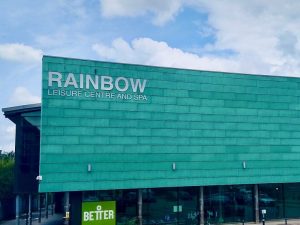
The issue concerns Cllr Neil Dallen’s (RA Town Ward) refusal before the election to answer questions relating to the Rainbow Leisure Centre, where a confidential urgent decision warned of dilapidations potentially costing “up to £500k”.
Guidance relied upon appears to undermine Council’s position
The Council disclosed a Surrey local government pre-election guidance document as the material relied upon. However, the guidance appears to say something rather different from the position adopted by Epsom and Ewell Borough Council.
The document emphasises political neutrality, impartiality and avoidance of electioneering by councils during election periods. But it also expressly states that councils may continue normal business and are allowed to “publish factual information to counteract misleading, controversial, or extreme information”.
It further stresses even-handed treatment of information requests and continuation of ordinary council business.
Epsom and Ewell Times’ questions to Cllr Dallen and others sought factual explanations of decisions already taken — not campaign material, political advocacy or commentary on electoral opponents.
“No advice held” raises further questions
The Council’s response identifies senior officers and a senior councillor as participants in the decision to invoke Section 2. However, when asked for legal advice, governance advice or internal briefing supporting the decision, the Council replied: “This information is not held by the Council.”
That response raises obvious questions. Was no legal or governance reasoning recorded despite involvement of the Monitoring Officer and senior management? Was advice given informally but not documented? Or has relevant information been withheld under another exemption?
The Council has separately relied on Section 36 of the Freedom of Information Act to refuse disclosure of internal communications concerning the decision-making process.
Neutrality — or protection from scrutiny?
The controversy touches on a sensitive constitutional question.
Pre-election restrictions exist to prevent councils using public resources to influence elections or support political parties. They are designed to preserve political neutrality.
But critics may ask whether refusing factual answers on controversial matters involving the ruling administration risks producing the opposite perception — namely that council machinery is being used to shield politically damaging issues from scrutiny immediately before voters go to the polls. That concern is sharpened by the context.
The Rainbow controversy involved questions about a confidential urgent decision, possible dilapidations of up to half a million pounds, the Council’s inspection responsibilities over a major public asset, and the role of the Chair of Strategy and Resources, Cllr Dallen, who was standing for election to the new East Surrey Council.
Whether the officers involved were properly protecting neutrality, or whether the interpretation adopted had the practical effect of protecting the ruling political group from uncomfortable questioning during an election campaign, is likely to remain contested.
Internal review sought
Epsom and Ewell Times has now requested an internal review by an officer independent of those involved in the original decision.
The review request challenges the Council’s use of Freedom of Information exemptions, the apparent absence of recorded legal reasoning, and the interpretation of the very guidance relied upon to justify pre-election silence.
The Liberal Democrats who swept to power in the inaugural East Surrey Council elections have confirmed their leadership team for the new authority ahead of its first full council meeting on 20th May.
Cllr Steve Wotton has been elected Leader of the Liberal Democrat Group, with Cllr Kirsty Hewens chosen as Deputy Leader following the party’s commanding victory across the new council area, which stretches from Epsom and Reigate to Thames Ditton, Caterham and Horley.
As previously reported by Epsom and Ewell Times, the Liberal Democrats secured 40 of the 72 seats on the new authority — enough for a clear working majority — meaning attention will now turn to how the party intends to shape the politically and financially challenging transition to the new East Surrey unitary authority.
The new “shadow authority” will oversee preparations for the abolition of the existing borough and district councils as part of Surrey’s Local Government Reorganisation programme, with the new unitary council expected to assume full powers in 2027.
In a statement following his election, Cllr Wotton said residents had voted for “a fresh start”.
He said: “Our immediate responsibility is to build a strong, effective and financially sustainable new council that works for communities across East Surrey.
“There is a significant amount of work ahead as part of Local Government Reorganisation; as part of the transition we are committed to establishing a culture that puts residents first, is compassionate and fights your corner.”
The Liberal Democrats said the new authority faces major pressures from the outset, including roads, social care, housing and special educational needs provision, as well as what they describe as an “up to £35 million shortfall awaiting the first budget”.
The party also signalled that it intends to distance the new authority from the culture of the former Conservative-led Surrey County Council, which governed the county for decades before local government reorganisation reshaped Surrey politics.
The Lib Dem victory was particularly striking in areas with Liberal Democrat parliamentary representation. The party claimed that in constituencies represented by Lib Dem MPs it won more than 75 per cent of available seats.
Cllr Hewens, who represents Walton South on Elmbridge Borough Council, has lived in Walton for more than 25 years and currently serves as Cabinet Member for Local Economy, Car Parking, Enterprise and Community Safety. The party said she had campaigned to support local businesses through free parking initiatives and had helped establish Business Improvement Districts across Elmbridge. She is also a long-standing food bank volunteer and recently became a trustee of a local arts charity.
Cllr Wotton lives in Horley and has a professional background in banking and financial services in London and Hong Kong. First elected to Horley Town Council in 2023 before joining Reigate and Banstead Borough Council the following year, he has campaigned on environmental and infrastructure concerns affecting Horley, including sewage flooding issues linked to the Horley treatment works.
The first meeting of the new council on 20th May is expected to formally establish the authority’s political leadership and governance arrangements as East Surrey begins one of the largest reorganisations of local government in Surrey for decades.
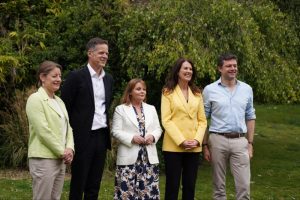
Left to right: Helen Maguire (MP for Epsom and Ewell); Steve Wotton (Leader and Cllr for Horley West, Salfords and Sidlow); Kirsty Hewens (Deputy Leader and Cllr for Walton South and Oatlands); Monica Harding (MP for Esher and Walton); Chris Coghlan (MP for Dorking and Horley)
Channel 4’s long-running property programme Location, Location, Location is searching for Surrey house hunters to take part in its next series filming this June.
Fronted by property experts Kirstie Allsopp and Phil Spencer, the show has been a fixture on British television for more than 20 years, helping buyers across the UK find their ideal homes.
The programme makers are now looking for individuals, couples and families across Surrey who need help finding their next property — whether they are first-time buyers, upsizing, downsizing, relocating or searching for a “forever home”.
A spokesperson for Channel 4 said: “We are casting for the new series, and we are interested in hearing from chain-free (or SSTC) house hunters who would be ready to buy in June this year.
“Applications are now open and we’re looking to spread the word to the community to encourage house hunters to apply and get the help they need.
“We are looking for individuals, families and couples who need Kirstie and Phil’s expertise to buy their dream home.
“Whether applicants are first-time buyers, looking for their next dream home, downsizing or relocating — whatever the reason they’re moving, we love to hear from them.”
The broadcaster said it strongly encourages applicants from all backgrounds and identities to apply as part of its commitment to greater inclusivity on screen.