Epsom and Ewell Times
24th September 2026

ISSN, LDRS and IMPRESS logos

Woking up to Surrey face recognition cameras

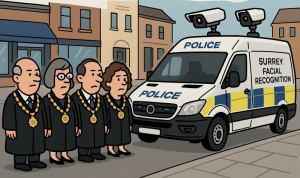
Cartoon councillors protesting against police camera van

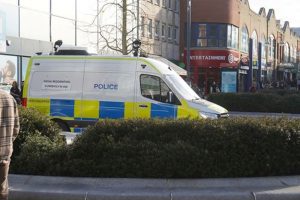
Formal protests have been lodged against Surrey Police’s use of facial recognition technology that scans the faces of every adult and child in a bid to identify known suspects. Surrey Police was given two live facial recognition vans from the Home Office in November and has since put them to use in Redhill and Woking. The surveillance cameras record the images of everyone who walks across their paths to see if they are a match for people on their watchlist. The force says it deletes anybody who does not match to “minimise the impact on their human rights”, with watchlist images deleted within 24 hours. The police said there were known issues in the past with facial recognition technology, including potential gender and ethnic bias, but that developments and new AI-driven algorithms have reduced this.

Now, a group of 25 cross-party Woking Borough Councillors have written to the force demanding the cameras are mothballed until meaningful consultation with residents and their elected representatives takes place over how, or whether, they are used. The letter says that fundamental questions of governance and human rights should have been resolved before any decision was made – including accountability for wrongful stops or arrests from misidentification, whether cameras record continuously or selectively, and how and when data is processed, shared, stored and deleted. A resolution has also been passed by Woking Borough Council’s Communities and Housing Scrutiny Committee calling on Surrey Police and the Crime Commissioner to join its January 20 meeting to answer questions about the use of live facial recognition cameras in Woking. In the meantime, councillors want the cameras’ usage suspended immediately, pending full consultation with residents, with a focus on young people and those from ethnic minority backgrounds and community groups, as well as a full independently led equality and human rights impact assessment.

Chairing the Tuesday, December 2 committee was Councillor Tom Bonsundy-O’Bryan. He said: “They were deployed in Woking on November 26 and in Redhill on November 13. They scanned the faces of more than 8,000 members of public; 99.9 per cent of those scanned were not arrested. Of the individuals explicitly flagged as alerts by the technology in Redhill, 60 per cent were ultimately not arrested; only two arrests were made. There are serious questions about the proportionality of this. Imagine the police standing down the road, and asking to see everyone’s passport, checking their ID, just in case they are a criminal. It would be a ludicrous thing, we wouldn’t stand for it, it would be outrageous, and that is effectively what this technology is doing. It scans the face of anyone, child or adult, walking down the street and compares it to a watch list. Everyone wants the police to stop criminals, to find and arrest the people responsible for crime, but is this technology really proportionate in being deployed here in Woking?”

A spokesperson for Surrey Police said: “The introduction of live facial recognition technology, which is already being used successfully by other forces in the UK, is a vital tool to help us investigate crime thoroughly and relentlessly pursue criminals. We meticulously planned the rollout of the technology to ensure our use is appropriate, proportionate, and that we are operating with transparency. As part of this, we appropriately engaged with a wide variety of stakeholders and have ensured all information, documentation and policies are publicly available on our website. Since the launch on November 13, we have successfully completed a deployment in Redhill where officers arrested a 69-year-old man for breaching his sexual risk order and conducted condition checks for a sexual harm prevention order and a stalking protection order. On a further deployment in Woking, a 29-year-old man was arrested on suspicion of rape and shoplifting and two women were issued community resolutions for shoplifting.”

Police added that the technology has been extensively tested by the National Physical Laboratory and that the algorithm used “shows no statistical bias towards gender or ethnicity (as tested nationally)”. They said officers are briefed before each deployment regarding any potential disparity relating to race, age and gender, and that “extra corroboration” is required before any action is taken. “It is our responsibility to use every tactic and innovation available to us to keep the public safe, deter criminal behaviour, protect people from harm, and locate the most serious of offenders – and the live facial recognition technology has helped us to do exactly that.”

Police and Crime Commissioner Lisa Townsend said: “I want to make sure our communities are as safe as possible for Surrey residents which is why our police officers must have every tool at their disposal to track down criminals operating in our midst. I do understand that people may have concerns which is why it is important that the debate on policing technology reflects the facts, the safeguards in place and the clear benefits to public safety. These vans will be used proportionately and it is important to stress that law-abiding members of the Surrey public going about their daily business have nothing to fear by their use. The cameras will help our policing teams identify and detain those on a pre-determined watchlist such as violent criminals and sex offenders.”

Chris Caulfield LDRS

Related reports:

Live facial recognition policing comes to Surrey


Surrey Police Commissioner responds to morale report

Lisa Townsend, Surrey Police and Crime Commissioner. (Credit: Surrey PCC office)

Surrey’s Police and Crime Commissioner has defended a reported drop in police officer morale, pointing to public and media criticism of the force. Only 57 per cent of officers believe they are making a difference, according to a new report, but PCC Lisa Townsend said the decline reflects wider tensions between the force and the field. Speaking at a Surrey Police and Crime Panel meeting on November 27, she said: “It doesn’t matter what this job you’re in, if the profession that you do is being attacked by the public, is being attacked in the news, attacked by colleagues or other people – there is an inevitable correlation in terms of morale.” She added that Surrey’s proximity to the Met Police, “that features in the news on a regular basis”, may also be influencing Surrey officers’ perceptions. “Our officers feel that. They see police officers being attacked and it’s not surprising they are not completely immune to feeling that themselves,” she said.

However, Ms Townsend warned against assuming pressure is spread evenly across the force: “We’ve got to be careful about treating it as a single… as a uniform [experience] across all police officers or police staff.” Backlogs in the justice process, not feeling adequately equipped and workload were also cited as frustrations potentially chipping away at morale. Nearly 66 per cent of officers said they were unable to finish tasks on time, according to council documents. Despite the uncertainty of local government reorganisation and the government’s plan to scrap the PCC role in 2028, Ms Townsend stressed that officer numbers remain strong. “We would never have enough police officers to deal with everything every member of the public will want to deal with. It is always going to be an issue. Police officers are always going to be under a certain amount of pressure, as everyone in the public sector.”

The Commissioner said work to improve retention and reduce stress is making progress but a tough reality remains: demand continues to feel high and work–life balance remains “the most common reason for leaving the force”.

Emily Dalton LDRS

Image: Lisa Townsend, Surrey Police and Crime Commissioner. (Credit: Surrey PCC office)


Live facial recognition policing comes to Surrey

A live facial recognition van. Sussex Police.

Surrey Police have begun using live facial recognition (LFR) technology after securing two mobile LFR vans in a joint bid with Sussex Police. The first deployment took place this week in Redhill following months of planning.

The vans use real-time facial recognition to compare faces captured on live camera feeds with a pre-determined police watchlist. Surrey Police say this list will include wanted persons such as sex offenders and perpetrators of domestic abuse. According to the force, images of everyone else are “instantly and permanently deleted”, and images of those on the watchlist are deleted within 24 hours.

Police acknowledge the historical concerns about gender and ethnic bias in commercial facial recognition systems but state that the national algorithm they will use “shows no statistical bias” and has been tested by the National Physical Laboratory. Officers will receive briefings on potential disparities relating to race, age and gender, and any computer-generated match will be checked by an officer before action is taken.

The force says deployments will only be authorised by a Superintendent and carried out “in a proportionate manner”, with clear signage on the vans and advance publication of deployment locations. The vans are funded by the Home Office for five years and may be made available to other forces for mutual aid.

Chief Inspector Andy Hill, Surrey Police’s lead for LFR, said the technology is “a vital tool to help us to investigate crime thoroughly and relentlessly pursue criminals”. He added that the rollout had been “meticulously planned” to ensure appropriate and transparent use. Police and Crime Commissioner Lisa Townsend described the vans as an important means of identifying violent criminals and sex offenders.

If the LFR vans come to Epsom and Ewell, Surrey Police say residents will be notified before deployments and that the vans will be signposted when in use.

National picture

The deployment in Surrey comes as the use of facial recognition technology accelerates across UK policing. Forces in England and Wales have increasingly turned to mobile LFR units, with millions of people scanned nationally each year and several hundred arrests made as a result. London’s Metropolitan Police and South Wales Police are among the heaviest users, reporting arrests of wanted individuals including violent offenders and registered sex offenders.

While these figures suggest a measurable benefit, LFR still represents a small proportion of overall policing activity, and questions remain about its accuracy, its effect on minority groups and the proportionality of scanning large numbers of passers-by for relatively small numbers of matches.

ICO guidance and safeguards

The Information Commissioner’s Office (ICO) has issued detailed guidance stating that facial recognition used by police must comply with strict requirements of data protection law. Forces must demonstrate that each deployment is lawful, fair, transparent and based on necessity and proportionality. Data Protection Impact Assessments are required, and forces must show clear justification for the locations chosen, the purpose of the watchlist, and the retention policy for images. The ICO stresses that facial recognition “does not operate in a legal vacuum” and will continue auditing police use.

Advance signage and practical concerns

One issue not fully addressed in the Surrey Police statement is how advance signage will work with mobile vans. In practice, UK police forces usually publish the location of an LFR deployment only shortly before the van becomes operational. Because the vans can be moved rapidly as part of an operation, advance publication generally refers to the place where the van parks, not its movements throughout the day. Some forces update information if the van relocates, though not always in real time.

Another question is whether advance notice undermines the policing purpose by alerting wanted suspects. Civil liberties groups argue it does, but police note that most arrests via LFR occur even when deployments are announced. Many wanted individuals do not monitor police websites, and the requirement for transparency stems from data protection law rather than operational convenience. The ICO has made clear that secrecy around deployments would be unlikely to meet legal standards of fairness.

Local implications

For residents, the potential arrival of LFR vans in Epsom and Ewell would bring a technology that is increasingly common across the UK. Surrey Police emphasise that law-abiding members of the public have “nothing to fear” and that images of those not on a watchlist are immediately deleted. However, questions remain about how watchlists are created, how effectiveness will be measured and whether Surrey Police will publish statistics on matches, false matches and resulting arrests.

As mobile facial recognition becomes a more familiar part of policing nationwide, the way Surrey Police implement and report on these deployments will be key to maintaining public confidence while pursuing the serious offenders the technology is designed to identify.

Sam Jones – Reporter

Photo: A live facial recognition van. Courtesy – Sussex Police.


Leatherhead to be home to 500 Surrey Police Officers

Cleeve Road premises bought by Surrey Police

Surrey Police will get its new East Surrey headquarters after huge plans including hundreds of homes was approved. The force has been on the lookout for a new hub after its Reigate base was forced to close suddenly when dangerous crumbly RAAC concrete that can collapse without warning was found through the old site in 2023. The plans, on the former ERA site in Cleeve Road, Leatherhead, will be built in phases after being approved by Mole Valley District Council’s development committee on Wednesday, November 5.

The first work at the site will be to build a new strategic divisional police headquarters for Surrey Police with 500 officers and staff moving into the building. Stage two will see the existing redundant buildings demolished to make way for a residential block accommodating 40 affordable residential homes that the police said would ideally be for its own staff. Stage three would build out 185 new homes.

Despite being voted through without any formal objections, concerns were raised over the lack of affordable housing in the project and that the council’s affordability targets had been made a mockery. It was admitted that, in the current market, it was practically impossible for new developments to have 40 per cent of the new homes be affordable, and the project be financially viable.

Speaking on behalf of the force, a spokesperson said: “We needed to move out of our Reigate Headquarters in 2023 due to the discovery of RAAC. We are lucky enough to have secured temporary accommodation, but very much a temporary solution in the knowledge that we needed a long-term divisional headquarters.” He said Surrey Police settled on Leatherhead because its gave their teams “good access to the local area and the major road links so officers can fight crime and protect people in the area.”

Better facilities would allow the force to attract and retain staff. He added that while there will be serving officers operating from the base it would not act as a fire type response meaning that, while they could not guarantee there would never be sirens going off, it would be “highly unlikely.”

Chris Caulfield LDRS

ERA Site, Cleeve Road, Leatherhead, Surrey (image Google)

Related reports:

New Surrey police division HQ plans

Surrey police to move to Epsom and Ewell constituency


Surrey Police HQ development dogged by flood risks

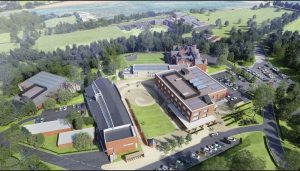
Proposed Redevelopment of Mount Browne, Surrey Police\'s HQ. (Credit: Surrey Police)

Plans to redevelop Surrey Police’s Mount Browne headquarters in Guildford — including a new dog training school — have been green-lit for a second time despite fresh flood risk modelling showing “pockets of high surface water flooding” across the site.

Guildford Borough Council’s Planning Committee approved the scheme in November 2024, but since then national planning rules have changed and the Environment Agency has issued new flood maps.

As a result, Surrey Police and the council agreed to bring the scheme back to committee.

The updated modelling shows parts of the site, including the former bowling green earmarked for the new dog school, face a high risk of surface water flooding.

Councillors raised concerns about what that actually means in practice at another planning committee meeting on September 9.

“On one hand we say there’s a high risk of flooding — and then we say the infrastructure will support that regardless,” Cllr Stephen Hives said. “So I’m a bit confused: is there a danger to welfare or not?”

Planning officers insisted the scheme still passes the required “sequential test” — which means no safer, alternative sites are reasonably available — and that the approved drainage strategy will prevent increased flood risk.

“In practical terms it will make no difference to this development,” an officer told the committee. “The drainage strategy already approved is sufficient even with the updated flood risk.”

The development does not fall within the newly created “Grey Belt” category introduced in the revised National Planning Policy Framework (NPPF), but it was judged to still harm the Surrey Hills National Landscape.

With no new highways flooding issues identified and no change to the approved drainage plan, officers confirmed the project remains compliant with planning rules. Plans to redevelop the police HQ and build a new access road was unanimously approved.

Mount Browne has been the headquarters of Surrey Police for more than 70 years. The current campus contains a large number of buildings which have been constructed mainly on a piecemeal basis and are judged no longer fit for purpose.

Emily Dalton

Proposed Redevelopment of Mount Browne, Surrey Police\’s HQ. (Credit: Surrey Police)


Surrey Police tax set to rise

Council tax bills could keep climbing despite warnings residents could be getting less bang for their buck. Surrey’s Police and Crime Commissioner has insisted she “will not ask the public to be less safe” as she defended plans to raise council tax for policing. 

At a Police and Crime Panel meeting last week (September 4), PCC Lisa Townsend explained the decisions on the annual precept rise were driven by the Chief Constable’s assessment of what the force needs to keep the country safe.

“It’s not me plucking a figure out of thin air,” she told councillors. For Ms Townsend, the choice is clear: “Surrey Police are cutting their cloth, but what I am not prepared to do is ask the public to be less safe.”

Surrey Police must find £14.8m savings by 2029 with pay (which makes up 80 per cent of its spending) ramping up costs, a report states. Each 1 per cent pay rise for police officers adds £2.4m to the budget, equivalent to £4.80 on the average council tax bill. 

The report revealed: “Whilst the force is making every effort to not impact services as a result of savings required, there is a risk that this will not be possible”. 

Ms Townsend’s comments came after councillors questioned whether constant tax rises could be justified when Surrey Police must still deliver sweeping budget cuts to balance its budget. 

Cllr Richard Wilson challenged: “At some point Surrey Police has to cut its cloth. You can’t keep asking the public for more and more money when it’s a regressive tax.” He asked the PCC to “give the public a break” from the ever-increasing tax bills. 

But finance officers warned that the ability to make further cuts “become more difficult every year” despite efforts to standardise IT systems, renegotiate contracts and improve procurement. They warned if Surrey Police do not increase the precept in a particular year then it has “missed that chance” in every following year to raise funds for the Force.

Although the Government has promised to fund some police pay rises above 2.8 per cent, Surrey is still waiting for clarity on how much of this money it will actually receive. The long-awaited Police Reform Bill could also see some functions stripped away to a national body or Surrey forced into merger talks — changes with potentially “major financial implications.”

Surrey remains one of the lowest government-funded forces in the country, leaving residents to shoulder more of the burden through local taxation.


 Anti-catcalling campaign triggered ‘vitriolic’ backlash

Lisa Townsend, Surrey Police and Crime Commissioner. (Credit: Surrey PCC office)

Surrey’s Police and Crime Commissioner has said the “vitriolic” online abuse she faced after an anti-catcalling trial campaign went viral shows why tackling violence against women and girls must remain a priority.

The ‘Jog On’ pilot, launched in the summer, was led by a female police officer who had been harassed while out running. It aimed to address the harassment many women face in public spaces just going about their lives but it sparked fierce backlash online- with some critics questioning whether it was a good use of police resources. 

Ms Townsend, who said she was not directly involved in the campaign, said she received the “most vitriolic messages” on social media and they were the worst she had faced in her time as a PCC. 

She told a Police and Crime Panel on September 4: “The fact that this was the most awful sort of language that I’ve had I think tells you why this work is so important.”

One X (formerly Twitter) user asked her whether the campaign was a waste of Surrey Police;s time, given that catcalling was not a criminal offence. Others said it was a total waste of taxpayer’s money.

Townsend has responded on social media and publicly that early intervention and crime prevention are essential parts of policing, explaining that behaviours dismissed as minor – like catcalling and public intimidation – can escalate into more serious offences. 

The PCC’s comments come as she set out Surrey’s apparent progress against her Police and Crime Plan which says tackling VAWG is a top priority.

Councillors challenged Surrey Police’s record claiming it is not possible to tell whether violence against women and girls has increased or decreased. The volume of violent domestic abuse crimes reported has decreased by 4 per cent from 7,995 in June 2024 to 7,673 in June 2025. However, the volume of serious sexual offences has increased by 2 per cent from June 2024 to June 2025.

The PCC said: “I hope to see reports of violence against women and girls go up during my term as PCC because we know it is one of the most under-reported crimes in this country, not just in Surrey but right across this country.

“I don’t take an increase in reports as a bad thing. I think everyone that comes forward to talk about an experience that they may not have had the confidence to do before is a good and important thing.

“I don’t expect to see a reduction in reports anytime soon.”

Lisa Townsend, Surrey Police and Crime Commissioner. (Credit: Surrey PCC office)


Surrey police officer barred for domestic abuse

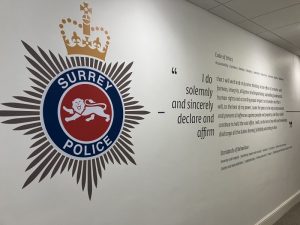
Surrey Police ethics print on wall at Mount Browne HQ. (Credit: Emily Dalton/LDRS)

A former Surrey Police officer secretly got back with his ex while under investigation for behaviour in their relationship – then tried to persuade her to retract a statement, a misconduct panel has ruled.

The officer, referred to as Officer A in the report, was supposed to stay away from his former partner, Ms A, after concerns were raised about his behaviour. But the hearing in July and August 2025 was told he started seeing her again behind the force’s back and even pushed her to withdraw what she’d told investigators.

The panel said it was a clear attempt to interfere with a witness and undermine a formal investigation to the alleged misconduct.

The panel concluded the officer’s behaviour as gross misconduct because he tried to interfere with a live investigation, secretly rekindling a relationship with a key witness and pressuring her to change her statement.

His harassment, aggressive behaviour and invasive social media posts were judged so serious they risked undermining public confidence in the police.

Further incidents of harassment were also proved by the hearing. Ms A said the former officer showed up to her home uninvited and barged his way in, leaving her with bruises, and confronted her in a pub where he made crude remarks in front of others.

Officer A denied contacting Ms A and asking her to retract her statement to the police. He also refuted barging into Ms A’s home.

Investigators also discovered that Officer A had been posting personal and sexualised material on Pinterest- including symbols from their relationship like a fake boarding pass for her birthday trip, yellow tulips (her favourite flowers) and photos of home-made sexual restraint gear.

While not every allegation was proven, the panel ruled that Officer A had broken police rules on honesty, respect and professional conduct, and said his actions were serious enough to damage confidence in the force.

The report read: “We do note that before these matters the former officer did serve the public well as demonstrated by the service record provided. He undertook a difficult and stressful role that required a lot of hard work to achieve and maintain during his career.

“We thank the officer for that service, however this past record would not allow us to impose a lesser outcome, given the serious nature of our findings.”

In terms of mitigating factors, the panel noted Officer A was emotionally distraught at times during the misconduct hearing and was finding matters personally difficult, as confirmed by another officer.

A Surrey Police spokesperson said: “As soon as we were made aware of the allegations involving Officer A, a thorough investigation was carried out by the Force’s Professional Standards Department.

“It was determined that former Officer A would have been dismissed had they still been serving and was placed on the College of Policing Barred List.

“Domestic abuse by any of our officers and staff simply will not be condoned and such allegations against any of our officers or staff are always subject to a thorough investigation by our Professional Standards Department.”

Surrey Police ethics print on wall at Mount Browne HQ. (Credit: Emily Dalton/LDRS)


Student overdose leads to policy change

HM Coroners Court Woking Surrey

A university student from Surrey could have been saved from an overdose if police had left a voicemail for her parents, an inquest jury has found. Despite needing to find her address, officers did not leave a message. Amy Levy, 22, deliberately took an overdose of her prescription pills at her student home in Bristol while on the phone to a friend on June 18, 2023. Her friend alerted the police as Amy’s condition worsened. Surrey Police and Avon and Somerset Police launched an urgent search to find the University of the West of England (UWE) student and tried to contact her parents, who live in Surrey, because they did not know her address. But when officers and staff tried to reach Amy’s parents, no one picked up the phone to the number showing ‘no caller ID’. The calls were left unanswered, unable to ring back and no voicemail was left despite the gravity of the situation. Amy was eventually located more than 90 minutes after the first police call. Sadly, she died in hospital on June 22, 2023 from an overdose of different medications which caused hypoxic brain injury.

In a statement, Amy’s parents said: “We are totally broken that Amy is no longer with us, but we are also so proud of Amy and grateful for the time we had her in our lives.” An inquest jury identified a “catalogue of missed opportunities” to save Amy. The five-day inquest from June 6, 2025 concluded if the police had found her sooner, she would have survived. The jury said that despite taking a deliberate overdose of prescription drugs, it was not possible to know her true intent. Robert Sowersby, Assistant Coroner for Avon, has now issued a report raising concern about the lack of guidance or training issued to officers and staff about leaving voicemail messages – especially in circumstances where they are trying to obtain important information in a time-pressured situation. He said it was “hard to understand” why all of the officers or police staff decided not to leave any voicemail or message despite both forces grading Amy’s case as requiring an “immediate” response, the most urgent category.

“Both police forces knew that Amy had taken an overdose at an unknown address and that her condition was deteriorating,” the report said. “Despite that factual background, none of the officers or call handlers who phoned Amy’s parents left a voicemail message.” The inquest found that because the missed calls were from an unknown number, Amy’s parents did not know that there was an emergency, or that the police wanted to speak with them, and had no way of calling them back. Assistant coroner Sowersby wrote: “It is probable that Amy’s location could have been obtained earlier than it was if the police had left a suitably worded voicemail for one or more of her parents.” Surrey Police attended the family home in person and received details of Amy’s current address, which led to officers being able to find her in Bristol, Avon and Somerset Police said.

Police inspectors from both forces gave evidence at the inquest. There was guidance in Avon not to leave voicemails when the incident in question concerns domestic abuse, but there is no general guidance about when to leave a voicemail message in other cases. Surrey Police provided the coroner with evidence of updated voicemail procedure indicating that callers must consider if it is appropriate to leave a voicemail or message. Mr Sowersby said: “With limited or no guidance, training or policy on when police and/or police support staff liaising with the public should leave a voicemail, particularly in circumstances where they are trying to obtain important information in a time-pressured situation, I am concerned that there is a risk that future deaths will occur unless action is taken.”

Iftikhar Manzoor, of Hudgell Solicitors, represented Amy’s parents at the Inquest and said her death ‘must lead to clear policies’ across UK police forces when the risk to an individual has been graded as the highest level of urgency. He said: “What has been truly shocking to learn has been the fact that there is no system in place with regard to leaving messages in a situation where somebody’s life is quite clearly at risk, and the only person posing a danger to them is themselves. The calls were shown as unknown numbers, and as the police chose not to leave messages and only made one call attempt, a huge opportunity was lost immediately, and the sense of urgency dropped. It was the bare minimum effort.”

Responding to the coroner’s report, Superintendent Chris Colley of Surrey Police said: “Our thoughts and condolences remain with Amy’s friends and family following what must have been a very hard couple of years for her loved ones.” He added: “We have now made changes to our procedure around the use of voicemails and telephone contact attempts, to ensure we are doing all we can to be there for people when they need us most.” A spokesman for Avon and Somerset Police said: “Our thoughts are with the family of Amy Levy, who died in extremely tragic circumstances two years ago. A private apology has been made to her family, which we wish to repeat publicly, and we are reviewing our organisational policies in line with the findings relating to this case.” Avon and Somerset Police also said they are looking at potential changes to force polices as guided by an Independent Office for Police Conduct (IOPC) learning recommendation earlier this month. The spokesperson said: “We will ensure any necessary changes to help protect the public are adopted and will provide a further update to the IOPC and coroner in due course.”

HM Coroners Court Woking Surrey


Surrey Police officer inspires change to racism law in private places

Candice Gill in uniform

Surrey Police officer Sergeant Candice Gill is celebrating this week after successfully campaigning for an amendment to the law that will have a far-reaching impact.   

While it is a criminal offence to racially or religiously abuse someone in public, this does not extend to incidents occurring in homes. This loophole left police officers and emergency workers with no legal protection from such attacks during home visits.   

Candice experienced the impact of this first-hand. She says: “I cast my mind back to the day of a racially aggravated incident against me. I knew the man was racist. Once I was inside his house, he made it overtly clear. The abuse he threw at me was both damaging and humiliating, and there were no legal consequences.  

“It seemed like a no-brainer to me that something had to change. But changing the law seemed way too big, far out of my remit, impossible even.”  

Surrey Police Deputy Chief Constable Nev Kemp heard about this outdated gap in the law and committed to championing the cause with Candice.   

He capitalised on opportunities to brief ministers and wrote numerous letters. Alongside Police and Crime Commissioner Lisa Townsend, Candice and Nev made a trip to Parliament to press the case for change.

When they learnt earlier this year that there was cross-party support in Parliament and the changes would be made, Candice and Nev were thrilled. Last week they received written confirmation that the government will make an amendment to the law, subject to the Police and Crime Bill receiving Royal Assent later this year. The government will introduce two new offences, ensuring that emergency workers are covered under the law when doing their jobs in private homes.  

Candice says: “I am absolutely delighted to have heard that my proposal to have the law changed has been agreed.  

“I hope the change will go some way into making all officers but particularly the officers who are ethnically or religiously diverse feel more protected and more valued while doing one of the hardest jobs out there. The positive impact is widespread across all police forces and other emergency services.”  

Deputy Chief Constable Nev Kemp says: “More than once, I heard from colleagues that the impact of being singled out and attacked for simply being who you are was more profound than being physically assaulted.  

“This important change wouldn’t have happened without Candice and is a reminder of the difference we can make with determination and teamwork. Letters of support from national leaders representing the ambulance service, fire and rescue service and the Police Federation have helped to confirm the difference it will make to emergency workers across England and Wales.        

“Surrey is a consistently improving force, and this is further evidence of our pathway to becoming a leading force in fighting crime and protecting people.” 

Policing Minister Dame Diana Johnson said: “Candice’s story is heartbreaking. Our emergency workers put themselves in harm’s way every day to keep us safe and they should never have to tolerate abuse due to their race or religion while simply doing their job. 

“As part of our Plan for Change, this government is rebuilding the bond between the public and police, and part of that means ensuring our officers have the protections they deserve.  

“By closing this loophole, we’re sending a clear message that racial and religious abuse directed towards those who serve our communities will not be tolerated, and I thank Candice, Deputy Chief Constable Nev Kemp and all those at Surrey Police who have campaigned for this important law change.” 


Surrey Police know where they’re going with more of them

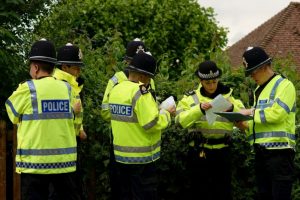
Surrey Police officers

Surrey Police will have ‘the highest number of officers in a generation” after locking up money for 40 more patrol cops. The estimated £2.5million in central government money is part of a Neighbourhood Policing Guarantee and will add to the 222 extra officers who joined the force since March 2021 – and its March 2025 total of 2,336 officers. The new recruits will likely comprise 25 full time police officers and 15 special constables.

The programme is part of the government’s plan to have at least one named, contactable, officer in each neighbourhood, as well as dedicated teams on patrol in town centres and other hotspots. There will also be dedicated antisocial behaviour leads in every force which Surrey Police said reflects the government’s recognition of the public’s crime and safety concerns.

Surrey Police Chief Constable, Tim De Meyer, said: “For us, the Neighbourhood Policing Guarantee is a chance to strengthen our presence in the heart of our communities, with officers working alongside residents, identify local issues, and resolve problems before they escalate. It’s about building lasting relationships and ensuring that we are seen as a trusted resource, not just an authority figure. The guarantee reinforces our commitment to community engagement, crime prevention, and proactive policing. With this initiative, we will be better equipped to build stronger relationships, deliver more targeted interventions though our hotspot policing efforts, and improve overall safety for the communities we serve. The promise of increased officer numbers will enable us to further tackle issues such as anti-social behaviour, theft, and drug-related crimes. While the Neighbourhood Policing Guarantee presents several advantages, it also comes with challenges that we must address to ensure its success. The demand for resources across the Force must be managed effectively to ensure that neighbourhood policing remains a priority, even in times of high demand. Additionally, engaging with communities that have historically had strained relationships with the police can take time and require a sensitive, consistent and tailored approach. However, these challenges present an opportunity for us to demonstrate our commitment to transparency, community-focused policing, and problem-solving.”

Assistant Chief Constable, Tanya Jones, added: “By staying true to the Force principles, and embracing the goals of the Neighbourhood Policing Guarantee, we can strengthen our role as a trusted, proactive Force that works alongside local communities to tackle crime, improve public safety, and build a sense of community pride. As officers and staff, we must embrace opportunities to speak with local residents, build trust, and work collaboratively to prevent crime. We can create environments where residents feel heard, supported, and secure. It’s more than just policing, it’s about shaping communities in a way that promotes safety, confidence, and lasting social cohesion.”

Surrey’s Police and Crime Commissioner, Lisa Townsend welcomed the additional funding. She said: “Based on the funding allocation provided, it is projected that Surrey Police will benefit from an additional 25 police officers, as well as 15 Special Constables.” Adding: “Neighbourhood policing is a key commitment for Surrey Police, and residents are already benefiting from that focus, with an additional 3,500 charges and 2,500 more arrests across all crime types in 12 months. Initiatives such as the Safer Streets programme and hotspot policing have led to increased trust and greater intelligence gathering in our communities. However, forces across the country are also seeing a rise in ‘hidden’ crime types, such as fraud, domestic abuse and sextortion, and Surrey is no exception. These crimes have very real victims, and we must ensure those victims are getting support from specially-trained officers dedicated to pursuing justice for them. As part of the doctrine of operational independence, Surrey’s Chief Constable Tim De Meyer decides where his officers and staff are best-deployed to tackle offending. Under his leadership, the Force is one of the fastest-improving in the country. Both Tim and I are determined to ensure this brilliant progress is sustained.”

 Image: © Copyright Peter Trimming and licensed for reuse under this Creative Commons Licence.


New Surrey police division HQ plans

Cleeve Road premises bought by Surrey Police

Plans for a new Surrey Police headquarters have been put forward for its eastern division in Leatherhead. 

The force said it hopes to develop a “bespoke and permanent” HQ on the former Electrical Research Association and Cobham Industries site. An application has also been put forward to develop an area of the Cleeve Road site into affordable housing. 

After discovering Reinforced Autoclaved Aerated Concrete (RAAC) in Reigate Police Station in September 2023, the division temporarily moved to the old Surrey Fire & Rescue Services HQ at Wray Park in Reigate.

Deputy Chief Constable Nev Kemp said the planning application is a “key step in our journey” to building a permanent location for police operations in East Surrey. He said the force has been focusing on finding a site that will help staff and officers to investigate and prevent crime and keep people safe.

Surrey Police bought the former Electrical Research Association (ERA) and Cobham Industries site on Cleeve Road in 2018 for nearly £20.5m, aiming to develop a new, purpose-built headquarters from the ground up.  But by 2021 the Police and Crime Commissioner and the Surrey Police Chief Officer team decided to scrap the idea and look to Mount Browne, in Guildford, and redevelop the existing HQ. 

The Local Democracy Reporting Service (LDRS) revealed earlier this year that Surrey Police spent nearly £3 million, on top of the £20.5m used to buy the Leatherhead site, on failed plans to move its headquarters as part of disastrous money-saving efforts. Much of the money used was spent on building designs and surveys for the project which the Police and Crime Commissioner said was directly transferable to the Mount Browne redevelopment project.

The force said it had held public meetings with local residents, businesses, councillors, and community group representatives to share initial plans and gather feedback. The force is also working closely with key stakeholders in the community, including Mole Valley District Council.

Related report:

Surrey police to move to Epsom and Ewell constituency

Cleeve Road premises bought by Surrey Police. Google Street View