
Epsom and Ewell Times

Current
ISSN 2753-2771

Epsom’s Earth health doctor checks GMC

Epsom residents led by Dr. Kristine Damberg converged Thursday 18th April on the General Medical Council (GMC) headquarters in Central London, decrying what they perceive as the regulator’s lackluster response to the urgent health risks posed by climate change. The demonstration, organized by the Planetary Health Coalition, aimed to spotlight the pressing need for action on climate-related health issues affecting the community.

Dr Damberg protesting outside General Medical Council.

Dr. Kristine Damberg, Senior Simulation Practitioner and ESTH Sustainability Champion based at Epsom Hospital, voiced concerns about the immediate health impacts of climate change in the area. She lamented the rise in climate-related ailments among patients, including heat-related illnesses during the 2022 heatwave. Dr. Damberg emphasized the gravity of the situation, citing staggering statistics: “In the UK, 29-43,000 people die unnecessarily every year because of air pollution.”

Adding: “Even in a relatively affluent area like Epsom we are seeing these impacts on patients presenting to GP surgeries and hospitals. In the 2022 heatwave there were 3000 excess deaths in the UK and on the wards at Epsom Hospital the temperature was consistently above 30 degrees. It was extremely challenging for staff to work and keep already vulnerable patients safe at these extreme temperatures.”

She stressed the imperative for proactive measures, echoing The Lancet’s designation of climate change as the most significant global health threat of the 21st century. “We need to act now to protect our community.”

However, the GMC’s recent efforts to incorporate sustainability into medical ethics guidelines have fallen short, according to Dr. Rammina Yassaie, a medic and ethicist. She criticized the optional nature of these additions, stating, “Practising climate-conscious medicine should be a clear duty of a doctor.” She called for more robust guidance from the regulator to address the climate crisis head-on.

Epsom resident Warren Bunce echoed these sentiments, expressing disappointment in the GMC’s perceived inaction. “The General Medical Council’s silence on climate change is a betrayal of public health,” he asserted. He called for stronger support for healthcare professionals in Epsom and beyond to confront the health consequences of a warming planet.

Protestors also raised concerns about the GMC’s financial ties to fossil fuel industries. Dr. Christelle Blunden, a GP from Southampton, highlighted the disconnect between the GMC’s ethical standards and its investments. “Doctors want their money out of ecologically destructive industries,” Dr. Blunden stated. She emphasized the need for regulatory bodies to lead by example in addressing the climate crisis.

The protest occurred amidst growing legal restrictions on climate activism, with the recent conviction of Dr. Sarah Benn, a GP from Birmingham, serving as a stark reminder of the risks faced by healthcare workers advocating for environmental causes. Dr. Benn’s case underscored broader concerns about the erosion of protest rights in the UK, prompting calls for greater protection for activists.

Related reports:

Climate Justice. A generation thing?


Surrey Uni works on self-drive safety

As the UK prepares to introduce legislation that paves the way for self-driving vehicles later this year, scientists and experts led by the University of Surrey have launched a new network to ensure that this new technology is safely implemented.  

The MASSDRIVE (Methods for Assurance of Self-Driving Vehicles) project has been funded by Innovate UK to help the country and industry develop robust methods of approving and certifying self-driving cars as they become available.  

Professor Saber Fallah, co-investigator on the project and the Director of Connected Autonomous Vehicles Research Lab (CAV-Lab) at the University of Surrey, said: 

“MASSDRIVE is all about bringing together industry, scientists, regulators, and the public to begin a conversation about how we can make self-driving cars safe for our roads.  

“Our main goal is to make sure these vehicles are safe. We want to create strong connections between car makers, people who set the rules, academics, government groups and local communities. By having regular discussions, workshops and meetings, we’re creating a space where everyone can share ideas and good ways of doing things, focusing particularly on making sure the AI in cars is trustworthy.” 

MASSDRIVE is a collaboration between the universities of Surrey, the West of England and Bristol. 

If you want to know more about MASSDRIVE or if you are interested in shaping methods for the safety of self-driving vehicles, please contact Professor Saber Fallah.

Image: Creator: eschenzweig Common License 4.0


Taking a ride on Epsom’s new S2 bus

More than most in the capital, South Londoners notice when the bus timetables change. Whether this stems from a love of the iconic red fleet or an over-reliance on the service due to a lack of London Underground coverage is besides the point.

Therefore, news of Transport for London’s (TfL) latest bus rejig last month did not go unnoticed. The changes affecting the capital’s most southerly boroughs have seen routes withdrawn and re-drawn.

Perhaps the most exciting changes have come in the form of the entirely new 439 and S2 routes, that would take South Londoners across Sutton, Merton, and Croydon in a fleet of brand-new EV buses.

Last month I took a long and winding ride on the 439, which was comfortable but eerily quiet. Now I decided to jump on South London’s other newcomer, the S2. The S2, introduced on March 2, has replaced sections of the old 470 and S4 route that took passengers between Epsom town centre and St Helier station. The route is operated by Go Ahead.

Getting a measure of what a bus service is actually like is hard, as there are so many variables that can influence the length and enjoyment of the journey. That said, I thought it best to take a ride mid-afternoon to get a taste of the post-lunch slump and rush hour mania.

While waiting outside my local Ewell East bus stop on an overcast Monday afternoon, I felt a pang of nostalgia for the former 470 service. While slow and clunky, the old route served me well during my school days.

However, this nostalgia quickly evaporated as the souped-up S2 came into view. The bright LED numbering and hum that come with all-electric vehicles suggested TfL was taking bus travel seriously in South London.

Once onboard you are met with a range of features designed to keep passengers occupied during their journey. The charging points (currently working) and display telling you how far you are from your destination are mod cons we will soon come to expect from all buses in London.

As with all new services, teething problems are common. Despite some press and handy diagrams displaying the new changes, some passengers remained confused by the change. Elderly passenger Sharon, on her ‘potter round the shops’ in Sutton, told me: “It’s the first time I’ve been on it. They’ve messed it all up, I don’t know where it goes now.”

I saw this confusion unfold later on in my journey as several passengers stood by the doors of the bus, waiting for what they thought was their stop only to find out the new stop was a further 200m up the road. One disgruntled passenger mumbled: “I’ve got to go all the way back on myself now.”

However, she admitted that she had seen news of the changes online. Moreover, she welcomed the increased frequency of the new service. She said: “They’re more frequent than the 470 though, which is good. If you missed it you thought, ‘oh god I have to wait half an hour’.”

Fellow passenger David agreed, saying: “I’ve seen these new buses fly past much more often than the ones before. It makes a change.” The route is largely residential, choosing to link up Sutton and North East Surrey’s stations via a network of sleepy treeline avenues rather than on the more hectic dual carriageways.

The salubrious route, plus the relative quiet of the electric engine, can make for a pleasant journey. Whilst gliding through Cheam’s affluent Sandy Lane, Sharon turns and says: “I like this bit, nice houses round here.”

However, as the service passes through Sutton town centre it becomes apparent that this is not the service for those in a hurry. While temporary traffic lights and the mid-journey driver change did their best to obstruct the service, the S2 route is far from direct.

The bus slows to a snail’s pace as it passes the decaying white edifice of the St Helier Hospital. Being a popular stop for visitors and medical professionals, most passengers alight at this point.

The one remaining passenger then begins to loudly cite the entire phonetic alphabet during a phone call to what sounded like a party planner. While this did provide some entertainment, the stuttered progress of the S2 meant I started to tire of her recital by the time she got to echo.

The next stage in the journey provided no relief as the bus passed through a location feared by learner drivers across Sutton and Merton. The dreaded four-lane Rose Hill roundabout.

After nearly an hour on the S2, the bus rolls up St Helier station ending the first leg of my journey. By this time the bus is empty save for me and the driver, which seems apt for the equally deserted St Helier.

Before starting on the return leg to Epsom, I ask the bus driver for his thoughts on the new service. He said the service is based out of the Sutton bus garage and is pretty easy-going compared to other routes.

He added: “It’s not been busy in general, to be honest. The buses are nice and smooth.”

During the journey back towards Epsom, you realise the journey’s most odious section comes when you pass through The Wrythe and its network of hilly residential roads. Things get a bit more straightforward once the bus passes through Cheam.

After leaving the bus on Epsom High Street, you are immediately struck by how busy Epsom’s main thoroughfare can be during rush hour. Its main road is teeming with school children hanging outside vape shops and weary late-afternoon shoppers trying to get in before closing time.

While the S2 is a pretty comprehensive route, taking in useful stations and popular shopping locations, it seems amiss to not extend the route that little bit further up to Epsom Hospital.

Surely a route joining Epsom Hospital with St Helier, which are joint in an NHS trust, would make sense for staff and visitors. While other services serve Epsom Hospital, it wouldn’t take much effort to extend the route.

Despite this, the S2 delivers on the whole. It gets you from A to B in comfort, and the increased frequency benefits those who relied on the previous service. Just don’t be fooled by its spruced-up appearance, it’s not taking you anywhere fast.

Related reports:

New Bus Route for S2 through the Borough

Image : Harrison Galliven on the S2. Credit the author.


Chalk Pit action – a tale of two committees

Epsom and Ewell Borough Council grappled with the pressing issue of noise and dust pollution stemming from the waste recycling centre, Chalk Pit off College Road in Epsom. Residents’ longstanding grievances prompted a debate among council members at yesterday’s meeting of the Strategy and Resources Committee.

The discussion opened with an  account from an affected resident, urging action to alleviate the suffering. The resident implored the council: “Epsom and Ewell Borough Council must allocate funds to proactively manage the Chalk Pit site, in accordance with your statutory duty to protect residents under the Environmental Protection Act.” There was support from a pro-active public gallery that was asked a couple of times not to interrupt.

Councillors echoed residents’ concerns, emphasizing the gravity of the situation and the need for decisive measures. Cllr Steven McCormick (RA Woodocte and Langley) emphasized the Council’s duty to support residents, stating, “This Council has been formed to serve local interests and must prioritize residents’ wellbeing by allocating funds to tackle the Chalk Pit issue.”

The legal dimensions of the problem were underscored by Cllr Bernie Muir (Conservative – Horton), who highlighted residents’ legal rights and the Council’s responsibility to address statutory noise nuisance. “Residents have a legal right to be protected,” declared Muir, emphasizing the need for unequivocal support for allocating funds.

Cllr James Lawrence (LibDem – College) emphasized the importance of prompt action, proposing earmarking funds to respond swiftly to noise complaints. “We must prioritize residents’ protection and ensure prompt action when noise nuisance is experienced,” Lawrence asserted, urging fellow council members to prioritize residents’ needs.

The wide-ranging impact of pollution on residents’ health and wellbeing was emphasized by Councillor Christine Howells (RA Nonsuch), who stressed the Council’s duty to enforce compliance with regulations. “Residents’ mental and physical wellbeing are compromised, necessitating urgent action to protect their rights,” Howells affirmed.

Amidst impassioned pleas for action, the Chair of the Committee, Councillor Neil Dallen (RA Town), provided a sobering assessment of the financial implications. Cllr. Dallen cautioned against hasty decisions, citing budget constraints and the need for responsible financial management to ensure continued service provision.

An officer provided updates on recent developments and enforcement actions, highlighting ongoing complaints and regulatory interventions. The officer’s report underscored the need for coordinated efforts to address pollution effectively.

Despite financial constraints, Cllr Shanice Goldman (RA Nonsuch) voiced support for allocating funds, citing previous actions and the importance of addressing environmental issues promptly. “We must prioritize residents’ welfare and take decisive action to address pollution,” Shanice urged fellow council members. She added: “ I think the fact that it’s been passed from committee to committee, started off at full Council, was deferred to the Environment committee then passed on to this committee. I don’t think we can justify passing it on again.”

Cllr Robert Leach (RA Nonsuch) shared residents’ grievances and proposed practical measures to address noise issues, emphasizing the moral imperative to protect residents. “We must cooperate across party lines and take decisive action to address this environmental tragedy,” Leach asserted. He read from a resident’s email: “I was awakened at 6.30 this morning by the sound of the site, preparing for the day, with lorries and presumably other machinery warming up and skips being made ready for transport before 6:45 a.m. A number of skipped lorries were exiting the site last week. On last Friday, 39 lorries left between 6.40 and 6.50. That is before they’re even supposed to be on the site. Let’s tell it as it is. We have two operators there, who blatantly just ignore the regulations.”

Following extensive deliberation, the Committee unanimously resolved to approve the allocation of funds. £40,000 was reserved for independent noise investigation, with an additional £100,000 allocated for potential enforcement and litigation work. The Environment Committee was tasked with identifying equivalent savings or income to replenish the reserve by the end of the financial year 2025-2026.

Related reports:

“Heat and Dust” epic in Epsom

Chalk Pit debate deferred by late abatement

Will the dust ever settle on Chalk Pit conflict?


Surrey Borough running ahead on bio-fuel

The first Surrey council to switch its entire vehicle fleet from diesel to waste fats and cooking oil said the move could cut emissions by about 90 per cent. Runnymede Borough Council said the decision, unanimously approved by its environment and sustainability committee last week, will stop about 650 tonnes of C02 from being released into the air each year.

The shift to Hydrotreated Vegetable Oil (HVO) is expected to take place over the coming months as about 80 of the council’s refuse trucks, minibuses, vans, street sweepers and other vehicles make the switch.

It makes Runnymede Borough Council the first in Surrey to go all in on HVO with the change expected to make greater inroads into reducing the council’s operational carbon emissions than any other initiative explored to date.

Details on how much it will cost have been kept private and confidential but the day-to-day operating costs of moving over to HVO are expected to be higher than with diesel, the council confirmed, but said it had set aside an additional £100,000 to cover fuel costs.

A statement issued by the council said it demonstrated the desire “across all parties to make an effective and lasting positive impact on Runnymede’s climate and environment”.

Committee chair Councillor David Coen, said: “It is great to know that in the coming months our fleet, from our bin lorries to our road sweepers, will continue to provide the same high level of service whilst producing less harmful pollution into the environment and people’s lungs.

“We’ve committed that by 2030 all our council operations will be carbon net zero. Switching over to HVO has the potential of hugely reducing the council’s overall carbon emission.”

HVO can be used with the council’s existing fleet without the need for  engine modifications or new machinery.

Cllr Don Whyte,  leader of the Liberal Democrat group and member of the environment and sustainability committee added: “It’s a positive move. Runnymede is very late coming to the climate crisis declaration. This is a small step, but it’s an important thing.”


New Bus Route for S2 through the Borough

The transport landscape in East Ewell has seen a significant improvement with the inauguration of Bus Route S2. Commencing operations on 2nd March 2024, the S2 service now runs seven days a week, including Sundays, providing a crucial link between Epsom and St Helier Station. The new route serves several key areas, including Ewell East, Cheam, and Sutton, enhancing connectivity for residents in these regions.

The introduction of Route S2 marks a strategic change in the local bus network, as it replaces the 470 service from Colliers Wood to Epsom, which now terminates at Sutton. This adjustment was made following consultation by Transport for London (TFL) on bus routes in the Sutton and Croydon areas.

Route S2 operates via a series of primary locations, including St Helier Station, Sutton Station, Cheam Station, Ewell High Street, and Epsom Clock Tower, offering a convenient and efficient mode of transport for commuters in the region. The route is operated by London General from their Sutton (A) garage, utilizing brand new Enviro200 MMC EV bodied BYD D8URs, with temporary use of an existing vehicle of the same type.

The introduction of Route S2 represents a positive step towards improving public transport accessibility and connectivity in East Ewell, benefitting residents and commuters alike.


Water company blind to Mole pollution?

A single Surrey river and its tributaries have had more than 4,500 hours of raw untreated sewage dumped into it by Thames Water already this year, according to a campaign group.

The River Mole River Watch (RMRW) , which is calling for clean water for the health of wildlife and people, tracks sewage outflows and storm discharges by the utility giant and said that February “saw the highest recorded duration of storm overflows of any month we have been testing so far”.

The group said the February figures topped the 2115 hours from January with the majority of the damage coming from the nine big sewage treatment plants.

Both Thames Water, which maintains over 68,000 miles of sewers, and manages 354 sewage treatment works, and RMRW said the pollution was more diluted than normal due to the heavy rain. Thames Water has also said it is carrying out improvement work across its network.

Campaigners though said the sheer volume of untreated waste meant the”absolute load” of phosphates would be “much larger during wet months”.

Posting to their website, RMRW said: “Some sewage works were discovered to be failing so badly that storm tanks overflowed outside the treatment works in a cascade of raw sewage that flooded footpaths and recreational fields. Despite the long duration of sewage overflows and perhaps contrary to expectations, our February pollution tests recorded some of the lowest phosphate levels in the 10 months of testing so far.

“While lower concentrations of phosphate are measured by our Hanna low range meters, the absolute load of phosphate entering our rivers will nevertheless be much larger during wet months. This is due to the long duration of untreated sewage outfalls added to the other pollution sources such as misconnections, road and farm runoff.”

Thames Water is the only firm to give live updates to its sewage overflows, or storm discharges. The data received from its monitors isn’t always accurate and only indicates rather than confirms discharges.The company says in makes the information immediately available  to open to allow customers to make more informed decisions.  Verified data is published annually.

A spokesperson for Thames Water said: “Storm overflows are designed to operate automatically when the sewer network is about to be overwhelmed which then releases diluted wastewater into rivers, rather than  letting it back up into people’s homes. We regard any untreated discharges as unacceptable, and we’re committed to stopping them from being necessary, with the assistance of our regulators.

 “We’re currently spending £34milion upgrading Crawley sewage works, as well as spending £23million improving our site in Burstow. These upgrades are due to complete in 2024. We’ve also started a £14million  upgrade to Dorking sewage works and we have plans to upgrade our Earlswood, Esher, Holmwood, Horley, Leatherhead and Merstham sites.

“Taking action to improve the health of our rivers is a key focus for us and we are leading the way with our transparent approach to data. We remain the only company to provide live alerts for  all untreated discharges and this ‘near real-time’ data is available to customers as a map on our website and is also available through an open data platform for third parties, such as swimming and environmental groups to use. We have published plans to upgrade over 250 of our sewage treatment works and sewers to treat the high volumes of incoming sewage and reduce the need for overflows  during wet weather.” 

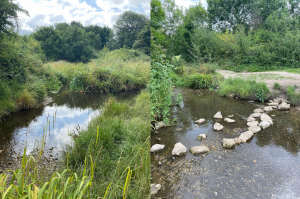
Image: River Mole at Leatherhead. Jim Linwood. License details

Related Reports:

Thames Water left human waste to fester

Thames Water rebate

Thames Water among worst in country


Gatwick Airport Expansion

The six-month inquiry into Gatwick Airport’s plan to double capacity is underway.

Airport chiefs at the country’s second busiest airport want to modify its northern runway so that it can increase passenger numbers to about 75 million a year on 386,000 flights.

It says this will help minimise delays, bring in about £1billion into the region’s economy every year, and create 14,000 jobs – all while staying within agreed noise levels.

It also has a carbon action plan for how the airport will be net zero for its own emissions by 2030.

Opponents, who staged a protest outside the Crawley hearing ahead of its February 27 opening, said the expansion will “have a devastating impact on both people’s lives and the environment.”

Also opposing the current plan is a coalition of 10 councils in Surrey, Kent, East Sussex that surround Gatwick.

Sally Pavey, chairs the Campaign Against Gatwick Noise Emissions (CAGNE) an umbrella aviation community and environment group for Sussex, Surrey, and Kent. 

She said: “If this application to build a new runway is permitted, it will have a devastating impact on both people’s lives and the environment.

“That is why it is so important that CAGNE are here – not just today, but every day of the hearing, with our qualified team of Kings Council, plus surface transport, aviation noise and air quality expert team, as well as supporting non-government organisations tackling the subject of jet zero and the environmental destruction of our planet.  

“This fight is not over until the Secretary of State for Transport makes his decision.  

“Whatever political party will be in power then, come elections, local or general, we hope that residents here today will reflect their feelings when it comes to the ballot box and the impact that aviation is having on our planet. 

“We could not have put together such a strong team, acting for communities and the planet, if residents had not put their hands deep in their pockets and donated to CAGNE.”

Crawley Borough Council, East Sussex County Council, Horsham District Council, Kent County Council, Mid Sussex District Council, Mole Valley District Council, Reigate and Banstead Borough Council, Surrey County Council, Tandridge District Council, and West Sussex County Council make up the consortium of councils opposing the plan.

They are concerned the proposals, as they stand,  fail to provide sufficient controls to noise and air quality levels are not exceeded.

The councils are also worried about how a doubling of passenger numbers would impact the transport network – and over the impact the huge surge would have on meeting sustainability needs.

The statement read: “We have been working together to ensure that if the proposal were to be approved, the required controls, mitigations and where appropriate, compensations are put in place to limit the environmental impacts and to maximise the economic and community benefits that should be sought from such development.”

Gatwick Airport said it was not taking part in any interviews.

Related Reports:

Gatwick 2nd runway sneaking in?

Gatwick expansion plans revealed

Gatwick to get 2nd runway?


M25 diversion cost me £12.50 ULEZ charge

Driven to despair and a £12.50 charge, Dorset pensioner complains to Transport for London for inadequate signs before the ULEZ charging A243 at the Hook Junction with the A3. She thanks Epsom and Ewell Times for a better explanation of the zone than provided by TfL.

In fact the TfL explanation has some clarity:

“Rushett Lane is outside the ULEZ. At the junction with the A243, the A243 going north is inside the zone, while going south it is outside the zone. Fairoak Lane is outside the zone.”

Moreover, Surrey County Council, as an Highway Authority, has indicated an unwillingness to cooperate with the warning signage.

Here is her story of woe:

Dear Editor,

I found clearer information from your on-line newspaper than I could from the TfL website.

It’s probably a waste of breath on my part but if there is a local battle in the Epsom area to have this phallic extension of the Ulez zone sticking out into Surrey, then count me in. I presume it’s to clobber all the tourists going to Chessington Zoo!

On Saturday February 3rd I paid the Ulez congestion charge because I believe my husband and I accidentally drove into the Ulez zone at Hook Junction on the A3 in Surrey without realising it. We had driven up from Dorset on Friday to East Molesey which is outside the Ulez Zone. Then on Saturday morning I took the train from Hampton Court to Vauxhall to pick up my younger son’s dog. However there was chaos on the railway in that area due to trespassers on the line and after several hours of delays I finally got a train back to Esher (instead of Hampton Court) where my husband picked me up. We don’t normally travel into East Molesey via Esher but was assured by my son that it was outside the Ulez Zone. At the Scilly Isles Roundabout we became confused by signs telling us to follow M25 diversion and joined the Kingston By Pass for a short distance which swept us into the Hook Junction interchange. We did not see any Ulez signs en route so just followed the M25 diversion signs which led us down the A243 past Chessington Zoo and eventually to the M25. We later discovered this was to help motorists avoid extreme traffic congestion at Junction 10 on the M25/A3.

When we got home I checked the Ulez map on my computer because we had heard about an extension of the Ulez zone into Surrey from the Surbiton area and while the online maps lack detail it seemed to me that a short length of the A243 Hook Road running south i.e. away from London has been placed inside the Ulez zone, and by following the diversion signs we had accidentally entered the zone for a mile or so.

I have had no choice but to pay the congestion charge or risk being fined, but I do think it is unfair to place M25 diversion signs on major roundabouts without warning that the diversion can take you through a section of the Ulez zone that isn’t even in Greater London.

Out of London visiting pensioners like ourselves, still driving government recommended diesel cars, rely on clear road signs, not trying to read an almost illegible Ulez on-line map on an iPhone.

Yours.

Mrs Geraldine Osment

Related reports:

Signs of Surrey resistance to ULEZ continue

London Mayor confirms drive of ULEZ to Epsom border. ULEZ explainer.

High Court gives ULEZ the green light to Epsom’s borders

ULEZ court challenge begins


“Heat and Dust” epic in Epsom

You don’t need to read or watch the historical romantic drama set in the British Raj epoch in India by Ruth Prawer Jhabvala. The Chalk Pit off College Road Epsom has been the source of noise and dust generated heated debate in Epsom and Ewell Council for years.

Conservative Councillors for Horton, Bernie Muir and Kieran Persand, in July proposed the following motion to full Council:

“That this council mandates officers to install professional noise measurement equipment around the Chalk Pit site in College Road, Epsom, to leave that equipment in place for a minimum period of three months, and to respond to any breaches of noise regulations on the site with the imposition of a noise abatement order on the landowner and any identified operators responsible for the excess noise.”

The full Council referred the matter to the Environment Committee to resolve.

The Chalk Pit site is the centre of a fiendishly complex plot of overlapping planning laws, regulations and three different law enforcement authorities: The Environment Agency (EA), Surrey County Council and Epsom and Ewell Borough Council.

In a detailed report to Councillors of the Environment Committee of Epsom and Ewell, sitting on Tuesday 23rd January, officers attempted to explain.

Here is a summary of that report:


Background:

The Chalk Pit site in College Road, Epsom, has been used for light industrial purposes for around 40 years.  Businesses operating at the site include Skip It, Reston Waste, and a coach company, among others.  Noise and dust emissions from various activities, such as trommel processing, materials handling, and vehicle movements, have led to increased complaints from nearby residents since 2021.

Complaints and Regulatory Responsibilities: 

Prior to 2021, complaints were minimal, but they increased significantly in recent years.  Regulatory responsibilities involve collaboration between the local authority, Environment Agency (EA), and planning authorities (Surrey County Council  SCC and Epsom and Ewell Borough Council  EEBC). 

Complaints related to EA regulated processes are directed to the EA, while non-regulated sources fall under the local authority’s jurisdiction.

Council’s Response to Complaints:

The council’s Environmental Health service conducted an extensive investigation, involving in person monitoring, remote monitoring, and the installation of CCTV.  Despite the intensive investigation, a June 2022 assessment did not provide sufficient evidence to issue an abatement notice. A renewed effort in October 2023 identified a specific nuisance related to a particular piece of machinery, leading to the issuance of an abatement notice.

Enforcement Actions:

The council issued Community Protection Warning Notices to the landowner and various users, mandating specific actions.  Legal steps included a notice requiring a skip company to cease operations on the site.  Ongoing monitoring will determine compliance, potentially leading to further enforcement, including prosecution.

Financial Implications:

The investigation has incurred costs of £5,600. Potential future costs for further investigations, legal proceedings, and appellant expenses may reach £140,000.  The council is exploring funding options within existing budgets and may seek additional funding from reserves.

Professional Opinion and Future Actions:

The report suggests that despite previous efforts, there was insufficient evidence for an abatement notice until October 2023.  Ongoing construction may impact noise levels, but relevant planning conditions could help control noise.  The burden is on the council to demonstrate statutory nuisance, and further evidence may be required for potential legal proceedings.

The report recommends that the Council continues to monitor and take necessary actions to address the noise and dust issues at the Chalk Pit site.


Cllr Muir opened the debate: “I’m alarmed that there is even a suggestion of walking away from funding and monitoring the Chalk Pit against the recommendations of the last Environment Committee and the previous Strategy and Resources Committee. The Chalk Pit site has now increased its activity with another major operator, Reston. Skip-it has not yet completed their building, with major doubts that the building will stop the problems. Anyway, there is still nuisance noise and potential hazard of dust. The Environmental Agency stipulates this operation needs to be enclosed to protect residents. Also, no building will address the noise and dust of skip and truck movements, which is excessive given the massive exponential rise in truck movements. Residents still complain about noise experienced outside permitted hours, starting any time from 5:30 in the morning. It is inevitable that noise will continue.”

She added: “On a personal level, I would not be able to live under these conditions and that they have been subjected to for the last three years. I have sat in on all the borough meetings, which thus far have done little more than kick the can down the road.”

Cllr. Steven McCormick (RA Woodcote and Langley) said: “the Chalk Pit situation is something that I’ve been involved with, and fellow councillors and I have been involved in trying to find a resolution for a significant period of time. It gets bounced around between the different agencies, and there is no light at the end of the tunnel for our residents, which is deeply upsetting.” He added: ” We are primarily a Resident Association Council; we are driven to support our residents and represent our residents, and if we don’t do this, I think we would be failing significantly in our duty.”

Cllr. Julie Morris (LibDem College) said: “It’s a complicated situation, not helped by years of everybody trying to dodge the bullet, really. But we do understand, I think, that the Strategy and Resources Committee are taking the planning breaches quite seriously now, which is good news. There is now light pollution to add to the noise and the dust, isn’t there, because of the various hours of operation and some hefty bulbs that they use to be able to see down there. We can’t just not do anything.”

The debate continued with detailed discussion of the nuisances complained of and the financial implications of the costs of enforcement.

After a lengthy and at times heated debate the Environment Committee finally resolved to “Submit a request to the Strategy and Resources Committee of the Council that funding be allocated from limited Council reserves to instruct external noise consultants to conduct a fresh investigation based upon the activities on the site and that significant complaints continue despite the buildings being constructed and commissioned. It is anticipated that further investigations may require a substantial financial commitment of taxpayer’s funds of up to £140,000”.

Related reports:

Chalk Pit debate deferred by late abatement

Will the dust ever settle on Chalk Pit conflict?

Image – Nick Kenrick – CC BY-NC-SA 2.0 DEED

Page 1
© 2021-2025. No content may be copied without the permission of Epsom and Ewell Times Ltd.
Registered office: Upper Chambers, 7 Waterloo Road, Epsom KT19 8AY