Epsom and Ewell Times
8th October 2026

ISSN, LDRS and IMPRESS logos

Prime Minister and Health Secretary Visit Epsom Hospital to Unveil NHS Recovery Blueprint

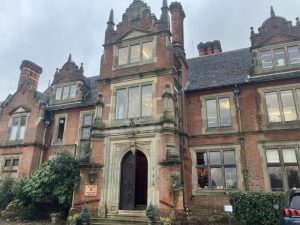
Epsom Hospital

Epsom Hospital played host to Prime Minister Sir Keir Starmer and Health Secretary Wes Streeting today as they unveiled a significant national plan aimed at tackling the extensive backlog of NHS tests, checks, and treatments. The visit highlighted the government’s strategy to expand healthcare capacity, streamline services, and reduce waiting times for millions of patients across the UK.

The blueprint includes a major partnership between the NHS and the private healthcare sector, intended to make additional hospital facilities, equipment, and staffing resources available. Prime Minister Starmer emphasized that healthcare reform must be “totally unburdened by dogma” and that prioritising patient outcomes over ideological constraints was essential.

The government announced plans for an extra 450,000 appointments for diagnostic tests and health checks, with local diagnostic centres operating 12 hours a day, seven days a week. GPs will have increased power to make direct referrals to these centres, reducing delays caused by administrative hurdles. Furthermore, 14 new surgical hubs will be established to handle less complex procedures, easing the strain on general hospital facilities.

Health Secretary Wes Streeting highlighted the urgency of these measures, pointing out that the current NHS backlog stands at 7.6 million patients awaiting elective treatments. He stressed that these reforms aim to address not only the backlog but also improve efficiency and convenience for patients.

Amanda Pritchard, Chief Executive of NHS England, expressed confidence in the proposed measures, stating that they would enable the NHS to deliver millions more tests, checks, and treatments annually, while also empowering patients and local healthcare providers.

While the national focus was clear, local concerns were also raised. Liberal Democrat MP for Epsom & Ewell, Helen Maguire, issued a statement welcoming the measures but stressing the ongoing need for infrastructure improvements at Epsom and St Helier Hospitals. She reiterated her campaign for the long-awaited Specialist Emergency Care Hospital in Sutton to be prioritised.

Cllr Kate Chinn, (Court Ward) Labour group leader on Epsom and Ewell Borough Council said: “It was great to see Keir in Epsom today, highlighting the great work done at SWLEOC and setting out Labour’s plans to cut NHS waiting lists. People in Epsom and Ewell know how the NHS is struggling after 14 years of Tory neglect and false promises of a badly-needed new hospital by 2030. Labour, which created the NHS, is determined to rebuild it, but it will not be an easy job.”

As the government pushes forward with its ambitious NHS recovery plan, the people of Epsom will be watching closely to see how these national promises translate into real-world improvements at their local hospital.

Related reports:

Planning buses not missing them says Epsom’s MP

Epsom and St Helier Hospitals in Desperate Need of Repairs

Public meeting about Epsom Hospital future


Surrey’s Conservative leader wants to postpone May’s poll reckoning

Tim Oliver Surrey County Council leader - Surrey Live

The leader of Surrey County Council is set to write to the Government calling for the 2025 elections to be postponed in order to allow authorities to focus on merging under devolution plans. In December last year the Government announced its vision to merge councils in Surrey and get rid of its 11 boroughs and districts. There would also be a directly elected mayor.

Councillor Tim Oliver plans to formally ask the government to postpone county elections until May 2026 to give the councils time to “put together proposals for local government reform necessary to unlock further devolution for Surrey.”

Not everyone has welcomed the delay with Surrey Heath Borough Council set to discuss a motion rejecting the county council leader’s proposals and allow the May 2025 poll to go ahead “in the interest of democracy and hearing the resident’s voice.”

Devolution plans are part of sweeping changes to how services are run as Downing Street looks to reshape local government.

Surrey currently operates under a two tier system with the county council overseeing things such as education, transport and fire with the boroughs and districts focused local planning matters, refuse collection and housing.

Devolution would do away with this system and instead create single unitary authorities, arguing it is more cost-effective.

In a draft letter set to be approved at an extraordinary meeting next week, Cllr Oliver writes that he shares the ambitions for boosting the country’s economic prospects and reforms to strengthen the efficiency and effectiveness of public services.

He said it was clear that reforming local government would unlock the full benefits of further devolution for the county.

The letter reads: “The current two-tier structure of local government in Surrey, comprising 12 sovereign local authorities, is fragmented and in a number of areas inefficient which inevitably diverts resources away from delivering the services that residents rightly expect.

“I believe reorganisation would provide more streamlined and cost-effective services for Surrey, enabling us to achieve further efficiencies and deliver better outcomes for our residents and communities.

“Local government reorganisation is a crucial stepping stone to further devolution for Surrey, to enable our communities to take more control of their own destinies.”

Cllr Oliver said the county already delivered more than £50 billion in gross value added every year, but further and deeper devolution could lead to even better returns.

It adds: “I am therefore writing to ask you to exercise your ministerial powers to lay the necessary legislation to postpone the county council elections in Surrey, which are due to take place in May 2025.

This will give us the time to work with the leaders of Surrey’s district and borough councils to put together proposals for local government reform that are necessary to unlock further devolution for Surrey.”

New unitary elections could then take place in 2026, and a mayoral election in 2027.

He argues that the delay would also allow time to determine how to deal with the “significant financial risk of the level of debt currently held across the Surrey local government footprint.”

Woking Borough Council is currently bankrupt with deficit of more than £1billion and debts of about £2billion, while Surrey County Council and Spelthorne Borough Council both have debts of more than £1billion.

Any proposals, Cllr Oliver adds, will need to adequately consider how to ensure the sustainable operation of any authority in the absence of exceptional financial support from the Government or a level of write-off.

Timetable for Devolution 

10 January 2025 Letter submitted to Minister of State requesting election postponement 
Before March 2025  Minister’s response to letter received 
March 2025  Interim Local Government Reorganisation (LGR) proposal submitted to government 
May 2025  Full LGR proposal submitted to government 
May – June 2025  Government evaluates proposal(s) received for LGR and makes a decision on whether to proceed on  single proposal, or to consult further on one or more proposals
July 2025  Government consultation with affected bodies on LGR proposal(s) 
Autumn 2025  Government decision on LGR anticipated, which begins statutory process to establish new council(s) 
January 2026  Parliamentary process begins to lay Statutory Instruments 
May 2026  Elections to shadow unitary authority/ies 
Spring 2027 New unitary/ies ‘go live’ 
Spring 2027 or 2028 Mayoral elections and mayoral strategic authority ‘go live’, with the preparations for the establishment of the Mayoral Strategic Authority (MSA) taking place throughout 2026/27, or Surrey joins MSA with neighbours

Related reports:

Tiers to be shed if Epsom and Ewell loses its Borough Council?

Image: Tim Oliver – Leader of Surrey County Council, Woodhatch Place, Cockshot Hill, Reigate. GL


Special case for VAT exemption for special education needs?

Outside Moon Hall School, Reigate. (Credit: Emily Dalton/LDRS)

Private schools are “not a lifestyle choice but a necessity” for children with special educational needs (SEN), argues the headteacher of an independent school in Reigate.

Tuition fees are expected to soar from Wednesday January 1, 2025 as the government is scrapping the tax exemption on private schools across the country. The tax is expected to bring £1.7 billion a year, according to the Treasury.

But Mrs Michelle Catterson, head of Moon Hall School, a Specialist Dyslexia school, said: “If you can afford to pay, you should. But there should be exemptions for SEN kids.”

Around 200 children between the ages of seven and 16 attend Moon Hall School- all of whom have been diagnosed primarily with dyslexia, a learning condition that can cause difficulty with reading, writing and spelling. Moon Hall provides a student-to-staff ratio of about 12:1 so pupils get extra support and adapt to meet their learning needs.

Mrs Catterson explained her students with SEN, 70 per cent of whom have an Education and Health Care Plan (EHCP), often cannot have their needs met locally in state schools, so there is “no viable alternative” for education. The Local Authority, like Surrey County Council, will pay for specialist provision in these instances.

“We offer local authorities good value for money,” Mrs Catterson claimed, with most of the school’s GCSE results boasting higher than average.

The head teacher said she believed “100 per cent of the kids [at the school] have SEN” but because of long and complicated process of applying for an EHCP, many parents often “give up” on the process. Instead, around 30 per cent of students pay for the specialist education.

Fees used to start at £7,505 per term for a child in year 7, according to the school’s prospectus. But now, parents could be set back £10,424. The Department for Education has said it does not expect school fees to increase by 20 per cent as schools do not pass VAT onto parents. But as tuition fees is Moon Hall’s only source of income, Mrs Catterson argued that they have no choice. “Small, specialist settings like [Moon Hall] simply cannot absorb the additional costs imposed by VAT,” she said.

Most Children with EHCPs have their needs met within the state sectors, according to government officials. If an EHCP assessment concludes a child can only be supported in a private school, the local authority funds that child’s place and can reclaim the VAT they pay.

Despite the expensive tuition fees, the headteacher claimed Moon Hall is “not an affluent school” and the government will find “no swimming pools” on the grounds. As a charity, any extra income is put back into the school by spending on staff to help the students, according to Mrs Catterson.

Impact on the parents

“It’s really short-sighted,” said Mrs Catterson. The head claimed adding VAT to SEN private school fees will mean more parents will apply for an EHCP, causing further backlog and creating extra costs to the government, which will need to provide for those needs.

Alternatively, some parents take on two jobs to fund their children through private school. Mrs Catterson stressed it would be an “awful situation” if a “settled, happy child, making good progress” was moved to the state sector where their needs cannot be supported.

Chris Coghlan MP for Dorking and Horley, said: “Moon Hall provides an outstanding education for children with special educational needs in Surrey. Adding VAT to school fees will place an unbearable strain on families who already make significant sacrifices to afford them. The Government must exempt specialist schools like Moon Hall from VAT to ensure children with special needs can continue to access the support and education they deserve.”

“Punish independent schools”

Built in 1863, Moon Hall is a grade II-listed building which was purchased by the founders of the dyslexic school and repurposed as an educational building some forty years ago. Although a grand historical building, repairs and maintenance costs to the site are almost constant- Mrs Catterson said the roof needs replacing which is expected to cost £1.6m, even before pricey specialist chimney repairs.

Not only is the school facing the VAT axe, Moon Hall will have to wrestle with changes in national insurance and minimum wage increases like many other charities. The head told SurreyLive she “still doesn’t know what the true figure will do” to the school and where it can find the extra money. Mrs Catterson said: “It feels like the Labour government is trying to punish independent schools.”

Rebuilding “confidence and trust”

A government spokesperson said: “Ending tax breaks on private schools will help raise additional funds to break down barriers to opportunity and support the 94 per cent of pupils who attend state schools to achieve and thrive including those with SEND.

“Pupils with the most acute needs will not be impacted by this policy. Work has already begun to rebuild families’ confidence in and reform the broken SEND system we inherited. The Budget invested £1b extra in day-to-day provision and earlier this month £740m was directed to support local authorities in creating more specialist places in mainstream schools.”

They added: “We are committed to improving inclusivity and expertise in mainstream schools, and ensuring special schools cater to those with the most complex needs, restoring parents’ trust that their child will get the support they need.”

Related reports:

Surrey Tory MPs against school fees VAT

Taxing question for Surrey’s private schools

Image: Outside Moon Hall School, Reigate. (Credit: Emily Dalton/LDRS)


Ahmadiyya Youth Clean the Streets of Epsom to Welcome the New Year

Ahmadiyya youth in Epsom Square

By Luqman Ahmed
Leader of the Ahmadiyya Muslim Youth Association Epsom

As the first light of the new year stretched across the horizon, a group of volunteers from the Ahmadiyya Muslim Youth Association (AMYA) in Epsom began their day armed not with party hats or confetti, but with gloves, litter picking sticks, and determination. While others were still nestled in beds, dreaming of resolutions, this remarkable group was out in the cold, rainy and windy morning, embodying their motto: Love for All, Hatred for None.

The volunteers worked in harmony to breathe new life into their community. With every littered bottle picked up and every forgotten candy wrapper swept away, the streets seemed to exhale a sigh of relief. It was as if the city, shedding its New Year’s Eve revelry, was donning a fresh, clean cloak to greet 2025.

The act itself was simple but profound. “We do this every year,” said 30-year-old volunteer Ahmad Iqbal Ch, a doctor by profession. “It’s our way of giving back and starting the year with positivity.”

For the Ahmadiyya Muslim Youth Organisation, the clean-up event is more than just an exercise in tidiness; it finds its roots in the teachings of Islam, where the Holy Prophet (pbuh) told his followers that half of their faith is cleanliness and that removing even a stone out of someone’s way is considered charity.

Members of the public, on their way to work in the wet and windy weather, stopped to thank the volunteers and wished them all a happy new year.

Three core principles guided the AMYA team that morning: humility, selflessness, and service. The humility to pick up after others, the selflessness to sacrifice a warm morning at home, and the service to a community they loved deeply. Their efforts painted a vivid picture of the human spirit at its best—undaunted by chill or challenge.

As the volunteers finished, one could almost hear the streets murmuring in gratitude, the trees nodding in approval, and the winds carrying their story to distant corners. The Ahmadiyya Muslim Youth Association had done more than clean up—they had planted seeds of hope, showing that even small acts of service can sweep away the remnants of the past and make way for a brighter, better future.

Indeed, as the Borough slept through its hangover, a group of quiet heroes ensured that its awakening would be one of cleanliness, care, and community—a new year, truly renewed.


Epsom & Ewell Faces Tight Constraints in 25/26 Government settlement

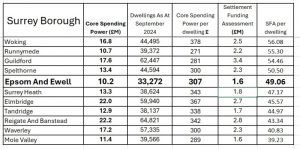
11 Surrey boroughs table of HMG funding

Epsom & Ewell Borough Council has received its provisional financial settlement for 2025/26, and while the figures align with expectations, they highlight ongoing financial pressures on local services. The settlement forms part of the UK Government’s wider local authority funding announcement, which has delivered mixed outcomes across Surrey’s district and borough councils.

Epsom & Ewell’s Settlement Overview

According to the latest figures, Epsom & Ewell’s Core Spending Power for 2025/26 is projected at £10.23 million, equating to £307 per dwelling. This places Epsom & Ewell below several neighbouring boroughs, including Woking (£378 per dwelling) and Elmbridge (£367 per dwelling), but slightly above Waverley (£300 per dwelling).

The Settlement Funding Assessment (SFA), which includes central government grants and retained business rates, stands at £1.63 million. This figure underscores the limited financial flexibility available to the council, particularly given rising costs and increasing service demands.

The Funding Context

The settlement includes a modest contribution from the New Homes Bonus, with Epsom & Ewell receiving only £6,160. This pales in comparison to Runnymede (£774,587) and Guildford (£614,903), reflecting the borough’s slower rate of housing growth.

A Challenging Year Ahead

The provisional settlement aligns with broader trends across Surrey, where councils have been advised to continue delivering “high levels of efficiency” to maintain balanced budgets. Surrey County Council, facing similar pressures, acknowledged the settlement as expected but warned of the continued uncertainty surrounding medium-term funding.

Councillor David Lewis, Surrey County Council’s cabinet member for finance and resources, noted: “Councils across the country continue to face a very challenging financial future. Uncertainty on funding into the medium term, coupled with high prices and increased demand, means high levels of efficiencies continue to be required in order to balance budgets.”

Limited Relief from Government

While councils such as Mole Valley have benefitted from additional Government grants targeting homelessness and recycling services, Epsom & Ewell has not been as fortunate. With no significant uplift in funding and reliance on reserves to bridge financial gaps, the council faces tough decisions in the coming financial year.

Furthermore, the funding floor mechanism has provided limited relief, ensuring that Epsom & Ewell does not see a drastic year-on-year funding drop. However, without long-term certainty or multi-year settlements, financial planning remains a significant challenge.

Looking Forward

As the Government promises to ‘fix the foundations of local government’ from 2026-27 onwards, Epsom & Ewell will need to rely on prudent financial management and creative revenue generation strategies to maintain essential services.

Residents can expect continued fiscal caution from the council as it navigates rising costs, growing demand for services, and ongoing funding uncertainty. The final settlement figures are expected to be confirmed early in the new year, and until then, the council’s budget planners remain in a holding pattern.

Related reports:

Tiers to be shed if Epsom and Ewell loses its Borough Council?

Examination of a Surrey Borough’s 2nd highest UK debt

What cuts to Surrey County Council services are you prepared for?


Epsom Choral Society carols for cardiac charity

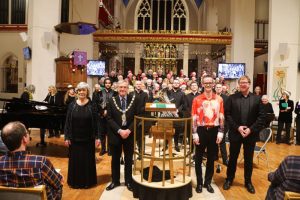
Epsom Choral Society with Mayor and Mayoress

Epsom Choral Society presented its ever-popular annual Christmas Concert on Saturday 21st December at St Martin’s Church in Epsom. Always a highlight of the festive season, this year’s concert was a joyful celebration filled with music, readings, and plenty of audience participation. The concert was attended by the Worshipful, the Mayor of Epsom & Ewell, and the Lady Mayoress, Steve and Carol Bridger.

The choir welcomed back Connaught Brass, one of the UK’s leading brass ensembles, known for their vibrant performances across the UK and Europe. They brought the true spirit of Christmas through their entertaining instrumental pieces and in their accompaniments to the traditional favourites.

This year’s programme featured a variety of carols and Christmas songs performed by the choir, accompanied by Marion Lea on the piano and Ben Lewis-Smith on the organ as well as seasonal brass arrangements and uplifting Christmas readings. As always, the audience had the opportunity to join in singing much-loved traditional carols, and filled the church with the warmth and joy of the season.

In keeping with the Christmas spirit of giving, there was an exit collection in aid of the charity Cardiac Risk in the Young (CRY) where over £650 was raised. CRY works to reduce the frequency of young sudden cardiac deaths through vital awareness, screening, and research, making this a particularly meaningful way to support those in need during the holiday season.


Epsom business contact with the King warranted

Cirrus team

Epsom based since 2013 Cirrus, the leading provider of contact centre software, is proud to announce it has been granted a Royal Warrant of Appointment by His Majesty King Charles III. The grants were made to 386 companies previously holding a Royal Warrant of Appointment from Queen Elizabeth II, as well as 7 companies with an established and ongoing trading relationship with HM Queen Camilla.

This prestigious recognition marks a reappointment for Cirrus, building on the acknowledgement previously granted by Her late Majesty The Queen for its outstanding service to the Royal Household.

Cirrus has built a strong reputation for providing innovative, cloud-based contact centre solutions that help organisations improve customer engagement and service delivery. This Royal Warrant recognises the company’s continued excellence in supporting the Royal Collection Trust.

Jason Roos, Founder and CEO of Cirrus, shared: “It’s an immense honour for Cirrus to receive this recognition with a Royal Warrant. This achievement reflects the hard work and dedication of our team. We’ve always focused on delivering solutions that make a real impact, and this recognition from His Majesty’s Household validates that effort in the most meaningful way.”

The Royal Warrant of Appointment is awarded to businesses that have supplied goods or services to the Royal Household for at least five years. This announcement also highlights Cirrus’ ongoing commitment to supporting local communities, while maintaining the highest environmental standards. Cirrus joins the ranks of household names such as BT and Samsung.

“Looking back, it’s incredible to see how far we’ve come. And looking ahead, we’re more motivated than ever to keep pushing the boundaries of what we can achieve. This Royal Warrant is a recognition of our daily efforts, and we’re excited to continue collaborating with fantastic partners and clients,” Roos added.

In the past year, Cirrus has continued to thrive, securing new clients across sectors such as public services, healthcare, and retail. The company’s solutions are trusted by organisations including Nisbets, Premium Credit, and Northern Ireland Water.


After 12 wins in a run Sutton & Epsom fall at the thirteenth

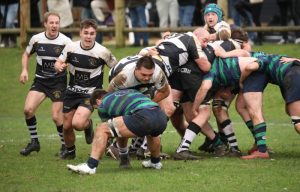
Rugby action

Old Reigatian 21 Sutton & Epsom RFC 15. Saturday 21st December.

Midweek illnesses, at one stage, threatened to derail Sutton selection for the last league game in 2024. Ultimately the usual array of injuries, concussion protocols and Saturnalian celebrations led to only four changes from the squad that tamed Beckenham. In September the two sides thrilled Rugby Lane with Old Reigatian holding on to win 48-43. Since that day OR have only enjoyed two more wins and even more remarkably S&E have not indulged in the frippery of a solitary further bonus point. Entering Round 13 after six wins on the spin would it be ‘Seventh Heaven’ or ‘A Game Too Far’ for the Black & Whites? In another enthralling and entertaining encounter the hosts triumphed 21-15 completing the season double over Sutton.

Despite the recent meteorological travails the pitch was in pristine condition and full credit to all those people who work tirelessly to make Geoffrey Knight Fields such an excellent venue. Though pleasantly moist under foot, rather than muddy, there was a strong diagonal wind and the ominous prospect of impending rain. Almost at once the wind, favouring the hosts, demonstrated its venomous teeth by sweeping a Reigatian kick comfortably beyond the playing parameters and play resumed with a Sutton scrum in the hosts’ half. Sutton opened their account after five minutes. A powerful scrum on halfway was followed by a Bibby break and a Rea run. Fleet-footed fly-half Freddy Bunting looped around and received the ball to dash into the corner. The captain, making light of the elements, added the conversion to his try for a 7-0 advantage.

From the restart the visitors were on the attack again with Ben Tame carrying out of the 22 to link with Josh Rea who fed Dan Jones who kicked ahead. Sutton stole the line out and were awarded a penalty. Freddy Bunting opted for the three points and extended the lead to 10-0. Perhaps Old Reigatian feeling the pressure of having the wind started to run from everywhere rather than exploiting the conditions with the boot. Errors mounted and Sutton were in the ascendancy and pressing for another try. Gareth O’Brien’s angled run was met by a fabulous try-saving tackle on the quarter hour. At the end of the first quarter the fluent play from the Rugby Lane team was rewarded. The referee played advantage and the ball was flung out to the right touchline. Angus Findlay did well to take the high pass and then excelled himself with a perfect inside pass to Rob Hegarty who dived into the corner. Their followed a moment or three of confusion. Freddy Bunting’s effort from the extremities split the jury if not the uprights. One flag was raised, the other remained disinterested and the scoreboard indicated 15-0. Then it became 17-0 before finally resting with 15 points to Sutton & Epsom.

Sutton’s play in the first quarter bore all the hallmarks of a side buoyed by their winning streak and confident in their method. The visitors then gave the hosts a foothold in the match. S&E overthrew their lineout ball 10 metres from their line. Jude McRobbie accepted the festive offering and had the awareness to exploit the situation and strode home for the try. Tom Baldwin navigated the wind with aplomb to see the home XV trail 7-15. This was followed by a frenetic period of play. The reinvigorated Reigatian team launched an ominous attack only to be undone by an Adam Bibby interception. The centre was hauled down 35 metres out and the ball was run back with an impressive counter until it was turned over and returned with interest. It was breathless stuff for players and spectators alike. Despite the best endeavours of all concerned the half ended with no further additions, or reductions, to the scoreboard. Sutton, who had dominated the early exchanges, led 15-7 but Reigatian were right back in the contest as the sides retired to the warmth of the dressing rooms to contemplate their strategy for the second period.

Old Reigatian began the second half in splendid fashion creating two chances in as many minutes. The first was thwarted by an errant pass and the second by an interception. Sutton threatened to score with a wonderful 60-metre burst by Adam Bibby but he failed to connect with the lone support of Matt Symonds. OR stepped up the pressure and were aided by a flurry of S&E indiscretions that did not go unmissed by Mr Stewart. Following considerable pressure and multiple advantages Old Reigatian deservedly scored. With the addition of the Baldwin conversion the Black & Whites lead had shrunk to a single point as they held a 15-14 advantage. In addition to his exemplary place-kicking Tom Baldwin was becoming increasingly influential with ball in hand as he exploited the extra time and space he was finding with numerous jinking breaks that had Sutton scrambling in retreat.

Driving drizzle descended for the last half hour as conditions for players and spectators deteriorated rapidly. Scrum-half Ali Webb made a fine break as the hosts started to dominate proceedings. As the game entered the final quarter Sutton & Epsom received an additional burden when Mr Stewart correctly issued a yellow card to Dan Jones to reduce the visitors to 14 men when the flanker failed to avoid the airborne catcher. At once slick handling and ruthless efficiency saw winger Jonny Bridges cross the whitewash for his side’s third try. Baldwin maintained his 100% record and the Geoffrey Knight Fields’ fans rose as one to celebrate the 21-15 lead. The fifteen-point deficit was now a distant memory.

However, this was familiar territory for the Black & Whites who have become remarkably proficient in coming out on top in close encounters of the rugby kind. They looked poised to score through their pack as they advanced to the line only to concede a penalty. In the blink of an eye the visitors were back in their 22 and grateful that skipper Reilly Franklin-Talbot dropped the ball so denying his side the chance to increase their lead. Sutton’s scrambling defence was being tested to the limits. As usual Steve Munford was to the fore but perhaps the best tackle came from Angus Findlay swooping off his wing to thwart another opportunity. With five minutes left the visiting forwards looked like they were going to add a third try. Once more they were denied by the whistle. This time the Rugby Lane team could not edge out their opponent at the death. Old Reigatian held on for a 21-15 victory. It was a well-deserved success as Old Reigatian had created more opportunities and played the more eye-catching rugby in the second half.

Sutton & Epsom
O’Brien, Symonds, Rea, Bibby, Findlay, Bunting ©, Munford, Johnson, Lennie, Boaden, Glanville, McTaggart, Tame, Jones & Hegarty.
Replacements: Mount, Davies & Hilton.

Old Reigatian:
Woodford, Briggs, Allen, Baldwin, Parker, Holder, Webb, Marshall, Nestor, Lee, Grant, Franklin-Talbot ©, McRobbie, Goodwin & Travers.
Replacements: Garrec, Cox & Overtoom.

Photo credit Robin Kennedy


Surrey prison failed IPP prisoner

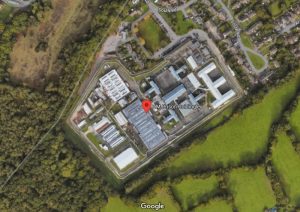
Aerial HMP Coldingley. Google

Staff at a Surrey prison failed to get medical attention for a prisoner who was reportedly found “naked on all fours, and barking like a dog” before he took his own life. Haydar Jefferies, 51, died in hospital on March 5 2023, after trying to kill himself in his cell at HMP Coldingley, Woking, a few days earlier. 

An inquest jury found scores of failures contributed to Mr Jefferies’ death, amounting to neglect. Mr Jefferies’ mental health drastically deteriorated while he was waiting for parole and this was left untreated by staff responsible for his care, according to his family’s lawyers. The 51-year-old pub manager attempted suicide the day before his long-awaited parole hearing. 

After being found guilty of an assault offence in 2006, Mr Jefferies served seven years of an Imprisonment for Public Protection (IPP) sentence, given to people considered ‘dangerous’ but the offence did not merit a life sentence.

Nearly ten years after his crime, Mr Jefferies was then recalled and sent back to prison in January 2022 on his IPP sentence. The allegation against Mr Jefferies was reportedly not backed up and the police decided no further action would be taken, within three months after being sent back to prison. 

But due to the nature of the IPP sentence and the delays in the Parole Board decision-making, Mr Jefferies was forced to stay at the prison despite all charges being dropped nine months prior.

A Ministry of Justice spokesperson said: “Our thoughts remain with Haydar Jeffries’ friends and family. As with all deaths in custody, the Prison and Probation Ombudsman are investigating and we will respond to their report in due course.”

By the end of February 2023, Mr Jefferies was acutely psychotic, found by officers in his cell flushing his head down the toilet, naked on all fours, and barking like a dog. 

Despite custodial staff noting major concerns over his mental health, they allegedly failed to seek any medical attention or even notify health care providers, according to the family’s lawyers Hodge Jones & Allen. Custodial staff allegedly failed to place him on constant supervision and/or take him to an external place of safety. 

The jury duly found that Mr Jefferies’ IPP status and the delays in his parole hearing materially contributed to the development of his subsequent psychosis, Hodge Jones & Allen solicitors said.

Between his initial release and recall, Mr Jefferies had tried to rebuild his life, setting up his own pub and B&B with his husband, who sadly passed away in 2021.

Zhora Jefferies, Haydar’s mother, said: “After creating a wonderful life in the community, it is devastating to have witnessed how Haydar’s life was completely destroyed by the nature of his IPP sentence and the extensive delays he experienced when waiting to be released from prison.

“We had to watch our beloved son, brother and father succumb to the fear and paranoia that he was suffering with in the final weeks of his life. We, and Haydar himself, were all crying out for help and it was falling on deaf ears.

“Nothing can be done to bring Haydar back but our biggest hope is that lessons can be learned from his experience. Haydar brought so much love to our family and we will always be grateful for the time we had with him.”

A few months into Mr Jefferies’ recall to HMP Bullingdon, in early 2022, it was confirmed the allegations against him were no longer being pursued. But he remained in prison for another year, waiting for authorised release by the Parole Board. An application to determine his release on papers was declined, and various delays led to his parole hearing being rescheduled to March 2023. 

Mr Jefferies was then transferred to HMP Coldingley on 28 December 2022. By 12 February 2023, he asked to be segregated for his own safety. The jury reportedly heard evidence from a consultant psychiatrist that after being segregated, Mr Jefferies’ mental health steeply deteriorated. 

By around 18 February 2023, he was suffering from a severe psychotic illness which required timely psychiatric assessment, treatment and transfer to a prison with a healthcare wing. 

The jury heard that, during his subsequent 10 days in segregation, Haydar made multiple concerning comments to both prison officers and his family symptomatic of his deteriorating ill-health. This included his intensifying delusional beliefs that prison officers were colluding with prisoners to sexually abuse and kill him, and that they were pumping gas into his cell. 

Mr Jefferies’ family made numerous phone calls to the prison with serious concerns over his welfare. But none of the calls were appropriately documented in prison records or passed onto the Mental Health Team. 

The jury concluded there was a “systematic failure on behalf of the Ministry of Justice” that there was no policy for recording and sharing information from concerned family members, according to Hodge Jones & Partners. 

Cormac McDonough, a civil liberties solicitor at Hodge Jones & Allen, who represented the family at the inquest said: “It is extremely rare for a jury to reach a finding of neglect in this context, which demonstrates how fundamentally failed Haydar was while under the care of prison staff at HMP Coldingley.

“It was evident that Haydar was suffering due to the unjust circumstances of his IPP recall and that this contributed to his deteriorating mental state. Staff at the prison failed entirely to recognise his deterioration and to take appropriate steps to keep him safe. His family made repeated attempts to get Haydar the help he patently needed, after receiving multiple distressing phone calls, but no action was taken.”


River Mole to attract visitors to Leatherhead?

Claire House and James House Watercolour (image McCarthy Stone)

Mole Valley District Council’s dream of “improving” and “enhancing” Leatherhead has taken a step forward after plans to regenerate Claire House and James House were submitted.

The site is part of the council’s vision for a new riverside area to attract visitors to spend time in the town centre.

The plans, submitted by McCarthy Stone the council’s preferred partner for regeneration, is for 37 one and two-bed retirement homes, a ground floor café and community space.

Developers McCarthy Stone said: “While the development is built around people in their later years this is not a development that offers care as you would find in extra care developments or care homes. 

“Retirement living creates safe and secure environments for homeowners to continue to live an active, independent life and caters for downsizers who are typically selling or vacating their former family home and moving to a smaller apartment. 

“Homeowners are generally the more active elderly rather than those who are in need of care or have more significant issues around mobility.”

McCarthy Stone also plans to improve the car park and landscaping the area to the front of the building. The work is part of the wider Transform Leatherhead project.

Councillor Keira Vyvyan-Robinson, Mole Valley District Council cabinet member for property and projects, said: “The Claire House and James House project aims to create a landmark mixed-use riverside development that will improve the western gateway to the town and enhance the area around the River Mole.

“The application marks the next step towards the regeneration of the area and enhancement of the riverside area, a key project of Transform Leatherhead.

 According to Mole Valley District Council, Leatherhead town centre is being re-invented, expanded and transformed.

It says the overall project, which also includes work on the retail and leisure quarter and Bull Hill, will “fully realise its potential as a distinctive, enterprising and highly regarded market town” adding that the “town’s character, history and environmental setting will be celebrated and complemented by new and revitalised uses.”

Not every aspect of the council’s vision has proven popular however. A petition calling on the authority to reconsider plans to build hundreds of homes in high rise blocks on the popular Bull Hill park gained 1500 signatures.

Some fear the plans will destroy the green gateway into the town, potentially turning it into another Croydon or Woking and causing people to leave.

Relared report:

Leatherhead town on the way up?


Tiers to be shed if Epsom and Ewell loses its Borough Council?

Surrey and Epsom Council buildings

Surrey could be split in two as part of sweeping changes to how services are run. Downing Street is looking to reshape local government and has set out a white paper outlining its vision. It wants to do away with two-tier systems of boroughs and counties and instead create single unitary councils. It argues this would not only be more cost-effective but also shift power away from Westminster. If devolution plans for the county go through, Surrey and its 11 boroughs and districts would be no more. The big question is: what replaces it? The most likely answer at the moment appears to be two councils with a directly elected mayor overseeing county-wide issues – these could include policing, fire and rescue, and transport.

The English Devolution White Paper says that new unitary councils “must be the right size to achieve efficiencies, improve capacity and withstand financial shocks. For most areas, this will mean creating councils with a population of 500,000 or more, but there may be exceptions to ensure new structures make sense for an area, including for devolution, and decisions will be on a case-by-case basis.” Surrey has a population of 1.2 million, and a single “mega-council” stretching from Farnham to Oxted, an area larger than Greater London, would simply be too vast, some have argued. This leaves the most likely option of merging the current boroughs of Tandridge, Mole Valley, Reigate & Banstead, and Epsom & Ewell into East Surrey Council, with Woking, Guildford, Spelthorne, Runnymede, Surrey Heath, Waverley, and Elmbridge forming West Surrey Council.

The white paper also argues: “Unitary councils can lead to better outcomes for residents, save significant money which can be reinvested in public services, and improve accountability with fewer politicians who are more able to focus on delivering for residents.” However, opponents argue devolution could push residents further from the decision-making process and only delay funding reforms for local government.

Will Forster, newly elected MP for Woking, expressed his concerns: “I don’t think that having a single mega council is a good idea. Camberley to Oxted is far too large, there are huge differences east to west. It’s too large and remote. A single council would be too vast. That’s not devolution, that’s not empowering people.” Even the idea of a West Surrey Council would create a single area stretching from Haslemere to Staines. He added: “It also ignores the elephant in the room, social care – this seems to be the Government’s way of ignoring that. They want authorities of 500,000 or more. You look at a map, you do the sums. That’s clearly an east and west split. They’ve never divided up a borough or district and you can’t do north or south.”

Other questions would need to be answered as well, such as how the directly elected mayors are held to account. At the county level, the council holds regular meetings to vote on decisions, with scrutiny committees playing a further role. How this would be replicated for a single mayor is yet to be made clear. Councils have been invited to submit proposals to the government in January.

Tim Oliver, leader of Surrey County Council, welcomed the devolution paper and its “bold ambition to empower local communities and councils.” He said: “The government has set out an agenda for change, including potential reorganisation of local government, particularly in two-tier county areas like Surrey. I believe there is general consensus that the current structure – here and elsewhere in the country – is not the most effective. Therefore, we welcome a real examination and review of how local government is organised to make it more efficient and more effective for residents. We intend to work alongside government, and other partners locally, and ensure any change ultimately benefits the people of Surrey.”

Announcing the paper’s publication, Deputy Prime Minister Angela Rayner stated: “Our manifesto pledged to give everyone access to devolved power. So I will legislate for a new power of ministerial directive – which will allow central government to knock heads together and create strategic authorities when local leaders cannot agree. If we are going to build an economy that works for everyone, we need nothing less than a completely new way of governing – a generational project of determined devolution. Because the Westminster system is part of the problem. Whitehall is full of layers of governance and bureaucracy, controlled and micromanaged from the centre. To truly get growth in every corner of the country and put more money into people’s pockets, we must rewire England and end the hoarding in Whitehall by devolving power and money from central government to those with skin in the game.”


Surrey Uni Doing the maths on virus transmission

Christmas tree with mathematical baubles

How prepared are we for another pandemic? Mathematical insights pinpoint lessons on airborne viral transmission  

Half a decade on from the start of the COVID-19 pandemic, a study by the University of Surrey highlights the significant impact of combined public health measures in reducing airborne viral transmission. High-quality face masks were shown to reduce transmission risk by ninefold, while doubling indoor air ventilation cut the risk by nearly a third, providing valuable insights to support future prevention strategies for respiratory diseases. 

In 2020, the world came to a near standstill as rising COVID-19 cases prompted unprecedented lockdowns, travel restrictions and widespread public health measures. The World Health Organization estimates that more than three million deaths were directly attributed to the virus during the first year of the outbreak, underscoring the devastating toll of the pandemic on global health and economies. 

To better understand the dynamics of airborne transmission and inform future preparations, Dr Richard Sear, Associate Professor at Surrey’s School of Mathematics and Physics, explored how the virus spreads during contact and the role of protective measures in reducing risk. 

Dr Sear said: 

“I’ve tried to measure how effective strategies, such as mask-wearing, are for the transmission of airborne viruses. This is both for any future pandemic, and for seasonal flu. I combined modelling with data from the UK’s NHS COVID-19 app. While these estimates are highly approximate, they provide guidance on the value of measures such as face masks, social distancing and improved indoor air quality, which could be tested in the future.” 

Factors such as viral load, ventilation and individual susceptibility are likely to influence a significant variability in COVID-19 transmission rates, with some contacts posing a much higher risk than others. These findings highlight the importance of addressing environmental and behavioural factors in public health strategies. 

In terms of personal protective equipment (PPE), high-quality face masks, such as N95/FFP2, were found to be particularly effective in reducing transmission risk, decreasing the effective reproduction number for COVID-19 transmission by a factor of approximately nine when worn by the entire UK population. Even individual use of N95 masks can lower transmission risk by threefold, no matter the duration of contact, whereas surgical and cloth masks are much less effective.  

Ventilation also plays a critical role in controlling airborne transmission, as viral particles linger in poorly ventilated spaces, compounded by individual behaviours, such as close-contact interactions, speaking or coughing. By doubling the air turnover rate indoors, whether that’s through open windows and doors or increasing speed on air conditioning systems, transmission can be reduced by as much as 30%. Complementing good ventilation with physical distancing further minimises the risk. 

Dr Sear added: 

“The COVID-19 pandemic was terrible for many of us, which is why it’s important that we learn from our experiences. It also demonstrated how quickly we can develop and roll out vaccines when faced with a global health crisis. Moving forward, both we as individuals and our leaders have an opportunity to apply these lessons to better control respiratory diseases – not only to head off any future pandemics, but to also manage seasonal diseases such as flu and RSV.” 

The study has been published in Physical Review E.