
Epsom and Ewell Times
8th October 2026

ISSN, LDRS and IMPRESS logos

The Essential Guide to Maintaining Clean Carpets and Upholstery in Woking

Upholstery cleaning

Sponsored article: Maintaining a clean and inviting home is a priority for every homeowner. Among the most overlooked aspects of cleanliness are carpets and upholstery, which, if left unattended, can accumulate dirt, allergens, and stains over time. For residents of Woking, finding reliable carpet and upholstery cleaning services is key to ensuring your home remains a sanctuary. In this article, we’ll explore the importance of regular cleaning, practical tips, and professional solutions to help you keep your carpets and upholstery in pristine condition.


Why Regular Cleaning Matters

Your carpets and upholstery are subjected to daily wear and tear, whether from foot traffic, spills, or pet accidents. Over time, these materials can trap dust, bacteria, and allergens, which can negatively impact indoor air quality and trigger allergies or respiratory issues. Regular cleaning not only prolongs the life of these furnishings but also ensures a healthier living environment for your family.


Signs Your Carpets and Upholstery Need Professional Attention

While routine vacuuming and spot-cleaning are essential, there are clear indicators that your carpets and upholstery need expert care:

  • Persistent Stains: Stubborn marks from coffee, wine, or ink often require specialized treatments to remove without damaging the fibers.
  • Unpleasant Odors: Lingering smells can indicate deeply embedded dirt or mildew.
  • Fading Colors: A dull appearance is a sign of accumulated grime and wear.
  • Allergy Symptoms: Frequent sneezing, itchy eyes, or a runny nose indoors could be caused by allergens hiding in your soft furnishings.

Professional Carpet Cleaning in Woking

For residents looking for high-quality Carpet Cleaning Woking services, enlisting a trusted provider is the best solution. Expert cleaners use advanced techniques like hot water extraction, dry cleaning, and stain removal to restore carpets to their original beauty. Not only do they tackle visible dirt, but they also eliminate deep-seated bacteria and allergens.


Don’t Overlook Upholstery Cleaning

Your sofas, armchairs, and other upholstered furniture also deserve attention. Regular professional cleaning can preserve their texture and appearance, preventing premature wear. Companies specializing in Sofa Cleaning Woking and Upholstery Cleaning Woking offer tailored solutions for different fabric types. From delicate silk to durable microfiber, professional cleaners ensure the process is safe and effective.


DIY Tips to Maintain Cleanliness Between Professional Services

While professional cleaning provides a deep refresh, here are some DIY steps you can take to maintain cleanliness:

  1. Vacuum Regularly: Use a vacuum with a HEPA filter to remove surface dust and debris.
  2. Address Spills Immediately: Blot (don’t rub) spills with a clean cloth and apply a gentle cleaning solution.
  3. Rotate Furniture: Prevent uneven wear by changing the position of rugs and furniture periodically.
  4. Use Protective Covers: For high-traffic areas, covers can shield your upholstery and carpets from dirt and stains.

Why Choose Professional Cleaning Services in Woking

Professional cleaners combine expertise with cutting-edge equipment to deliver exceptional results. Whether it’s your carpets or upholstery, services in Woking provide customized solutions to suit your needs. With eco-friendly cleaning agents and meticulous attention to detail, they ensure a hassle-free experience and a fresher home environment.


Conclusion

Carpets and upholstery are significant investments that deserve regular care. By combining routine maintenance with professional services, you can enhance your home’s appearance and promote a healthier living space. Don’t wait for stains and odors to become a problem—schedule a professional cleaning today and enjoy the benefits of a spotless, inviting home.



Broad Gauges New Train Set to Serve Epsom

Stuart Broad and new SWR train to serve Epsom

Residents of Epsom will soon benefit from South Western Railway’s (SWR) latest investment in modern rail travel as the new Arterio trains, officially launched this week, are set to roll onto local lines in March 2025. The £1 billion fleet of state-of-the-art trains promises greater capacity, enhanced comfort, and cutting-edge features for commuters and leisure travellers alike.

The launch event at London Waterloo was marked by cricketing great Stuart Broad CBE naming one of the trains the Nighthawk, in a nod to his storied cricket career. Speaking at the ceremony, Broad reflected on the role trains play in bringing communities together:

“Trains are a lifeline for fans travelling to iconic venues. It’s exciting to think of the Nighthawk connecting people across London and the South East, including my beloved Oval cricket ground.”

The Arterio fleet is a major upgrade for SWR’s suburban network. By June 2025, these sleek trains will serve routes to Dorking, Epsom, Guildford, Hampton Court, and Reading, with some of the first services to Epsom and Guildford scheduled for March.

What’s New for Epsom Commuters?

Local residents can look forward to a host of improvements:

  • More Space: Each 10-car Arterio train offers over 50% more capacity than the outgoing Class 455 models.
  • Modern Comforts: Passengers will enjoy Wi-Fi, charging points at every seat, air conditioning, and accessible toilets.
  • Real-Time Information: Advanced technology will provide live updates, helping commuters stay informed.

These upgrades are set to make travel smoother for Epsom residents, whether commuting to London or exploring nearby destinations like Guildford and Hampton Court.

A Train Network Honouring Sporting Heritage

SWR’s nod to sporting excellence was evident at the event, where trains were also named the Jockey, Red Rose, Ace, and Thames Racer, celebrating key destinations such as Ascot, Twickenham, Wimbledon, and the Boat Race course. The Nighthawk is expected to carry cricket fans heading to the Oval via nearby stations, including Vauxhall.

Stuart Meek, Interim Managing Director of SWR, highlighted the significance of the new fleet:
“The Arterio trains are more than just a means of travel – they symbolise connection and community. Epsom passengers, among others, will soon benefit from the extra capacity, reliability, and comfort these trains bring.”

A Boost for Epsom and the Local Area

The introduction of these trains is part of a broader commitment to enhancing rail services across Surrey. With more than 80 peak services planned each weekday, residents can expect reliable, comfortable journeys into London and beyond.

As Epsom prepares to welcome the Arterio trains, the town’s position as a well-connected suburban hub is set to be further cemented, offering improved travel options for work, leisure, and everything in between.

For further updates on Arterio services to Epsom, keep an eye on the Epsom and Ewell Times.


What cuts to Surrey County Council services are you prepared for?

Montage of Surrey County council services.

Surrey County Council has unveiled its draft budget for the upcoming financial year and is calling on residents to share their views through a public consultation.

As councils nationwide grapple with severe financial pressures, Surrey remains confident in its ability to set a balanced budget. However, making difficult decisions will be essential to ensure long-term sustainability of vital services.

The proposed budget outlines crucial investments in areas such as specialist care services, special education provision, road maintenance, and transport improvements. Public feedback will help shape these priorities.

Tim Oliver, Leader of Surrey County Council, stated:

“Councils across the UK are facing unprecedented financial challenges, and while Surrey benefits from a stable budget position, we are not immune to these pressures. “Our key services – including social care, children’s services, and highways maintenance – are experiencing rising demand, escalating costs, and reduced funding. The demand on services in Surrey is particularly high, and it’s critical that the government addresses this by providing sufficient funding in the upcoming finance settlement.

“We are committed to supporting the residents who need us most and delivering essential services that people rely on every day. Achieving this requires cost reduction where feasible, alongside transforming how we operate and exploring innovative ways to deliver services effectively. “We need your input to guide these decisions. Please participate in this consultation – understanding your priorities is essential.”

The draft budget, approved at a recent Cabinet meeting, aligns with the four priority objectives set out in the council’s Organisation Strategy 2023-2028. To balance the books while delivering essential services, the council has identified £57 million in efficiencies. Public feedback will help refine how these savings are implemented.

Residents are encouraged to share their thoughts through the consultation survey, which takes no more than 10 minutes to complete and can be submitted anonymously.

The survey is open until 11:59 PM on Tuesday, 31 December 2024. Feedback from this phase will contribute to the final budget report, which is set to be published in January 2025.

To participate, visit Surrey County Council’s website.

HOW YOUR COUNCIL TAX IS SPENT:

In Epsom and Ewell, Council Tax contributions are distributed among three authorities: Surrey County Council, Surrey Police, and Epsom & Ewell Borough Council. For every £1 of Council Tax paid:

Surrey County Council receives 76p.
Surrey Police receives 14p.
Epsom & Ewell Borough Council receives 10p.

For the fiscal year 2024/25, the total Council Tax for a Band D property in Epsom and Ewell is £2,308.34, allocated as follows:

Surrey County Council: £1,758.60
Surrey Police: £323.57
Epsom & Ewell Borough Council: £226.17

Allocation of Funds:

Surrey County Council utilizes its share to fund services such as:

Education
Social services
Highways and transportation
Libraries
Public health
Waste disposal

Surrey Police allocates its portion to:

Maintain law and order
Crime prevention
Community policing
Emergency response services

Epsom & Ewell Borough Council uses its share to provide services including:

Waste and recycling collection
Maintenance of parks and open spaces
Housing services
Planning and development control
Environmental health
Leisure and cultural services, such as the Epsom Playhouse and Bourne Hall


X-Ray vision wins Surrey Uni “spin-off” a prize

the Silveray team with the IoP award can be found

Silveray, the digital X-ray film company and Surrey spinout, wins coveted Institute of Physics award with a new approach to X-ray imaging 

Innovation in X-ray technology could be key to detecting cancer more accurately than ever before, says the CEO of a startup that has won this year’s Institute for Physics Business Startup Award.  

Silveray, a spinout from the University of Surrey, has invented a flexible, reusable, and cost-effective Digital X-ray Film (DXF) that is transforming industrial radiography for weld inspection. In the long term, the ground-breaking technology offers the promise of more accurate diagnostic X-ray imaging at lower radiation doses for earlier and more accurate tumour detection, leading to better patient outcomes. 

Silveray’s nanoparticle-based material for X-ray imaging is made of a semiconductor ink that is coated on to a flexible electronic backplane with pixels that captures the X-ray image. Unlike the current X-ray market status quo, Silveray’s technology enables enhancements in image quality on a physically flexible medium at a cost-effective price point. 

Dan Cathie, CEO and Co-Founder of Silveray, said: 

“The X-ray imaging sector has seen relatively few revolutionary innovations since the advent of digital imaging. Our vision at Silveray is to develop technology that disrupts this way of thinking by creating financially sustainable, reusable, physically flexible Digital X-ray Film (DXF). 

“We know there is more to be done but this award from the Institute of Physics is a recognition of the valuable potential of our technology for the industrial non-destructive test (NDT) market. Furthermore, our vision is to become game changers for mammography and other areas of X-ray imaging with our high-sensitivity, high-resolution, Digital X-ray Film invention. 

“This award comes as fantastic recognition for the team at Silveray following the close of our recent funding round, led by Northern Gritstone.” 

Silveray was founded in 2018 by Professor Ravi Silva, Director of the Advanced Technology Institute (ATI) at the University of Surrey. Since then, Silveray and the ATI have painstakingly worked on the technology that incorporates high-Z elements (heavy atoms known for their ability to absorb X-rays) into semiconductor polymer materials, creating flexible X-ray detectors that are both sensitive and adaptable to curved surfaces.  

Professor Silva said: 

“Traditional indirect conversion X-ray detectors are stiff, costly, and inherently force a trade-off between image quality, speed, and dose, but our innovation at Silveray changes that. 

“Our direct conversion technology is flexible, reusable, and closely mimics human tissue, making it perfect for medical uses like accurate diagnosis for early tumour detection. Because it doesn’t require complicated processing, this could make a real difference in improving medical X-ray imaging and radiotherapy.” 

Image: the Silveray team with the IoP award.


Epsom SEND case highlights a national problem

Joshua Mayle

A shocking case of systemic failure by Surrey County Council (SCC) has brought renewed attention to the challenges faced by families of children with Special Educational Needs and Disabilities (SEND). After nearly two years of delays and inadequate support, the Mayle family from Epsom has finally secured a suitable school placement for their 7-year-old son, Joshua. However, the damage caused by SCC’s inaction is undeniable—and emblematic of a national crisis.

A National Struggle for SEND Support

Joshua’s case, while devastating, is far from unique. Across England, families are grappling with a SEND system under unprecedented strain. The number of children with EHCPs has surged by 77% since 2015, a rise that local authorities nationwide are struggling to accommodate. Against this backdrop, funding for SEND services has not kept pace, creating a perfect storm of unmet needs, prolonged delays, and rising parental frustration.

The Local Government Association (LGA) reported earlier this year that councils are grappling with a national SEND funding gap of over £1.9 billion. Without urgent intervention, local authorities warn that they will be unable to meet their statutory duties under the Children and Families Act 2014.

Surrey’s Struggles in Context

Surrey County Council has seen a sharp rise in demand, with the number of children requiring EHCPs rising from 10,000 in 2017 to around 15,000 today. In response, the council has committed £240 million to SEND provision, promising 6,000 new specialist school places and additional support within mainstream schools. Yet, progress has been slow, and communication failures continue to erode parental trust.

Helen Maguire, MP for Epsom and Ewell, who intervened in Joshua’s case, said:

“It is a sad day when a family in such dire straits has to approach their MP on an issue that should have been addressed much earlier by the local County Council. No family should have to escalate matters this far, especially when their child’s needs are at stake. The voice of parents MUST be listened to, and while I am relieved that Joshua has finally received the education and support he deserves, it is deeply troubling that it took this long for the Council to act.”

“This case highlights systemic failures within Surrey County Council’s SEND services. Urgent reform is needed to prevent other children from suffering in the same way.”

Surrey’s challenges are reflected across the country. In some areas, families report waiting months—sometimes years—for EHCPs to be approved, with many forced to take local authorities to tribunal to secure adequate support. Nationally, tribunals have increased by 80% since 2016, with parents overwhelmingly winning cases against councils, further highlighting systemic issues.

The Role of Central Government

Local authorities are not solely to blame. Reductions in central government funding have left councils stretched thin, with many struggling to recruit and retain qualified staff to meet rising demand. The LGA has called for an urgent review of SEND funding, warning that councils are increasingly using general education budgets to plug the gaps, putting additional strain on mainstream schools.

The Department for Education (DfE) recently announced a SEND and Alternative Provision Improvement Plan, promising £2.6 billion in capital funding to create new school places and improve existing facilities. However, critics argue that the funding is insufficient to address the scale of the problem.

Paul Whiteman, General Secretary of the National Association of Head Teachers, warned earlier this year:

“The government’s SEND review is a missed opportunity to address the systemic underfunding of support for children with additional needs. Families and schools need real solutions, not sticking plasters.”

The Human Cost of Delays

For families like the Mayles, the impact of these systemic failings is profound. Joshua, once a bright and independent child, has regressed significantly due to delays in accessing the support outlined in his EHCP. His father, Alex, said:

“Surrey County Council’s failure to meet its statutory obligations is shocking. All children are entitled to an education, and they are being failed by a broken system that is underfunded and under-resourced.”

The strain on families is echoed across the country, with parents often feeling forced to navigate a labyrinthine system to secure their children’s rights. A recent survey by the charity Contact found that 65% of families with disabled children believe the SEND system is “not fit for purpose,” and 48% say their child’s mental health has suffered due to delays in accessing support.

A Call for Urgent Reform

Joshua’s story underscores the urgent need for reform—not just in Surrey, but across England. While councils like SCC grapple with rising demand, the root cause lies in a system underfunded at every level. Families should not have to fight this hard for their children’s education and wellbeing.

As the government prepares to roll out its SEND improvement plan, experts warn that without significant investment and a more collaborative approach between councils, schools, and families, the crisis will only deepen. For Joshua and thousands like him, the question remains: how many more children will be failed before meaningful change is delivered?


Is a Isa the answer to Epsom’s high house prices?

Middle class house

With the five-year anniversary of the Help to Buy ISA closure approaching, a fresh analysis has revealed how Epsom and Ewell compares to other Surrey boroughs in benefiting from this government initiative. Launched in 2015, the Help to Buy ISA offered first-time buyers a 25% bonus on their savings, helping them onto the property ladder before its closure to new applicants in November 2019.

According to research by UK conveyancing specialists Bird & Co, only 0.15% of property sales in Epsom and Ewell since 2015 involved the Help to Buy ISA. This ranks our borough 10th among Surrey’s local authorities. However, a significant spike occurred in late 2021, with ISA-backed property purchases rising to 0.73% of sales in Epsom and Ewell during the final quarter of the year.

Experts attribute this spike to several factors: delays caused by the COVID-19 pandemic, which pushed completions into 2021, a rush to secure mortgage rates amid fears of rising interest rates, and confusion over the scheme’s eligibility deadline. Across Surrey, such spikes were common, reflecting national trends.

Daniel Chard, a partner at Bird & Co, commented:
“The Help to Buy ISA has undoubtedly provided vital support for first-time buyers, particularly in areas with lower house prices or greater awareness of the scheme. Epsom and Ewell’s figures highlight the role of regional affordability and access to information in shaping how these schemes are utilised.”

How Does Epsom and Ewell Compare?
While our borough’s 0.15% average use of the scheme lags behind Surrey’s leader, Reigate and Banstead (0.47%), the data tells a broader story of affordability challenges. House prices in Epsom and Ewell may exceed the limits of the Help to Buy ISA, reducing its appeal for local buyers.

The borough also saw a notable drop in ISA usage following the 2019 deadline for new accounts, with property sales using the scheme falling from 0.19% before the cut-off to 0.12% after—a 0.07% decline. This trend is consistent with other Surrey boroughs, where the closure of the scheme saw reductions in usage.

What Are the Alternatives?
For first-time buyers who missed the Help to Buy ISA window, the Lifetime ISA offers similar support, with a 25% government bonus on savings and higher annual limits. However, it’s worth noting that eligibility criteria differ.

Bird & Co, who conducted the analysis, specialise in conveyancing law and offer guidance to buyers navigating government schemes. They highlight the value of understanding regional differences and tailoring advice to individual needs.

As Epsom continues to grow as a desirable place to live, schemes like these underline the importance of affordability in ensuring that first-time buyers can achieve their homeownership dreams.


Fly-tipping bags and BB gun shots close Bagshot recycle centre

Bagshot Recycling Centre (Image Surrey CC)

Bagshot community recycling centre will close in an effort to protect  staff from being threatened with violence, Surrey County Council has said.

The depot has been plagued with issues for years with people “dodging bb bullets”, catapults fired,  angle grinders used in break ins, and staff put in danger by those dumping hazardous waste, senior councillors said.

The closure would not save the authority money, they said, as alternate sites will have to their hours extended to deal with the knock on.

Waste contractors Suez has recorded 801 instances of fly tipping across all Surrey recycling sites between January 2019 and August 2024. Of these, 531 (66 per cent) were at Bagshot.

A nuisance report listed examples of flytipping at the site as well as details of break ins such as when an “angle grinder was taken to the office shutter” and “oil thrown around site”.

Other times vandals broke in and left fluorescent tubes “smashed over the site”.

Some of the break ins forced the recycling centre to close, while on June 17 “Someone fired a bb gun towards members of the public” which was later reported to the police.

Campaigners had argued that the centre was valued by the community and rather than give up on Bagshot, money should be spent on modernising and making it safer.

They argued that closing the Bagshot centre would make it harder, longer, and more expensive for many people to recycle their waste.

Councillor Natalie Bramhall, cabinet member for property, waste and infrastructure, told the Tuesday, November 26.  meeting at Surrey County Council: “ Suez keeps the site safe, but it has inherent problems which are not present at other community recycling centres. 

“For many many years the site has suffered from overnight vandalism and unlawful ingress.

“Containers, particularly those used for electricals, are regularly forced open and plundered and the site office has been vandalised.

“The perimeter fence has been driven into and fly tipping left outside the gates and tipped over the fences.

“Prevention measures, whatever we do, things get broken, they use catapults to knock out all the lights, they used angle grinders to get the fence and into the office and vandalise.

“Suez staff receive threats and have to deal with materials delivered to the site that are hazardous and not allowed on the site but they have to turn a blind eye to this because they are threatened with violence.”

The report described the Swift Lane site as small, unmodernised and not fit for purpose. 

It serves around 7,000 people in the Bagshot area who will be redirected to Camberley. Those who came from further afield, such as Windsor and Maidenhead, will be directed to the recycling centre in Lyne, Runnymede.

Subject to Surrey Heath Borough Council approval, it is anticipated that Bagshot tip will close immediately prior to the new tenant moving onto the site. This is likely to take place in December 2024.

Photo: Bagshot Recycling Centre (Image Surrey CC)


Epsom & Ewell’s local history museum to be born again?

Kids running into Bourne Hall Ewell

Bourne Hall Museum in Ewell, a cherished repository of local history, faces an uncertain future as its esteemed curator, Jeremy Harte, prepares for retirement in March 2025 after 35 years of dedicated service. Harte’s tenure has been marked by significant contributions, including the curation of approximately 17,000 artefacts and 45,000 photographs that represent the lives of tens of thousands of people who’ve lived in the area since the Ice Age.

Concerns have arisen within the heritage community regarding the museum’s continuity post-Harte’s departure. Jon Cotton, President of the Epsom and Ewell History and Archaeology Society, expressed apprehension over the Council’s succession planning, stating, “We fear that no such planning has been put in hand, and there is a growing belief that the Council intends to wind down its commitment to the Museum, its staff, premises and collections.”

Epsom and Ewell Times asked the Council: “Does EEBC intend to keep the museum open after Jeremy Harte’s retirement and is the Council actively recruiting a new curator?”

In response, Councillor Clive Woodbridge, Chair of the Community and Wellbeing Committee (RA Ewell Village), affirmed the council’s commitment to the museum’s future, stating, “We are putting plans in place to determine how we will continue to run the museum into the future. There are currently no plans to close Bourne Hall Museum.”

Bourne Hall Museum has been instrumental in community engagement, recently participating in the national Kids in Museums ‘Takeover Day’ by collaborating with Ewell Grove Primary and Nursery School. This initiative, part of the council’s Arts, Culture and Heritage Strategy, aims to inspire local youth by providing hands-on museum experience.

As the museum approaches this transitional period, many remain hopeful that Bourne Hall Museum will continue to serve as a vital educational and cultural resource for future generations.

Related reports:

Bourne Hall’s Christmas Supremacy

Kids takeover Ewell’s Bourne Hall

Ewell History Day returns to Bourne Hall


Epsom Choral Society’s Verdi Requiem reviewed

Epsom Choral Society singers

I will never forget the first time I heard Verdi’s Requiem.  That crashing wall of sound that was the Dies Irae filled me with fear and awe.  It seemed as if the mouth of hell had been opened and nothing could stop the all-consuming fire.  And here on offer from Epsom Choral Society is this mighty work, accompanied by only five instruments.  Would it work?  I couldn’t wait to find out.

The choir started off solemnly setting the scene.  Their warm-hearted singing incorporated a range of colours – from a luminous ‘et lux perpetua’ to a firmness of purpose in ‘te decet hymnus’.  The four soloists also made an impressive appearance with their fugal ‘Kyrie’.

Then came the ‘Dies Irae’.  Such was the spirit of the choir as they hurled their phrases at us that it was hard to believe there were not twice the number of singers on stage. This was fearless and exciting singing.  With alternating timpani and bass drum replicating the original scoring, we were wholly immersed in fire and brimstone. 

In addition to the high octane ‘Dies Irae’, the choir is given other saner but even more challenging fare, such as the fugue for 2 choirs in ‘Sanctus’.  Here, ECS was nimble and assured, keeping the texture light, transparent and a joy to listen to.  The concluding movement ‘Libera me’ is a balancing companion to the ‘Sanctus’, demanding equally tight control to prevent any section from charging off the rails.  Such hair raising moments showed the true mettle of ECS in their ability to conquer details, keep a clear head and ride the storm.

What a fabulous quartet of fine young soloists. All performed magnificently and immeasurably added to the enjoyment of the evening.  There were simply too many superlative moments, the following being a cruelly curtailed list.

Soprano Elisabeth Findon‘s impassioned singing during the concluding ‘Libera me’ was a highlight of the evening.  Her high Bb near the end – a true pianississimo (pppp) – floated above a muted chorus;  it was translucent and sublime and a moment to remember.   ‘Quid sum miser’ was exquisitely sung by mezzo Judy Louie Brown.  It was accompanied by the marimba – an unexpectedly successful substitute for solo bassoon in the original score, and especially notable this evening for both percussionists duetting on the one instrument!

John Findon is a commanding tenor. He was majestic in the opening of the ‘Kyrie’, and tenderly sensuous in ‘Qui Mariam’.  Mark Nathan‘s cantabile bass solo ‘Voca me’ showed off Verdi’s song-writing skill at its most natural and beautiful.  And whenever the four of them joined forces to sing as an ensemble, at times a cappella, they always added colour, sparkle and emotion to the drama.  I came out from the concert knowing that the haunting ‘Lacrymosa’ will be my Ohrwurm for weeks to come.

Verdi’s Requiem is universally adored.  That this wonderful work can be accessible to local choirs with smaller forces at their disposal is thanks to Berlin musician, Michael Betzner-Brandt, who has miraculously reduced the massed orchestral requirements to an ingenious chamber ensemble of piano, horn, double bass, marimba (plus big bass drum) and timpani.  Yes, there are moments that are hard to replicate, such as the antiphonal trumpets in the ‘Tuba mirum’, but they are a very small price to pay for what has been gained.

Lynda Chang

Related reporr:

Epsom born baritone to bring requiem to life


Surrey Taxpayers Face Policing Squeeze Amid Funding ‘Postcode Lottery’

Lisa Townsend

The “post-code lottery” of police funding could force residents to shoulder more of the burden, according to Surrey Police and Crime Commissioner (PCC) Lisa Townsend. The PCC said she fears it will be inevitable taxpayers will have to contribute more to policing. 

Home Secretary Yvette Cooper announced she will end the “postcode lottery in policing”, in a speech to local PCCs and police chiefs on November 19. She confirmed that central government funding for police will go up next year by around £500m, with a detailed breakdown of funding allocations for each force will be published mid-December. Until then, many police forces are left in uncertainty about what the changes might be. 

But Surrey’s Commissioner said she fears money will be distributed unfairly in Surrey, from the government’s “not fit for purpose” police funding formula. Ms Townsend said if there is a postcode lottery of policing it is financial. She said: “There’s an idea that Surrey is wealthy, but Surrey Police isn’t.” 

The way money is divided up for police forces means that some areas receive a significantly larger share than others. For instance, money allocated to Surrey covers just 45% of the total budget whereas other areas such as Northumbria get 80%.

Surrey Police have to save, or cut, £23.4m over the next four years to maintain its current service, according to the LDRS. Inflation, government-agreed pay increases have also contributed to the force’s position. 

The Conservative PCC wrote to the Home Secretary on November 13, urging her to review the police funding.  She asked the Home Secretary to not use the police funding formula when granting additional money to combat the increase in employers’ National Insurance (NI) as this would “penalise” some counties and benefit others. 

Earlier this year, the government provided an additional grant to cover the police pay increase of over 2.5 per cent. Because this money was distributed by the funding formula, Surrey Police had to make up for a shortfall of around £1m, according to the PCC. 

In the letter, Commissioner Townsend said she is “prepared to ask local taxpayers to shoulder more of the burden of the cost of policing”. But she added it “cannot be fair” that residents have to pay for an “imposed” increase. 

The letter read: “Here in Surrey, 80% of our costs relate to people and so we have calculated that the proposed increase in NI would add approximately £4.5m to our costs. To put this into context, this would be equivalent to an additional £9 on Band D Council Tax or around 100 Police officers.”

Ms Townsend said she did not want to alter Surrey Police’s service to make residents suffer. “What we’re not clear on is what else the government wants us to cut,” she said. 

The PCC said she is “not optimistic” about Surrey achieving more money from the new government, despite the county getting an additional £17.3m last year.  “We’ve got nobody making the case for us,” Ms Townsend told the LDRS, “we’ve got no Labour MPs or Labour councils.” 

A Home Office spokesperson said: “The Government will fully compensate police forces for the impact of the changes to National Insurance Employer contributions.” They added: “Details on the allocation of this funding will be confirmed at the provisional police settlement in mid-December.”

Photo: Police and Crime Commissioner for Surrey Lisa Townsend. Credit: Surrey Live photographer Darren Pepe.


Epsom and Ewell Talking Newspaper talks about 50 years

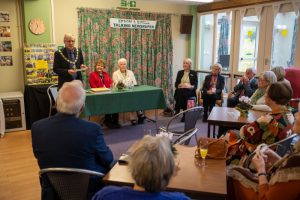
Mayor of Epsom with EETN crowd.

“I feel we are here today to pay homage to those good people who 50 years ago, established this splendid Charity and all those who have contributed ever since. On behalf of all the visually impaired Listeners over the past fifty years, I send a huge thank you to the Founders of Epsom & Ewell Talking Newspaper – EETN – and the multitude of Volunteers who have kept the free service operational for over half a century.’’ With these words, Judy Sarssam the present Chairwoman of EETN, welcomed the Worshipful Mayor of Epsom and Ewell (Charity’s President) Councillor Steve Bridger along with forty Volunteers and guests, to celebrate its Golden Anniversary on Thursday 21st November.

‘Our Volunteers are the shining stars,’ Judy continued, ‘because without them there would not be an Epsom & Ewell Talking Newspaper, whose function today is as valid as it was fifty years ago.’ Judy, herself visually impaired, went on to explain the importance of keeping visually impaired people feeling part of their community, as those with sight loss can so easily become isolated. Although technology has advanced in leaps and bounds since the early recordings, Judy was keen to emphasize that in a world now dominated by technology, isolation becomes more of an issue for those who are not technically adept.

During the celebration, messages of congratulations were read out, including from Mike Wood, President of The Talking News Federation, who acknowledged that 50 years of providing this regular, interesting and friendly service, recording more than 2390 editions, showed commitment by Volunteers and Listeners alike. Lionel Blackman, Director of Epsom & Ewell Times, said he was proud to be associated with EETN and was inspired by the dedication of its Volunteers. Councillor Clive Woodbridge, Chair of the Community and Wellbeing Committee for Epsom & Ewell said when he visited EETN as Mayor and presented long service awards to 15 Volunteers, he was impressed by the passion and hard work that goes into creating each edition.

Many of the Volunteers have been with the EETN for more than 10 years. Penny Dearing and Gwyneth Smith have been associated with EETN almost from its inception. Gwyneth joined as a Reader and her distinctive voice was well loved and remains melodic though Gwyneth is past her 90th birthday. She moved to Wales when COVID struck to join her family. A talented poet, she had planned to come to the celebration and read her 50th Anniversary poem. Sadly she was snow-bound in Wales, but emailed her wonderful poem which was read by MC of the day, James Dubois.

Following the messages from the many well-wishers, Penny Dearing, a former News Editor, Trustee/Committee member and Reader, told us her pleasure at working with those early pioneers. The EETN travelled from being recorded in Volunteers’ homes to a room in the Age Concern offices to a corridor at Swail House and eventually into a designated Studio at Swail House, which was the first site in the UK, designed specifically for visually impaired residents. During Covid full circle was reached as once more the EETN was temporarily recorded and produced in Volunteers’ homes until it was possible to return to the Studio once more.

A montage of Volunteers past and present caught everyone’s eye, as they enjoyed the delicious anniversary cake which the Mayor Councillor Steve Bridger ceremonially cut after making a generous speech in praise of the free EETN service. The celebration provided a wonderful opportunity for Volunteers to share their pleasure in continuing to offer access to local news, entertainment and information for the visually impaired people of Epsom and Ewell. Judy closed the event praising once more the special, hard-working team of 2024.


EETN Golden Jubilee – Poem by Gwyneth Smith

For over thirty years it was my privilege and pleasure
To be one of the READERS and the memories I treasure.
When Covid lockdown was announced my son rushed down to Surrey
To take me back with him to Wales to save us all from worry.

Continuing injections for my macular condition
I’ve now become a LISTENER and welcome each edition.
When it arrives in yellow pouch, protected from the weather,
I’m grateful to the Post Office, and how much more to Heather.

Epsom born I did not leave until my ninetieth year
So Epsom news and local views I’m very pleased to hear.
The MAGAZINE has always been the choice of those who EDIT
The wide variety produced is greatly to their credit.

It gives the READERS much more scope for their interpretation
Verse old and new and humour too can be a revelation.
So well done all who have a share in making each RECORDING
I hope you find the jobs you do are suitably rewarding.

With SECRETARY, TREASURER and Judy in the CHAIR,
We’re led by a COMMITTEE and we thank them for their care.
So happy Golden Birthday TALKING NEWSPAPER we say.
Let’s give three cheers for fifty years and longer may you stay!

Gwyneth Smith, 2024

Photography by Steven McCormick.


Epsom historian and the Frenchman who trained the British armies that defeated Napoleon

Royal Military Academy Sandhurst, Book cover and author.

The Royal Military Academy Sandhurst has seen a lot of famous faces over the years. Several members of the Royal Family have attended the Academy. Sir Winston Churchill graduated in 1894, Field Marshal Montgomery in 1908. The Academy is so respected that many countries send their military personnel there for training, making it one of the top military schools in the world.

But, how much do we really know about the origins of Sandhurst?

Local author and historian Paul Le Messurier has been a resident of Epsom for several years now. His latest book, Founder of Sandhurst, Maj-Gen John Le Marchant, tells the remarkable story of the British cavalry officer who started what has now become one of this country’s great institutions.

John Gaspard Le Marchant (1766-1812) was a French-born British cavalry officer who rose to prominence despite starting from humble beginnings. The son of a Guernsey father and a French mother, he joined the British Army at just 16. Through sheer skill and determination, he rose to become one of the most distinguished cavalry officers of his generation.

Le Marchant’s first taste of active service came during the French Revolutionary Wars, where he served as a captain in a cavalry unit during the ill-fated Flanders campaign. A skilled swordsman, it was here that he noticed that the British Army’s sword training was seriously lacking. Determined to make a difference, he designed a new cavalry sabre, wrote manuals on swordsmanship, and took it upon himself to train cavalrymen across the country.

Even then, he was still not satisfied and set his sights on an even grander and more ambitious attempt at reform: improving the overall standard and education of army officers.

Le Marchant’s idea for a military academy to professionally train army officers met with some initial resistance, but he eventually won royal and political backing. In 1801, Parliament approved his plans and allocated a budget of £30,000. The Royal Military College was established by Royal Warrant, initially based in High Wycombe and Marlow, with Le Marchant serving as its first Lieutenant-Governor. The college would later move to its prestigious location at Sandhurst.

In 1811, Le Marchant joined the Duke of Wellington’s army in the Peninsular War against Napoleon’s forces, taking command of a Heavy Cavalry brigade. He distinguished himself at the Battle of Salamanca, where he led one of the most successful cavalry charges of the campaign. Sadly, Le Marchant was killed in action during the battle at the age of 46. A memorial was erected in his honour at St. Paul’s Cathedral.

The Royal Military Academy’s motto today is ‘Serve to Lead,’ and that is exactly what Le Marchant did – both with the ground-breaking reforms he introduced and his bold leadership on the battlefield. Despite his many achievements, Le Marchant remains relatively unknown today. Paul Le Messurier’s engaging book seeks to change that, shedding light on the powerful and lasting impact Le Marchant had on the British Army.

Royal Military Academy photo: Antony McCallum – https://www.wyrdlight.com