

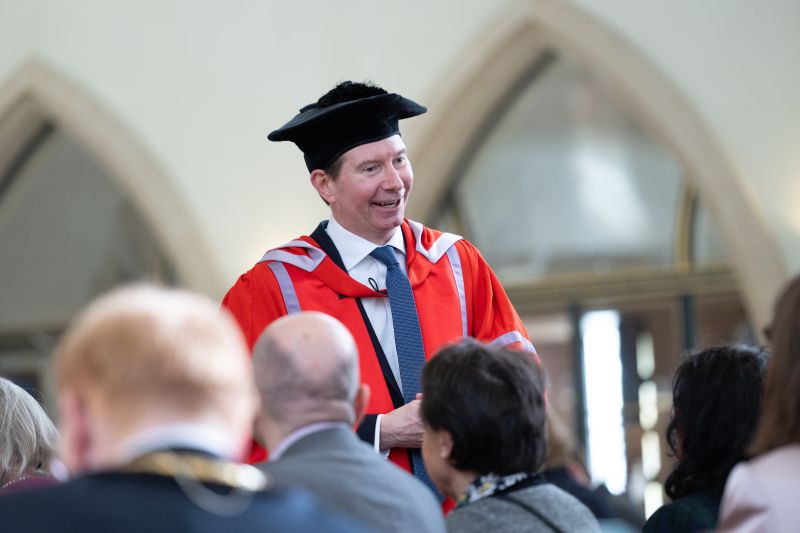
Surrey University installs Vice-Chancellor number six


Guildford Cathedral played host as town and gown come together to see formal installation of Professor Stephen Jarvis as Surrey’s sixth Vice-Chancellor
In a ceremony that fused a message about the dual research and teaching purpose of the University, the urgency of a rapidly changing world, and age-old academic pageantry, Professor Stephen Jarvis was formally installed as the University of Surrey’s sixth President and Vice-Chancellor at Guildford Cathedral on 11 February.
The academic and civic occasion was attended by community representatives and leaders – including council leaders, current and former MPs and representatives from across the region’s business and academic communities, alongside hundreds of staff and students from across the University community.
Professor Jarvis shared a message of a University with deep local roots – bringing together our community of academics, students and graduates with the wider community in Guildford, Surrey and beyond to contribute to social, economic and cultural wellbeing. He spoke of a University with a critical leadership role in combining entrepreneurship and purpose to find solutions to the challenges of the modern world, and in driving economic growth, social opportunity and the future skills agenda.
A computational scientist and former Royal Society Industry Fellow who helped establish The Alan Turing Institute, Professor Jarvis is internationally recognised for his academic leadership in high-performance computing, data science and applied artificial intelligence. On these foundations, he has established himself as an institutional and sector leader. At the University of Birmingham, where he served as Provost and Vice-Principal, he played a central role in shaping strategic vision, whilst at the University of Warwick he led industry-academic partnerships in big data as Deputy Pro-Vice-Chancellor (Research).
Professor Jarvis took up the role of President and Vice-Chancellor at the University of Surrey on 15 September 2025. In his address to a packed cathedral, he said:
“The University of Surrey is defined by a dual commitment to excellence in both education and research. Ours is also a university with a clear sense of purpose: to provide an education that equips graduates for the world of work, and to undertake research that addresses some of the most urgent challenges facing society.
“Surrey aspires to be recognised among the very best universities in the UK, with a strong and growing global reputation, reach and influence. I firmly believe that the UK needs universities like ours to navigate the opportunities and challenges of technological change, respond to critical skills needs, and prepare students for the workplaces of the future.
“The University of Surrey is deeply rooted in its local community – not only a place of learning and discovery, but also an active contributor to the social, economic and cultural wellbeing of the communities we serve. The long-term success of a place is built through a shared endeavour: universities, colleges and schools that educate and inspire; public services that protect and enable; infrastructure that connects people to opportunity; and governance that provides stability, trust and direction. Aligned, we don’t just function, we flourish.”
The installation ceremony featured a traditional academic procession with full regalia, a specially commissioned fanfare, and music from the University Chamber Choir. The fanfare has been arranged for the installation by Dr Christopher Wiley, Head of Music and Media at the University, having been originally composed by the renowned composer of the day Dame Ethel Smyth. Dame Ethel lived in Surrey for most of her life and is commemorated at the University and with a statue in her home town of Woking. More information on the fanfare is included in the Notes to Editors, below.
Professor Jarvis joins Surrey as the University continues to deliver Vision 2041, its long-term strategy to become a globally recognised top 100 leader in research, innovation, education and civic engagement. The University has achieved its highest-ever global position of 219th in the Times Higher Education World University Rankings 2026 and remains within the UK top 15 for student satisfaction, with 85% of graduates progressing into highly skilled employment.

The specially commissioned fanfare was originally composed in the 1930s as one of eight Fanfares for the Musicians’ Benevolent Fund, each composed by one of the eight best-known British composers of the day, based on a traditional military bugle call. The ‘Men’s Meal (2nd call)’ bugle call, also known as ‘Hot Potatoes’ was composed as a fanfare by Dame Ethel Smyth, who lived in Surrey for most of her life and is commemorated at the University and with a statue in her home town of Woking. As well as producing an impressive canon of musical works, Dame Smyth was a much-published author and an influential suffragette. Her fanfare was first performed by the Royal Military School Bandsmen under Captain H.E. Adkins at a Musicians’ Benevolent Fund Annual Dinner held in London’s Savoy Hotel on 8 May 1930. It was recorded by the same ensemble and performed on other occasions, but the manuscript was lost, with Dr Wiley using the 1930s recording to bring the fanfare back to life for today’s installation.
Related report:
Surrey’s suffragette composer re-imagined in many ways