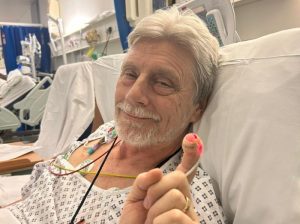
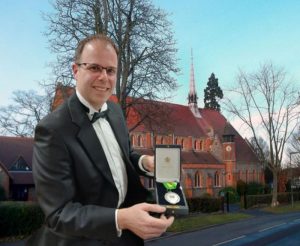
A patient has spoken of his gratitude to the NHS after he received life-saving robotic surgery – as hundreds more patients across London and Surrey are set to access the cutting-edge technology.
Paul Wickens, who lives in St Mary’s Bay in Kent, was one of the first heart disease patients at St George’s Hospital in Tooting to receive robotic-assisted surgery – an innovative procedure minimising recovery time for heart operation patients. Care worker Paul had lived with the condition for 24 years and his symptoms had deteriorated in recent years, leaving him “tearful” over what this could mean for his health.
The 66-year-old support worker was given new hope when he had a robotic coronary artery bypass grafting (CABG) surgery in December 2025 – one of the first of its kind at the hospital group, one of only three units in London who can perform the innovative procedure. His surgery was assisted by one of two da Vinci surgical robots – one of the most advanced systems of its kind – at St George’s, which have resulted in fewer complications for patients, lower readmission rates and shorter length of stays across other specialities.
Now, more patients like Paul across Surrey and London are set to benefit from a brand new da Vinci Xi surgical system now at Epsom Hospital, enabling surgeons to carry out more life-saving procedures on hundreds of patients every year.
Paul said: “I didn’t really understand what robotic surgery involved, but I felt very trusting of the surgical team and was immediately put at ease. I was in a little pain afterwards, although it was managed well with medication, and I was able to talk to my family that afternoon.”
Traditional surgery for coronary artery bypasses typically involves an incision in the middle of the chest (sternum) with multiple bypass grafts. Robotic-assisted surgery is less invasive, using small incisions and a high-definition 3D camera to allow greater precision. This results in less damage to surrounding tissue, reduced blood loss and lower levels of post-operative pain.
Paul returned home within four days rather than the week in hospital that is typically expected. He is planning on returning to his role in the care sector next month, where he has worked for the past thirty years. He added: “I am so grateful and lucky to be born in a time when such technology has come to the fore and I can’t thank the team enough – my symptoms have gone and I can move on with my life.”
Dr Richard Jennings, Group Chief Medical Officer for St George’s, Epsom and St Helier University Hospitals and Health Group, said: “We are embracing the latest technologies including robotic-assisted surgery, to improve care for thousands of patients – cutting waiting times, speeding up recovery and getting patients home sooner. Paul is one of many patients we expect to treat with robotic-assisted surgery in the coming years, in a major step forward for our hospitals. I’m very pleased that Paul is doing so well and I am proud of the way our teams are working together every day to provide innovative, safe and up-to-date care to our patients.”
The debut cardiac procedure is leading the way in the hospital group’s commitment to using innovation to improve patient outcomes and recovery times. The new robotic da Vinci system, part funded by Epsom and St Helier Hospitals Charity, will be shared by surgical teams from Epsom and St Helier and St George’s hospitals – with the first patients being treated this week.
It will be used for a range of procedures including general surgery, colorectal cancer surgery, and gynaecological surgery as well as urology and ENT (ear, nose and throat) procedures. It is expected to treat around 300 patients in the first year, rising to over 550 annually as more surgeons complete specialist training.
Molly Simpson, Head of Charity and Fundraising for Epsom and St Helier Hospitals Charity said: “We’re incredibly proud to help more local people access cutting-edge surgery by part-funding the new surgical robot at Epsom Hospital. Thanks to our generous donors and fundraisers, we’re able to make every penny count and deliver real benefits for patients.”
St George’s, Epsom and St Helier University Hospitals and Health Group
Paul Wickens – robot op patient
Surrey leaders promise smooth transition to unitaries
20 March 2026
On Friday 13 March, the East and West Surrey Joint Committees met to continue preparations for the transition to new unitary councils ahead of “vesting day” on 1 April 2027.
The committees, made up of councillors from existing Surrey authorities, are meeting monthly to lay the groundwork for the creation of East Surrey Council and West Surrey Council. This interim phase will continue until Shadow Authorities are formally established following elections in May 2026. The focus is on ensuring stability and effective planning during a period of significant local government change.
Financial pressures and planning challenges highlighted
Members reviewed progress from the Implementation Team (Programme Board), which is overseeing the transition. A draft illustrative financial baseline was presented, offering an early indication of the financial position the new councils are likely to inherit.
The report highlighted that both East and West Surrey are expected to face ongoing financial pressures, including rising demand for services and constrained resources—challenges that would exist irrespective of reorganisation.
Particular concern was noted in parts of West Surrey, where historic debt issues—especially those linked to Woking—will require careful management. The importance of robust governance, financial oversight and continued engagement with government on potential debt support was emphasised.
A recent ministerial letter from Alison McGovern MP confirmed that the government would “continue to explore what further debt support is required at a later point”.
Scrutiny and governance arrangements
Looking ahead to the Shadow Authority phase, councillors discussed how implementation plans will be reviewed. Shadow Overview and Scrutiny Committees will be established to provide independent challenge to decision-making, helping ensure plans are realistic, legally sound and properly risk-assessed.
A draft timetable for meetings during the Shadow period was also considered, with initial meetings expected to begin from 20 May 2026.
Devolution discussions continue
Surrey councils are continuing discussions with government on a potential countywide Strategic Authority, which could bring greater local control over areas such as economic growth.
Councils will consider whether to submit an expression of interest for a “Foundational Strategic Authority” — a non-mayoral model that could act as a stepping stone towards a future mayoral arrangement.
Leaders emphasise stability and strong foundations
Terence Herbert, Chief Executive of Surrey County Council and Senior Responsible Officer for the programme, said the work was about “planning ahead, being honest about the challenges, and making sure the new councils start on a strong footing.”
Cllr Bridget Kendrick, Chair of the East Surrey Joint Committee and Leader of Mole Valley District Council, said the focus was on “clear programme governance” and “strengthening scrutiny and oversight” to ensure a smooth transition.
Cllr Ann-Marie Barker, Chair of the West Surrey Joint Committee and Leader of Woking Borough Council, added that the priority was to establish “two stable and resilient councils… providing confidence, continuity and stability through the transition.”
What happens next
The next meetings of the Joint Committees are due to take place in April, with dates and venues to be confirmed. Meetings will continue to be webcast.
Background: what the changes mean
From April 2027, Surrey’s current two-tier system of county, district and borough councils will be replaced by two unitary authorities—East Surrey Council and West Surrey Council—each responsible for delivering all local services.
Elections for the new councils will take place on 7 May 2026, after which elected members will act as Shadow Authorities to oversee the transition.
Until then, residents will continue to access services through existing councils in the usual way.
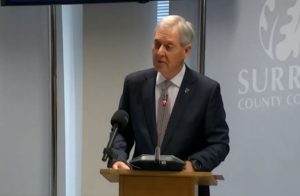
Tensions boiled over in the council chamber as outgoing Surrey County Council leader Conservative Cllr Tim Oliver defended his administration and staff against accusations from local MPs and opposition councillors. He accused them of “cheap political mudslinging” against “the very people dedicating their working lives to helping others”.
Speaking at the final full council meeting before the May elections, Cllr Oliver said a “small number of recently elected MPs have crossed the line multiple times” despite repeated attempts to engage with them on sensitive issues and the complex services the council provides.
Liberal Democrat MPs said after the meeting they make “no apologies for sticking up for residents”.
“They continually undermine the work of dedicated expert staff, largely from a position of naivety and ignorance, all to try and score political points,” Cllr Oliver said. “Cheap political mudslinging impacts the very people dedicating their working lives to helping others.”
Cllr Oliver read aloud the words of a staff member from the Children, Families and Lifelong Learning Directorate, describing how political attacks felt like a “personal blow”. He read: “Most people will never see the hours spent untangling difficult cases, the compassion behind tough decisions, or the sheer persistence required to get things right […] Words have consequences beyond political point scoring.”
The criticism comes after a damning BBC report revealed the county council had been formally sanctioned by the SEND tribunal in 38 cases over a five-month period. The council said barring notices were issued during an “exceptionally high period of activity”, according to the report. An ITV report claimed Surrey adults with learning disabilities face “dangerous” cuts to care; meanwhile the council insists it is increasing investment in the service and encouraging people to speak up if they feel the assessment does not meet their needs.
Cllr Oliver has urged MPs to engage constructively with staff and warned that the workforce would not easily forget years of political attacks. “While you may claim that your words are not directed at officers, I’m afraid there is no avoiding the impacts of cheap politicisation of serious and complex work,” he said.
A statement later issued after the meeting read: “Liberal Democrat MPs make no apologies for sticking up for their constituents’ interests and raising the failures of Surrey County Council, whether it is SEND provision, safeguarding, adult social care or potholes.
“No Surrey MP mentioned SEND in Parliament before 2024. They were all Conservative. As soon Liberal Democrats were elected in 2024 we relentlessly focused on making people’s lives easier in Surrey – as we were elected to do. We hope the Leader of Surrey will work with us in trying to achieve that instead of his blatant electioneering.”
Opposition councillors also pushed back. Cllr Paul Follows said he was “bored of the ‘let’s not be political’ speeches followed by a version of ‘everything is fine and nothing is broken’.” He acknowledged Cllr Oliver’s desire for a professional approach to the Local Government Reorganisation (LGR) but said implying scrutiny from MPs or councillors was “unwelcome” and “simply a waste of everybody’s time.”
Clashes continue
The debate quickly turned into a wider clash over finances and priorities. Liberal Democrat councillors questioned whether the council’s debt levels and budget planning were as secure as Cllr Oliver claimed, while Cllr George Potter described the leader as “thin-skinned” and accused him of dodging accountability by apparently “cancelling elections”.
Despite the tension, Cllr Oliver called for a focus on collaboration across party lines. “Residents don’t want to get caught in the crossfire of politics,” he said. “They want their elected representatives to improve their lives, not score points.”
As Surrey approaches its first Unitary Council elections in May, the row highlights the delicate balance between navigating political rivalries and council staff reputation, all while preparing for a major shake-up of local government. By the time Surrey’s County Council meets again, the political map will look very different.
Local LibDem leader slams Helen Maguire MP in shock resignation
20 March 2026
In a shock development in the politics of Epsom and Ewell Liberal Democrat Council Group Leader Cllr James Lawrence (College Ward) has resigned from his Party and joined the growing Independent Group on Epsom and Ewell Borough Council.
The Independent Group, led by former Residents Association Councillor Alex Coley (Ruxley), has been joined by ex-LibDem and long serving Councillor Julie Morris (College) and former Residents Association Councillor for Nonsuch Ward, Christine Howells.
The Liberal Democrats once formed the largest opposition group on the Council. Now the group is the smallest. The Independent Group has four councillors, Labour four and the Liberal Democrats just two.
The first version of this report overlooked the little known fact that Cllr Chris Watson (Ewell Court) defected from the RA to Labour on 10th February this year.
The Residents Association remain predominant with the remainder of the total 35 seats in the Chamber.
In Cllr James Lawrence’s resignation letter he takes wounding Parthian shots at both Epsom and Ewell’s first woman and first Liberal Democrat MP Helen Maguire, who was elected in the July 2024 General Election and her Party’s leader. He pulls no punches in his critique of Sir Ed Davey, MP for Kingston-Upon-Thames.
Resignation letter of Cllr James Lawrence
Dear Resident
I joined the Liberal Democrats in 2018 because I believed that the Party had both the strong intellectual foundations Britain needs and the pragmatism to achieve them. A principled commitment to liberalism, socially responsible markets, and devolved power differentiated the Liberal Democrats from other parties. Moreover, the Party’s understanding that it existed to influence politics from the outside by winning public support for important issues was tried and tested.
In 2023, I decided to play an active role in this mission and stood for election. I was fortunate enough to win and become a councillor representing College Ward. Serving the community where I grew up has been a great privilege. I’m proud to have co-led a cross-party coalition working for better outcomes at the Chalk Pit site, increased Council lease scrutiny, and passed a motion requiring all urgent council decisions to be published. Navigating an overly complex housing payments system to keep a roof over the head of a vulnerable resident is an experience that will stay with me.
While I have been doing all I can to serve our community, I have unfortunately been undermined by both the national and local Liberal Democrats Party. Under Ed Davey’s leadership, the Party has become rudderless. What do the Liberal Democrats stand for? I wish I could tell you. Davey’s Mr. Tumble-style stunts cover up a lack of direction, policy, and commitment to seriously engage with the challenges this country faces, particularly the economy. As the two-party system collapses, the Liberal Democrats should stand to benefit. But Davey’s Party is incapable of taking advantage, and given its purposelessness, that’s probably a good thing.
Locally, I have been disappointed with our Liberal Democrat Member of Parliament who seems more interested in leafleting and electioneering than engaging in meaningful policy change at the national level. Having worked with the MP closely on local matters, I am also concerned by her ability to alienate volunteers who freely give up their time. While I was pleased to support the successful campaign to displace the Conservatives in Epsom and Ewell, I now feel a sense of guilt at having played a role in enabling her to be elected.
For these reasons, I am resigning from the Liberal Democrat Party with immediate effect. I sincerely hope that the Party returns to the seriousness of its past, but I unfortunately no longer have faith it will. I will continue to serve the people of College Ward and the Borough to the best of my ability as an Independent councillor.
James Lawrence
In response Helen Maguire has issued the following statement:
I understand that Cllr James Lawrence has decided to step away from the Epsom and Ewell Liberal Democrats and will finish his term as an independent.
While I wish him well in his future endeavours, I am saddened to see his portrayal of my values and priorities as a Member of Parliament working for local matters at a national level.
The feedback I receive from local residents is consistently positive. I frequently receive correspondence from constituents who value the regular literature they are sent informing them of the important work I am conducting in Parliament. It is equally vital to me that constituents know how accessible and visible I am as their MP, engaging with them on their doorsteps each week. It is because I am an MP who strives to be a truly present voice within Epsom and Ewell that I am able to understand these concerns and raise them at a national level.
I recently met a constituent during one of my canvassing sessions, who told me that they were having difficulties accessing a breast cancer drug. I raised this issue directly with the responsible Minister, who then intervened with our local NHS organisation, and consequently the constituent received their medication. I do not need to debate the merits of consistent canvassing when the importance of it is so clear in cases such as this.
I am proud to be a very visible and active Member of Parliament within the Epsom and Ewell community, and will continue to fight for every single one of my constituents at both a local and national level.
New moped bays introduced to tackle pavement parking in Epsom High Street
20 March 2026
Epsom & Ewell Borough Council have established new moped-only parking spaces outside the Town Hall in a bid to combat pavement parking on Epsom High Street.
The issue of delivery riders mounting kerbs outside fast-food restaurants has been a cause of significant concern for residents and visitors in recent years. Vehicles blocking pavements create serious safety risks for pedestrians, particularly wheelchair users, those with visual impairments, and parents with prams and pushchairs.
The bays are the latest measure in the council’s multi-agency approach to the problem. Motions have been successfully passed at both Epsom & Ewell Borough Council and Surrey County Council calling for dedicated motorcycle parking at all new retail and takeaway developments, the introduction of “round-table” discussions with delivery apps such as Uber Eats and Deliveroo, and stronger enforcement of parking regulations.
The Epsom Business Improvement District (Go Epsom) is also working directly with restaurants and delivery riders to promote the use of these dedicated bays as a faster and legal alternative to pavement parking.
The local initiative coincides with a significant national policy shift. On 8 January 2026, the Department for Transport responded to a long-awaited consultation, announcing new powers for local authorities to tackle pavement parking more effectively.
Unlike the previous street-by-street approach, which was often slow and costly to implement, the new secondary legislation will allow councils to enforce against “unnecessary obstruction” more easily.
Councillor Steven McCormick, (RA Woodcote and Langley) Chair of the Planning Committee and a member of Surrey County Council’s Communities, Environment and Highways Select Committee, said:
“Pavements are for people, not for motorised shortcuts. We’ve heard from residents who have been forced into the road because the footway is entirely blocked. We are committed to making the High Street safe for everyone. The new moped bays that Epsom & Ewell have provided will mean there is no longer any excuse for this unacceptable and inconsiderate parking.”
“I also welcome the announcement of new powers from the Department for Transport. As soon as this national legislation is fully enacted, I will be pushing Surrey County Council to implement a new Traffic Regulation Order specifically designed to curb pavement parking across the borough.
“This TRO will provide the ‘teeth’ that enforcement officers have lacked, allowing them to issue civil penalties.”
Epsom and Ewell Council transparency row erupts as council backs publication of urgent decisions
20 March 2026
Epsom & Ewell Borough Council has agreed to improve transparency over so-called “urgent decisions” following a heated debate that revisited the controversy surrounding the Rainbow Centre and allegations of secrecy over a £500,000 liability.
At its Full Council meeting on 12th March, councillors voted to support a motion calling for a clearer and more timely system for publishing decisions taken by officers under delegated authority.
The move follows months of criticism over how urgent decisions have been handled and disclosed, culminating in disputes over a confidential document linked to the Rainbow Centre.
Motion seeks clearer publication of decisions
The motion, proposed by Councillor James Lawrence (LibDem College) and seconded by Councillor Alex Coley (Independent Ruxley), called for a formal process to ensure that officer decisions are properly recorded and made publicly accessible.
Lawrence told councillors that while urgent decisions are currently noted in committee papers, the underlying decision notices themselves are not published in a timely or transparent way. “The decision notice itself isn’t given… that is not at all in the same timeframe as a decision notice from committee,” he said. He added that in the past it could take months, or even up to a year, for such decisions to be reported.
The motion proposed that the Chief Executive develop a process for publishing these decisions, with an update to be reported back to council later in the year.
Legal compliance questioned
The debate turned on whether the council is already complying with transparency laws. Lawrence said the current arrangements were “legally questionable”, pointing to regulations requiring a written record of officer decisions to be produced “as soon as reasonably practicable”.
However, Councillor John Beckett (RA Auriol), chair of the Standards and Constitution Committee, rejected claims that the council was acting unlawfully. He told the meeting that the council’s existing practice – recording urgent decisions in committee agendas and reporting them annually – complied with the regulations. “The custom and practice of this council… satisfies this requirement,” he said.
The Mayor also intervened to clarify that officers believed no law had been broken.
Rainbow Centre controversy looms over debate
The discussion was heavily influenced by the ongoing controversy surrounding the Rainbow Centre, where an urgent decision was used to deal with issues linked to the site.
That episode has been the subject of previous reporting by the Epsom & Ewell Times, including concerns about a secret document referring to substantial potential dilapidation costs – reported to be in the region of £500,000.
Councillor Chris Ames (Labour Court) directly linked the motion to that issue, accusing the council of a broader lack of transparency. “We’ve had an ongoing shambles over the so-called urgent decision over the Rainbow Centre,” he said.
He alleged that key information had not been disclosed and suggested there had been no intention to publish the document. “The reality is… there was never any intention to publish the document in the first place,” he said. Ames also described what he called a “growing transparency crisis” within the council.
Since 20th January Epsom and Ewell Times has awaited disclosure from Epsom and Ewell Borough Council of information that will throw light on the Rainbow Centre controversy. Despite a 20 day legal limit under the Freedom of Information Act to disclose and our concession to accept delay where some items sought may take longer to find, we have received no disclosures of even readily available information.
Calls for greater openness
Councillor Alex Coley (Independent Ruxley), who seconded the motion, said he had been investigating urgent decisions since discovering their limited visibility several years ago. “I accidentally discovered that they exist,” he said. He told councillors that hundreds of historic officer decisions had not been publicly disclosed, including some involving significant financial commitments. “Some of them record millions of pounds being spent… even non-exempt information has been withheld as a matter of course,” he said.
Coley said progress had been made in recent years, but argued further reform was needed to ensure proper compliance and public confidence.
Cross-party engagement leads to compromise
Despite the sharp exchanges, the motion itself reflected a degree of cross-party cooperation. Both Lawrence and Coley acknowledged that they had worked with Councillor Beckett and officers to reach a compromise. Beckett, in turn, thanked them for their “time and patience” in developing the proposal.
The agreed approach stops short of declaring the current system unlawful, instead tasking the Chief Executive with designing an improved publication process.
Motion carried by council
The motion was approved by councillors, signalling a clear intention to increase transparency over urgent and delegated decisions. It requires the council to develop a system for publishing decisions in a more accessible and timely way, subject to the usual rules on confidential or exempt information. An update on progress is expected later in the year.
Wider implications
The debate highlights continuing concerns about governance and transparency at the council during its final years before abolition under Surrey’s local government reorganisation.
The Rainbow Centre episode appears to have acted as a catalyst for change, bringing the issue of urgent decisions into sharper public focus.
While the council maintains it has acted within the law, the adoption of the motion suggests a recognition that existing arrangements have not met public expectations. As one councillor put it during the debate, the issue is not only legality but trust.
With further major decisions expected before the transition to a new unitary authority, the way those decisions are recorded and disclosed is likely to remain under close scrutiny.
Epsom & Ewell Borough Council has approved changes to the political balance of its committees following further shifts in councillor allegiances, amid continuing tensions within the ruling Residents’ Association group.
The decision, taken at Full Council on 12 March, reflects the latest change in group composition after another RA councillor, Christine Howells (Nonsuch), moved to sit as an independent.
The adjustment of committee seats – known as proportionality – is a routine requirement when political group numbers change. However, the debate revealed deeper concerns about control, transparency and internal stability within the council.
Rebalancing committees after defections
Introducing the report, Councillor John Beckett (RA Auriol)said the changes were necessary to reflect the council’s evolving political makeup. “As a result of changes within the political representation within this council, there has been a need to review the proportionality sitting on committees,” he told members.
The revised allocations had been agreed between group leaders and were presented for formal approval by the full council.
Councillors approved the updated distribution of seats, ensuring that representation on committees broadly reflects the current balance of political groups.
Dispute over whether seats belong to parties or individuals
The debate exposed a technical but significant disagreement about whether committee places belong to political parties or to individual councillors.
Councillor James Lawrence (LibDem College) argued that while parties are allocated seats proportionately, it is the council that appoints individuals to those positions. “It is not the party being appointed, it is the person,” he said, adding that councillors who change political group should not automatically lose their place on committees.
He pointed to examples in the report where individuals had been nominated to seats allocated to a particular party, suggesting this supported his interpretation.
But Councillor Rachel King (RA, Town) rejected that view, insisting that committee places are fundamentally party allocations. “Seats are for parties, not for people,” she said, adding that parties retain the right to nominate replacements if councillors change allegiance. She said the arrangements had been agreed by group leaders and urged councillors to support the proposals.
Tensions over substitutions and control
The issue of substitutions – where councillors stand in for others at meetings – also proved contentious. Opposition councillors criticised what they described as inconsistent or politically motivated handling of substitutions following recent defections.
Councillor Chris Ames (Labour Court) said the situation had become “farcical”, alleging that rules were being stretched to maintain control. “The clique that runs this council has a special talent for alienating members… bending the rules,” he said. He linked the proportionality changes to wider political instability, suggesting the Residents’ Association group was “bleeding members”.
The debate reflects a broader struggle over influence as the RA group’s long-standing dominance of the council comes under increasing pressure.
Background: shifting political landscape
The latest changes follow defections from the Residents’ Association group over recent months, with councillors moving to sit as independents or aligning with opposition groups. The departure of Christine Howells (Independent Nonsuch) from the Residents’ Association further alters the balance, reducing the RA group’s numbers and requiring another recalculation of committee representation.
Under local government law, councils must ensure that committee seats are allocated in proportion to the size of political groups, as far as practicable. This means that each defection can trigger a reshuffle of committee places and, potentially, influence over key decisions.
Vote confirms new balance
Councillors approved the revised proportionality arrangements, including updated committee memberships.
A separate vote on one recommendation – relating to specific appointments – was carried by 15 votes to eight, with four abstentions, indicating some continuing division within the chamber.
Despite the disagreements aired during the debate, the council formally adopted the new structure, bringing committee representation into line with the current political balance.
Ongoing instability ahead of reorganisation
The debate highlights a council in a degree of political flux as it approaches both local elections and the planned abolition of the borough under Surrey’s local government reorganisation.
With further changes in group membership still possible, additional reviews of proportionality may be required in the coming months.
The shifting balance of power on committees could prove significant in the council’s final year, particularly as it continues to make decisions on major issues before handing over responsibilities to the new unitary authority in 2027.
Epsom’s empty and second homes face local tax increases
20 March 2026
Epsom & Ewell Borough Council has approved a 2.98% increase in its share of Council Tax for 2026/27, alongside new measures to penalise empty properties and second homes, but not without some questioning from councillors over the purpose and clarity of the changes. (Strategy and Resources Committee 27th January.) The increase equates to £6.93 a year for a Band D household, keeping within the government’s referendum limit and adding around 58p per month to bills. While modest in isolation, the rise sits within a wider package aimed at strengthening council finances and aligning local policy with other Surrey authorities ahead of the planned move to unitary government.
The more contentious element of the decision was the tightening of rules on empty homes and second properties. From April 2026, owners of empty and unfurnished properties will no longer receive a one-month exemption and will face a 100% Council Tax premium after one year, effectively doubling their bill. From April 2027, the same 100% premium will apply to second homes. Introducing the policy, Committee Chair Cllr Neil Dallen (RA Town) said: “It’s something that the rest of the boroughs and districts in Surrey are already doing… coming up to unitary it’s now proposed that we do do it and align ourselves ready for the unity proposal.”
Although the measures were approved unanimously, several councillors probed the reasoning and operation of the policy. Cllr Chris Ames (Labour Court) questioned whether the changes were primarily about raising income or achieving social outcomes such as reducing homelessness and increasing housing supply, asking whether the Council was “trying to achieve any of those things, or is it simply about… increasing the income that we get.” In response, Cllr Dallen indicated the policy served both purposes, noting that while the number of empty homes locally is limited, “every property is another family home,” and officers confirmed that bringing homes back into use remains an objective.
Cllr James Lawrence (LibDem College) also raised detailed questions about how the policy would work in practice, particularly the rules around when a property is considered occupied and how time limits on empty status are reset. He highlighted potential ambiguity in the wording of the policy documents, suggesting that the distinction between a property being “substantially furnished” and actually occupied could lead to confusion. While confirming his support for the policy in principle, he sought reassurance that the expected income—estimated at around £29,000—would exceed the administrative cost of implementing the scheme.
The discussion reflected a broader concern among some members about balancing financial necessity with fairness and clarity. While there was no outright opposition to the proposals, the debate revealed differing emphases: some councillors focused on revenue generation and alignment with Surrey-wide practice, while others stressed the importance of ensuring the policy delivers genuine housing benefits and is clearly understood by residents.
In the end, the committee approved the recommendations without dissent, confirming both the Council Tax increase and the new premiums on empty and second homes as part of the authority’s budget-setting process for the coming financial year.
Surrey-wide plan aims to get thousands back into work
20 March 2026
A cross-county plan to bring thousands of people back into employment in Surrey has received backing from Surrey County Council and government ministers.
The Get Surrey Working Plan brings together key partners to support 26,900 economically inactive residents who want to work but currently face barriers to employment.
Although Surrey has a lower-than-average economic inactivity rate of 17.8% compared to the national average of 21.2%, around 131,000 working-age residents are not currently employed.
Government ministers and local leaders from across government, Jobcentre Plus, health services and business have pledged to work together to tackle the issue through a range of interventions. These include multi-million pound schemes such as Connect to Work, Skills Bootcamps and WorkWell.
A new online Skills, Training and Employment Portal, known as STEP Surrey, will provide streamlined access to services, helping residents find support, gain skills, secure employment or access assistance more easily.
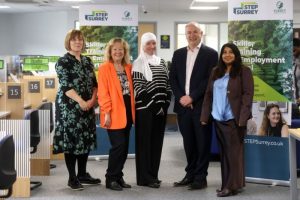
The plan was formally launched by representatives from the One Surrey Growth Board at Redhill Jobcentre Plus.
It identifies key reasons why many working-age residents are not in employment, including long-term health conditions and caring responsibilities.
The plan also addresses a mismatch in skills, where many highly skilled professionals commute to London, leaving local employers struggling to fill vacancies. Sectors such as health and social care, automotive and technology are particularly affected.
To address this, the plan will deliver targeted business support and skills development programmes, helping employers fill vacancies while supporting workforce planning and more inclusive employment practices.
The soon-to-be devolved Adult Skills Fund will focus on priority sectors and identified skills gaps, enabling residents to gain qualifications aligned with local employer needs.
Young people without access to skills or further learning will receive early intervention support in schools, reducing the risk of becoming not in education, employment or training (NEET), with clearer vocational pathways and work experience opportunities.
Matt Furniss, Surrey County Council’s Cabinet Member for Highways, Transport and Economic Growth and Chair of the One Surrey Growth Board, said: “While the economic picture in Surrey is largely a positive one, we know that there are thousands of people out there who are currently out of work but not in employment.
“Through the Get Surrey Working, we’re committed to breaking down those barriers and creating a truly inclusive labour market where everyone has the opportunity to access good quality employment and reach their full potential.”
Secretary of State for Work and Pensions, Pat McFadden, said: “The Get Surrey Working Plan is a perfect example of how partners can come together to support people into work and help local businesses find the talent they need.
“Surrey is a county with real strengths – a thriving economy, top-class businesses and talented people – yet we know there are many more people who want to work but face barriers that hold them back.
“By bringing together local employers and support services we can reach people where they are and give them a genuine route into good work. This kind of practical, locally-led support is exactly what we need to get Britain working.”
The plan has been developed through partnership working with public health teams, Jobcentre Plus, Surrey Chambers of Commerce, employment support providers and other stakeholders.
Its aim is to avoid duplication of services and ensure support reaches those who need it most, by coordinating employment and skills provision across Surrey into a clear, joined-up local offer.
Residents can access employment and skills support through the STEP Surrey portal at www.stepsurrey.co.uk
Representatives from the Surrey Growth Board launch the Get Surrey Working Plan
Ash dieback keeps Thames island closed
20 March 2026
The Environment Agency has warned against any planned protests over the closure of a Surrey riverside island and announced a public engagement event to update residents on safety work there.
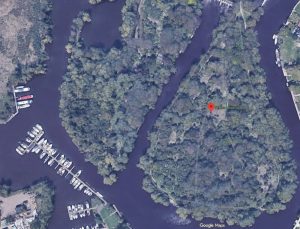
Penton Hook Island has been shut since July 2025 after diseased trees were discovered across the site. Officials say the trees are affected by ash dieback, a disease that rots them from the inside and makes them unstable and unpredictable to cut down. As a result of the scale and complexity of the work required the island cannot safely reopen yet, officials said.
The agency has warned people not to attempt to access the island amid reports of possible protests around the site. A spokesperson said: “We would like to remind everyone that access to the island is currently prohibited due to the significant safety concerns resulting from diseased trees. Please do not attempt to access the island.”
Ash dieback weakens trees internally, meaning they can collapse or drop branches without warning. The Environment Agency said this creates a serious risk to both workers and the public, with falling branches, collapsing trunks and debris on the ground posing a potential injury hazard.
Local residents will have a chance to discuss the plans at a public engagement event on March 20, 2026, at Staines Library between 2pm and 5pm.
Environment Agency staff will provide an update on the work and hear feedback from the community. People will also be able to share information about memorials located on the island so they can be protected where it is safe to do so.
A spokesperson added: “Keeping the public safe is one of our priorities and we apologise for any inconvenience this closure may be causing. We know the importance of this site to the local community, and we are committed to keeping everyone updated on our progress.”
Instead of using standard chainsaws, specialist mechanical equipment will be needed to remove the affected trees, the Environment Agency said. The machinery will have to be transported to the island by river, adding further logistical challenges.
The agency said additional work will also be required to strengthen parts of the island bank before equipment can be brought in.
Seasonal wildlife restrictions are another factor. The bird nesting season, which runs from March to September, limits when some work can take place, further complicating the project.
Plans are also being explored to restore the island once the dangerous trees have been cleared. Environment Agency officials said they hope to replace the diseased trees with new species better suited to the island’s ecology.
Support programme launched to help Surrey’s high streets
20 March 2026
Dedicated support for high street businesses across Surrey to attract new customers, boost sales and drive growth is now available as part of wider efforts to strengthen and futureproof town centres.
The Surrey High Street Growth and Innovation Programme is open to a wide range of businesses, including independent retailers, start-ups, market traders, charities and social enterprises.
Funded by Surrey County Council’s Economic Growth Fund and delivered by specialists Smarter Society and The Retail Group, the scheme offers free practical workshops, online resources and one-to-one tailored support.
There is a particular focus on 22 high streets across all 11 district and borough areas in Surrey, with targeted workshops designed to help businesses attract more customers, increase footfall, improve visibility and boost customer spend.
Businesses can register for support directly via the programme’s enrolment form.
Matt Furniss, Cabinet Member for Highways, Transport and Economic Growth at Surrey County Council, said: “High streets are the lifeblood of our communities. They’re integral to the character and vitality of our towns and villages, which is why we’re committed to supporting them alongside our district and borough partners and Business Improvement Districts.
“This programme is a real investment in the people behind Surrey’s independent businesses, giving them the tools and knowledge to thrive – which is good for our economy, our residents and our communities.”
The scheme has been developed in collaboration with economic development teams from district and borough councils, alongside representatives from Business Improvement Districts (BIDs) across Surrey.
Launched last month, the programme includes workshops running through February, March and April at key locations across the county.
The Smarter Society outreach team is already engaging directly with businesses on Surrey’s high streets, meeting hundreds of owners face-to-face and signing retailers up for workshops.
Four free workshops are being held in each district and borough, covering practical topics such as increasing footfall, improving online and in-store visibility, making better use of social media and promotions, and planning for growth.
Workshops are also being streamed live online, with recordings available on demand.
In addition, a range of free toolkits, guides, templates and short videos is available via the Business Surrey website, alongside one-to-one support for businesses with more specific needs.
In the first few weeks of the programme, nearly 140 businesses have registered, with 75 already receiving support across five areas.
Geoff Baxter, Managing Director of Smarter Society, said: “The Surrey High Street Growth & Innovation Programme is gaining real momentum. Businesses across the county are engaging enthusiastically with our on-street support and workshops, and we’re proud to see such strong early signs of growth and innovation on Surrey’s high streets.”
The programme is free and open to any business trading on a Surrey high street. Further information is available via the Business Surrey High Streets page, with direct registration also available through the programme’s enrolment form.
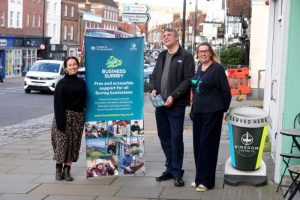
Photo: Reps from Surrey CC, Smarter Society and Hello Dorking mark the delivery of the High Street Support scheme
.
.
.
Epsom and Ewell FC’s first home game of 2026 drawn
20 March 2026
Epsom & Ewell FC 0 v Camberley Town FC 0 14th March, Chalky Lane, Chessington Combined Counties Premier League
We finally saw our first home game of 2026 at Chalky lane after a stop start preparation.
After several hours of work in the morning, the referee passed the pitch fit for play in the morning but then on arrival required four further inspections. The club carried out additional work to make the surface playable, forcing kick off to be delayed until 3:10pm.
Courtney Swaby came in for his debut in the number 10 position, with Callum O’Keeffe moving to right back and Ore Allen back into centre midfield. Jason Vincent also returned to the club up top.
Both sides started brightly, with the Salts striking the crossbar early on through a long-range effort from Brendan Murphy-McVey and could have had 3 or 4 goals in the first half an hour as Camberley arrived to park the bus.
The match then took a dramatic turn when a dangerous high boot saw Camberley’s Mo Black sent off, while the Salts Stefan Aiwone suffered a serious head injury and had to be withdrawn. Luke Miller came on to make his 150th appearance for the Salts. The score remained goalless at half-time.
In the second half, Epsom & Ewell made a series of changes to dry to find a way through Camberley’s obdurate defence and keeper who was having a blinder.
Tom Smith was replaced by Ali Fofahan on 63 minutes then Anthony Nazareth made way for Karl Bailey on 74 minutes. New signing Courtney Swaby was replaced by Ryley Merrett and captain Brendon Murphy McVey was substituted for Leo Cunningham late on.
The Salts created several chances and had a strong penalty appeal, but despite their pressure—and the man advantage—the match finished 0–0.
On the plus side another clean sheet in short order which will please the management, but the inability to turn chances into goals remains a frustration. Teams around us in the league continue to slip up and provide some breathing space, but The Salts will be looking to Tuesdays’ home match against Redhill as a chance to finally hit the back of the net.
We would also like to thank our mascots from BMM Sports Coaching and Epsom & Ewell Colts for your support; we hope you enjoyed the afternoon!
The big child smartphone use debate starts in Surrey
20 March 2026
Parents are facing “no bigger issue” than the impact of smartphones and social media on their children, says Godalming and Ash MP Jeremy Hunt.
The former chancellor told a public meeting in Godalming that his own family are now also “in the thick of it”, debating whether to allow their kids to have smartphones and social media.
Doctors, teachers, parents and politicians gathered at Wilfred Noyce Community Centre in Godalming on March 13 to discuss concerns around children using smartphones and social media, and whether there should be a ban for under-16s.
The discussion forms part of ongoing work with the campaign group Smartphone Free Childhood Surrey, which have been working with Mr Hunt and other local campaigners to raise awareness on the impact smartphones might be having on young people’s learning and wellbeing.
Concern is growing among parents, carers and educators that smartphones are disrupting classrooms, compromising safety and chipping away at children’s mental health. Evidence shared at the meeting suggested only around 11 per cent of schools are currently smartphone-free, despite research indicating pupils in such schools can achieve GCSE results one to two grades higher.
Audience members also heard stark anecdotal evidence from a frontline healthcare professional in a statement she sent to be read at the meeting. Consultant paediatrician Dr Louise Mills described several cases she had treated linked to online trends and cyberbullying. They included a 14-year-old admitted after suffering a seizure while attempting a TikTok challenge, and an 11-year-old who suffered life-changing burns after copying something seen online. Another 14-year-old patient took their own life following sustained cyberbullying.
GP Susie Davies, founder of the charity PAPAYA (Parents Against Phone Addiction in Young Adults), said young people were experiencing a “mental health epidemic”.
She said teenagers now spend on average two to three hours a day on social media (some spend more than five) exposing them to constant comparison and harmful content.
“The tech is addictive by design,” she said. “It is structured with dopamine reward pathways which the teenage brain is particularly vulnerable to.”
Ms Davies told the community centre that problematic phone use makes young people more likely to experience depression. She added that children are missing out on sleep, real-world experiences and face-to-face friendships, with some even suffering trauma after viewing disturbing content online.
Shadow education secretary Laura Trott MP told the audience smartphones and social media were “not safe for our young people”. She argued schools should remove smartphones from classrooms and ensure technology is only used when it has proven educational value.
The MP for Sevenoaks, Swanley and the Dartford Villages said: “We’ve sleepwalked into the overuse of screens in schools to the detriment of education.”
Leader of Waverley Conservatives Councillor Jane Austin said: “As a mum of four, I’ve seen directly the impact smartphones and social media can have on children. A number of Surrey schools have already adopted no-smartphone policies, and the evidence is clear that this helps children focus and achieve better outcomes.
“If elected to run West and East Surrey, Conservatives will work to ensure all Surrey schools are smartphone-free so that children can learn without constant digital distraction.”
Some Year 11s in the audience raised the issue that some children might get VPNs to work round the social media ban, or might find other ways to source smartphones. “We have bans on alcohol and cigarettes for children,” she said. “They’re not 100 per cent perfect but they exist because those things are harmful. The same is true for social media.”
Campaigners from the group Smartphone Free Childhood also called for cultural change, arguing that delaying children’s first smartphone until at least 16 could dramatically improve attention spans, wellbeing and learning.
Headteacher Adam Samson said his school, Godalming Junior, already requires pupils to hand in phones at the start of the day, with Year 6 pupils sometimes allowed a simple “brick phone”. The policy has reduced cyberbullying incidents to zero, he said.
“Once children have a smartphone, they always have one,” he said. “We’re simply delaying it and giving them more time to be children.”
Karl Nicholas honoured with Active Citizen Award at Borough Civic Reception
20 March 2026
A long-serving community volunteer whose work spans youth organisations, music, policing and education has been honoured with Epsom & Ewell Borough Council’s Active Citizen Award at the Mayor’s Annual Civic Reception.
The award was presented to Karl Nicholas by the Mayor, Cllr Robert Leach, during the civic gathering held on the evening of 13 March at Bourne Hall in Ewell. The reception, hosted by the Mayor and Mayoress Marilyn Leach, brought together councillors, aldermen, freemen of the borough, past mayors and other invited residents who have contributed to civic life in Epsom & Ewell.
Among those attending was Mary Zoeller, Deputy-Lieutenant of Surrey, along with a wide range of community figures representing voluntary organisations, education, faith groups and public service across the borough.
The Active Citizen citation described Nicholas as someone with a “distinguished record of public service”, highlighting decades of involvement across multiple areas of community life.
He has been involved with Second Cuddington Scouts for more than two decades, including 18 years serving as assistant commissioner for the area. The scout group provides activities for boys and girls aged six to eighteen and offers training opportunities for young people, including camps and leadership development.
Music has been another major thread in Nicholas’s community service. He serves as bandmaster and assistant musical director of the Kingston and Malden Scout and Guide Band, a role he has held for 25 years. The band has performed at prestigious occasions including Buckingham Palace garden parties and the Lord Mayor’s Show.
His musical contribution also extends to church life. Nicholas learned to play the organ at Cuddington Church and has been involved in church music there for more than 30 years, first as a choirboy and later as organist and choir director. The citation notes that he has frequently stepped in to support services when needed, including standing in at short notice to play for the Mayor’s civic service when the regular organist was taken ill.
Alongside his voluntary work, Nicholas has also served as a special constable for 14 years, and in his professional life works as a teacher. He currently serves as Head of Inclusion and Special Needs at Southborough High School, having previously been deputy head at a school in Cheam.
The citation concluded that across these roles Nicholas has shown “commitment and competence” and that his personal manner and skill make him “a worthy recipient of the Active Citizen Award”.
The civic reception itself provided a relaxed and celebratory atmosphere in Bourne Hall. The evening featured musical performances from Ukrainian musician Vladislav Voloshin, who entertained guests with a programme including pieces by ABBA and Bach, performed on saxophone and clarinet. The Mayor himself accompanied the performance on the piano.
Guests mingled over refreshments in the hall while reflecting the borough’s long civic traditions. The gathering brought together representatives from across the political spectrum and many strands of local life, demonstrating the borough’s continuing culture of voluntary service and public engagement.
Proceedings were guided with humour and warmth by Cllr Julian Freeman, the Liberal Democrat councillor who acted as master of ceremonies for the evening.
While politics often divides in the council chamber, the reception provided a reminder that the borough’s civic culture rests on a broader shared commitment to public service and community life.
That spirit was embodied in the recognition of Karl Nicholas — a volunteer whose decades of work in youth development, music, education and policing have quietly strengthened the fabric of local life in Epsom & Ewell.
Sun sets on Residents’ Associations’ cherished Parishes for Epsom and Ewell
20 March 2026
Epsom & Ewell Borough Council has formally abandoned plans to create parish-style community councils after a public consultation produced overwhelming opposition, bringing to an end a controversial review that has cost about £70,000.
The decision was taken at a full council meeting on 12th March following a debate that exposed sharp political divisions and prompted renewed criticism of the Residents’ Association administration that initiated the review.
Councillors ultimately accepted a report concluding that the consultation “does not demonstrate sufficient public support for the proposals”, after residents rejected the idea of creating two community councils covering Epsom and Ewell.
But the debate revealed tensions over the purpose of the consultation itself, the cost of the process, and the future of local representation in Surrey after local government reorganisation.
Beckett: residents “have spoken” but warns of democratic deficit
Introducing the report, Councillor John Beckett (Auriol), who led the Community Governance Review (CGR), said the council had carried out extensive engagement with residents and should be proud of the exercise.
He told councillors that more than 2,200 responses had been received, making it one of the council’s most widely responded-to consultations in recent years.
Beckett said the consultation was justified because residents across Surrey had not been properly consulted about the government’s decision to reorganise local government. He argued the borough had taken a different approach by asking residents directly what they wanted.
However, he acknowledged the result left the council with little option but to halt the plan. “Our residents have spoken on this matter, and with 82 per cent opposed to the idea of community councils, the recommendation of this report is not to proceed with CGR,” he said.
Despite accepting the result, Beckett used both his opening speech and his closing remarks to warn that the new local government structure could weaken local representation.
He questioned how the proposed neighbourhood committees expected under the new unitary structure would address local issues. “How the non-funded, non-decision-making neighbourhood committees will miraculously deliver those local issues facing our residents,” he asked, warning they may not resolve the democratic deficit created by large unitary councils.
In his summing-up he said the future system could leave a patchwork across Surrey of areas with and without meaningful local representation.
Opposition: “self-serving” and a “vanity project”
Opposition councillors were sharply critical of the review and its purpose. Labour councillor Chris Ames (Court) said the administration had been warned not to embark on the process. “The Residents’ Association administration was warned not to take the council into this shambolic, costly and self-serving process,” he said.
Ames argued the public had rejected what he described as an RA “vanity project”. “The public saw through it. It’s clear that the residents rejected the RA vanity project,” he said, adding that residents also resented the idea of another layer of taxation.
He criticised the consultation structure, saying residents were effectively offered only one option. “It’s laughable to present giving residents a choice of unwanted parishes or nothing at all as a choice,” he said.
He also asked where accountability lay for the £70,000 cost of the review. “Seventy thousand pounds later, where does the CGR shambles leave us?” he asked.
Claims the review was about creating roles
Councillor Julian Freeman (Liberal Democrat, College) argued there had never been a public demand for parish councils in the borough. “There’s never been any demand for it,” he said. Freeman suggested the proposal had been linked to the approaching abolition of borough councils. “It was a way of trying to carve out some kind of role for soon-to-be former Residents’ Association councillors,” he said.
He added that residents reacted strongly once they realised the potential council tax implications. “People saw that it was going to cost an extra £50 plus on their council tax bill and quite rightly said, what on earth do we want to pay for another layer of government for?”
Criticism of consultation design
Several councillors criticised the structure of the consultation. Councillor Bernie Muir (Conservative Horton) said residents had not been offered alternative governance models. “We were given one option or nothing,” she said.
She added that neighbourhood area committees proposed under Surrey’s local government reorganisation had not been presented as an option. “Those committees should at least have been given a chance to see if they worked,” she said.
Another councillor said the consultation had effectively framed the issue as a choice between parish councils or losing local influence entirely.
Cllr Kieran Persand (Conservative Horton) reminded the Chamber that the proposed Parishes would only manage a handful of allotments that residents grow fruit and vegetables in.
Administration defends consultation
Residents’ Association councillors strongly defended the review as an exercise in democratic engagement.
Councillor Clive Woodbridge (RA Ewell Village) said the borough had done what central government had not done during the reorganisation process. “We had the courage to ask our residents what they wanted,” he said.
He added that the council was respecting the outcome. “They’ve quite clearly said that they don’t want parish councils, and we will act upon that advice.” He claimed, wrongly as it transpired, that Epsom and Ewell would be the only area in the County without any parishes. See Epsom and Ewell Times table below.
Councillor Rachel King (RA, Town) also defended the cost of the consultation. She said the £70,000 spent equated to less than £1 per resident. “We’re talking about less than a pound per person for two full consultations,” she said.
King said the aim had been to explore how residents might retain local representation once the borough council disappears in 2027.
A consultation that defeated its own proposal
The consultation outcome – around 82 per cent opposition – effectively forced the council to abandon the idea it had been exploring.
But the debate highlighted a paradox. While the Residents’ Association leadership defended the consultation as a democratic exercise, several councillors argued the process appeared designed primarily to test support for parish councils rather than explore a range of possible governance models.
Critics pointed to the absence of alternatives such as neighbourhood area committees and the framing of the consultation around the creation of community councils.
At the same time, Beckett’s own speeches emphasised his belief that parish councils would have helped address what he described as the democratic deficit created by large unitary authorities.
End of a £70,000 process
The Community Governance Review had been one of the council’s strategic priorities for 2025–27. It involved two rounds of consultation, public meetings, publicity campaigns and engagement activities.
Despite the extensive engagement programme, the consultation produced a clear rejection of the proposal.
For now, Epsom & Ewell will remain without parish councils even after the borough council disappears under the planned Surrey reorganisation.
Parish councils across Surrey
Although Epsom & Ewell currently has none, several Surrey districts contain parish or town councils. In many cases these cover only parts of the district rather than the entire area.
A Worcester Park resident and former Epsom College music scholar is behind a new national competition celebrating Britain’s thriving amateur choral scene.
Lucy Mitchell, founder of UK Choir of the Year, is launching the initiative with a fundraising concert at Cadogan Hall in London on 18th May, ahead of the competition opening for entries later this year.
Mitchell, who lives in Worcester Park and is a member of the Adam Street Singers, said the project had been in development for more than a year and aims to highlight the strength and diversity of choirs across the country.
The new competition will open applications in June 2026 and culminate in a live final at Milton Court at the Guildhall School of Music & Drama in April 2027.
The launch concert will feature performances from the Adam Street Singers, Citi London Choir and the Lewisham & Greenwich NHS Choir – whose members famously topped the Christmas charts – alongside guest appearances by TV doctor Dr Ranj and The Choir with No Name.
Mitchell said the competition was designed to recognise the many high-quality choirs operating outside the fully professional music sector.
“So many choirs are doing extraordinary work but rarely get the chance to be heard nationally,” she said. “This competition exists to celebrate the standard, diversity, and community behind choral singing across the UK.”
UK Choir of the Year is being run as a not-for-profit initiative rooted in the belief that collective singing plays an important role in wellbeing and community identity.
Some of the proceeds from the competition will support The Choir with No Name, an organisation which runs choirs for people affected by homelessness.
The competition will be judged by leading figures from the UK choral world including composer Will Todd, conductor and vocal specialist Dan Ludford-Thomas and conductor and gospel specialist Karen Gibson MBE.
Funds raised at the Cadogan Hall concert will help develop the competition and create access bursaries to ensure choirs from across the UK are able to take part.
Mitchell said the initiative was intended to celebrate the “richness and diversity” of Britain’s choral tradition while creating a national platform for amateur ensembles of all styles and sizes.
Applications for UK Choir of the Year open at the end of June 2026, with the inaugural final scheduled for 10 April 2027.
The official opening of Hopescourt School in Walton-on-Thames marks a new chapter for children with additional needs in Surrey. The Lord Lieutenant of Surrey joined pupils, staff, Bourne Education Trust, project partners and the Leader of Surrey County Council to celebrate the opening of a school designed to give children the support, stability and opportunities they need to thrive.
Hopescourt School will ultimately provide 200 specialist places for autistic pupils and children with communication and interaction needs by 2029. For many families, the new school means shorter journeys and stronger connections to their local community, ensuring children can learn and grow in an environment that feels safe, familiar and supportive.
With the first cohort of pupils already settling into their new learning environment, the school will continue to expand over the coming years, strengthening Surrey’s local specialist education offer. It forms a key part of Surrey County Council’s commitment to increasing high quality specialist provision close to home, helping more children access the right support without needing to travel long distances.
The opening event brought together students, families, Surrey County Council, Bourne Education Trust, construction partners Willmott Dixon and many others whose expertise and dedication have helped bring this new school to life.
The Lord Lieutenant of Surrey, Michael More-Molyneux, said: “I was so pleased to be present to celebrate the opening of Hopescourt School. Never having visited the new building, I was immediately taken with its design. For members of the teaching team, it was obvious that they were very enthusiastic about their new school. The pupils, it should be said, were equally enthusiastic about their new place of learning. It is a facility that is certainly needed in Surrey, and I send my congratulations to all concerned for the building of this most impressive centre of education.”
Surrey County Council’s investment of nearly £30 million to build the school reflects its long-term ambition to give children and young people with additional needs the best possible start. The expansion of specialist provision is a core aim of Surrey’s Inclusion and Additional Needs Partnership Strategy 2023–2026, ensuring children receive the right support where and when they need it.
Tim Oliver, Leader of Surrey County Council, highlighted the life-changing impact this new school will have on children and young people and their families: “Hopescourt School is a symbol of what can be achieved when partners work together with a shared vision, creating a school that is inclusive, sustainable, and truly life-changing for Surrey children and their families.”
Hopescourt is also Surrey’s first Net Zero Carbon in operation specialist free school, combining sustainability with child-centred design. Specially designed spaces support the school’s ethos of ‘pause, breathe, think and flourish’, ensuring a calm and nurturing environment for pupils aged 4 to 19.
Richard Poulter, Managing Director at Willmott Dixon, highlighted the lasting impact of the project: “Delivering Surrey’s first Net Zero in Operation school reflects our joint commitment to sustainability and community impact. This school will provide much needed specialist places and support generations of young people.”
The project is the result of close collaboration between Willmott Dixon, Surrey County Council, the school, Bourne Education Trust, Freemantles School, AtkinsRealis and many other partners. In particular, the dedication and expertise of the council’s Land & Property Capital Projects team and construction partners Willmott Dixon ensured the successful delivery of a school built around the needs of children.
Andy Field, Chair of Bourne Education Trust, reflected on the collective achievement: “Hopescourt stands as a powerful example of partnership in action. This school demonstrates what can be achieved when organisations come together with a shared purpose: to create exceptional, inclusive opportunities for young people. With these fabulous new facilities and excellent staff serving our children, we now have the opportunity to build a thriving school at the heart of the community with the aim of becoming one of the best special schools in the country.”
Acting Headteacher, Nicky Meston, paid tribute to the dedication of the Hopescourt staff and the excitement of the school community: “I am incredibly proud of our team and the way they champion our pupils every single day. Today isn’t just about opening a building, it’s about opening doors to opportunity, belonging, and the very best start in life.”
Hopescourt School embodies the council’s vision for inclusive, high-quality and community-anchored provision, delivering sustainable support and improving outcomes for children and families across Surrey.