

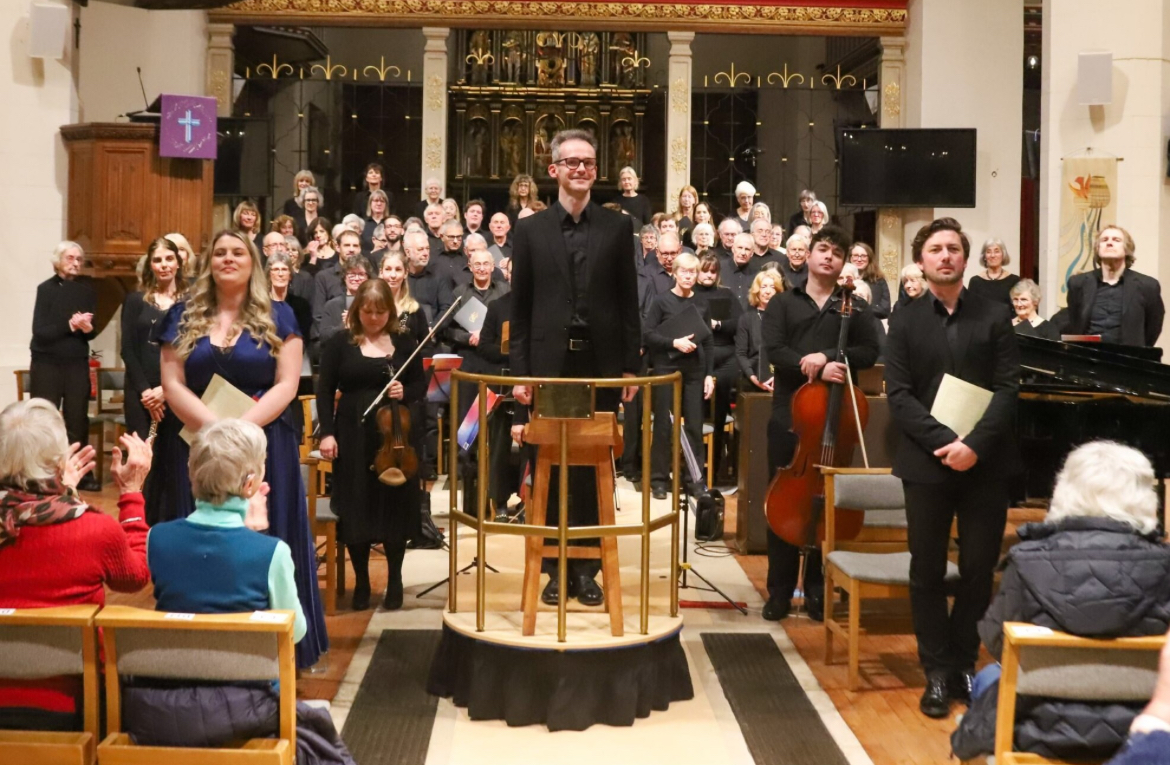
An evening song preludes a Mass and a Requiem by Epsom Choral Society


This concert at St Martin’s Church, Epsom, was another milestone in the life of one of the town’s cultural jewels, its Choral Society. The German Requiem by Johannes Brahms was coupled with two pieces by his contemporary and friend Josef Rheinberger – Abendlied and the Mass in E Flat – providing an effective and well-matched prelude to the main work.
Rheinberger’s Abendlied, composed when he was just fifteen (and later revised), brought a warm six-part choral texture well suited to the spacious acoustic of St Martin’s. The performance was well controlled, with clear communication between choir and conductor. His Mass for Double Choir (1878), rooted in Renaissance tradition but shaped by Romantic language, offered greater contrasts of dynamics and texture. These were generally well realised, though from some positions the antiphonal effect of the two choirs was less distinct. The Gloria made a strong impact with tight ensemble in the louder passages, while the restrained drama of the et sepultus est in the Credo was sensitively handled. The confident entries of the Sanctus contrasted effectively with the quieter close of the Benedictus, and the atmospheric Agnus Dei provided a fitting conclusion to a thoughtful performance of this substantial work.
Brahms’s German Requiem is not a liturgical setting but a deeply personal reflection on remembrance. Taking years to complete, it stands as a work of remarkable craftsmanship and cohesion. Here it was performed using Iain Farrington’s seven-part accompaniment for three strings, three wind and piano. This arrangement proved effective, avoiding the balance challenges of a full orchestra, though at times the upper strings felt slightly underpowered.
The choir was central to the performance and rose impressively to the challenge. From the opening movement, there was a strong sense of confidence, contrast and atmosphere. The ensemble supported the second movement effectively, with particularly dramatic forte and fortissimo passages, although the fugal writing was not always fully clear.
Baritone soloist Dominic Sedgewick delivered a confident and commanding account in the third movement, matched by accurate and responsive choral singing in demanding passages. While some contrapuntal textures lacked clarity, the movement concluded strongly. The well-known fourth movement was rendered with tenderness, its fugal sections particularly successful, alongside Brahms’s shifting rhythmic patterns.
Soprano Elizabeth Findon was equally impressive in the fifth movement, her clarity and projection standing out. Balance across the ensemble was generally good, though harder to assess from nearer seating positions. The sixth movement maintained a strong tempo and opened effectively, building to a final section of conviction and a powerful conclusion.
The final movement began with excellent balance, including a particularly effective passage pairing soprano/alto with tenor/bass lines. The closing pages sustained the expressive intensity that characterised the performance throughout. This was a demanding work, requiring stamina and commitment, both of which were clearly evident. Epsom Choral Society can be proud of a performance that amounted to a genuine triumph, with the enthusiasm of its members and an influx of new singers pointing to a strong future.
Peter Lutton
*Evening song