

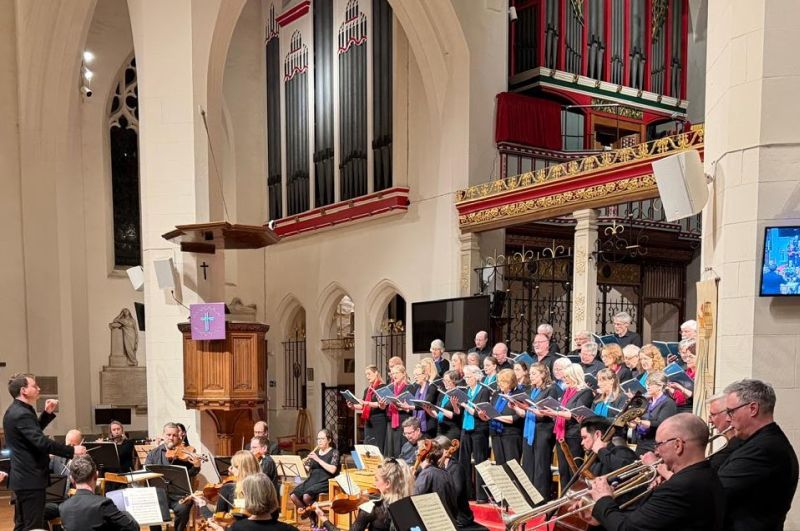
Epsom Chamber Choir spring bridge across the centuries


What a glorious evening of music there was to be enjoyed last Saturday night (21st March) in St Martin’s Church, Epsom, with the Epsom Chamber Choir accompanied by Affinity Chamber Orchestra. There were two apparently diverse works for the concert, one in each half, having no obvious connection to each other and yet surprisingly intertwined. The conductor was the fine musician Jack Apperley.
A Time to Dance by Alec Roth, performed after the interval, was composed with the idea of being heard alongside the work which opened the concert, Bach’s Magnificat. Alec Roth had thought to use very similar instrumental sections as Bach intended when composing the Magnificat, Mary’s song of praise to God on learning that she will bear the Messiah. Affinity Chamber Orchestra were therefore the perfect accompaniment to the Chamber Choir for both works, although A Time to Dance added some unusual percussion instead of the timpani for Bach’s Magnificat.
The programme notes were very thorough and helpful, reminding the listener of the rich history of Bach’s Magnificat and providing background to the composition of the modern work, A Time to Dance. The Choir and Orchestra gave an incredibly uplifting rendering of Bach’s Magnificat, a joy to hear with its choral drama and fine arias.
Throughout the concert, the sound was consistently glorious, with impressively clear enunciation from the Choir and very sensitive accompaniment by the Orchestra. The acoustics of St Martin’s Church were ideally suited to the extensive dynamic range of both singers and instrumentalists, as well as to the style of both the Magnificat and the modern Roth composition.
The whole concert showcased the exceptional talents of the Chamber Choir singers, as members took all the solos throughout. This followed Bach’s original intention when composing the Magnificat and was mirrored beautifully in the storytelling of A Time to Dance. This modern composition proved a tuneful delight, taking the listener through movements depicting Time, the Seasons, times of day, Love and Dance. These themes were inspired by biblical text from Ecclesiastes, chapter 3, alongside both modern and historic poetry used as settings for the various movements.
The audience was treated to an ever-changing variety of words and music for Sunrise, a Spring Morning, Summer Noon, Autumn Evening and Winter Night. After the delights of Spring, with soloists and Choir beginning a journey of joyful reawakening and the encouragement to dance, Summer Noon conveyed a sense of drowsy heat and gently swaying countryside, including text from William Blake’s The Fly. The Choir and soloists vividly captured the atmosphere of high summer.
In “Humdrum” during Part III, Autumn Evening, the Choir revelled in the fun of song and dance, escaping the daily routine of life. This movement was brought to life by percussive elements including washboard, dinner gong and desk bell. Moving into Winter Night, more delicate musical textures emerged before “A Glee for Winter” burst forth, bringing merriment and evoking love and laughter, with dance once again at its heart.
The final movement, Afterdance: Proper Exercise, saw the Choir put down their scores to sing and clap with visible joy and enthusiasm. The whole work was magnificently performed by both Orchestra and Choir, expressing a vivid sense of dance throughout.
This was an exceptional concert of the highest quality and clearly much appreciated by the audience.
Future concert dates for Epsom Chamber Choir are 27 June, 7 November and 12 December at St Martin’s Church, Epsom.
Elizabeth Hargrave
Photo credit: Paul McCan