New Gatwick wetland aims to reduce flood and drought risks
21 July 2026
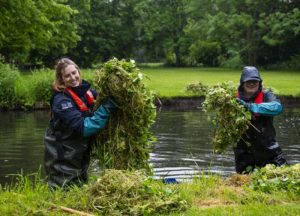
A new wetland capable of holding up to 600,000 litres of water has been created near Gatwick as part of efforts to make the Upper Mole catchment more resilient to flooding, heatwaves and prolonged dry weather.
The South East Rivers Trust has completed the latest phase of a project using natural measures to slow, store and filter water before it travels downstream.
Across two sites, the environmental charity has created the wetland and reconnected 100 metres of river with its natural floodplain.
The wetland will collect rainfall and surface water, releasing it gradually downstream. Restoring the connection between the river and its floodplain will also give water more space to spread out and be held temporarily during periods of heavy rain.
The measures are intended to ease pressure on downstream communities when rainfall is intense, while keeping more water in the landscape during hot and dry periods. The restored areas should also provide new and improved habitats for wildlife.
The work was funded by London Gatwick through its Decade of Change sustainability programme, a strategy covering 10 environmental and social priorities up to 2030.
The latest phase, delivered between July 2025 and June 2026, included:
Installing more than 50 “leaky barriers” to slow the movement of water;
Planting a 100-metre hedgerow containing 400 native trees;
Bringing two more landowners into the catchment project; and
Monitoring rainfall, river levels and water clarity to study how water moves through the landscape.
Leaky barriers are carefully positioned structures made from natural materials such as branches and logs. Under normal conditions, water can continue to flow through them, but during heavier rainfall they slow the flow and hold back some of the water temporarily.
George Biggs, project officer at the South East Rivers Trust, said the recent spell of hot and dry weather illustrated one side of the challenge facing the area.
“During the current hot and dry weather, it can be difficult to imagine how quickly heavy rainfall can create problems for our rivers and local communities,” he said.
“The Upper Mole responds very rapidly when it rains, with water moving quickly through the catchment. By restoring wetlands, reconnecting rivers with their floodplains and installing leaky barriers, we can give that water more space and more time.
“These measures help create a healthier, more resilient landscape that is better prepared for both very wet and very dry conditions. They also provide valuable new habitats for wildlife.”
The Upper Mole is particularly responsive to rainfall because of its clay soils, modified river channels and surrounding urban development. Heavy rain can move rapidly downstream, increasing the risk of flooding and placing additional pressure on water quality and river habitats.
Natural flood management seeks to tackle those problems nearer their source by working with the landscape to slow, store and filter water.
Mark Edwards, head of sustainability at London Gatwick, said: “This important initiative, delivered in partnership with the South East Rivers Trust, is a vital part of London Gatwick’s Decade of Change sustainability programme.
“This partnership is a great example of bringing together technical expertise, landowners and local knowledge to deliver practical measures that support biodiversity, water quality and climate resilience.
“It demonstrates how London Gatwick can support enhancements to the local area outside the airport.”
Further restoration work is now being planned across the Upper Mole catchment. Proposals include restoring an old pond so that it can store more water and support biodiversity, installing additional leaky barriers and designing another wetland to improve water quality and availability.
The partners also intend to extend the project into another of the Upper Mole’s six waterbodies, continue monitoring the measures already installed and hold community engagement days about the river and natural flood management.
The project initially concentrated on the headwaters of the River Mole, including Baldhorns Brook near Rusper. Its longer-term ambition is to expand throughout the Upper Mole catchment and demonstrate how nature-based measures could help restore other urban river headwaters across the South East.
Monitoring equipment is recording rainfall, river levels and turbidity – a measurement related to water clarity – so that the Trust can assess how the catchment and the completed interventions respond to wet weather.
Councillors dispute significance of EEBC’s complaint rate
21 July 2026
Epsom and Ewell recorded Surrey’s second-highest rate of upheld Local Government and Social Care Ombudsman complaints during 2025/26 — although officers and some councillors argued that the numbers were too small to indicate a systemic problem.
The Ombudsman received 18 complaints concerning EEBC, up from 15 in the previous year. Two were recorded as upheld, producing a rate of 2.4 upheld complaints per 100,000 residents. Only Spelthorne, at 2.8, had a higher rate among Surrey’s borough and district councils.
At last night’s Audit and Scrutiny Committee meeting Cllr Alex Coley (Independent Ruxley) asked why Epsom and Ewell’s rate appeared markedly worse than most neighbouring authorities.
Cllr Steve McCormick (Conservative Woodcote and Langley) asked what weaknesses in the Council’s first and second-stage complaints processes were causing cases to reach the Ombudsman and what service improvements would be put in place before the transfer to East Surrey Unitary Authority.
Assistant Director Andrew Bircher rejected the suggestion of systemic failure. He said the actual number of complaints was very low and that one of the two cases was classified as upheld even though the Ombudsman had not opened a full investigation. In that case, the Council had already accepted the complaint and taken satisfactory remedial action.
“I don’t see that there is an issue to be concerned about here as we transition into the new East Surrey authority,” he said.
Cllr Robert Leach RA Nonsuch) agreed that percentages based on one or two cases could be misleading. “When you’re dealing with very small numbers, you really have to have a viability threshold,” he said. “This is probably something barely worth reporting.”
Refuse, rodents and reasonable adjustments
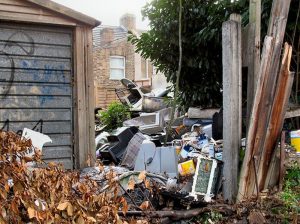
The first upheld case concerned repeated accumulations of refuse and fly-tipping near a resident’s home, causing a rodent problem.
Following the Council’s own stage-two investigation, it apologised and agreed to double waste collections and inspections, make the location a priority site and increase the presence of uniformed officers.
The Ombudsman decided that no further investigation was required because the Council had already remedied the injustice. Its system nevertheless recorded the complaint as upheld.
The second case concerned the Council’s requirement that reports of planning breaches be submitted online or on a specified form.
The Ombudsman found that, after the complainant explained difficulties using their hands, the Council should have asked whether a reasonable adjustment was required. Its failure to do so caused uncertainty, although the Ombudsman could not say that an adjustment would necessarily have been granted.
The Council subsequently contacted the complainant and reminded officers of their anticipatory duty under the Equality Act.
Eleven data breaches
The report also disclosed 11 data breaches since the committee’s February meeting.
Nine involved email. Two were reported to the Information Commissioner’s Office, which took no further action beyond providing general advice.
The Council had also been notified of two complaints to the ICO concerning its responses to Freedom of Information requests. At the time of the committee meeting, both were still awaiting allocation to an investigator.
Under the new data legislation, residents will generally be required to complain to the Council about its handling of personal information before taking the matter to the ICO.
Mr McCormick asked how the Council could guarantee that complaints about its own conduct would be investigated objectively and whether the financial and staffing implications had been calculated.
Mr Bircher said the Council’s Business Support Team would provide an independent review through its existing two-stage complaints procedure. He could not say how the workload would be measured or reported under the new unitary council. “I dare say that this annual complaints report won’t come to this committee next year because it won’t exist,” he said.
Epsom and Ewell Council admits homelessness pressure is “getting worse” despite action
21 July 2026
Epsom and Ewell Borough Council’s homelessness expenditure remains at its maximum risk rating despite additional staff, fraud investigations, government funding and the implementation of a homelessness action plan.
The Council’s year-end performance report recorded a £410,000 adverse budget variance for 2025/26, with net expenditure of £10.679 million against an approved budget of £10.269 million.
The overspend was driven primarily by temporary accommodation costs. It would have been higher without treasury income approximately £100,000 above forecast and around £200,000 of additional income from property leases completed later than anticipated.
Councillor Steve McCormick (Conservative Woodcote and Langley) told the Audit and Scrutiny Committee 16th July that those gains had effectively masked what would otherwise have been a £710,000 operational overspend.
The number of homelessness applications rose by 82.6% during the year to 623. The number of households in nightly-paid accommodation remained above target and was 5.5% higher than at the equivalent point a year earlier.
The corporate risk of homelessness spending exceeding its budget carries an inherent score of 16 and, unusually, remains at 16 even after the Council’s controls are taken into account.
Mr McCormick asked whether that meant the controls were ineffective or that external pressures had simply overwhelmed what the Council could do.
Assistant Director Andrew Bircher said: “Notwithstanding all these actions that we seem to be taking in order to try and reduce the amount of homelessness, we’re not seeing that come to pass. In fact, we’re seeing the number of nightly paid and the homelessness numbers increasing. If it was getting better, I think we would see our residual risk lower, but what we’re seeing is it’s not getting better; it’s getting worse.”
He distinguished between making prudent financial provision for the costs and successfully reducing the underlying demand. “The fact that we might be able to cope with that doesn’t mean that it isn’t still a risk,” he said.
Where will the missing £650,000 come from?
Cllr Alex Coley (Independent Ruxley) agreed that officers had undertaken a considerable amount of work. He said almost every action within the homelessness and rough-sleeping strategy was marked green or completed, with modular housing the main exception. Without that work, he estimated annual costs could already have reached around £2 million.
However, he questioned whether the budget figures matched the scale of the known pressure. “The allocation of funding to temporary accommodation was significantly short of the money we spent in the last year, which is £1.4 million,” he said. “I think we’ve only allocated something like half of that, so £750,000. There is a question, isn’t there: where’s the other £650,000 going to come from?
“People might reasonably ask: did we actually set a balanced budget back in February?”
Three modular homes nearly two years late
The Council’s modular-homes programme remains more than three months off track against an original completion date of July 2024.
Only one location, providing three homes, was found to be viable. Progress has since been delayed by a requested land tribunal hearing, and the performance report supplied no new completion date.
Mr McCormick questioned why the tribunal risk had not been anticipated and what alternative rapid-delivery housing schemes were being pursued. Officers were unable to answer at the meeting and said a response would be obtained from the relevant service.
Financial position “unsustainable” without reorganisation
The Annual Governance Statement contained a candid warning from the Head of Paid Service that, although EEBC remained relatively financially stable, its position would be unsustainable over the longer term without local government reorganisation.
Mr McCormick asked whether that meant the Council might otherwise have faced a Section 114 financial emergency.
Mr Bircher said EEBC was in a better position than many neighbouring authorities but had previously relied upon reserves to balance its budget. “Clearly, use of reserves year after year is not a sustainable position,” he said.
Without reorganisation, the Council would have needed to consider substantial transformation and change programmes. He said the efficiencies expected from creating the East Surrey Unitary Authority would perform some of the function that a separate savings programme would otherwise have been required to achieve.
Property problem arises for third time
Without disclosing details discussed at a separate exempt meeting, Cllr Coley also challenged the red-rated risk attached to the Council’s property portfolio.
He said a problem involving the Council’s investment company had now arisen for a third time and would cost more than six figures. Previous advice had said doing nothing was not an option, but the problem had nevertheless been allowed to recur. “I would like to know what the control is so it doesn’t happen a fourth time,” he said.
Mr Bircher agreed the risk register should be updated with new mitigation but declined to bring a separate report back to the committee.
Mr McCormick noted that the Council described its approach as “treat” while both the inherent and residual property risk remained at 12. He asked what active measures had been taken to prevent commercial tenants defaulting. That question was also taken away for a later response.
ICT and other services off target
The Council’s 2024/25 ICT roadmap, originally due for completion in March 2025, remains off track. Its IT service-interruption risk remains high, with ageing components and dependence on outside suppliers identified as continuing threats.
Although new firewalls had been installed and other network work was progressing, Mr McCormick asked why the cyber-security response-plan review had slipped to September 2026 and whether investment might become redundant when systems were combined under the new unitary council.
Other significantly off-target indicators included long-term sickness absence and the proportion of parking penalty appeals answered within ten working days, which had fallen from 100% to 63%.
Mr Bircher said parking staff were diverted at the financial year-end to time-critical work such as permit and garden-waste renewals. The Council had chosen not to fund temporary extra capacity, although its response times remained better than the statutory requirement.
“When someone is accountable, they do not”
Many detailed questions were left unanswered because the heads of the relevant services were not at the meeting.
Mr McCormick asked how councillors and the public could be assured that written answers would subsequently be provided and published. Mr Bircher said it would be disproportionate to require every head of service to attend in case a question arose and that Democratic Services had a good record of recording questions and obtaining later answers.
Cllr Coley contrasted the attendance with a Strategy and Resources meeting two days earlier, at which the Chief Executive, Section 151 Officer, Monitoring Officer and senior property officers were present.
“The public and members might get the impression that when somebody wants something, everyone shows up, and when someone’s accountable, they do not,” he said.
The committee noted the performance and risk report.
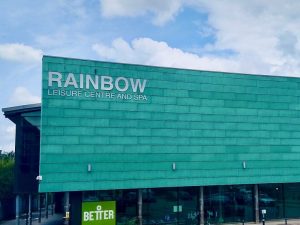
Epsom and Ewell Borough Council’s Audit and Scrutiny Committee has formally concluded that the process used for the confidential £500K Rainbow Leisure Centre urgent decision did not follow the Council’s stated procedure and was not justified by the information presented to councillors.
The finding came at the end of a lengthy and at times heated debate on Thursday 16 July over Urgent Decision 158, which was signed off by Cllr Neil Dallen (RA Town) as chair of the Strategy and Resources Committee, in December 2025 without first obtaining the approval of his Committee.
Councillor Chris Ames (Labour Court) proposed that the committee record:
“The process followed for Urgent Decision 158 did not follow the correct stated procedure and was not justified according to the information put before this committee.”
The proposal was carried.
The committee separately backed a recommendation from Councillor Alex Coley (Independent Ruxley) that, where a matter of significance is known about in advance — such as proposed expenditure exceeding £50,000 or a change to the Council’s constitution — the first action should be to schedule a committee meeting.
As Audit and Scrutiny cannot itself alter the constitution, the proposal is expected to go to the Standards and Constitution Committee.
Months of warning or sudden urgency?
The Council’s report stated that a decision was needed by 17 December to progress negotiations with the new Rainbow Leisure Centre operator. The next scheduled Strategy and Resources Committee meeting was not until 27 January 2026.
Officers said that failure to resolve the matter could have caused the contract to collapse, leading to the loss of management fees, a need to retender, the Council having to maintain the centre without an operator and uncertainty for staff.
However, the Council’s constitutional test is not simply whether a decision is required before the next scheduled committee meeting. An urgent decision may be used only where delay would seriously prejudice the Council or public interest and it is not practicable to convene a quorate meeting in time.
Cllr Ames said the same problem could be seen in the explanations given for several other urgent decisions.
“The next scheduled meeting is irrelevant,” he said. “What matters is: could a quorate meeting of the relevant decision-making body be brought forward to take this decision?”
Assistant Director of Corporate Services Andrew Bircher acknowledged that some of the explanations in the annual report did not fully reflect the constitutional test.
“It would be better on this report had we been able to identify that,” he said, adding that future reports would set out the position more clearly.
Cllr Coley said the Rainbow difficulties had been apparent months before UD158 was signed and that there had been ample opportunity to arrange a special committee meeting.
He described what had happened instead as “sofa-style governance”, with discussions taking place among senior officers, lead councillors and the Residents’ Association group before opposition councillors were informed.
“The process here is a committee meeting should have been organised,” he said. “Instead, what happened was a lot of talking behind closed doors.”
He said RA councillors had been shown the issue in early December, approximately four weeks before opposition councillors were given access to it.
Cllr Ames said the timetable appeared to have been “artificially managed” to create urgency and avoid a committee decision.
Chair Cllr Steve Bridger (RA Stamford) repeatedly attempted to restrict discussion to the decision-making process rather than the underlying Rainbow dispute. He also said the officers needed to answer many of the questions were not present and asked members to submit further questions in writing.
Cllr Ames sought a commitment that the answers would be published, arguing that otherwise residents might conclude that the Council was trying to avoid explaining what had happened to public money.
Who decided the document was exempt?
A second dispute concerned who decided that UD158 and its contents should be withheld from the public.
The committee report stated that Chief Executive Jackie King, acting as the Council’s “proper officer”, had made the exemption decision after considering its commercial sensitivity.
Cllr Ames repeatedly asked whether there was any contemporaneous written record of that decision or of the required balancing of the public interest in secrecy against disclosure.
Mr Bircher said the Chief Executive had confirmed by email that she authorised the exempt treatment and that the matter had been discussed at meetings of the Strategic Leadership Team.
He acknowledged that there was no separate record in the leadership team’s meeting notes, but said the Chief Executive had agreed that future exemption decisions would be evidenced on the relevant committee report or urgent decision form.
The Council’s legal adviser, Deborah Davis, said the exemption decision did not necessarily have to be recorded in writing. Someone did, however, need to have made the decision after considering both the relevant legal exemption and the public-interest test. Recording the decision and naming the proper officer would be good practice, she said.
Cllr Coley told the committee that, at a group leaders’ meeting in early January, the Chief Executive had said she had been on leave and that Deputy Chief Executive Vicky Potts had prepared and signed the urgent decision.
He questioned when the Chief Executive had subsequently decided that the document should be exempt and whether an exemption could properly be applied retrospectively.
Mr Bircher responded that the Chief Executive had been aware of the circumstances through leadership team discussions and was satisfied that the matter should be treated as commercially sensitive.
Ms Davis advised that leaked information does not automatically cease to be exempt. The Council could continue to treat it as confidential until an authorised decision was made that disclosure was now in the public interest.
£500,000 Rainbow background
Epsom and Ewell Times has previously reported that the confidential urgent decision approved by Cllr Neil Dallen (RA Town) authorised access to Council reserves of up to £500,000 in connection with disputed dilapidations discovered during the change of leisure centre operator.
Former operator GLL has said it was unaware of any legal claim and handed the building back in the condition required by its agreement. The Council has acknowledged that it holds no record of routine landlord inspections over the operator’s lengthy tenure.
UD158 has therefore become central not only to the financial dispute but also to questions over how the Council monitored one of its largest public assets and why councillors and residents were given so little contemporaneous information.
A written public statement read at the start of Thursday’s meeting accused the Council of six months of “procedural silence” and urged the committee to demand answers over whether defects had been concealed, missed by consultants or allowed to develop through a failure of landlord oversight.
Despite the Audit and Scrutiny committee’s investigation and debate on the Urgent Decision on the Rainbow Leisure Centre the public are still in the dark about how the dilapidations estimate (if accurate) arose in the first place.
Wider transparency failures
The Rainbow discussion was not the meeting’s only dispute over withheld information.
At the beginning of proceedings, Cllr Ames challenged an exempt internal-audit appendix because the agenda did not state that the public-interest test had been applied.
Ms Davis agreed that such a statement should have appeared. Mr Bircher apologised for the omission, and the restricted appendix was withdrawn because neither the Chief Executive nor Monitoring Officer was present to confirm the exemption decision.
Cllr Ames noted that he had raised exactly the same problem four months earlier.
The committee later amended the Council’s Annual Governance Statement to recognise the “urgent need” to deliver a previous Full Council resolution establishing a process for publishing urgent decisions.
Cllr Coley said the Council had reduced its use of urgent decisions from 22 in the previous reporting year to six, but that uploading six decision forms should not present an insurmountable resource problem.
“We have agreed it is going to be delivered,” he said. “The decision is to do it, not to investigate it.”
Nearly £4.92 million of infrastructure and community-project funding has been approved by Epsom and Ewell Borough Council despite a resident’s detailed appeal for the decision—or at least funding for a new Hogsmill footbridge—to be deferred.
The Strategy and Resources Committee approved five strategic Community Infrastructure Levy projects and eight neighbourhood schemes by six votes to one abstention at its meeting on Tuesday 14th July.
CIL is money raised from property development and intended to provide infrastructure required to support growth. The Council had approximately £5.04 million of unallocated strategic CIL and £1.13 million of unallocated neighbourhood CIL available at the beginning of the process.
The projects funded
The strategic allocations were:
£1 million for the Local Cycling and Walking Infrastructure Plan, conditional upon at least £1 million in match funding;
£114,000 for earth bunding and green-infrastructure work at ten open-space sites vulnerable to unauthorised vehicle access;
£144,000 for a new footbridge across the Hogsmill River;
£1 million for initial community sports infrastructure at Hook Road Arena, conditional upon at least £1 million match funding; and
£2 million for Ewell Village public-realm improvements.
The neighbourhood awards included improvements to Ebbisham Sports and Social Club; tennis and pickleball courts at Poole Road and Gibraltar Recreation Ground; play equipment at St Martin’s School; a Scout tomahawk range; modernisation of the Epsom Beekeepers’ classroom; the Glyn Hall replacement project; and the final phase of a Scout headquarters redevelopment.
A correction made during the meeting reduced the published neighbourhood total from £668,871 to £660,911. Together with the £4.258 million strategic allocation, the corrected package amounted to £4,918,911.
The Council stressed that funding would ordinarily be released only after projects had been completed and that applicants remained responsible for obtaining planning permission, landowner approval and other necessary consents.
Stovell asks councillors to wait
Resident Kristy Stovell had sent councillors and Epsom and Ewell Times an eight-page evidence review before the meeting.
Her primary request was for the whole CIL item to be deferred until the next ordinary committee meeting. As a minimum, she asked councillors to remove the £144,000 Hogsmill bridge allocation from the package pending publication of further information.
Her analysis did not allege that every scheme was unsuitable. Instead, it argued that councillors were being asked to approve almost £4.93 million without complete applications, comparable cost plans, individual scoring, supporting assessments or CIL Working Group records being publicly available in one accessible place.
She noted that all five strategic schemes had been classified as “essential but not time critical”, which she argued allowed time for a short deferment.
Among the concerns raised were the absence from the public pack of full applications and supporting evidence; a lack of published Working Group papers and minutes; inconsistent identification of applicants; incomplete financial comparisons; and reports recording no equality, environmental, safeguarding or crime-and-disorder implications for projects that included a river crossing, earthworks, highways schemes, school play equipment and a Scout tomahawk range.
She asked for the full applications, detailed project costs, previous awards, match funding, Stage One assessments, point-by-point Stage Two scores and Working Group attendance, voting and declarations to be published before a final decision.
Bridge evidence questioned
Ms Stovell’s three-minute public statement concentrated on the proposed Hogsmill footbridge.
She said: “I am not opposing accessibility or the principle of providing safe and inclusive routes. I am asking the committee not to approve a substantial award before the proposal’s financial, environmental, accessibility and delivery evidence has been published and properly examined.”
She said the public documents did not clearly identify the applicant, the precise bridge location, a completed design, the full project cost or the additional design and planning funding required.
She also questioned whether the published material demonstrated a continuous accessible route for wheelchair and mobility-scooter users.
“The project was assessed as essential but not time critical,” she said. “There is therefore no demonstrated need to approve it tonight before the missing information has been supplied.”
She asked councillors to decline the recommendation or defer it until the location, design, complete costs, dependencies, environmental effects and whole-route accessibility had been evidenced and published.
Her longer review noted that the bridge application had been submitted before the Environment Committee selected a bridge option on 30th June. It also questioned the absence of an exact location plan, completed design, environmental and hydrological evidence, and clear maintenance and liability arrangements.
Members asked to trust the Working Group
In the Chair, Cllr Hannah Dalton (RA Stoneleigh) told the committee that it was the final CIL funding round and warned: “If we remove this item, we also lose the funding.”
She said councillors had appointed a cross-party Working Group to examine the applications and “there’s got to be some trust that our colleagues took the time to go through that detail”.
An officer said the Working Group had access to the full bids and supporting information and held four meetings during June to undertake the Stage Two assessments.
Councillor Steve McCormick (Conservative Woodcote and Langley) asked where the minutes of those meetings were and whether members could review them. The officer replied that the scores and decision-making were recorded in what he described as a comprehensive spreadsheet.
Councillor Kate Chinn (Labour Court) said that although councillors were being asked to trust the Working Group, it would have been helpful to see more detail, including the locations of the ten sites covered by the £114,000 green-infrastructure bid.
She also questioned why neighbourhood bids could fail where planning permission was missing while the strategic bridge bid could proceed without permission.
An officer explained that the adopted protocol did not require strategic applicants to have all permissions in place at the application stage, although no project could begin and no money would be released without the necessary approvals.
“A rock and a stepping stone”
The committee also wrestled with whether the proposed footbridge was intended to replace the existing stepping stones.
The published project description stated that the bridge would “replace unsafe stepping stones”. Yet Cllr Dalton said at the meeting that the two issues should be treated separately and proposed removing those words.
Councillor James Lawrence (Independent College) pointed out that the Environment Committee had acknowledged that the Environment Agency would remove the stones and had approved a new bridge as an alternative crossing.
“That reads like ‘replace’ to me,” he said.
Councillor Phil Neale (RA Cuddington) said the Working Group had considered only the bridge but had found itself “between a rock and a hard place—or a rock and a stepping stone”.
He strongly supported the bridge, while suggesting that if the Environment Agency removed the stones, campaigners might put new ones back.
Chief Executive Jackie King clarified that the Environment Agency owned the riverbed and banks but apparently not the stepping stones themselves. Their ownership—and therefore liability—remained uncertain.
She said members had responded to the strength of public feeling by separating construction of the bridge from decisions about the stones.
The committee amended the description to read: “Construction of a new footbridge across the Hogsmill River, providing a safer, more inclusive river crossing.” The words saying it would replace the stones were deleted.
The £144,000 figure was also clarified as including a 20 per cent contingency on an estimated £120,000 construction cost.
Questions over Surrey funding
Several councillors questioned how much Surrey County Council was contributing to the larger schemes.
Councillor John Beckett (RA Auroil) said the Council was being asked to fund £1 million towards cycling and walking infrastructure even though highways were a county responsibility.
He said Surrey appeared not to have “any skin in the game”, although officers explained that Surrey had funded much of an earlier phase and that the Epsom and Ewell contribution was intended to unlock funding from bodies such as Active Travel England.
On the £2 million Ewell Village scheme, Cllr Beckett described Surrey’s approach as presenting the borough with “this kind of fait accompli”.
Officers said Surrey had already spent money progressing the design, while rising material costs had increased the sum required.
Funding approved
No councillor formally moved Ms Stovell’s requested deferment, either for the full package or for the Hogsmill bridge alone.
The committee approved all thirteen recommended awards by six votes to one abstention, subject to the revised bridge wording and corrections to the published figures.
The decision commits the CIL money to the projects, but applicants will still have to secure the relevant permissions and deliver their schemes before receiving payment. The new East Surrey authority will assume responsibility for administering and monitoring CIL expenditure from April 2027.
Bucha Ukraine “ducks missiles while Epsom Council mucks about”
21 July 2026
A proposal for Epsom and Ewell Borough Council to support in principle a twinning arrangement with Bucha in Ukraine was defeated only after Strategy and Resources Committee Chair Councillor Neil Dallen (RA Town) used his casting vote against it.
The vote at the committee’s meeting on Tuesday 14th July was tied, with three councillors supporting the declaration and three opposing it. Cllr Dallen then exercised the Chair’s casting vote, saying: “It’s going to leave it to me, and I will vote against that.”
The rejected wording would have approved “in principle the objective of establishing a twinning arrangement between Epsom and Ewell and the City of Bucha in Ukraine”.
The committee did agree that its Working Group should continue examining who could initiate and administer the borough’s existing twinning with Chantilly and, if approved in principle at some future point, any relationship with Bucha, and how both might continue after Epsom and Ewell Borough Council disappears in April 2027.
However, it rejected the declaration of friendship its supporters had sought.
“Bucha is waiting patiently”
Earlier in the meeting Roy Deadman, Chair of Surrey Stands With Ukraine and a committee member of the Bucha Epsom Association, spoke during the public-participation session.
He told councillors: “Bucha is waiting patiently for a clear response from this borough.”
Mr Deadman accepted that local government reorganisation raised practical questions about who would administer a twinning relationship after April 2027. But he argued that those questions did not prevent the Council giving immediate support to the principle. “There is a distinction between approving a principle and settling every future administrative detail,” he said.
“This is not a financial commitment. The report itself says there are no immediate financial implications, nor would there be a practical burden falling upon this Council.”
He said the day-to-day relationship could be developed by volunteers through the Bucha Epsom Association, involving schools, charities, cultural groups and residents. “Bucha is not asking Epsom and Ewell for a blank cheque,” he said. “It is asking for friendship.”
Mr Deadman warned that the real risk was not acting too quickly but that “repeated referral, further delay and a general offer of friendship is allowed to wither”.
He asked the committee to recommend that Full Council support twinning in principle, leaving the formal structure to be resolved later.
The Mayor of Bucha, Anatoliia Fedoruk, has expressed a wish for Epsom and Ewell to become the Ukrainian city’s first twinning partner in the United Kingdom. Local volunteers have sent substantial humanitarian support to Ukraine, while Ukrainian families have been welcomed into the borough.
Epsom and Ewell MP Helen Maguire had also written to committee members supporting the proposal. Cllr Dallen summarised her position at the meeting as supporting “twinning between Epsom and Ewell and Bucha”. Her letter highlighted the 100 year Partnership Agreement between the United Kingdom and Ukraine, signed in January 2025, which envisages partnerships at local levels.
Chinn: offer “the hand of friendship”
Councillor Kate Chinn, (Labour Court), proposed the amendment giving support in principle.
She questioned why the Bucha proposal had become tied so closely to the existing Chantilly arrangement, saying a constituted community organisation already existed locally with strong links to Bucha.
Cllr Chinn said Epsom and Ewell’s relationship with Ukraine was “really quite special”, referring to the welcome given to Ukrainian families and the cultural contribution they had made locally.
“We are a very fortunate generation that we haven’t been in that place where we are under attack,” she said. “I really think it’s important that we offer the hand of friendship to Bucha.”
Responding to suggestions that twinning might be an inappropriate distraction for a city at war, she said: “It’s Bucha who want this. Bucha want it very much, and they want it to happen as soon as possible. It’s not Epsom and Ewell imposing their twinning on the town, and maybe it is in times of conflict when you do need the hands of friendship and support the most.”
Warning against the “long grass”
Councillor Steve McCormick, (Conservative Woodcote and Langley Vale), seconded Cllr Chinn’s amendment and warned that the borough was running out of time before its abolition.
“We do run the risk of just running out of time and just kicking this can down the timeline,” he said. He described approval in principle as “a good positive first step of action, rather than just delay, delay, delay and delay”.
“There’s work to be done, but we can get this done,” he said. “If we kick it into the long grass, it’s never going to get done before this Council basically wraps up.”
Councillor James Lawrence (Independent College) also argued that it should be for Bucha to decide how it used its own resources.
“If they wish to pursue twinning with us, then I would let them be the final arbiters of that decision, rather than us try and second-guess their resourcing,” he said.
He noted that there was no legal requirement for one single twinning association to manage every relationship for the same geographical area. The Council’s Monitoring Officer confirmed that this was a matter of “custom and practice” rather than a legal obligation.
Opposition during wartime
Councillor Phil Neale (RA Cuddington) said he supported Ukraine and had contributed financially, materially and voluntarily. Nevertheless, he questioned whether twinning was appropriate during the war.
“At the moment, it’s totally irrelevant, and it will be totally lost with LGR,” he said. He suggested that twinning should wait until peace returned and the rebuilding of Ukraine was under way.
Councillor John Beckett (RA Auriol) said he was uncomfortable approving the principle without first understanding possible costs and demands on Council officers. “If we were to approve this in principle, what would be the costs? What would it actually take? Have we got the officers to actually deal with it?” he asked.
Cllr Chinn responded that councillors had repeatedly been assured the relationship would not consume Council resources. Chief Executive Jackie King confirmed that the present Chantilly arrangement required the Council to do little more than put its name to the charter, saying nothing had changed in that respect.
The committee report itself said there were no immediate financial implications and no anticipated Section 24 implications if a Bucha twinning agreement proceeded. It acknowledged that any later commitment of Council resources would have to be identified, costed and separately approved.
Principle rejected, process continues
After the tied vote and Cllr Dallen’s casting vote rejected support in principle, councillors approved further investigation.
The Working Group must now clarify who could initiate and administer the Chantilly and Bucha arrangements and how they could continue after “vesting day” on 1st April 2027. It must return with another report to a future committee meeting.
Lionel Blackman, Director of Surrey Stands With Ukraine, commented after the vote: “Extremely disappointing. Bucha ducks missiles while Epsom Council mucks about with meetings and petty analysis. Twinning with Bucha has been on the agenda for over a year now. Anybody’s guess what motivates Councillors to kill off this initiative and why they want to bury it in endless committee meetings.”
He added: “With the rejection of a simple and cost free statement of support for twinning in principle, we will be lucky if we maintain Bucha’s preference for Epsom in all of the United Kingdom. Probably, since World War Two there has been no comparable volunteer community effort experienced in our Borough as that of the support for Ukraine. Demonstrated by sending so far in excess of £5 million of humanitarian aid.”
The result leaves the machinery of the proposal uncertain without any statement of support its local advocates had requested.
The Man Who Signed It, Chaired It, and Wouldn’t Explain It: Six Months of Silence Over Rainbow’s £500,000 Bill
21 July 2026
Six months after Epsom and Ewell Borough Council quietly authorised the use of its reserves to cover a dilapidations bill of up to £500,000 at the Rainbow Leisure Centre, the six basic questions this paper put to the Councillor who approved that decision remain unanswered. Not because the council disputes the facts. Not because litigation prevents comment. But because, first, it said the matter was commercially sensitive; then, once an election was called, it said the law forbade a response; and now that the election is over, it has offered residents a statement about gym upgrades instead.
The common thread through every stage of this story is one councillor: Neil Dallen (RA Town), Chair of the Strategy and Resources Committee, who signed off the original urgent decision, chaired the meeting where questions about it were cut off, and has twice found a procedural reason not to say how the bill arose.
A smooth handover, on paper
Rainbow Leisure Centre transferred from its operator of 22 years, GLL, to Places Leisure on 1 October 2025. The council’s own account, recorded in the Urgent Decision document later obtained by this paper, describes an unremarkable changeover: no break in service, a deal offering “significantly more income than the Council had been receiving,” and a pre-handover check by an external consultant intended to confirm the building “would be handed back in good condition.” That check, the document specifies, “was not an invasive analysis.”
Within weeks, Places identified a long list of problems: faults in fire alarms, lifts, seating, glazing, sanitaryware, ventilation, damp, possible roof cracks, and machinery officers now describe as at “end of life.” Some were flagged as health and safety risks requiring immediate action.
December: a £500,000 estimate, marked not for publication
On 17 December 2025, under the reference DEC 158, the council took an Urgent Decision — a mechanism used when a matter cannot wait for the ordinary committee cycle — authorising its Section 151 officer to finalise dilapidations negotiations with Places. The document, marked “OFFICIAL SENSITIVE – NOT FOR PUBLICATION” and exempted under paragraph 3 of Schedule 12A to the Local Government Act 1972, put the likely cost at up to £500,000, to be met initially from the council’s dilapidations reserve and recovered from GLL only “in due course” — with the same document conceding the council “must accept that it will not be able to recover the Places claim in its entirety.” Cllr Dallen was consulted as committee chair and recorded his view in two words: “Happy to support.”
The decision stayed confidential until this paper obtained and published it in January.
January to March: leak, backlash, and the first stonewall
The story prompted sharp criticism from opposition councillors, who accused the ruling Residents’ Association of secrecy and complacency. The council’s public response — attributed to Dallen and Cllr Clive Woodbridge (RA Ewell Village)— framed the transfer as “an exciting new chapter” and declined to discuss “terms and financial arrangements” as commercially sensitive. GLL, for its part, maintained it had fixed everything flagged by the pre-handover survey and handed the building back to the required standard.
This paper submitted a Freedom of Information request on 13 January seeking the lease’s inspection clauses, any log of landlord inspections or condition surveys since 2003, records identifying the backlog and its cost, and evidence of when councillors were first told. The council took over two months to respond, and released only a handful of lease clauses.
At the Strategy and Resources Committee on 27 January, Cllr Chris Ames (Labour Court) pressed Dallen, as chair, on why the decision had been kept confidential and whether a public-interest test had ever been carried out. Dallen confirmed he had supported both the decision and its confidential status, then closed the matter down: “It is my meeting… I have made a decision there is going to be no further comments.”
The survey that two accounts can’t both describe
A letter to this paper from Cllrs Ames and James Lawrence (Independent College), following the Audit and Scrutiny Committee’s March meeting, surfaced a direct conflict in how the council has characterised the pre-handover survey. The Assistant Director for Corporate Services told that committee that consultants Carter Jonas had been commissioned to carry out “a very detailed survey of the whole leisure centre.” But in June 2025, recommending the Places contract to the Strategy and Resources Committee, the same officer described the exercise as a stock condition report commissioned merely to “inform the procurement process,” on the basis that the council “has been very satisfied” with how the centre had been run and that it was, “overall,” in good condition.
Both descriptions cannot comfortably be true of the same piece of work — and neither sits easily with the Urgent Decision document’s own characterisation of the survey as “not an invasive analysis.” This paper has been unable to establish which account is accurate, because the council has refused to release the survey itself, citing legal professional privilege.
April and May: an election as a shield
As the 7th May East Surrey Unitary Council elections approached — in which Dallen was himself a candidate — the council declined to answer a detailed list of questions this paper put to him on 24 March, citing Section 2 of the Local Government Act 1986, which bars councils from publishing material designed to influence political support. Independent expert opinion obtained by this paper, from Nathan Elvery, former Chief Executive of Croydon Council, concluded the questions posed were “factual in character” and that a response “would not constitute political publicity within the meaning of the Act” — the council, he noted, was “not being asked to promote a political position; it is being asked to account for its stewardship of public funds.” Cllr Hannah Dalton (RA Stoneleigh) relied on the same provision to avoid unrelated questions about a separate governance matter.
A subsequent FOI request established that the decision to invoke Section 2 in Dallen’s case involved the Chief Executive, the Monitoring Officer, senior communications officers, and Dallen himself — yet the council said it held no record of the legal or governance advice behind that decision. The guidance document it pointed to as its basis, meanwhile, explicitly permits councils to continue normal business and to publish factual information during an election period.
Dallen finally responded on 18 May, twelve days after polling. The response answered none of the substantive questions this paper had posed two months earlier about how the dilapidations arose; it repeated that “details relating to terms and financial arrangements are commercially sensitive.”
June: privilege claimed, release refused
On 18 June the council upheld its refusal to disclose the 2025 inspection report or any related backlog, dilapidation or financial exposure documents, now citing Section 42 of the Freedom of Information Act — legal professional privilege — on the basis that litigation was “a live issue” and the council was “already talking to our lawyers.” This paper’s request for internal review had argued the exemption was being applied as a blanket, rather than document by document, and that routine inspection and survey material does not become privileged merely because litigation is later contemplated. The council’s review upheld the original refusal in full. This paper is now preparing a complaint to the Information Commissioner’s Office.
29 June to 6 July: the same six questions, and no answers
With the election well behind it, this paper wrote to Dallen again on 29 June, posing six direct questions: did GLL hide the dilapidations; did the handover survey fail to report them accurately; is the scale of the dilapidations agreed by the council; did they arise in the gap between survey and occupation; is there another explanation; and which parties are under consideration for legal action. The council’s communications team acknowledged the request that evening and asked for a deadline — a response was received on 6 July, attributed to Dallen. It addressed none of the six questions. It described the transfer as “the beginning of an exciting new chapter,” referenced planned investment in the gym, studios and changing rooms, and reiterated that financial arrangements remain commercially sensitive.
Ames states: “”The holes in the administration’s story are so big they do not need an expert survey to locate them. It is obvious that it used the urgent decision process to cover up its own incompetence and negligence and that it has continued the cover-up ever since. When the issue comes before the Audit and Scrutiny Committee next week, I expect the administration to use every trick in the book – plus a few new ones – to hide the truth from residents, but I and other councillors are determined not to let this happen.”
Where this stands
Four explanations remain on the table for how a “very detailed” — or, on the council’s alternative account, non-invasive — pre-handover survey and an uneventful transfer became a £500,000 liability within three months: that GLL was not straight about the building’s condition; that the council failed to inspect or enforce its rights as landlord across more than two decades; that the survey’s scope was too narrow to catch what mattered; or that Places has overstated what it found. Each implicates a different party, and each is precisely why the underlying documents matter.
What is not contested is the pattern: a councillor who authorised the spending, chaired the meeting where it was challenged, and has since given two different procedural reasons — commercial sensitivity, then election law — for not answering the same six questions about how it happened.
Residents who ultimately fund the shortfall are still waiting for a plain account of why.
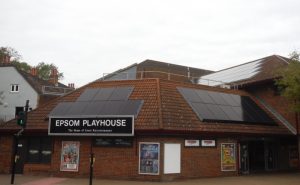
Epsom Playhouse to embrace heat pumps and trees to be felled – a planning committee’s night’s work
21 July 2026
Last night Councillors unanimously approved the council’s own application to replace ageing air-conditioning plant at Epsom Playhouse with a modern heat pump system, in a decision expected to cut the theatre’s reliance on fossil fuels.
The scheme, brought to committee because the council itself is the applicant, will see five redundant roof-mounted air conditioning condensers and a gas-fired boiler removed from the roof of the Ashley Avenue theatre and replaced with six air source heat pumps and four condenser units. The new equipment will sit within a 1.8-metre acoustic screen to control noise.
Presenting the report, a planning officer told the committee the works would modernise the Playhouse’s building services and “contribute towards the council’s net-zero objectives, and reduce the building’s reliance on fossil fuels.” Because the theatre adjoins the Grade II listed 47-51 South Street and sits next to the Epsom Town Conservation Area, officers had assessed the impact on the setting of those heritage assets, concluding it would cause “less than substantial harm” — but that this harm was outweighed by the public benefit of the energy efficiency improvements.
The council’s Environmental Health Officer raised no objection, subject to a condition requiring a report confirming noise from the new plant does not exceed 37 dB — measured at the nearest habitable window, at neighbouring properties including 39 South Street.
Cllr Alison Kelly (LibDem Stamford) asked officers whether any images were available of how visible the new acoustic screening would be from street level. The officer explained that although the fencing would stand 1.8 metres high in total, most of it would sit behind the existing roof parapet, meaning only around 1.3 metres would be visible — and only from the Ashley Avenue side of the building, a route she described as “a public thoroughfare, but not well used.”
As a verbal update, members were told Surrey County Council’s Highway Authority had raised no objection, and the scheme had received support from the Theatres Trust.
Following the questions, the application was approved unanimously subject to the conditions and informatives set out in the officers’ report — including a requirement that the equipment be removed within a month of any future cessation of use, to protect the setting of the neighbouring listed building.
Drummond Gardens: committee refuses to fell veteran oak and three poplars, approves loss of six other protected trees
The most contentious item of the evening concerned an application to fell ten trees protected by Tree Preservation Orders at Drummond Gardens, a 1930s apartment block off Christ Church Mount, after the block’s managing agents argued the trees were causing subsidence damage to the building.
The application sought consent to fell four English oaks within the private grounds of Drummond Gardens, and six Lombardy poplars in the adjoining, council-owned Long Grove Park. Following a lengthy and detailed presentation from the council’s Tree Officer, members voted to approve felling of six of the ten trees, refuse felling of the remaining four, and instead require substantial crown reduction pruning of those four as a compromise measure.
A long-running subsidence dispute
The officer explained that Drummond Gardens has “a long history of building movement,” with cracking on the building’s west-facing wall having worsened in recent years, most severely around flats 26 to 31. A potential insurance claim was first notified to the council in 2020, but was deferred at the time because the trees involved were protected and there was insufficient evidence — including missing structural engineering and level-monitoring data — to justify their removal. That evidence has since been gathered, including a structural engineer’s report, drainage surveys, and building level monitoring carried out between 2021 and 2024.
He told members the building’s foundations are shallow — between 45 and 68 centimetres deep in most places, save for a section towards the south-west corner that was partially underpinned to a depth of two to three metres in 1995. He explained that foundations of this shallow depth are “inadequate by modern standards” on clay soil, particularly where trees are nearby, though he noted that “many properties with shallow foundations on clay coexist with trees without suffering subsidence.”
Root samples recovered during site investigations were not starch-tested, meaning there is no scientific confirmation of whether they were alive at the time they were dug up — a gap in the evidence that came up more than once during member questions.
Tree-by-tree recommendations
The assessment, illustrated with photographs of each tree, distinguished between:
Oaks T5 and T6 — two middle-aged oaks close to the point of greatest recorded building movement. Mr Young said these were “clearly implicated in causing subsidence damage,” noting that even after a neighbouring oak was removed in 2020, level monitoring still showed a seasonal pattern of movement associated with these two trees. Because they are still young enough to grow significantly larger, he judged the future risk to be high and recommended felling.
Oak T12 — a small, suppressed specimen tucked behind the veteran oak, recommended for felling as being of low amenity value.
Oak T9 — a “transitionary veteran” oak estimated to be around 160 years old, likely a survivor of the field-boundary hedgerow that predates Drummond Gardens itself. Mr Young recommended this tree be retained, explaining that because the tree pre-dates the building, its long-term extraction of moisture from the clay soil may already have caused the ground — and the building above it — to settle to a lower level than it would otherwise sit at. Felling the tree now, he warned, risks the reverse effect: the ground swelling back upwards (“heave”) as the soil rehydrates, potentially causing fresh damage. He noted the tree shows signs of naturally “retrenching” — dying back at the crown and roots as it ages — which may explain readings showing the building had actually risen slightly over the past winter. His recommendation was crown reduction rather than felling.
Lombardy poplars T22, T23 and T24 — recommended for felling. These are the three poplars closest to the corner of the building where subsidence has been recorded, and Mr Young noted they also have decay at old “topping” points from previous pruning, reducing their safe life expectancy and increasing the risk of branch failure onto the more open part of the garden nearby.
Poplars T20, T21 and T25 — recommended for retention with substantial crown reduction (cutting back the canopy by around a third), rather than felling. Mr Young said building movement at this end of the site was slight, “within building tolerance,” and that there was no clear evidence any single poplar was responsible for seasonal movement.
Member questions
Before discussion began, Chair Cllr Clive Woodbridge (RA Ewell Village) noted for the record that he — and, he believed, other members — had been contacted directly by the Drummond Gardens Property Group, but stressed the committee was approaching the item “with an open mind.”
Cllr Neil Dallen (RA Town) asked whether the council would be financially liable if the committee’s decision were followed but further damage subsequently occurred. Head of Development Management and Planning Enforcement, confirmed that in principle it could be, “but they would need to do additional work to prove that.” Cllr Dallen also queried how much weight the committee should give to the council’s financial exposure in reaching what would normally be a purely planning judgement. The officer confirmed this was a legitimate material consideration in this case, given “the financial risk to the council… could be significant, depending on the extent of works that are required to the building.”
Cllr James Lawrence (Independent College) questioned the internal consistency of the recommendation, noting that Oak T9 sat close to boreholes where oak roots had been recovered — comparable evidence, he suggested, to that used to justify felling T5 and T6 — and that T9 did not show the hollowing typically associated with veteran trees. He also queried whether the level of crown reduction proposed for the poplars was proportionate, given it would need to be repeated regularly and would itself reduce the trees’ amenity value. Mr Young responded that the key distinction was vigour: T5 and T6 remain in active growth and have significant capacity to expand their root systems further, whereas T9, as an ageing tree past its physiological peak, was more likely to be naturally reducing its water demand rather than increasing it. He added that without DNA root testing, it was not possible to say definitively which poplars’ roots lay beneath the building, and that felling all six risked being “quite a scorched earth approach.”
Cllr Alison Kelly asked what risk of heave would arise if the committee took a “wholesale” approach and approved felling of all ten trees, and whether that would carry legal liability. The tree officer explained the heave risk applied specifically to the veteran oak, T9, because of its age relative to the building, but not materially to the younger oaks or the poplars, which post-date or are roughly contemporary with the building’s construction and would not have caused the ground to subside below its original level.
Cllr Robert Leach (RA Nonsuch) praised the report as “an excellent, well-written report, well-researched, well-argued, factually based,” noting that his initial assumption — that the tree officer was simply recommending wholesale felling — had not survived a proper reading of the evidence. Vice-Chair Cllr Phil Neale (RA Cuddington) echoed the praise for the report’s thoroughness, and asked whether it was coincidental that the two highest-value trees on the council’s own amenity valuation (T9 and T20) were also the two recommended for retention. Mr Young said the correlation was not the basis for his recommendation; rather, T20 and the other retained poplars back onto a more sheltered part of the group, whereas T22–T24 sit closer to an open area of garden where a falling branch would have nowhere else to land.
Responding to a question from the Chair about future monitoring, the officer confirmed that if building movement continued despite the works being carried out, officers would review whether other, currently unimplicated trees might be responsible. He confirmed that ongoing level monitoring would be carried out by the private landowner’s own structural engineer, not the council.
Decision
The committee voted to approve the officers’ recommendation in full: refusing consent to fell Oak T9 and Poplars T20, T21 and T25, on the grounds of insufficient evidence of a direct causal link to the subsidence and the harm their loss would cause to environmental quality and amenity; and approving felling of Oaks T5, T6 and T12 and Poplars T22, T23 and T24, together with crown reduction works to the four retained trees, subject to conditions.
Officers’ report put a figure on what was at stake: felling all ten trees would have represented a loss of public amenity valued, using the industry-standard CAVAT (Capital Asset Value for Amenity Trees) methodology, at £954,480. The committee’s part-refusal reduces that loss to £387,818.
Upcoming applications
Members briefly noted a report listing applications likely to come before the committee in September, including a called-in application at Langley Bottom Farm concerning a variation to affordable housing obligations, a residential care home proposed south of Oak Glade, and a 48-dwelling scheme across two flat buildings at Swail House, Ashley Road. A site visit to Swail House has already been requested and will be arranged ahead of that meeting.
Cllr Alison Kelly raised a query about tree and ground-levelling works she had observed while cycling past a site off Christ Church Road, near Oak Glade, asking whether it involved any protected trees. An officer said she understood the activity related to dormouse survey work, which requires regular checking of monitoring tubes, though officers agreed to look into the specific site and confirm whether any tree works taking place required scrutiny.
Surrey vehicle theft charge rate among lower-performing forces, figures show
21 July 2026
Surrey Police recorded 1,551 thefts or unauthorised takings of motor vehicles in 2025, with charges or summonses recorded in 34 cases, according to Home Office figures analysed by the Liberal Democrats.
That represents a charge or summons rate of 2.19 per cent. In 1,150 cases — 74.15 per cent of the total — the recorded outcome was that the investigation had been completed with no suspect identified.
The figures put Surrey in the lower half of police forces in England and Wales for the proportion of vehicle-theft cases resulting in a charge or summons, but not at the very bottom.
Excluding the British Transport Police, Surrey’s 2.19 per cent rate was the 12th lowest among 43 territorial police forces. The overall England and Wales rate in the data was 2.45 per cent.
Surrey was also among the worse-performing forces for cases ending without a suspect being identified. Its 74.15 per cent figure was the eighth highest of the 43 territorial forces, although it was slightly below the England and Wales overall figure of 75.90 per cent.
In terms of the number of vehicle thefts, Surrey sat around the middle of the national table: its 1,551 recorded offences made it the 20th highest force area out of 43. The highest totals were recorded by the Metropolitan Police, with 31,534 offences, followed by West Midlands Police with 12,979.
Among Surrey’s neighbouring and nearby force areas, Sussex had a lower charge rate of 1.47 per cent, Hampshire 1.80 per cent and Hertfordshire 1.91 per cent. Thames Valley recorded 2.45 per cent and Kent 2.46 per cent. Surrey’s proportion of cases with no suspect identified was higher than in Thames Valley, where the figure was 64.22 per cent, and Kent, at 70.48 per cent, but lower than Sussex’s 80.02 per cent and Hertfordshire’s 77.42 per cent.
Helen Maguire, Liberal Democrat MP for Epsom and Ewell, said the statistics showed that too few vehicle thieves were being brought to justice.
She said: “Across Surrey, people rely on their cars to get to work, take their kids to school, and get themselves to the doctors and other essential services. It is completely unacceptable that 1,551 individuals and families in our county have had their vehicles stolen, with so few of those responsible ever brought to justice.
“How can we expect to deter would-be thieves from stealing people’s cars when so few criminals are actually being charged by Surrey Police? The Government is asleep at the wheel and people in Surrey are paying the price.
“We urgently need to restore proper community policing to tackle car theft. For too long forces have been left overstretched and underfunded, without the resources they need to respond.”
The Liberal Democrats are calling for more neighbourhood policing and for a specialist National Crime Agency team to bring together automatic number plate recognition data, insurance records, border intelligence and information from police forces to target organised vehicle-crime networks.
The figures relate to the offence category “theft or unauthorised taking of a motor vehicle”. A charge or summons is one recorded outcome; cases may also have other outcomes not shown in the comparison.
Epsom Council leader’s delayed response to additional local government layer initiative
21 July 2026
Dalton says Surrey devolution letter was non-binding and rooted in Council’s 2025 vote
Epsom & Ewell Borough Council leader Councillor Hannah Dalton has said her decision to sign a letter supporting exploration of a new Surrey-wide “Foundation Strategic Authority” was based on the Council’s previous backing for local government reorganisation and the prospect of a future mayoral strategic authority.
The explanation follows questions raised by Epsom & Ewell Times over why Cllr Dalton signed the Expression of Interest without the matter first being referred back to the full Council.
Earlier attempts to obtain an answer were met with references to election-period restrictions, prompting criticism that the Council was avoiding a straightforward question about the authority under which its leader had acted.
In a response supplied to EET, and attributed to Cllr Dalton, the Council said the background lay in the Government’s English Devolution White Paper, published on 16 December 2024.
It said that, at a full Council meeting on 6 May 2025, Epsom & Ewell Borough Council agreed to support a proposal for local government reorganisation in Surrey. The proposal envisaged a future Mayoral Strategic Authority for Surrey, led by an elected mayor and intended to unlock the Government’s wider devolution offer.
Cllr Dalton said the Council and other Surrey authorities were now working on the reorganisation process and had recently been invited by the Government to explore a possible Foundation Strategic Authority.
The Council describes this as an intermediate stage towards fuller devolution. It says the letter signed by Cllr Dalton was a “non-binding Expression of Interest”, intended only to keep open the possibility that the proposed new East Surrey and West Surrey unitary councils could later explore creating such an authority.
The response states: “It did not commit the Council, confer obligations upon it, or determine any future course of action.”
It adds that any formal decision would follow a statutory consultation.
The answer clarifies the Council’s position that Cllr Dalton did not require a new Council resolution before signing the letter, because the authority relied upon was the Council’s broad 2025 endorsement of a reorganisation proposal which contemplated a Surrey mayoral strategic authority.
However, it is likely to leave open the political question of whether that earlier approval was sufficiently specific to authorise support for this particular Government initiative, especially where the letter was signed in the name of the Borough Council rather than simply as a contribution to exploratory discussions between Surrey leaders.
A Foundation Strategic Authority is a proposed form of combined authority with devolved powers but without an elected mayor. It may be used as a stepping stone towards a fuller mayoral combined or strategic authority. The Council says discussions with the Ministry of Housing, Communities and Local Government continue, including the next steps and the scope and timing of any statutory consultation.
The Council has directed readers to its online democracy pages for the reports and minutes relating to the 6 May 2025 meeting.
Nescot students restore Pat Eddery memorial bench at Epsom Downs
21 July 2026
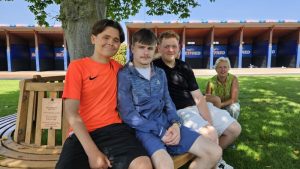
Students from Nescot have helped restore a memorial bench dedicated to legendary jockey Pat Eddery at Epsom Downs Racecourse.
The work gave young people on Nescot’s alternative provision programme, for those aged 14 to 16, practical experience in woodworking and restoration while contributing to one of Epsom’s best-known sporting venues.
Eddery, regarded as one of the most successful jockeys in British racing history, rode more than 4,600 winners during a career spanning over three decades. He was British champion jockey 11 times and won The Derby on several occasions.
His achievements at Epsom Downs, and his long association with the Derby Festival, make the restoration of the memorial bench especially significant.
Following the project, the students were invited to Epsom Downs Racecourse to see the bench reinstated in the Parade Ring. They were also given a behind-the-scenes tour of the historic Queen Elizabeth II Stand by Julie Kapsalis MBE, Principal and CEO of Nescot and a member of the Epsom Downs Racecourse Committee.
The group visited areas not usually open to the public and followed the route taken by King Charles III and Queen Camilla during their recent Derby Festival visit, ending at the Royal Box balcony overlooking the racecourse.
Julie Kapsalis said: “Working alongside The Jockey Club on projects like this is a fantastic example of how education and industry can come together to benefit both students and the wider community.
“Our students have shown tremendous dedication in restoring this important memorial, gaining valuable practical skills while helping to preserve a piece of Epsom’s unique heritage.”
Jim Allen, General Manager at Epsom Downs Racecourse, said the restored bench was “a fitting tribute to one of racing’s greatest jockeys”.
He added: “The students have done an outstanding job. The bench looks absolutely fantastic and is a fitting tribute to one of racing’s greatest jockeys.
“We are proud to see it back in the Parade Ring, where racegoers, owners, trainers and jockeys can continue to enjoy it for many years to come.”
The bench restoration is part of a developing partnership between Nescot and The Jockey Club. Nescot students also sang on the Community Zone stage at this year’s Betfred Derby Festival and have begun work on a large-scale mural for the racecourse underpass, intended to mark the 250th running of the Derby in 2029.
The project combines practical learning with the preservation of a small but meaningful part of Epsom’s racing heritage.
Photo: Nescot students with NESCOT CEO Julie Kapsalis