
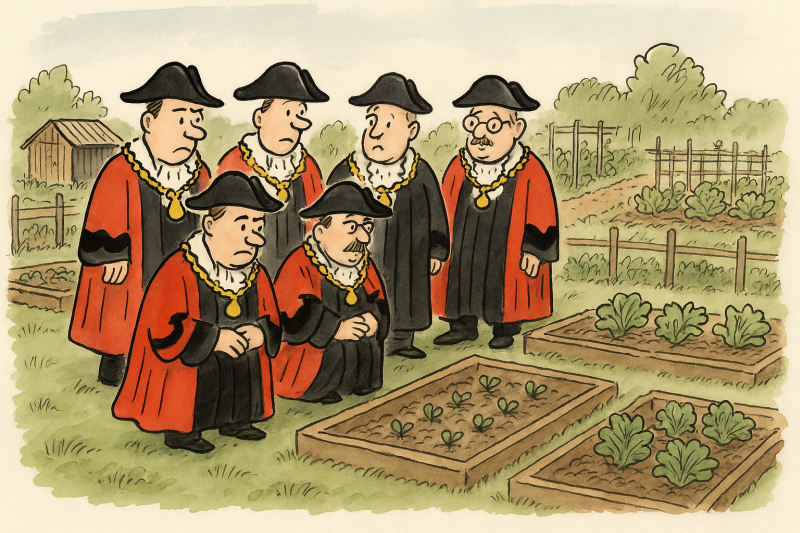
Do Epsom and Ewell Borough’s allotments need their own elected Councils?


Epsom and Ewell Borough Councillors will meet on Tuesday 9 December to decide whether to progress the next stage of creating two new parish councils for the borough before the authority itself is abolished in 2027. The proposal comes amid the Government’s reorganisation of Surrey, which will see all boroughs, districts and Surrey County Council replaced by two large unitary authorities.
Parliament’s direction of travel is clear: to simplify local government by replacing the current two-tier structure with single, consolidated authorities. East Surrey Council, which will take over responsibility for all local services from 1 April 2027, is intended to achieve economies of scale and reduce duplication between bodies. The question now before councillors is whether introducing new parish councils beneath the new unitary structure would support or undermine that objective.
Earlier this year the Borough Council launched a Community Governance Review seeking resident views on the creation of parish councils. Of a borough population of around 80,000, the consultation received 352 responses. The most favoured option was the creation of two parishes—one for Epsom and one for Ewell—each with its own parish council and councillors. Whether this level of public engagement constitutes a sufficient mandate for a constitutional change that introduces a new local taxation and governance layer is one of the issues councillors must now weigh.
The proposal is also set against the backdrop of Surrey County Council’s own recent approach to local engagement. In other parts of Surrey the County Council has piloted “Neighbourhood Area Committees” aimed at bringing councillors, residents and partners together to shape local priorities without creating new bodies with precept-raising powers. These committees are designed to provide an alternative route for local consultation and influence that stops short of formal parish governance. Whether such models should be adopted more widely under a single-tier system—and whether they might re-emerge under the new East Surrey Council—adds a further dimension to the discussion about the need for, and value of, parish councils.
Supporters of parishing argue that the disappearance of the borough council leaves a significant democratic gap. Once abolished, the entire former borough area will be represented by just ten East Surrey councillors instead of the 40 elected representatives residents currently have across county and borough levels. Parish councils would help preserve local identity, provide a community voice on issues close to home, and maintain civic traditions, including the mayoralty, which would otherwise require Charter Trustees.
However, the financial implications remain uncertain. Initially, the proposed parish councils would take on only the minimum legal duty of managing allotments, with no parks, community buildings or other assets transferred. On that basis, it is estimated by Epsom Council officers, a Band D property would pay a parish precept of about £43–£46 per year. But if parish councils later seek wider responsibilities—whether by local choice or because East Surrey Council wishes to devolve services—the cost to residents could increase. In time, this could reintroduce something resembling a two-tier model from below, even as the new unitary seeks to simplify structures from above.
Proponents of the unitary approach argue that genuine savings depend on consolidating services, not recreating local administration. Advocates of parish governance counter that representation and community influence have a value that cannot be measured solely in financial terms. Councillors, meanwhile, must judge whether the balance of risks and benefits favours moving to the next stage of consultation or pausing the process entirely.
If the Borough Council votes to proceed on Tuesday, a second consultation will run from mid-December to early February, with a final decision required before March 2026, when powers transfer to the East Surrey Shadow Authority. If the proposal is halted, decisions about any future local governance arrangements—whether parish councils, neighbourhood committees or other models—will fall to the new unitary authority.
The choice before councillors therefore becomes one of the last major decisions the Borough Council will make about the shape of local democracy in Epsom and Ewell. Residents can follow the meeting live via the council’s YouTube channel.

See