Epsom and Ewell Times
10th September 2026

ISSN, LDRS and IMPRESS logos

When a meeting is not a meeting, in brief.

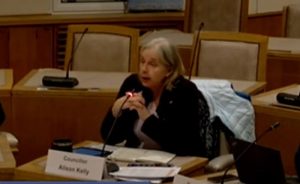
Cllr Alison Kelly at the Council meeting

The vexed issue of whether a “members’ briefing” is a “meeting” or not has received some attention of late. Anxiety was aroused by fears that a “confidential” meeting of Epsom and Ewell Councillors might effectively determine whether Green Belt land would remain in the Local Plan as potential sites for housing development. The “meeting” on 10th January was “met” by a small group of protestors who had caught wind of the event.

According to Cllr. Alison Kelly (LibDem Stamford) “I did tell a friend that I was going to a member’s briefing. I didn’t realize that I was not to disclose that. I just gave that out because a friend asked me why I can’t come out. I don’t understand why they cannot be publicly declared as meetings.”

She revealed this at the meeting of the Strategy and Resources Committee of 25th January. This was a meeting and the press and public were allowed in as usual. During a debate about the Council’s new “Communication Strategy” Cllr Kelly also said: “we’ve recently faced accusations over secrecy with response to the Local Plan Green Belt members briefings and some legal guidance; we’ve also been asked to remain silent on some matters including the existence of a briefing meeting and we seem to have had quite a lot of part two sessions [sections of Council meetings that are closed to the press and public]. How does this strategy help us to address the issue of secrecy levelled at us by the residents?”

In response RA leader Cllr Hannah Dalton (Stoneleigh) said: “The purpose of member briefings is for members [i.e., councillors] to be informed and in a safe and confidential space to ask questions, to understand information, to obtain data from officers, whether from our council or other councils or the LGA [Local Government Association] or whomever. To then provide a steer to… what then comes to committee.”

The Council’s law officer advised: “I don’t think there’s problem actually saying that you’re coming to a council briefing. If you went further to say I’m coming to a council briefing on xxx subject then that is disclosing at times confidential information.”

Cllr Steven McCormick (RA Woodcote and Langley Vale) told the Epsom and Ewell Times 15th January: that the 10th January “members’ briefing”, “…was not a secret meeting; it just wasn’t a public meeting. I stated publicly at the September LPPC Committee and extraordinary full Council on 24 October 2023 that Member briefings regarding the Local Plan would be taking place during this time period assuming the local plan was unpaused by full council, which it was.”

Epsom and Ewell’s Member of Parliament Chris Grayling has weighed in and on 31st January told constituents: “The Council has now decided to press ahead with its plans, and while details of the updated proposals remain confidential, I understand from Councillors in the ruling group that they continue to include substantial green belt development in the area. This is despite the fact that existing brownfield sites can deliver most of what is needed.”

He urged residents to make their views known to the Council.

Related reports:

Councillors belted-up on Green Belt?

Mystery Local Plan critic revealed

Image: Cllr Alison Kelly at the Strategy and Resources Committee meeting

Should we have a petition about petitions?

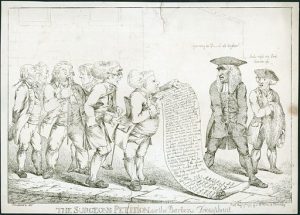
The Surgeons Petition or The Barbers Triumphant

While Epsom and Ewell Borough Council’s ePetition platform offers residents a voice in local decision-making, a closer examination of the data reveals a challenging picture. From September 2016 to the present, the Council’s ePetition system has faced difficulties in garnering community support and has seen a high rate of rejections, often on vague grounds.

Debate Requests – An Uphill Battle for Support

a) Petition Requests Submitted for Full Council Debate: 13  

b) Permitted: 4  

c) Successfully Reached Required Number of 1500 for Debate: 1

The stark reality emerges when analyzing the numbers. Despite 13 petition requests for Full Council debate, only four were permitted, with a solitary petition managing to secure the necessary support. The challenges in mobilizing community backing for debates raise questions about the effectiveness of the ePetition platform in truly representing resident concerns.

Rejected Petitions:

1. Continued designation of Hook Road Arena as Green Belt land  

   Reason for Rejection: Relates to the Council’s Planning or Licensing functions, separate statutory processes in place.

2. Railings outside the Metro Bank and Lester Bowden’s  

   Reason for Rejection: Relates to a matter for which this Council is not responsible or cannot influence.

3. Petition to EEBC regarding height and density regulations for Proposed building developments  

   Reason for Rejection: Relates to a matter for which this Council is not responsible or cannot influence.

4. Subject matter not specified in petition submission  

   Reason for Rejection: Does not meet the requirements of the Council’s ePetition Scheme.

5. Objection to the Epsom Hospital Development Scheme  

   Reason for Rejection: Does not meet the requirements of the Council’s ePetition Scheme.

6. Hook Road speed limit & cameras  

   Reason for Rejection: Relates to a matter for which this Council is not responsible or cannot influence.

7. Keep Epsom and Ewell Green Belt  

   Reason for Rejection: Does not meet the requirements of the Council’s ePetition Scheme.

8. Fairview Road temporary homes for the homeless  

   Reason for Rejection: Relates to the Council’s Planning or Licensing functions, separate statutory processes in place.

9. Compulsory Purchase Order for Horton Cemetery  

   Reason for Rejection: Does not meet the requirements of the Council’s ePetition Scheme.

Dismayed at the Council’s refusal, made on the basis it was for the Strategy and Resources Committee not the Council (sic), The Friends of Horton Cemetery set up their own petition on change.org 

The rejection of petitions, often on grounds as vague as not complying with the ePetition Scheme requirements, underscores the challenges residents face in navigating the system. This pattern raises skepticism about the transparency and accessibility of the ePetition platform.

Scrutiny and Accountability

The removal of the Council Officer appearance request from the Petition Scheme in May 2023 marks a significant shift in the dynamics of accountability, leaving residents with fewer avenues to question and scrutinize Council decisions.

Epsom and Ewell Borough Council’s ePetition system, while ostensibly a tool for community engagement, faces challenges in attracting support and exhibits a high rate of rejections. The rejection of petitions on rather vague grounds raises questions about the system’s accessibility and transparency, prompting a critical examination of the Council’s commitment to genuinely amplifying resident voices.

For more information and to explore current and past ePetitions, visit  www.epsom-ewell.gov.uk.

Image: The Surgeons Petition or The Barbers Triumphant: Science Museum, London. (CC BY 4.0)


Two Q or Not to Q? That was the Q….

Cllr Ames addresses Council

Epsom and Ewell Borough Council debated public participation in its committees on Tuesday 12th December. A proposed amendment to standing orders has the effect of restricting a member of the public to asking only one question on a topic and being confined to one supplementary question on that topic only if it arises from the answer given to the first question. And this remains the case even if there is no other member of the public wishing to use what may remain of the 30 minutes the rules provide for public participation at the meeting.

Cllr Chris Ames (Labour Court) was unhappy with this apparent restriction on residents taking part in local democracy. He moved an amendment to send back the proposal to the Council’s constitution drafting sub-committee for a re-think.

He said the rules should “not only encourage but also should not unduly restrict the right of residents to participate in public meetings.” 

In relation to the rules determining whether a resident’s question qualified to be asked he emphasized the importance of avoiding unnecessary administrative burdens on officers while promoting transparency in the democratic process.

Cllr Liz Frost (RA Woodcote and Langley) chair of the sub-committee did not accept Cllr Ames amendment and so a debate ensued.

Cllr Ames went on to argue the Council should actively encourage residents who voted for them to participate in the democratic process. In his view, the rules in question imposed unnecessary restrictions on residents, hindering their ability to engage effectively in public meetings. He expressed concern about the potential detachment of councillors from the residents.

He described the new rules as a retrograde step.

One specific point of contention for Cllr Ames was the addition of the words “and final” to an existing rule, which, in his interpretation, unnecessarily restricted the order in which questions could be asked. He called for moral courage if the Council indeed intended to restrict residents to two questions and suggested that any such restriction should be clearly stated, perhaps subject to the chair’s discretion and the existing 30-minute time limit.

He also disputed the notion that residents asking more questions would significantly burden officers, pointing out that the Council had constructed a set of rules making the process labour-intensive in the first place. In his view, the focus should be on eliminating cumbersome rules that deter resident participation.

Additionally, Cllr Ames challenged the alleged rule that a second question must be on a separate topic from the first, deeming it as another way of stifling debate. He brought up an incident where a resident was initially invited to ask a supplementary question but was later told he could not ask a second question on the same issue.

As a journalist Cllr Ames drawing from his extensive experience with Freedom of Information requests, shared his insights into how public bodies tended to complain about the cost of answering questions while simultaneously relying on rules and restrictions to avoid transparency, particularly when uncomfortable issues were raised.

He concluded by urging the Council to discard what he termed as ludicrous rules and embrace a more open approach, allowing residents to participate even if it meant confronting uncomfortable truths. Despite his impassioned plea, Cllr Frost reiterated her rejection of the proposed amendment and the “clarified” rule on public questions was approved by the majority of Councillors.

Related Reports:

Quis custodiet ipsos custodes?

Image: Cllr Ames rises in the Council Chamber. Epsom and Ewell Borough Council Youtube channel.


Alderman awards for Epsom and Ewell trio

Chris Frost, Eber Kington and late Clive Smitheram

Epsom and Ewell Borough Council Tuesday 12th December conferred the title Alderman of the Borough on three men who long served the district as local councillors.

Former Councillor Eber Kington (RA), a stalwart in local governance, dedicated an impressive 36 years of service as an Epsom and Ewell Borough Councillor, presiding as Mayor of the Borough in 1999-2000 and Deputy Mayor in 2000-2001.

Similarly, former Councillor Chris Frost (RA), with 24 years of devoted service from May 1999 to May 2023, held the role of Mayor of the Borough in 2015-2016 and Deputy Mayor in 2014-2015.

The late former Councillor Clive Smitheram (RA), who served for 23 years until April 2022, receives his recognition posthumously. His term included the role of Mayor of the Borough in 2010-2011 and Deputy Mayor in 2011-2012.

During the meetings Councillors Peter O’Donovan, Clive Woodbridge, Liz Frost, Neil Dallen, Alex Coley, Jan Mason and Hannah Dalton (RAs) paid tributes to each nominee.

At 9:55 pm the motion carried unanimously in the absence of LibDem and Labour councillors, who earlier had left the Chamber.

Related reports:

Local Council stalwarts up for local honour

Long serving Councillor Clive Smitheram dies at 76

Image: Chris Frost, Eber Kington and Clive Smitheram


Local democracy to be energised?

A packed Council meeting

Epsom and Ewell Borough Council has taken a significant step forward in opening up its committees to public participation. Under a new constitution the public now have the right to ask questions at committees on topics on the agenda! The previous constitution prohibited this.

Last night at a meeting of the Full Council a new constitution was adopted. After a year of weekly Friday night meetings and a Byzantine network of committees and sub-committees beavering away, the fruits of a cross-party effort were approved. Cllr Liz Frost (RA Woodcote Ward) was widely credited for her leadership of the initiative.

The end result is admittedly a somewhat labyrinthine set of documents: annexes within appendices within operating frameworks within a constitution. But, hey ho – the public now have clearer rights and Epsom and Ewell Times has extracted what you really need to know:

CLICK HERE for the key rules about public questions and public statements allowed at most committees of the Council. Note that these rules do not apply to meetings of the Full Council.

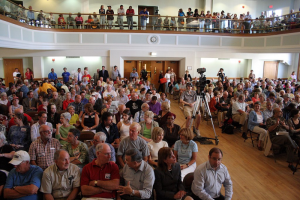
Will we now see more public participation at Council meetings, as illustrated in our accompanying image from Conneticut USA? (Happens to bear a slight resemblance to our own Town Hall Chamber). In contrast there were no members of the public attending last night’s Council meeting.

Image: Sage Ross CC BY-SA 3.0

Related reports:

Local Audit meet: unexpectedly interesting…

Council Committees: Everything you need to know


Your right to ask questions at Council

The public may not ask questions at Full Council meetings. Only most committees.

Annex 4.5 – Protocol for Members of the Public Speaking at Committees

  1. Questions and statements from the public
    1.1. At ordinary meetings of the council’s committees and sub-committees, up to 30 minutes will be
    set aside for questions and statements:
    i. On matters within the terms of reference of the body in question.
    ii. From any member of the public who lives, works, attends an educational establishment, or who
    owns or leases land in the Borough.
    1.2. This protocol is not applicable to advisory panels, regulatory committees, Epsom Walton Downs
    Conservators and Epsom Walton Downs Consultative Committee.
    1.3. The topic of the question or statement may not relate to:
    i. Specific planning or licensing cases, …….
    ii. The personal affairs of an individual.
    iii. A matter which is exempt from disclosure or confidential under the Local Government Act 1972.
    1.4. Questions and statements which in the view of the Chair are defamatory, offensive, vexatious or
    frivolous will not be accepted.
    1.5. Each question or statement will be limited to 3 minutes in length.
    1.6. This protocol does not cover questions and statements from the public for meetings of the
    Planning Committee or licensing sub-committees, which are not permitted……….. For the avoidance
    of doubt, questions and statements from the public relating to planning or licensing committees
    matters can only be made at those specific committees with the consent of the Chair of that
    committee.
  2. Procedure for Questions
    2.1. The chair of the committee shall indicate the item on the agenda at which questions may be put
    by individual members of the public. Questions are welcomed from the members of the public and
    must satisfy the conditions below.
    2.2. All questions must consist of one question only they cannot consist of multiple parts. This does
    not preclude a member of the public from asking another question on a separate topic, time
    permitting.
    2.3. A person who wishes to ask a question must submit their question in writing (either in hard copy
    or by email) to the Democratic Services Manager at democraticservices@epsom-ewell.gov.uk. The
    written question must arrive by noon on the third working day before the day of the meeting.
    2.4. The member of the public submitting a question must set out:
    i. the wording of the question they wish to ask.
    ii. an address, email address or telephone number at which they can be contacted before and after
    the meeting.
    iii. The details of where they live, work, attend an educational establishment, own or lease land in the
    Borough.
    2.5. Following receipt of a written question, the Democratic Services Manager will ensure that the
    member of the public asking the question is contacted and told whether their request complies with
    the conditions above. If contact details are not readily identifiable or have not been supplied, the
    question will not be accepted even if in all other respects it is valid.
    2.6. At the committee meeting, questions must be addressed to the Chair of the relevant committee
    / sub-committee. The Chair will invite the questioner to put the question at the meeting.
    2.7. The Chair may decline to answer a question, may give an answer orally at the meeting or may
    provide a written reply. If available, the questioner will be supplied with a written answer before the
    meeting.
    2.8. Questions regarding items on the agenda for the meeting may not receive an answer, as the
    matter will not yet have been considered.
    2.9. At the meeting the Chair will ask the questioner if the response answers their concern or if they
    wish to ask one supplementary question. If a supplementary question is asked, it must arise from the
    reply given. The Chair may decline to answer a supplementary question or invite other councillors or
    officers of the relevant body to contribute to a response.
    2.10. If a member of the public wishes to ask more than one question, their second question shall be
    taken after all other individuals who wish to ask a question have been given the opportunity to do so.
    As an alternative to submitting a written question, a member of the public may address a meeting of
    a committee or sub-committee for up to three minutes.
    3.1. A person wishing to make a statement at a meeting must provide written notice (via hard copy or
    email) including a summary of the subject matter, to the Democratic Services Manager. The written
    notice must arrive by noon one working day before the day of the meeting.
    3.2. Speakers may not engage in further debate once their statements have been made