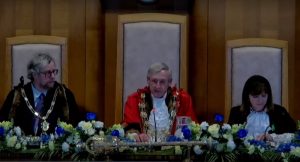
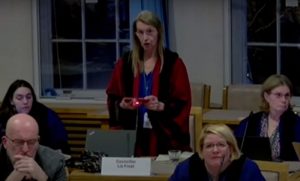
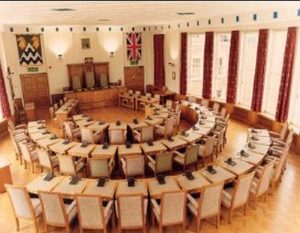
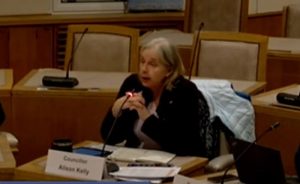
Every day the Epsom and Ewell Times brings you a fresh chess puzzle to solve. Harder to solve than any chess puzzle run so far is what, if anything, at a meeting in the Epsom and Ewell Town Hall Chamber on 1st February of the Audit and Scrutiny committee, was actually resolved on the question of how to get items on the agenda.
We don’t want to get in the way of today’s puzzle, contained in the following transcript of a Council debate, but in fairness to our readers, we should first give a few clues.
Opposition Councillors Lawrence and Ames had both advance requested items to be on the agenda of the meeting. Both requests were refused. One of the rejected items requested was the question “how to get an item on the agenda?” (!)
That issue then in fact became the matter discussed after a question was asked by Cllr Lawrence on the committee’s annual work programme that had come up for debate.
Cllr. Ames disagreed with Cllr. Leach (the Committee’s Vice-Chair) on the latter’s statement that the rules were contradictory and needed re-writing. Cllr. Ames said the rules were clear and an item should go on an agenda if requested by any councillor. Cllr. Leach stated he agreed with Cllr Ames. And that is where things are a bit puzzling.
The Council officer implied that a request for a matter to be on the agenda might be rejected if to deal with it would take up too much officers’ time preparing for the meeting. Cllr. Leach said the point of the committee was, for example, to investigate whether Council practices could be improved and money saved. If that cannot occur because of the resources that would be taken up by such enquiries it follows that the committee may be a waste of money itself.
Over to you to solve this puzzle.
Submit your answers on our online contact form or by email to admin@epsomandewelltimes.com
The TRANSCRIPT:
Audit and Scrutiny Committee 1st February 2024:
Bridger = Cllr Steve Bridger (RA Stamford Ward and Audit and Scrutiny Committee Chair). Leach = Cllr Robert Leach (RA Nonsuch Ward). Lawrence = Cllr James Lawrence (LibDem College Ward). Ames = Cllr Chris Ames (Labour Court Ward). Bercher = Andrew Bercher (Interim Director of Corporate Services).
Bridger:
Move on to item 8, which is the work programme.
Bercher:
Thank you, Chair. Yes, this is the committee’s annual work programme, and again, it has the planned activities for the next few months. This is detailed, and any changes feature in the footnotes at the bottom of each page. So again, happy for any comments on this one.
Bridger:
Do we have any questions at all for it?
Lawrence:
Thank you, Chair. I’m just going to carry on from an email that I was raising about this. So, I was wanting to have an agenda item—maybe there’s more proof for a work plan on how councillors add scrutiny items or agenda items to this committee because I know at some parts in the constitution, we get given a right to add an agenda item, but I was also told it was at the chair’s discretion. So, I just wanted to check, do councillors, as, for example, as members of the committee, do we have the right to add them, or is it a qualified right with the chair’s permission? Thank you.
Bridger:
It is. As long as you submit a written request, yes, we can put things onto the agenda. But it has to be within the correct time frame; obviously, things have got to be added, etc. No problem. Okay.
Lawrence:
Thanks, yeah, because I did send an email—I can’t remember the exact date it was, but it was a while ago. It was about asking for an agenda item. About December. It was asking for an agenda item for the committee on how we have a scrutiny action or some discussion or to say note to the steps for it. So, I remember other committees asking about it, and it wasn’t very clear to me how that process works. I just wanted to check if that’s something that’s possible to add to the work plan. Thank you.
Bercher:
Thank you, Councillor. I think there’s an element of it that depends on this: because if there is a big piece of scrutiny work that the committee wants to carry out, then that needs to be resourced. And it needs to be resourced not only by officers but potentially by members who are going to then form a separate group to go and look into whatever particular issue it might be. And when I’ve worked with these things in the past typically there’s been a little working group that’s been set up, and members have met over a number of weeks, possibly months, in order to look into things and have worked alongside officers in order to gather data, analyse data, assess, produce a report, and then bring a report back to committee.
So that kind of scrutiny activity can be quite resource-intensive. And currently, unless it’s on the work programme and is resourced, then we won’t have the capacity to do it. But it depends on what it is. If someone says, I’d like to hear at the next committee something about X, and that’s a relatively important thing but it’s an update from a particular piece of work which is already in hand. I don’t know; I’m surmising here. Then that might be relatively easy to do. So in the way that with the chair, we’ve said that we need a report every time we meet on complaints and ICO and something like that that wasn’t previously programmed, but it’s something that we’ve been able to accommodate, and very, very happy to do that. So I think it’s with your discretion as well, chairs, to what gets on the agenda.
Leach:
I think I can take the matter a little further. I had a meeting with the legal officer. It was on a ward issue, but the conversation strayed into this area. Mr. Bercher, is quite correct in saying that a scrutiny report can be very work-intensive. Yes, it can. It can also be not intensive at all. It could be something where a person could just sit down there on the spot and probably write out a report. A scrutiny really should be, as I understand it, limited to an area of the council’s work where we believe that work could be done better, it could be done more quickly and for less cost, or easily. And it is possible that having done the work, we might well conclude that we are doing it as well as it can be done, no changes needed.
I think what Councillor Lawrence is suggesting is there are areas of concern. That’s not really a scrutiny issue, but I think it’s an area where if you have a concern, and I see this committee as being totally non-partisan. So a Liberal Democrat or a Labour member has exactly the same rights as an RA member to have their concerns dealt with. It could be that just an informal conversation behind the scenes which would then be relayed back to you might be a better way than actually trying to go through a whole scrutiny procedure.
Lawrence:
Thank you both. That makes sense. I understand why you want to have a discussion first before coming to a full meeting. I have some other different agenda items, but I’ll see if anyone else wants to ask questions. Thank you.
Ames:
I remain a little bit unclear. I’m trying to reconcile the answer that you gave, Chair, just now about putting an item on the agenda with the response that Councillor Lawrence got when he ironically requested that this issue be placed on the agenda. We’re talking about the very issue of getting an issue on the agenda, and that was refused. And it was reported to Councillor Lawrence that this was your view, that this didn’t need to be placed on the agenda. I’m trying to reconcile the various responses about this being a subjective decision with the very clear statement in the operating procedure that sets out an unfettered right for councillors to request that an issue be put on the agenda for this committee, any councillor, not just a member of this committee. And that should happen.
What the framework says: Any councillor who wishes to have an item included on the agenda of this committee should give written notice of the item to the scrutiny officer. If the scrutiny officer receives such a notification, he will, in consultation with the committee chair and vice-chair, include it on the first available agenda of the committee for consideration by the committee. I don’t see the chair having a veto in that procedure or making a subjective decision.
This provision puts into the council’s constitution something that would be in statute for a council that didn’t work on the cabinet system. I don’t see it as being something that the chair is entitled to reject. There’s obviously a discussion about what would be the first available agenda, but I can’t see this committee operating its scrutiny role effectively if it’s within the gift of the committee chair and the vice-chair, who are both from the ruling party of this administration, to veto requests for something to be brought to the attention of this committee.
It simply isn’t possible to reconcile the explanations that we’ve been given with a very clear statement in the operating framework that there is an unfettered right for councillors to place an item on the agenda of this committee. These are not subjective decisions that are being taken, judgments being taken by the chair, it’s to be included on the first available agenda. It is quite clear in the operating framework, and both Councillor Lawrence and myself have had requests for something to be placed on the first available agenda rebuffed. This committee, in this sense, is not operating in line with the constitution and the operating framework. It couldn’t be clearer in the operating framework that there is an unfettered right. Things go wrong in local authorities when people are trying to bring this to the attention of a scrutiny committee, and those items are not able to be discussed. So, it’s a matter of great concern that this is happening.
Leach:
I’m not aware of the two issues that you refer to, but if you could tell me either publicly now or perhaps privately we’d certainly look into them. The constitution on how you get an item onto this agenda is actually contradictory, as you know. We have no less than 18 versions of the constitution in the last five and a half years, and the result of it is that we have now improved a constitution to the level where it is poor. We still have further to go. I mean, it is a badly drafted document, and in fact, the constitution contradicts itself. I’ve had a conversation with a view to drafting it into something which is more coherent, which will be the best plan. All this is just basically an idea I’ve had and a conversation I’ve had with the legal officer. It’s got no further than that, but it is a matter that I certainly would like to take forward to make it clearer.
Ames:
I think we’re a little bit going around in circles. What Councillor Lawrence has asked for is for this very issue to be placed on the agenda for this meeting, and that request was rebuffed. That’s a very clear explanation about what was requested.
If you feel that this item in the framework, which I’ve read, is in any way unclear, we clearly need to have a discussion on that because it’s fundamental to how this committee operates.
If members of this committee, or indeed any other councillor, Councillor Coley, for example, is not able to place an item on the agenda for this committee, as is their clear right here, and somebody says that it’s because there’s some kind of anomaly in the constitution, we need to have that discussion. This committee cannot operate as it’s set out and intended to in the constitution and operating framework if the committee chair has a veto over what can be placed on the agenda. It’s simply not what it says in the constitution and the operating framework.
Leach:
You’re absolutely correct. That’s why I believe that part of the constitution needs to be rewritten. And my idea, and this is purely my idea, it’s not an RA group’s, it’s not even the chairman’s view, but my view is if someone puts forward a motion or requests something to go onto the agenda, there should be, first of all, the consideration as to whether it is acceptable. I’m sure your request would be perfectly reasonable, but we have to allow for the fact that you could have people putting vexatious or malicious matters onto the agenda, and I believe there needs to be a filter process there whereby you could turn around and say this is not acceptable.
As for the constitution, if the member is dissatisfied, then that decision will come to this committee as to whether we would be prepared to do a scrutiny. Now that’s my suggestion that I’m happy to forward and will be putting forward. I believe that it’s necessary to have a filter to stop somebody just filling up the agenda with all sorts of things that aren’t scrutiny items while still protecting the rights of members. I stress that’s my personal opinion. It’s not necessarily something that’s going to be happening.
Lawrence:
All right, thank you, Vice-Chair. I understand there needs to be some sort of filter in what comes onto committee or agenda items. I know I’d certainly feel that way if I was the chair of a committee. Just for clarification on what I was also asking for the agenda item, it was what I was just talking about previously to Councillor Ames. It was about this committee, for example, noting the process of how a scrutiny operation would work, certainly would be useful for me, for example, because being a new councillor, I haven’t seen a scrutiny operation. I haven’t seen what can be added to a committee agenda. I haven’t seen what can be a scrutiny item or how the process works or how that filters back to the committee. So, that was the point. That was what I’d requested to go on the agenda item. That’s just for a bit of clarification and thank you.
Bridger:
Any further questions?
Thank you,
Ames.
Thank you. I’m just making one very brief comment, and I’ll leave it there because we’re not getting anywhere. I’m quite shocked by Councillor Leach’s comments. We have to have this committee operate as it is set out in the operating framework and not as Councillor Leach would like it to be. I think that’s a fairly fundamental process of how a council operates under its constitution and operating framework. We have to follow the constitution and not some version of the constitution that’s in the head of a vice-chair that would be like that if he had his way. And we’re not following the process, and we really need to follow the constitution. Otherwise, the whole idea of having a council that operates constitutionally is out the window. Thank you.
Leach:
Sorry, can I say, I again, I agree with you. I outlined how I believe the constitutional issue could be sorted out. Until that has been implemented, that’s been put to the council and been voted and supported. That is not part of the constitution. I did it as a courtesy to this committee to sort of give you forward notice as to a change that I hope to be able to make to the constitution to resolve it. But Councillor Ames, until that change has been made, if it ever does get made, yes, we have to operate under the constitution as it is. I think your criticism of me was a little unfair.
Related reports:
Local Audit meet: unexpectedly interesting…
Quis custodiet ipsos custodes?