Epsom and Ewell Times

ISSN, LDRS and IMPRESS logos

Epsom less flat after more flats approved

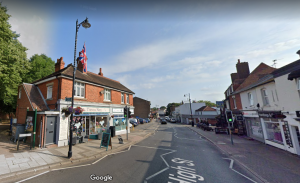
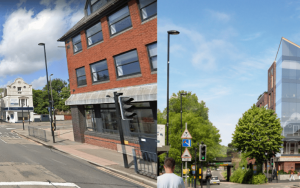
West Street before and after

Two new blocks of flats will be built next to Epsom Railway Station after planners gave the go-ahead.
Planning applications for 16 new homes on the corner of East Street and Kiln Lane and for 20 flats where West Street and Station Approach meet were approved by councillors on Thursday (June 8).

With just two affordable homes over the two developments, both will be subject to a review before completion, to determine if the schemes could provide more than are currently proposed.

Councillors at the Epsom and Ewell Borough Council planning committee meeting raised concerns about the “dreadful design” and “ruined” entrances to the town regarding the West Street development. But an attempt to refuse the application failed, when a motion put forward by Councillor Neil Dallen (Residents’ Association, Town) was lost and the application was approved with six votes in favour and three against.

The development of 20 homes, over five and six storeys, is planned for the former corn and coal merchants which was previously the home of Gillespies Bakery.

The 1905 building will be demolished for a development that was put forward by the developer as a sustainable location for homes that would benefit businesses in the town centre as well as creating jobs during construction.

Councillor Bernie Muir (Conservative, Horton Ward), who has spoken out about previous plans for the site, said the site was within the town centre conservation area and within view of multiple listed buildings. She said she wasn’t against something going on the site but worried the conservation area was “meaningless” with no reference to the surrounding buildings in the plans.

Had the designs had “some nod” to the look of that part of the town, Cllr Muir said she would be saying something different. She added: “If we don’t embrace our conservation areas and what that actually means, then we’re just another urban sprawl. And if we want to be another destination high street, this is the beginning of it. This is the one entrance to the town that hasn’t been ruined so far, and that matters to the economic life of the town.”

She and other councillors recognised the need for more housing in the borough, with the council in March having put a pause on the process to develop its plan for homes in the area.

Councillor Clive Woodbridge (Residents’ Association, Ewell Village Ward) pointed out that developers had responded to comments and designed a smaller building than plans that had been previously refused on the site. He said you “couldn’t get more sustainable” than a block of flats built next door to the train station and within walking distance of the town centre.

The East Street application, like the one on West Street, had also had previous applications refused and been amended before being approved at Thursday’s meeting.

The development of 16 flats, none of which will be affordable because the scheme would otherwise be deemed non-viable, will be allowed to go ahead after changes to previous plans.

Government inspectors had dismissed an appeal on a previous application because of concerns about pedestrians crossing the access road to the block, off Kiln Lane towards Sainsbury’s.

But after four year’s work on the proposal, which now includes pitched roofs and is of a lower height, plans had been changed and a new footpath had been added to give direct access to the site, avoiding blind corners that had been a concern.

With 18 parking spaces, a suggested condition put forward by Councillor Jan Mason (Residents’ Association, Ruxley Ward) was agreed by the committee, to allocate the spaces per flat. Cllr Mason said she wanted to avoid “fisticuffs” as there were at similar developments in her area when residents did not have allocated spaces.

She questioned the “viability” claims of developers, saying houses in Epsom sold “at a premium”, while Cllr Kate Chin (Labour, Court) called for a briefing for councillors on affordable housing and what the council could do to ensure more was built.

The scheme of eight one-bed, five two-bed and three three-bed flats was unanimously approved by the committee.

With a decision yet to be made on plans to turn the former Epsom police station into a 96-bed care home, which was due to come to a cancelled committee meeting in April, the committee’s next meeting is due to be on July 20.

Image: Before and after – West Street.

Related reports:
West Street developers climbing down enough?

Two Epsom brownfield developments?


Woking bankruptcy, far or near to us?

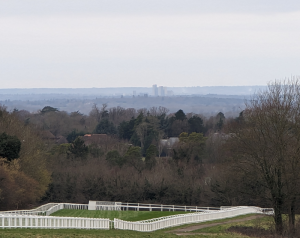
Woking from Epsom Downs

Woking maybe a town distant on the horizon of Epsom but its debts may yet ripple onto Epsom and Ewell taxpayers’ shoulders. Chris Caulfield reports.

Woking Borough Council has gone bust under the weight of its £2billion debt and banned from any new spending after effectively being declared bankrupt.

The dire situation means the council will cut all spending for non-essential services after a section 114 notice was issued. The authority’s debt is forecasted to rise to £2.6bn. The only exceptions are in cases where it must legally protect vulnerable people and for services it must cover by law.

The  full impact on residents is not yet clear. Croydon Council, which issued its third 114 notice last year, had to increase council tax by 15 per cent and its till negotiating a bail out for about half a billion pounds.
Woking Borough Council’s notice comes three weeks after Government appointed commissioners were sent in by, the Department of Levelling Up, Housing and Communities (DLHUC) over the “serious concerns” over the “exceptional level of financial and commercial risk” the authority exposed itself to, “as well as its approach to strategic financial decision making and debt management”.

Julie Fisher, Woking Borough Council’s chief executive, said: “The issuing of a Section 114 Notice is a very serious matter that rightly reflects the scale and breadth of the acute financial situation facing the Council. Through the commissioning of an independent financial review of the Council’s borrowing and loans to its companies, we have a comprehensive understanding of our severe financial position which informed the Section 151 Officer’s decision to issue a Section 114 Notice.

“The Council is required to meet within 21 days to consider the notice. I am preparing a response to this notice for an Extraordinary Meeting of Full Council that is being arranged for Tuesday June 20 to meet this requirement. Following the Secretary of State’s appointment of a Commissioning Team, I will be seeking their expertise and using their critical insight to help the council deliver an Improvement and Recovery Plan at pace to ensure we take actions that are in the interests of the public purse.

My first report on these actions will be to the Thursday 13 July meeting of the Council’s Executive.”

The council’s debt soared into the billions on the back of an investment strategy that saw it borrow hundreds of millions of pounds for regeneration projects.

The most high profile, the Victoria Square development in Woking town centre, was based on £750million in borrowing, with reports now showing the project to be worth just £200m.

The council said its Section 151 officer and interim director of finance  issued the notice “in response to the unprecedented financial challenges facing the Council.” It said “the expenditure of the council is set to exceed the financial resources available, and therefore it can no longer balance its budget for the current financial year nor subsequent years.

“Against the core funding of £16million available in the 2023/24 financial year, the Council faces a deficit of £1.2billion.”

The council has been on DLUHC’s radar for sometime, given the scale of its commercial activity and financial situation, noting that, relative to its size is became the “the most indebted local authority” in the UK.

As of December 2022 it had amassed £1.9bn of debt compared to a core spending power of £14m. The section 114 notice means it is no longer possible for the council to balance its budget but as yet the government has not committed to a bail out – the scale of which could have national implications.

The amount of money needed to get the council on to an even keel is beyond the remit of DLUHC and needs formal government approval. However leaked documents from an unpublished report suggested this could impact government borrowing ability.

Two main private companies run by the council, Wey Group and Victoria Square Woking Ltd, generated the majority of its debt through housing and regeneration schemes between 2016 and 2019.

Cllr Ann-Marie Barker, leader of Woking Borough Council, said: “My administration has been very clear about the huge financial challenges facing the council due to the legacy of inherited debt.

“The Notice makes clear the true scale of these challenges which are so significant that the Council cannot simply deal with them on its own. We must work in partnership with the whole of government and its agencies to support us in delivering a robust Improvement and Recovery Plan.

“I understand the concerns and questions this will raise, and I am committed to maintaining transparency with residents and partners as we progress through this unsettling time. Difficult decisions will lie ahead as we seek to balance the Council’s budget and address the unaffordable debt.”

WOKING’S DEBT CRISIS EXPLAINED

Related reports:

Woking Council has the worst debt in Britain!

Woking £490m write down sparks ‘worst fears’

Waking to Woking’s woeful debt

Would you want to live in Woking?

Woking up to a very big debt problem


Verging on the ridiculous

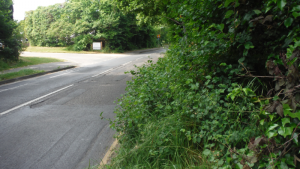
Dangerous verge overgrowth

Opinion by County Councillor Eber Kington: The decision by the Conservative ruling group at Surrey County Council to take back from April the cutting of highway verges from Epsom and Ewell Borough Council was heralded as means of securing consistency across the County. Whether that was meant to be a consistent levelling down of the service (but not the height of the grass!) I am not so sure. But so far it has been a very public display of how not to launch a new service to the public.

It’s nine weeks into the new regime and still many verges in Epsom and Ewell have not been cut, and the latest website information shows that many roads in Epsom and Woodcote will have to wait another week before the mowers move in.

There is grass so high that street name plates, bollards and signs cannot be seen, and sight lines that are dangerously obscured, making driving hazardous. Clovers, trefoils and daisies in verges that are of most nectar value and will best cater for our wildlife, are swamped by tall growing grass and weeds. And a policy of blowing back grass cuttings on to the verge, whilst sensible and manageable when the grass is cut at a reasonable level, is not workable when the grass has been left to grow so high. The blow back just spreads the grass on to the footpaths and has the potential to block the drains.

And when the machines have actually done their work, residents in our urban streets are far too often looking out at poorly mown verges peppered with clumps grass, as though our verges were experiencing a bad hair day!

SCC puts it down to “operational issues at the start of the new contract and the wet weather we had in April and at the start of May”. Is that politicians way of saying a failure to plan effectively and ensure sufficient resources were deployed from the start. And if a period of rain delays the schedule by nine weeks, that does not augur well for the future given our unpredictable climate.

Sadly, the problem has been compounded by poor communication from SCC. A website page with the scheduled dates for cuts regularly missed and not updated, and just general locations listed (Epsom, Ewell, Stoneleigh) so that residents of Cuddington and Langley Vale, for example, have no idea when their verges will meet up with a SCC grass mower.

At least the Leader of SCC has acknowledged this is not his finest hour and set up Task and Finish Groups to find what went wrong and how it can be fixed. Residents’ Association and Independent County Councillors have put in a joint submission highlighting the failings and offering solutions. Those solutions include a commitment to return to the 6 to 8 cuts previously provided by Epsom and Ewell Borough Council – the verges in residential roads are too narrow to support the meadow look.

It is going to take some time for our verges (and residents) to recover from this. Sadly there may be more to come…………..from April SCC has also taken back responsibility for weeds, alleyway clearance and highway roundabouts!

County Councillor Eber Kington (RA Ewell Court, Auriol & Cuddington)

Related reports:

Verging on reason?

A Greener Future in Partial Sight As Verges To Be Left Unmown


Birds dropping trees?

Trees at Merrow golf club

The fate of trees which a Surrey golf club wanted to cut down because of bird poo falling on its clubhouse patio is still unclear. The beech trees outside Guildford Golf Club’s clubhouse, in Merrow, were scheduled to be cut down in May, before a last-minute tree preservation order (TPO) was put in place. Guildford Borough Council’s officers put the TPO in place on Friday (May 12) just days before the trees were due to be felled, on the following Monday.

Residents and councillors had spoken out against the plans to fell the trees, which are within the Surrey Hills Area of Outstanding Natural Beauty, and officers will decide in the next six months if they should be permanently protected.

People can write to the council to give their views on protecting the trees, though the council’s former leader made clear this was not a subjective exercise, but one based on the expert opinions of the council’s tree officers.

Councillor Joss Bigmore (Residents for Guildford and Villages, Merrow) said he thought they were “beautiful” trees, but there had to be expert analysis rather than people saying: “I just like the tree.”
He told the LDRS: “They should be assessed. If they’re dangerous, then something needs to be done with them. If they’re not, then they should be protected because they’re stunning trees. But we should let the experts opine as to whether there is any real danger from them or whether they should be protected.”

The golf club set out reasons for wanting to fell the trees in a newsletter to members, seen by the LDRS, which outlined “key reasons” for wanting to fell the trees, including regarding insurance and after storms in January 2022 had brought down one tree at the club.

The newsletter also outlined the “unacceptable” problem of bird droppings falling from the trees and landing on patio seating and tables.

Residents have until June 8 to write to the council to outline their views on if the TPO should be made permanent.

Katherine Atkinson, the independent chair of the Board of the Surrey Hills Area of Outstanding Natural Beauty (AONB), said cutting down the trees “would have a significant negative impact on the local environment and the public’s enjoyment of it”. She wrote to the borough council regarding the TPO, pointing out the trees’ location in the nationally protected AONB and that they provided a “natural screen” for the clubhouse buildings, conserving and enhancing the “scenic beauty of the landscape”.

She added: “The trees provide shade for those using the public footpath (especially in the areas with benches) and because they are mature trees they provide important habitat for a wide range of species. The trees stand as a highly visible and highly valued feature within this part of the AONB, from a distance forming a natural green skyline around the clubhouse and contributing to the sweep of landscape up from the bottom of Merrow Downs.”

She said the response to the initial plans to fell the trees was “immediate and clear” and that the “amenity value” of the trees to the public was clear.

Councillor George Potter, (Lib Dem, Burpham), who sits on the district and the borough council, said the door was “always open” for the golf club to have a discussion about the plans for the trees. He added: “The borough council will make a decision based on the merits of the case, and considering comments made by any and all parties, but public support for making the TPOs permanent would certainly be welcome.”

Maggie Mamen lives in Canada, but regularly visits Guildford, and wrote to the council to call for the TPO to be made permanent. She said: “It is one of the major joys of these visits to walk up to Merrow Downs and admire the beautiful beech trees outside the club house in all the seasons. It is appalling that they are under any kind of threat.”

Guildford Borough Council spokesperson said: “A Provisional Tree Preservation Order was served on Guildford Golf Club on 11 May 2023. Interested parties have at least 28 days to comment on, object to, or support the Order. The Provisional Order will remain in force for up to six months. During this time, but only after the first 28 days, we will consider the responses and decide whether the order will be confirmed.”

Guildford Golf Club was contacted for comment.


Council to pay £15,000 to families over failings

School class

A “senior level” review into Surrey County Council’s educational shortcomings must be carried out and £15,000 paid out to the families it has failed, a local government watchdog ordered.

The county council must also demonstrate what it is doing to increase educational psychology capacity, and cut waiting times  – as well as show how it will increase capacity for specialist school places.

The ruling came in three damning reports published by the Local Government and Social Care Ombudsman against Surrey County Council that found it has again failed young people. 

In the first ruling, the county council was found to have caused someone to miss three quarters of their education  over a two year period. According to the published report, a county council ‘fault’ caused an eight-month delay in their education and evidence showed the person’s father had “concerns” his son was “academically behind as a result”. The report read: “He has not received the education he was by law entitled to receive. 

“This had a serious impact on [his] educational development and caused him distress by reason of being isolated at home. Our remedies guidance outlines that where no education is provided at all, we would normally recommend £600 per month to remedy a loss of education. There are 10 academic months in each school year. In this case, there was lack of the required provision over two academic years. This equates to a remedy of £12,000. 

“However, the council provided 27 per cent of the provision [he] was entitled to receive and so this should be accounted for. This informs a financial remedy of £8,760 to put right [the] loss of education and his associated distress.”

The county council was also ordered to apologise to the family for each area of fault and injustice cause, and to pay a further £200 as an acknowledgement of the uncertainty and distress suffered.

As a result, the ombudsman said the county council must conduct a senior-level detailed written review into its failings. It should focus on “delays in implementing timely alternative provision and the effective monitoring and recording of decisions relating to what provision is suitable in the circumstances”.

The review will then inform “service improvements and policy changes, as well as specific feedback and areas of needed training to those involved in the case”.

The second ruling, issued at the same time in April and published six-weeks later, found council maladministration caused a mother, who said she had to leave work to look after her two out-of-school children, distress. The council blamed staffing changes and shortages but there appears, the ombudsman said, to have been a lack of monitoring or oversight during one of her children’s  processes.

Documents seen by the ombudsman showed the council “delayed consulting with schools and finding suitable a school place”. 

The watchdog found Surrey County Council to be at fault and that it failed to provide education and SEN provision to the children. As a result the council was told to apologise and pay £100 for time and trouble, £1,000 for distress, and £3,300 for missed provision.

The third ruling the ombudsman issued, found the council to be at fault for a two-month delay in issuing an Education, Health and Care Plan, and then failing to provide what it recommended. The council agreed to apologise and make a payment in recognition of the injustice caused. It must now apologise and pay £200 for the frustration caused by its faults.

The council was also ordered to pay £600 for the loss of provision caused by its delay, and a further £300 every month from the date of the plan until  a special school place or suitable alternative provision can be arranged.

Within three months the council must also provide evidence of what it is doing to increase educational psychology capacity and reduce waiting times, as well as evidence of how it will increase capacity for specialist school places.

Clare Curran, Surrey County Council cabinet member for education and learning said  “We take the findings from the Ombudsman very seriously and we apologise for the distress these families experienced.

We are not able to comment on any individual children specifically, however we are constantly reviewing how we support young people who are unable to attend school, and are implementing our £180million capital programme that is increasing the availability of, and access to specialist provision. We also recognise the significant issues that confront the SEND system nationally. 

“We have seen a 64 per cent  increase in education, health and care needs assessment requests across Surrey since 2020, at a time of a national shortage of educational psychologists.”

She added that the council was doing its “utmost” to recruit more but hoped to see the shortage in trained education psychologists and other issues addressed soon through the government’s improvement plan.

Cllr Curran said: “We remain committed to improving outcomes for children with additional needs so that they are happy, healthy, safe and confident about their future.”

Related reports:

Education assessment delays making parents sick

Council pays £3,900 to mother of SEND child

Surrey County failed SEND boy


Surrey’s school transport £12M overspend

418 bus

Surrey County Council officers say the authority must tackle a £12million overspend on school transport “to avoid adversely impacting services”.

The situation is made all the more difficult as “pressures anticipated for 2023/24 are significantly higher than in recent financial years”.

Surrey County Council has a duty to ensure 160,000 school children  can get to school each day. 
Of those, about 9,600 qualify for home to school travel assistance. 

In 2021/22, 4,185 children used the travel scheme, up from 3,452 the year before. Between 2017 and 2020 the figure never topped 3,000.

The experience of families applying for travel assistance in the lead up to the 2022/23 academic year were so bad, and the service so overrun, the council set up a review that came back with 50 recommendations.

One parent interviewed as part of the process said “I felt incredibly sorry for them because they must have had every parent in Surrey with children screaming at them”.

The review found that during the peak of 2022, travel assistance teams became “stretched and overwhelmed”, with key staff absent for “reasons including stress”.

The £12m overspend is particularly bad news for parents, many of whom were forced to wait months after the academic year began to get travel provision organised by the council, as the gap between funding and demand is only set to grow, council papers showed.

According to scrutiny papers, the “overall outlook for 2023/24 is one of significant challenge, with budget envelopes remaining relatively static in the face of substantial increases in the cost of maintaining current service provision and increased demand.  Despite a small increase in the projected levels of funding, pressures anticipated for 2023/24 are significantly higher than in recent financial years.”

The main driver behind the massive budget overspend, officers said, was “significant inflation, policy changes and the need to maintain the delivery of priority services experiencing significant demand pressures”. Closing the gap, they said, would “require further actions” that would be “extremely challenging, given the level of pressure forecast, and may require the council to adopt measures that postpone the achievement of [its] ambitions”.

An update on the council’s finances, discussed on Tuesday, May 30, showed that biggest cause for the the Children, Families and Lifelong Learning directorate’s £17.8m  total overspend was the result of “rapid increases in demand following the COVID pandemic” for the travel service,  and the re-opening of schools “after the 22/23 budget setting process” which was  “further compounded by high fuel costs and driver shortages.”

Officers have said that “tackling this gap will require a fundamentally different approach, given the level of efficiencies required, to avoid adversely impacting services”.

Related reports:

School transport failings lead to foodbanks…

Families ‘in limbo’ as SCC fails on school transport

It’s Walk to School Week in Surrey


Surrey safeguarding slip-up

Surrey fines

Surrey authorities publicly named a five-month-old baby who died and his mother in a safeguarding review due to “human error”.

The LDRS* can exclusively reveal Surrey Safeguarding Children Partnership breached the anonymity of three family members by revealing their names, including the baby who died, in a document that was publicly available for nine months.

It outlined the tragic events leading up to the death of baby Acer (not his real name), a twin who was found lifeless in his baby bouncer in January 2021, after social services had been involved with his family for 14 years.

Simon Hart, independent chair of the Surrey Safeguarding Children Partnership, said the breach was “totally unacceptable” and that the partnership “sincerely apologises to those impacted by this error”.
He said the family had been informed, and were being supported.

The publicly-available review pointed to “a short-sighted decision”, “a lost opportunity” and “a lack of a coordinated approach by professionals” at various points in the family’s history. Near the end of the 32-page document, an appendix outlining the terms of reference broke the anonymity of the family and named the mother, the father and the baby.

LDRS found mother’s public Facebook profile from safeguarding report. The LDRS alerted Surrey County Council, one of three statutory safeguarding partners along with Surrey Police and NHS Surrey Heartlands Integrated Care Board, to the breach, leading to an urgent review of all other published reports.

The document had a date of August 2022, meaning the family’s details could have been in the public domain for as long as nine months by the time the breach was identified.

Mr Hart added an investigation had identified that despite going through a “thorough review process”, human error meant identifiable information was missed in the document appendices.

The LDRS was able to find a public Facebook profile appearing to belong to the mother in the family, in which she named her children, shared pictures of the twins and shared posts comparing social workers to snakes.

On alerting the county council to the breach, the LDRS made clear that no article would be published while the report was still in the public domain, in order to protect the identity of the family.

The partnership confirmed no other breaches had been found in published reports, and that staff were working “at pace” to add more steps to the review process for such documents before publication. Mr Hart also confirmed the partnership had referred itself to the Information Commissioner’s Office.
‘No other identifiable information in published reports’

Mr Hart’s full statement to the LDRS said: “On 26 May, we were notified of a data breach within a Surrey Safeguarding Children Partnership Local Child Safeguarding Practice Review report. Regrettably, the report – which should have been entirely anonymous – named three individuals in its appendices. This is totally unacceptable and the partnership sincerely apologises to those impacted by this error.

“As soon as we became aware of the data breach, we informed the affected family and will continue to provide them with appropriate support. We have urgently reviewed the SSCP website and can confirm that we have not found any other identifiable information in published reports. We have also referred ourselves to the Information Commissioner’s Office as per due process.

“We take this matter extremely seriously and a thorough investigation has identified that, although the document went through a thorough review process, human error resulted in identifiable information being missed in the document appendices. We are working at pace to add additional steps to our review processes to prevent this happening again.”

*[Epsom and Ewell’s BBC Partner – Local Democracy Reporting Service]

The full background story is HERE Child victim of Co-Vid constraints?


Child victim of Co-Vid constraints?

A five-month-old who died in his baby bouncer could have been part of a “systemic failure” of social services that were there to get the “best outcomes” for the children in his family.

“Baby Acer”, a twin who was described as a “a loved and happy child”, died in January 2021. His death came after social services had been involved with his family for 14 years, with his siblings having been on three child protection plans and three child in need plans, all under the category of neglect.

A Safeguarding practice review carried out by the Surrey Safeguarding Children Partnership into the baby’s death said the covid pandemic impacted on his monitoring at home, and set out the history of “dangerous behaviours”, substance abuse and social services involvement with the family.

Moira Murray, the lead reviewer, pointed to “a short-sighted decision” in closing the family’s case and removing the children from child protection and child in need plans, as well as “a lost opportunity” to look at the safeguarding risks to the unborn twins by not convening a pre-birth assessment for the mother.

What does the review say?

The review said: “Similarly, after their birth, consideration should have been given to convening a pre-discharge meeting in order to consider the risks presented to premature, low-weight babies returning home to parents where chronic neglect of their children had been a consistent feature of their parenting.”

Ms Murray said the 14 years of involvement should be seen in the context of “the absence of a multi-agency systemic approach to assessing the impact on the children” of being exposed to “chronic neglect and the consequences of their parents’ dangerous behaviours”.

She also said it “could be construed” that despite the known risk factors to Acer and his twin, “there was a lack of a coordinated approach by professionals” to address the safeguarding risks presented to the twins’ health and wellbeing.

Councillor Sinead Mooney, cabinet member for children and families at Surrey County Council, described Acer’s death as tragic and said the review highlighted “some areas where safeguarding practice at that time should have been better”. She added that the partnership took the safeguarding of children “extremely seriously” and would continue to ensure “all the necessary changes were made and lessons were learned”.

According to Ms Murray’s review, Acer’s mother had woken up on the morning of January 15, 2021 and found him lifeless in his baby bouncer in the living room where she, Acer and his twin sibling were sleeping.

She called an ambulance, and Acer was taken to hospital having suffered a cardiac arrest. Despite attempts to resuscitate him, Acer died aged five months old.

Acer was known as ‘Little Man’ because he was the smaller twin, and the review described both parents as “deeply distressed at the loss of their child”. In his family at the time of Acer’s death was his mother, father, twin brother and five-year-old sibling, as well as siblings aged 14 and eight, who had a different father from the mother’s previous relationship.

The family had been known to police and social services since 2006, because of domestic abuse against the mother by her then partner, according to the report. Child protection and child in need plans followed, until the mother was arrested in January 2019 for alleged assault and criminal damage, followed by a week when the children were cared for by their respective fathers.

Ms Murray said neither father want to take formal responsibility of caring for the children, despite each having raised concerns about the mother’s mental health and substance abuse, and that the children returned to their mother when a number of the charges did not proceed.

‘Acer was a loved and happy child’. According to the review: “The tragic death of Acer severely affected his parents and siblings, as well as those professionals who knew him.  That it happened at a time of an unprecedented pandemic meant that the period prior to his death was one in which there was less interaction with frontline practitioners than may have normally been the case.”

Acer and his twin were born at 32 weeks in August 2020, spent two weeks in a hospital neo-natal unit and then were sent home. Both had tested negative on a toxicology test, with neither showing symptoms of withdrawal, checked because of the mother’s history of substance misuse.

The review shows a health visitor allocated to the family made five home visits before Acer’s death, and had “stressed the dangers” of sleeping on the sofa in the sitting room with the twins, as well as sleeping in bed with them. It also said that the mother’s medication and drug use “was known to impact on her ability to stay awake and alert to the babies’ needs”.

When the health visitor had raised concerns about co-sleeping and propping a bottle to feed the babies, the mother had said she was “confident in knowing how to care for the twins”, given that she had three older children.

But the review also said that the mother had told Ms Murray she was dyslexic and had difficulty reading, and that the mother’s “level of understanding of what was being explained to her may appear to be greater than it was in reality”. She would sometimes look to the father for help on what was being said.

Ms Murray’s review said of the meeting: “It was when the named nurse for child death reviews explained in simple language that babies can die if they are not laid on their backs in a cot that mother said she now understood how dangerous it was to sleep with the babies on the sofa and in bed, and how she wished she had never placed Acer in the baby bouncing chair.”

The mother told the lead reviewer she was “shocked” to have had her children removed from her care after Acer’s death, blaming it on “a faulty baby bouncing chair”. The review said: “The tragic loss of their baby son was devastatingly apparent when the lead reviewer met the parents. 

“That Acer was a loved and happy child was evident from the way mother and father spoke about him and from the many photographs on display.” Closing case in March 2020 was ‘unwise decision’ ut Ms Murray said: “Given that from 2008 onwards until 2021, when Acer died, the children had been on a total of three child protection plans and three child in need plans, all under the category of neglect, it can be said that there was a systemic failure to achieve the best outcomes for the children of this family.”

Closing the case in March 2020, when the mother’s pregnancy with twins known, was an “unwise decision” according to the review, “given the history of chronic neglect of the children and the dangerous, risktaking behaviours of mother and father”.

It went on to say: “If the case had remained open there would have been the opportunity to continue to monitor the children and risk assess mother’s behaviour during her pregnancy and after the birth of the twins.”

Cllr Mooney said: “The report outlines the need to ensure appropriate pre-birth risk assessments are carried out, although it is noted that steps have already been taken to improve practice in this area.
“The report also highlights the continued need to remind carers about the risks associated with co-sleeping, and stresses the importance of effective multi-agency communication and practice throughout, particularly when assessing the impact on chronically neglected children. The report also recognises the significant impact the outbreak of the Covid-19 pandemic had on this case, particularly on the delivery of training to practitioners, and steps have since been taken to make training programmes more accessible online.

“As a partnership, we take the safeguarding of children extremely seriously and will continue to ensure all the necessary changes are made and lessons are learned. The Surrey Safeguarding Children Partnership has shared the recommendations of this report with all relevant agencies in Surrey.”


Ewell Village vitalisation

Ewell Village

Ewell residents are being asked to take part in a public consultation on a range of improvements to revitalise Ewell Village and help to make it a safer, more welcoming place for everyone.

The consultation will take place online and in person, with a number of drop-in events scheduled. Residents have until the end of June to have their say on the proposed improvements. See the website for more information.

Community-led research, which began in 2020, identified potential areas for improvement in Ewell Village. Following on from this, Surrey County Council carried out further research to understand what improvements were needed to meet the needs of residents. This highlighted concerns about road safety, congestion and narrow and uneven pavements throughout the village.

Working with a group of residents and local councillors, and in consultation with Epsom & Ewell Borough Council, Surrey County Council has designed a number of proposed improvements across the village based on the highlighted concerns. This includes introducing safety measures at several junctions, designed to create better spaces for pedestrians and cyclists.

However, the most significant changes are proposed for the High Street, with three different options for residents to consider ranging from partial pedestrianisation to making a section of the road one-way. All options include pavement enhancements, more space for community gatherings, additional pedestrian crossing points, and a proposed 20mph speed limit on many roads.

Councillor Matt Furniss, Surrey County Council Cabinet Member for Infrastructure and Transport, said: “Ewell Village residents have told us they would like to improve certain aspects of the village, particularly around traffic congestion and safety, and they would like to see their local area improved. I’m delighted to present a number of options to residents that address their concerns and will enhance community spaces for years to come. I look forward to hearing the feedback from residents on which of the options they prefer.” 

Detailed plans and maps, along with artist’s impressions of how the village could look, are available online for residents to view at ewellvillage.commonplace.is along with space to provide feedback.

In addition, the maps and plans will be on display in Ewell Village library, Bourne Hall, for the first two weeks of June. There will be three drop-in sessions, to meet the project team, discuss the plans and ask any questions. They will be at:

  • Saturday 3 June, Ewell Village Artisan Market,10am-3pm
  • Wednesday 7 June, Bourne Hall, Begonia room, 10am-1pm
  • Friday 9 June, Bourne Hall, Begonia room, 4pm-8pm

Residents and local businesses in Ewell can view the online consultation and provide feedback on the proposed changes by visiting ewellvillage.commonplace.is. The consultation closes on 30 June 2023.


Watch Epsom and Ewell Borough Councillors at work

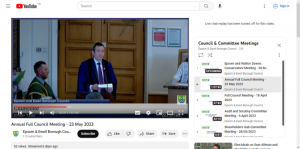
EEBC YouTube channel

Not only can you watch online all Epsom and Ewell Borough Council and Council committee meetings live, you can also catch up on those you miss on the Council’s YouTube channel.

The live online links can be found by navigating the pages of the Council website starting HERE. You will also find on those pages the agenda and background papers and minutes.

Not forgetting that the public gallery is always open for personal observation of proceedings.

Whatever grumbles you may have about your local Council it cannot be denied that its decision making is open to public inspection.

There are times when committees go into closed session and the Epsom and Ewell Times has challenged some of the secrecy. But at least you will be aware when they have gone into secret session and can challenge such decisions through the Freedom of Information Act.

The Epsom and Ewell Times champions accountability, transparency and democracy. The provision by the Council of windows for the public to its business, using today’s technologies, is to be praised.

In a world in which authoritarianism and autocracy are gaining ground it is vital at all levels of British society that we value the liberties we have. We can demonstrate how much we do so by living our democratic ideals daily, not merely paying lip-service to them at periodic elections.

Differences of view held passionately can give rise to personal antagonism but where debates are conducted fairly, mutual personal respect should prevail. Democracy leads to better decision making and can be fun. The alternatives will never be fun for anyone.

Epsom and Ewell Borough Council’s transparency through public video recording is in itself a significant contribution to maintaining a higher quality of respectful debate.