

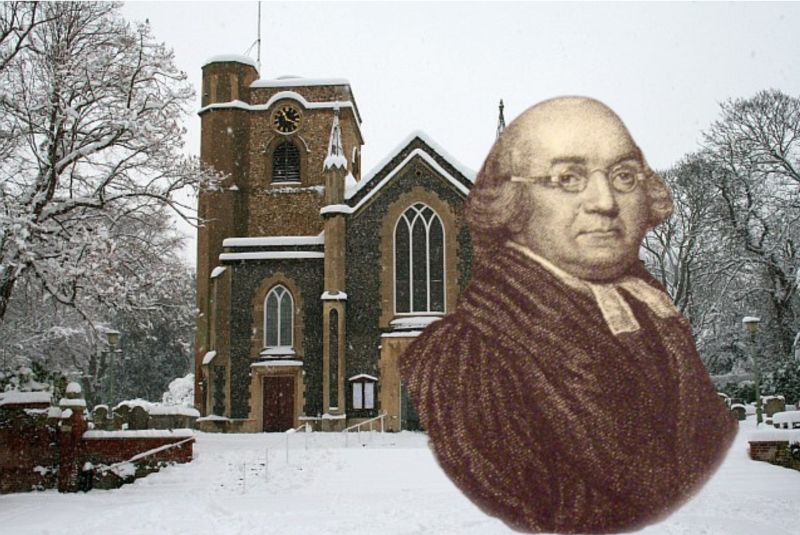
Friend of George Washington who came to Epsom after opposing armed revolt against the Monarchy


Revd. Jonathan Boucher was the Vicar of Epsom for 20 of the last 25 years of the mediaeval church, 1785–1805.
Born in Blencago, Cumbria, into a family ruined by the Jacobite rebellion, he did however get to WIgton Grammar School and eventually taught at St Bees.
He emigrated to Virginia in 1772 at the age of 16 to teach there. He served first as a tutor to the children of plantation owner Edward Dixon, and ran a school that had as a pupil Jackie Custis, stepson of George Washington.
He returned to England to be ordained and then returned and settled in Maryland through the patronage of the Governor Sir Robert Eden. He settled in Caroline county as rector of St Mary’s Parish where he served until 1772.
He resided in Port Royal but wrote in his diary: “There was not a literary man, for aught I could find.”
He had become a personal friend of George Washington and sympathetic to the interests of the colonists. He opposed the Stamp Act and the Vestry Act. He could not support armed resistance to the king.
He was always a sturdy Royalist and once thrashed a rebel Yankee blacksmith who had insulted his king and country and this made him so unpopular that he had to return to England.
Indeed he had to hold the leader of his congregation at gunpoint to ensure his safe departure. He had been informed that if he dared pray for King George he would be fired at in his pulpit.
Nothing daunted the next Sunday the resolute man ascended the pulpit stairs armed with two horse pistols, one of which he laid on either side on his pulpit cushion; with this preamble he preached what has become known as his “Farewell Sermon”.
In an unflinching sermon, on Nehemiah 6,10-11, he ended with this stinging passage.
“Unless I forbear praying for the king I have been notified that I am to pray no longer. No intimation could be more distressing to me; but I do not require a moment’s hesitation distressing as the dilemma is. Entertaining my respect for my ordination vow, I am firm in my Resolution, whilst I pray in public at all, to conform to the unmutilated Liturgy of my Church and reverencing the injunctions of the Apostle ‘I will pray for the king and all who are in authority under him as long as I live’. Yea while I have my being, I will, with Zadok, the priest and Nathan, the prophet, proclaim GOD SAVE THE KING”
The Americans had no heart to fire at so bold and honest a man and Jonathan Boucher descended his pulpit stairs unharmed.
On September 10, 1775 Revd. Boucher and his wife amidst tears and cries of their slaves, went aboard the ship “Nell Goynne” and sailed for England, where he received a government pension.
No longer living a life of ease and affluence he was at first supported by William Stevens and Friends.
Wm Stevens was it was ten years later, through the good offices of Revd. J. Parkhurst, another member of Stevens’ circle, he was appointed Vicar of Epsom in 1785.
While serving here in Epsom he gained a reputation as a writer and scholar and acquired a reputation as one of the finest preachers of his day.
He made substantial contributions to William Hutchinson’s “History of the County of Cumberland” (1794) his home county and where he was educated and had his first teaching post in St Bees.
St Bees School is on the Cumbrian coast below Whitehaven. Interestingly, in the American Revolutionary War, Whitehaven was raided by John Paul Jones the well known United States naval commander.
According to some this attack, in 1778, was the very last invasion of England.
He went on to write “A view of the Causes and Consequences of the American Revolution in thirteen discourses preached in North America between the years 1763 and 1775 which he dedicated to George Washington published in 1797, as well as “a Glossary of Provincial and Archaic Words, which was later used by the compilers of Webster’s Dictionary, and “Reminiscences of and American Loyalist” published in the 1870’s.
A magisterial biography and appreciation of his role in the revolution by Anne Young Zimmer “Jonathan Boucher: Moderate Loyalist and Public Man” (1966). In a Wayne State University Dissertation can be found on the internet
In 1786 Boucher wrote to make a proposal of marriage to Miss Mary Elizabeth Foreman a lady of about his own age (48) who had devoted herself to looking after two sick and elderly maiden aunts recently deceased.
She accepted the offer and, in anticipation of their union, Jonathan rented from Northey a large house on Woodcote Green [Woodcote House] for £100 p.a., purchased a coach and four horses, hired seven servants etc to set up an establishment in a “dear but genteel neighbourhood”.
Sadly, she, his second wife, survived only until 17 September1788.
Following her demise, Boucher had spent months away in Cumberland adding to his real estate at Blencogo but seems to have returned in December 1788 to a ‘melancholy and uncomfortable home…at the Vicarage – extremely inconvenient and quite too small especially for the books (he had ten thousand of them according to White and Hart, many collected for an improved edition of Dr. Johnson’s English Dictionary), whilst impossible to be enlarged and improved at any reasonable expense’.
He decided to purchase ‘a good house with about 5 acres of land on Clay-Hill’ although distant from the church and with an unsatisfactory water supply: alterations to provide rooms for a library were not completed until July 1789.
Consequently, when Edwards conducted a survey for his COMPANION FROM LONDON TO BRIGHTHELMSTON the vicarage house was occupied by ‘Miss Boucher’, the Vicar’s daughter.
Jonathan Boucher continued vicar of Epsom until his death in 1804.
Howard Bluett
Image credits and licence: https://creativecommons.org/licenses/by-sa/2.0/ St Martins as it is today not as in Boucher’s time. Hugh Craddock. Portrait superimposed.