Epsom and Ewell Times
19th November 2026

ISSN, LDRS and IMPRESS logos

Bitter exchanges in Epsom and Ewell Council Chamber on Local Plan oversight

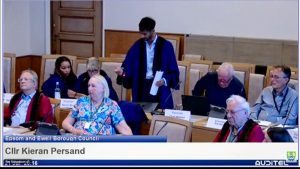
Cllr Persand speaks at Epsom Council Chamber

A bid to force greater councillor oversight of Epsom and Ewell’s Local Plan was defeated after an extraordinary council meeting descended into bitter accusations of dishonesty, procedural obstruction and democratic failure.

The motion, proposed by Councillor Kieran Persand (Conservative, Horton) and seconded by Councillor Julian Freeman (Lib Dem, College), was rejected by 15 votes to 12, with three abstentions, on Tuesday 21 July.

It sought to instruct the Licensing and Planning Policy Committee (LPPC) to review additional Local Plan documents submitted to the Government-appointed Planning Inspector after the 2025 examination hearings.

It also called for consultation responses not to be sent to the Inspector without LPPC approval. By the time the extraordinary meeting was held, however, the consultation had closed, 346 responses had been submitted and a further examination hearing had taken place on 2 July.

Recognising that events had overtaken parts of his original motion, Cllr Persand attempted to substitute proposals for an independent external review of the Local Plan’s governance.

His amendment questioned whether delegated authority allowing officers to propose “changes and corrections” to the plan and its supporting documents had been used more extensively than councillors intended.

It listed eight additional documents, covering urban sites, the Green Belt, potential housing allocations, sustainability, habitats, infrastructure and transport. Cllr Persand argued that the “scale and significance” of these documents raised questions about whether they should have gone before LPPC.

The proposed review would have examined:

  • The use of delegated powers during the examination;
  • Whether LPPC had fulfilled its constitutional role;
  • Whether councillors received adequate opportunities to scrutinise material changes;
  • Whether appropriate constitutional and legal advice was available;
  • How governance and transparency could be improved.

A separate factual report would have listed the documents submitted, the powers relied upon and the reasons they had not been considered by LPPC beforehand. The review’s findings would have gone to the Standards and Constitution Committee, the Planning Inspector and the shadow East Surrey Council.

Cllr Persand said the purpose was “to strengthen governance, transparency and democratic accountability, not to revisit the planning merits of the Local Plan”.

Mayor rejects amendments

Mayor Councillor Lucie McIntyre (RA, West Ewell) rejected the amendment under Full Council Rule 17.5 after taking officer advice.

She ruled that it was outside the scope of the published motion and did not identify a source of funding for an external review.

“The proposed amendment has no relation to the scope of the original motion,” she said. “It would not be in order to allow your proposed amendment, which seeks to make decisions which have no bearing on the original motion and provides no source of funding for the request.”

Cllr Persand disputed the ruling. “You’ve just quoted back my amendment, not really telling me why it’s out of scope,” he said. “It is about the Local Plan, but it’s also about transparency and governance, which the original motion was about.”

The Mayor said she had made her decision and invited him to follow the issue up in writing after the meeting. Following further exchanges, she agreed to adjourn the meeting so that Cllr Persand could prepare a revised amendment.

After consulting the Chief Executive and legal advisers Cllr McIntyre rejected the second version on the same basis.

When Cllr Persand continued to challenge the decision, she warned that she would ask him to leave the meeting if he persisted. “I have made my decision,” she said. “I have given my rationale. I am not going to discuss it any further.”

Councillor Bernie Muir (Conservative, Horton) intervened after another member called out during Cllr Persand’s speech. “This is not normal,” she said. “I haven’t seen this happen at county or anywhere else, where a member of the floor has piped up in the middle of someone’s speech.”

The Mayor then warned all members against interruptions.

“Masterclass” in democratic failure

Forced to proceed with his original motion, Cllr Persand launched a fierce attack on the council’s administration and handling of the plan. “This Local Plan process has become a masterclass of how not to conduct democratic decision-making,” he said. “Time and again, councillors have been denied the opportunity to do the very jobs residents elected us to do – scrutinise.”

He accused the council of cancelling meetings, delaying discussions and relying too heavily on decisions taken under delegated authority.

“Important decisions have been taken away from the committee whose constitutional role is to review, consider and help shape the Local Plan,” he said. “Councillors have too often been told what has been decided instead of being given the opportunity to help make those decisions.”

Cllr Persand claimed LPPC chairman Councillor Peter O’Donovan (RA, Ewell Court) had previously admitted not reading what was submitted to the Inspector.

“Think about that,” he said. “The chairman of the committee responsible for planning policy doesn’t know what was submitted in the council’s name. If that does not ring alarm bells across this chamber, I genuinely do not know what will.”

He also criticised the absence of a legal officer when constitutional concerns were previously raised at LPPC.

“Members were asked to consider important constitutional issues without legal advice being available in the room,” he said. “That should be a concern to every councillor here, regardless of political party.”

Cllr Persand said residents had been encouraged to spend hours responding to consultations but increasingly believed their views had “disappeared into a black hole”.

“Whether residents supported the Local Plan or opposed it is almost beside the point,” he said. “They deserve confidence that their views have been properly considered and that decisions affecting the future of this borough are being taken openly and transparently. That confidence has been damaged.”

He argued that the affair was symptomatic of broader problems at the council, referring to recent Audit and Scrutiny Committee criticism of the procedure followed over an urgent decision concerning Rainbow Leisure Centre dilapidations.

“What we are seeing is not one isolated issue,” he said. “It points to a wider pattern where proper scrutiny is too often treated as optional, where transparency comes too late and where councillors are expected to accept decisions that have already been made rather than being given the opportunity to shape them.”

Motion “out of time”

Councillor Steve McCormick (Conservative, Woodcote and Langley Vale) agreed with the motion’s underlying concerns but acknowledged that one of its proposed instructions was no longer capable of being implemented.

“Major, highly sensitive Local Plan evidence submitted under delegated authority was sent to a Planning Inspector without prior consideration or scrutiny by the Licensing and Planning Policy Committee,” he said. “When the committee tasked with setting out our planning framework is bypassed, our elected members are sidelined and our residents are completely left in the dark.”

However, the consultation had already closed and its responses had been sent to the Inspector. “Recommendation two is simply out of time,” Cllr McCormick said. “All 346 responses have long been sent to the Inspector, and the hearing itself concluded on July 2.” He added: “We cannot rewrite the past, but we must urgently address how we restore transparency, enforce committee oversight and ensure our residents are never shut out again as we move towards the main modifications stage.”

Councillors “struggled” to participate

Councillor James Lawrence (Independent, College), elected in 2023, said he had struggled to become meaningfully involved in Local Plan decisions. “I haven’t been able to be involved in a single public committee, apart from the one committee in November 2024, which released over 1,000 new pages in seven days to read,” he said.

“That’s not a realistic way to run a committee system. We’re not resourcing our committee system properly. You cannot make considered decisions on that basis.” Cllr Lawrence said committees should be properly engaged because they provided the principal means by which backbench councillors could influence decisions. “If we just get presented with 1,000 pages and seven days to read them, you’re not going to get a meaningful decision,” he said.

Councillor Kate Chinn (Labour, Court) said the “spirit of the motion is absolutely correct”. “We need a plan for the borough,” she said. “It needs to go to Licensing and Planning Policy Committee to make those decisions in the authentic and proper way.”

Cllr Muir described three recurring problems: “Transparency, scrutiny and a fair understanding of our concerns.”

“It has been an almighty struggle to actually have any input that’s been considered,” she said. “We cannot treat members like this. When you treat members like this, you are treating our residents like this.” She said councillors in other authorities were astonished when told how the process had operated in Epsom and Ewell. “Every single member in this room should feel appalled – absolutely appalled – at how we are consistently treated,” she said.

Councillor Christine Howells (RA, Nonsuch) said the sole issue should be whether the correct process had been followed. “It is eminently clear that this process was fundamentally flawed,” she said. “Due diligence now has to take place to show transparency, accountability and regain trust in the system.”

She urged members to put “duty, honesty and integrity” above political allegiance, warning: “This vote will be judged and scrutinised by the residents.”

“Democracy is being subverted”

Councillor Chris Ames (Labour, Court) linked the Local Plan dispute to wider concerns about transparency and officer decisions. When he began referring to the Rainbow Leisure Centre dilapidations issue, the Mayor twice directed him back to the motion. The Mayor being the daughter of Cllr Neil Dallen, who Ames has criticised in connection with the alleged “cover-up” of the £500,000 dilapidations Rainbow Centre bill.

“I really don’t think it’s for you to tell me what my speech is to be about, Madam Mayor,” he replied. “If I think this is relevant, I will make this point. I will not be silenced.”

He accused the administration and senior council figures of using procedural rules to prevent legitimate debate.

“There’s a pattern here,” he said. “Procedural rules are being used all the way along to stop councillors discussing things. This is supposed to be a democratic council, and democracy is being subverted.”

Defence of officers and administration

Councillor Clive Woodbridge (RA, Ewell Village) mounted a forceful defence of council officers and rejected opposition claims that the process lacked transparency.

“One of the most disgraceful things about this whole Local Plan process is the way that the opposition criticises officers – officers who work diligently and hard on behalf of us and our residents, and they’re not in a position to fight back,” he said. He described Cllr Ames’s criticism as “unconscionable” and called on opponents to reconsider the appropriateness of their language.

Cllr Woodbridge said opposition councillors had been given time to prepare an amendment which could properly be debated but had failed to do so. “Rather than blaming us, blaming the Mayor or blaming officers for this, they only have themselves to blame,” he said.

He said an officer had given a lengthy explanation at the previous LPPC meeting and the council’s Monitoring Officer had repeatedly stated that the constitution and due process had been followed. “It’s not about transparency,” Cllr Woodbridge said. “They just don’t like the answer that they get.”

He alleged that the opponents’ real objective was to stop the plan. “What they’re dressing up as transparency and integrity is that they want to stop this Local Plan,” he said. “We know we have to deliver a Local Plan for our residents that protects the Green Belt, protects our environment and delivers the housing that our current and future generations need.”

Cllr Woodbridge nevertheless agreed that residents and councillors should be involved when the Inspector’s proposed main modifications were published.

Delegation dispute

Councillor Shanice Goldman (Conservative, Nonsuch) said she had been an LPPC member when the disputed delegated authority was approved. “In no uncertain terms, we were told that the delegated authority was going to be for the purpose of making small changes, including grammatical errors and spelling mistakes,” she said. “We were not told that material changes would be made by way of delegated authority.”

She said members had been misled about the effect of their decision, while stressing that she was not alleging bad faith. “We took a vote with the information that was given to us,” she said. “That information was misleading. It was wrong.”

Councillor Alex Coley (Independent, Ruxley) said he had raised infrastructure issues directly at the examination hearing because he felt unable to do so through the council. “I made the point that I did it in that forum because I’m not able to do it at this council, either by committee or by talking directly to officers,” he said.

Although the Inspector suggested that councillors and officers should communicate, Cllr Coley said he had received no subsequent approach from the planning policy team. “This blanket, umbrella coverage of delegated authority suggests that councillors are not allowed to take part any more in their own process,” he said.

Councillor Alison Kelly (Lib Dem, Stamford) rejected Cllr Woodbridge’s contention that critics wanted to derail the Local Plan. “What we want is a Local Plan that has fulfilled all the consultation that’s necessary,” she said. “My personal disappointment was that we couldn’t have had an extra LPPC meeting before those original documents were submitted.”

She added: “I definitely want a Local Plan because it’s in the residents’ interest to have a Local Plan.”

“Worst-run council”

Cllr Freeman, who seconded the motion, strongly criticised the handling of the meeting itself.

He said the original motion had been available for two weeks, yet councillors received procedural advice shortly before the meeting which raised doubts about what they could debate. “This should have been quite a simple, straightforward process,” he said. “Instead, it has descended into farce, with people shouting out, being accused of things and being told they can’t talk about this and they can’t talk about that.”

Drawing a comparison with the shadow East Surrey Council, where he serves as a member, he described Epsom and Ewell as “probably the worst-run council I’ve ever had experience of….. For me, there has been a complete lack of due process,” he said. “This underlines why it is a good thing, in my view, that this council will soon cease to exist.”

He added: “In the end, I think there has been a failure of adequate oversight over this whole Local Plan process.”

The Mayor subsequently said Cllr Persand’s amendment had been submitted at 6.39pm, but corrected herself after he protested, confirming it had been sent at 5.04pm. The original motion had been published two weeks earlier.

LPPC chairman rejects accusations

Cllr O’Donovan disputed Cllr Persand’s assertion that he did not know what had been submitted.

“I did not read the actual responses, but I was in full conversation with the Head of Planning Policy and Economic Development,” he said. “I knew what was being asked, what was being replied to and therefore I was in full knowledge of what was being sent.”

He stressed that delegated authority did not require him to sign off individual documents. “I have to make it clear: under the delegated authority, it is not for me to sign anything off,” he said. “But I was well aware of what was being said.”

Responding to Cllr Goldman, Cllr O’Donovan said the full wording of the delegation appeared in the committee papers available to councillors before the November 2024 meeting. “I did not mislead anything,” he said. “The full motion was there, and you could have read it.”

Cllr O’Donovan said the necessary political decisions had been made during preparation of the plan. During examination, responsibility for the process rested with the Planning Inspector, who requested additional evidence to address concerns about soundness. “That work was completed under the delegated authority granted in November 2024,” he said.

The Inspector then approved publication of the additional documents for consultation. At the 2 July hearing, she indicated that documents submitted during the examination could only be withdrawn at her direction.

“As the documents and consultation responses have been published on the examination webpage under the direction of the Inspector, both parts of the motion being considered this evening cannot be implemented,” he said.

Cllr O’Donovan said the Inspector appeared likely to find the plan sound, subject to main modifications. Those modifications would be consulted upon before Full Council decided whether to adopt them. “If we decide not to, then the plan will not be found sound, and we will be in serious trouble,” he said.

Cllr Goldman replied that she had read the papers and fully participated in the November 2024 debate.

“Members of the committee queried the scope of the delegated authority,” she said. “We were then given assurances by the chair that the scope would be limited to small changes, including grammatical errors. That’s what we were told.”

Accusations of lying

In his final reply, Cllr Persand accused Cllr O’Donovan of making two false statements and said video evidence supported his account of what the LPPC chairman had previously said. “You did say that you hadn’t read the papers,” he said. “That is on a video recording.”

He accused Cllr O’Donovan of having “passive involvement versus active involvement” as LPPC chairman and said it was inappropriate given the significance of the Local Plan. “You’re under no obligation to read a paper for us, but you are under an obligation not to mislead the committee and to lie,” he said – apparently meaning not to lie.

Cllr Persand maintained that the November 2024 delegation had been presented as covering minor amendments rather than the material changes subsequently submitted. “There is a culture in this chamber and council where scrutiny is treated as an inconvenience, where transparency is something to be managed rather than embraced,” he said.

He rejected claims that the opposition wanted to defeat the plan. “All of us want a Local Plan. All of us want a sound Local Plan,” he said. “It’s the RA who are bulldozing decisions through without proper consultation, notification or working with other councillors.”

Cllr Persand turned his fire on the Residents’ Association’s record in local government, arguing that voters had already passed judgement in the East Surrey elections, at which only two RA candidates were elected. “You will not be leaving a positive legacy,” he told the administration. “Residents made that very clear in the last local elections.”

Cllr O’Donovan immediately objected to being accused of lying. “I’ve been accused of deliberately misleading the council and lying,” he said. “I just think that is unacceptable language.”

“I’m not lying,” he added during a brief exchange across the chamber.

The Mayor ended the argument and called the vote. Twelve councillors supported the motion, 15 opposed it and three abstained.

The motion was therefore defeated, leaving the additional examination documents without the retrospective LPPC review sought by its supporters. No external governance review or factual report will be commissioned under Cllr Persand’s rejected amendment.

The meeting closed at 8.22pm.

Sam Jones – Reporter

.

Related reports


Surrey Council leader thinks new PM will back a County Mayor

Cartoon of Oliver and Burnham dreaming of a Surrey Mayor

Surrey County Council’s leader says he expects Andy Burnham to “turbocharge” initiatives that could see the county get its own elected mayor.

Speaking at a meeting of the full council, Councillor Tim Oliver said he “fully expects” the new Prime Minister to lean hard into the devolution of powers to England’s regions.

Councillor Oliver is serving a final stint in office before the county council he leads is abolished, along with Surrey’s 11 district councils. These will be replaced next April by two unitary councils in East Surrey and West Surrey, each of which will be responsible for all local government services in its respective area.

But Councillor Oliver expressed his hope that these reforms will go one step further, leading to the creation of an overarching elected mayor for all of Surrey.

He said he is “pleased to see” progress being made towards the establishment of a foundation strategic authority (FSA) – a county-wide body that would serve as a stepping stone towards a new mayoralty.

Councillor Oliver said: “Having seen the Secretary of State last week at the LGA (Local Government Association) conference, I know it is his hope to establish that FSA here in Surrey. And I’m confident that will lay the ground for a directly elected mayor of Surrey in the near future.”

Former Greater Manchester Mayor Andy Burnham, who was elected as MP for Makerfield last month succeeded Keir Starmer as Prime Minister yesterday

Mr Burnham has championed greater devolution of powers to regional governments across Britain, which is set to be a signature part of his policy programme. He served for nine years at the head of Greater Manchester’s combined authority, a body that brings together the region’s 10 boroughs under one directly elected mayor.

Councillor Oliver said he hopes Mr Burnham’s experience as a regional mayor will inspire him to roll out further devolved powers and new mayoral authorities.

He said: “I fully expect our incoming Prime Minister to turbocharge that devolution agenda, having seen first hand the benefits of a mayoral system – and with change, growth, and improvements in local services that can be delivered.”

The abolition of Surrey County Council comes as part of a wider local government reorganisation, which is seeing mergers in many “two-tier” authorities where there are separate county and district councils.

Areas with this two-tier structure have local government responsibilities split between these two types of council, while newer unitary authorities oversee all services.

Councillor Oliver said he believes Surrey County Council officers and councillors have “a record to be proud of”.

“We said we would make Surrey fit for the future, and we have done just that,” he added. “Over recent years, many councils across the country have struggled, and Surrey has met those challenges head-on and thrived. Our finances have been transformed to a point where we have a stable, balanced budget, even in the face of extreme pressures.”

Elections were held for the West Surrey and East Surrey “shadow authorities” in May, which will work to get the new councils up and running in time for the handover of power in April 2027.

Councillor Oliver previously told the Local Democracy Reporting Service (LDRS) it is his “expectation” that Surrey could be ready for mayoral elections in 2028, alongside four other new combined authorities.

However, this would depend on the green light for its creation being given by central government.

James Moules Local Democracy Reporter

.

.

Related reports

.

.

.

.


Wild Arts brings Mozart and opera favourites to Surrey

Marriage of Figaro scene courtesy Wild Arts

Opera will be coming to Surrey this summer as the touring company Wild Arts presents Mozart’s The Marriage of Figaro in Guildford and at Titsey Place.

The production visits the Yvonne Arnaud Theatre in Guildford on Friday 7 August before returning to the county for a performance at Titsey Place, near Oxted, on Sunday 6 September.

Titsey Place will also host An Evening of Opera on Saturday 5 September, combining well-known operatic arias with songs from classic musicals.

Founded in 2022, Wild Arts takes opera and classical music to theatres, country houses, gardens and other distinctive venues around the UK. Its productions favour intimate staging, imaginative costumes and close engagement between performers and audiences rather than large sets and heavy touring equipment.

The company also supports singers, musicians and theatre practitioners at the beginning of their professional careers through its Emerging Artist Programme.

Its new production of The Marriage of Figaro marks the directorial debut of international opera singer Danielle de Niese. Orlando Jopling conducts the ten-player Wild Arts Ensemble, with the opera performed in English in a new translation by de Niese and Jopling.

Mozart’s comedy follows Figaro and Susanna on the morning of their wedding, when they discover that their employer, Count Almaviva, has designs on the bride-to-be.

A day of disguises, misunderstandings and plotting follows as servants attempt to outwit their master and ensure that the wedding goes ahead. Among the opera’s best-known musical moments are its fizzing overture, the Countess’s aria “Dove sono” and the jubilant finale.

The cast includes Jack Sandison as Figaro for the Guildford performance, Ellie Neate as Susanna, Timothy Nelson as Count Almaviva and Elinor Rolfe Johnson as Countess Almaviva. Matt Siveter takes over the role of Figaro for the September performances.

They are joined by Abbie Ward as Cherubino, Olivia Ray as Marcellina, Timothy Dawkins as Bartolo and Antonio, William Searle as Don Basilio and Don Curzio, and Eleanor O’Driscoll as Barbarina.

Wild Arts describes the production as an evening of “sparkling tunes, tangled romances and razor-sharp wit”, staged with bold costumes, inventive props and an emphasis on pace and storytelling.

The company’s second Surrey offering, An Evening of Opera, is intended to provide an accessible introduction to the art form as well as an entertaining programme for established opera enthusiasts.

Devised and directed by Guido Martin-Brandis, the semi-staged production follows four singers through a 75-minute story of intrigue, jealousy, comedy and love, accompanied by a string quintet.

The programme brings together music by Handel, Mozart, Puccini, Rossini and other leading opera composers alongside songs by Irving Berlin, Leonard Bernstein, Rodgers and Hammerstein and Noël Coward.

Selections include the Flower Duet from Delibes’ Lakmé, the overture to Rossini’s William Tell, “Anything You Can Do” from Annie Get Your Gun, “On the Street Where You Live” from My Fair Lady and “Make Our Garden Grow” from Candide.

The Surrey performances are:

The Marriage of Figaro
Friday 7 August – Yvonne Arnaud Theatre, Millbrook, Guildford GU1 3UX

An Evening of Opera
Saturday 5 September – Titsey Place, Oxted, Surrey

The Marriage of Figaro
Sunday 6 September – Titsey Place, Oxted, Surrey

Further information and booking links are available from the Wild Arts website and its dedicated Marriage of Figaro page. Tickets for the Guildford performance are available through the Yvonne Arnaud Theatre.

Lionel Blackman Photo: Marriage of Figaro scene courtesy Wild Arts


New Gatwick wetland aims to reduce flood and drought risks

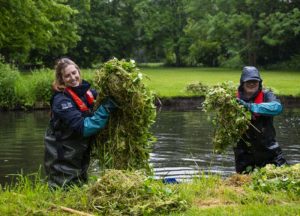
Weed clearing courtesy South-East Rivers Trust

A new wetland capable of holding up to 600,000 litres of water has been created near Gatwick as part of efforts to make the Upper Mole catchment more resilient to flooding, heatwaves and prolonged dry weather.

The South East Rivers Trust has completed the latest phase of a project using natural measures to slow, store and filter water before it travels downstream.

Across two sites, the environmental charity has created the wetland and reconnected 100 metres of river with its natural floodplain.

The wetland will collect rainfall and surface water, releasing it gradually downstream. Restoring the connection between the river and its floodplain will also give water more space to spread out and be held temporarily during periods of heavy rain.

The measures are intended to ease pressure on downstream communities when rainfall is intense, while keeping more water in the landscape during hot and dry periods. The restored areas should also provide new and improved habitats for wildlife.

The work was funded by London Gatwick through its Decade of Change sustainability programme, a strategy covering 10 environmental and social priorities up to 2030.

The latest phase, delivered between July 2025 and June 2026, included:

  • Installing more than 50 “leaky barriers” to slow the movement of water;
  • Planting a 100-metre hedgerow containing 400 native trees;
  • Bringing two more landowners into the catchment project; and
  • Monitoring rainfall, river levels and water clarity to study how water moves through the landscape.

Leaky barriers are carefully positioned structures made from natural materials such as branches and logs. Under normal conditions, water can continue to flow through them, but during heavier rainfall they slow the flow and hold back some of the water temporarily.

George Biggs, project officer at the South East Rivers Trust, said the recent spell of hot and dry weather illustrated one side of the challenge facing the area.

“During the current hot and dry weather, it can be difficult to imagine how quickly heavy rainfall can create problems for our rivers and local communities,” he said.

“The Upper Mole responds very rapidly when it rains, with water moving quickly through the catchment. By restoring wetlands, reconnecting rivers with their floodplains and installing leaky barriers, we can give that water more space and more time.

“These measures help create a healthier, more resilient landscape that is better prepared for both very wet and very dry conditions. They also provide valuable new habitats for wildlife.”

The Upper Mole is particularly responsive to rainfall because of its clay soils, modified river channels and surrounding urban development. Heavy rain can move rapidly downstream, increasing the risk of flooding and placing additional pressure on water quality and river habitats.

Natural flood management seeks to tackle those problems nearer their source by working with the landscape to slow, store and filter water.

Mark Edwards, head of sustainability at London Gatwick, said: “This important initiative, delivered in partnership with the South East Rivers Trust, is a vital part of London Gatwick’s Decade of Change sustainability programme.

“This partnership is a great example of bringing together technical expertise, landowners and local knowledge to deliver practical measures that support biodiversity, water quality and climate resilience.

“It demonstrates how London Gatwick can support enhancements to the local area outside the airport.”

Further restoration work is now being planned across the Upper Mole catchment. Proposals include restoring an old pond so that it can store more water and support biodiversity, installing additional leaky barriers and designing another wetland to improve water quality and availability.

The partners also intend to extend the project into another of the Upper Mole’s six waterbodies, continue monitoring the measures already installed and hold community engagement days about the river and natural flood management.

The project initially concentrated on the headwaters of the River Mole, including Baldhorns Brook near Rusper. Its longer-term ambition is to expand throughout the Upper Mole catchment and demonstrate how nature-based measures could help restore other urban river headwaters across the South East.

Monitoring equipment is recording rainfall, river levels and turbidity – a measurement related to water clarity – so that the Trust can assess how the catchment and the completed interventions respond to wet weather.

Further information about the Gatwick Airport Natural Flood Management Project is available from the South East Rivers Trust.

Sam Jones – Reporter

.

Photo: Weed clearing – courtesy South-East Rivers Trust


Surrey University leads research against anti-biotic resistance

Artist’s impression of Pseudomonas aeruginosa bacteria encased within a protective biofilm under flowing conditions.

Faster and more effective ways to treat pseudomonas aeruginosa, a bacterium identified by the World Health Organization (WHO) as one of the most life-threatening pathogens, could be on the cards thanks to a first-of-its-kind 3D computer model developed by the University of Surrey.  

The model has shown how pseudomonas aeruginosa grows and reshapes its protective layer and spreads to new surfaces. The WHO estimates that bacterial antimicrobial resistance – where antibiotics are no longer effective – was directly responsible for 1.27 million deaths worldwide in 2019 alone. 

In a study published in npj Biofilms and Microbiomes, researchers used BioDynaMo, an open-source simulation platform developed as part of an international collaboration involving the University of Surrey and partners worldwide, to create a three-dimensional agent-based model (ABM) that recreates how pseudomonas aeruginosa forms biofilms.  

Biofilms are communities of bacteria encased in a protective sticky layer made up of sugars, proteins and DNA that allows them to cling to surfaces and resist antibiotics. For Pseudomonas aeruginosa, these biofilms commonly form in flowing environments such as catheters and plumbing systems. 

Unlike previous computer models, the Surrey-developed ABM captures how biofilms grow under constant fluid flow – similar to real-world conditions – and how the bacteria naturally break away from them to spread and colonise new surfaces. The team validated the simulation against laboratory experiments, demonstrating that it accurately reproduces the growth, structure and detachment patterns seen in real bacterial biofilms. 

Ryan Bournes, postgraduate researcher at the University of Surrey and lead author of the study, said: 

“Biofilms are incredibly difficult to study because many of the important interactions happen at a microscopic level. Our model allows us to simulate these processes in a virtual environment, making it much easier to test new ideas and understand how these bacteria spread without solely relying on costly and time-consuming laboratory experiments.” 

As well as helping scientists study pseudomonas aeruginosa, the modelling framework could be adapted to investigate other biofilm-forming bacteria and predict how factors such as fluid flow, surface design and bacterial behaviour influence the spread of infection.  

Dr Roman Bauer, Senior Lecturer at the University of Surrey’s Computer Science Research Centre and BioDynaMo spokesperson, said: 

“Antimicrobial resistance is steadily rising due to the overuse and misuse of antibiotics, so finding faster and smarter ways to understand the behaviour of pathogens is essential.  

“Using BioDynaMo, we’ve been able to recreate for the first time how Pseudomonas aeruginosa biofilms grow, change shape and spread under flowing conditions – biological processes that would be extremely difficult, expensive or even impossible to observe directly. This gives researchers a powerful new tool for virtual testing before moving into the laboratory.” 

The research could help researchers optimise experiments, reduce laboratory costs and support the development of safer medical devices, hospital plumbing systems and other environments where harmful biofilms can form. 

Surrey University

.

Image: Artist’s impression of Pseudomonas aeruginosa bacteria encased within a protective biofilm under flowing conditions.


When the Rolling Stones rolled into Epsom — twice

Rolling Stones Foreign Tongues album cover

Before the stadium tours, private jets and worldwide fame, five young rhythm-and-blues musicians performed on a temporary floor laid over the swimming pool at Epsom Baths Hall. More than six decades later, as the Rolling Stones celebrate another chart-topping album, local history reveals that the band visited Epsom not once, but twice.

The Rolling Stones have returned to the top of the British album chart with Foreign Tongues, released on 10 July. It is the band’s 25th studio album and their 15th to reach number one in the UK—putting them level with the Beatles and one behind record-holder Robbie Williams.

That remarkable longevity offers an opportunity to look back to two winter Saturday nights in Epsom, when Mick Jagger, Keith Richards, Brian Jones, Bill Wyman and Charlie Watts were still climbing towards stardom.

A swimming pool became a concert hall

Epsom Municipal Baths opened in East Street on 15 March 1939. The £65,000 complex had been designed from the outset to serve two very different purposes: swimming during the warmer months and public entertainment during the winter.

Its main pool was 100 feet long and 35 feet wide, with galleries seating 412 people. For dances, concerts, boxing and theatrical performances, a moveable maple floor supported by tubular scaffolding was erected over the water. A stage, lighting system, microphone and record turntable completed the transformation. The converted hall was licensed to accommodate as many as 1,396 people for music, dancing and public meetings.

It must have produced an unusual atmosphere: a rock-and-roll audience gathered on boards above the drained or concealed pool, surrounded by tiled walls, diving boards and the acoustics of a municipal swimming bath.

After the Second World War, the Baths Hall became one of Epsom’s principal social venues, hosting dances, boxing, orchestral performances and visiting entertainers. The Epsom and Ewell History Explorer describes the Rolling Stones’ 1963 engagement as a sold-out highlight for which the band received a fee of £60.

Saturday 14 December 1963

The best-documented Stones appearance took place on Saturday 14 December 1963.

“Star Rhythm Blues Time with the Rolling Stones”

The publicity picked out the band’s two records, Come On and I Wanna Be Your Man, and advertised an appearance by supporting group The Presidents, described as “that ever popular attraction”. Dancing and music were scheduled from 8pm until 11.30pm. Tickets cost five shillings and sixpence in advance or six shillings and sixpence at the door, with reduced rates offered for parties.

The instruction to “get your tickets early and avoid disappointment” proved well judged if the History Explorer’s record of a sell-out is correct.

A surviving business trail also corroborates the engagement. Christie’s has catalogued an Eric Easton Ltd performance contract for the Rolling Stones at Epsom Baths Hall among a collection of early Stones agreements covering venues in and around London during late 1963. Eric Easton was then managing the group with Andrew Loog Oldham.

The Epsom booking came at a fascinating point in the band’s ascent. They were no longer an unknown club act, but neither had they become the international institution familiar today.

On the chart dated 11 December 1963, three days before the concert, I Wanna Be Your Man stood at number 16. It moved to number 15 the following week and eventually reached number 12. Their self-titled debut album had not yet appeared; it would enter the albums chart in April 1964 and spend 12 weeks at number one.

Thus, Epsom caught the Stones in the narrow interval between their first taste of chart success and their transformation into one of Britain’s biggest bands.

Back again four weeks later

Concert chronologies reveal something overlooked in the familiar local account: the Rolling Stones returned to Epsom Baths only four weeks later, on Saturday 11 January 1964.

The second appearance is listed in detailed Stones performance records as an “extracurricular gig”—a separate engagement fitted around the band’s first major tour of 1964. Their schedule at the time was punishing. They performed two shows at Walthamstow’s Granada Theatre on 10 January, played Epsom the following evening, and then gave two more shows at the Granada in Tooting on 12 January.

They were recording at the same relentless pace. On 10 January—the day before returning to Epsom—the band worked at Regent Sound Studios on Honest I Do, I’m a King Bee and an early version of Not Fade Away, before travelling to Walthamstow for the evening performances.

Their chart fortunes were still improving. I Wanna Be Your Man was at number 15 during the week of the second Epsom appearance and rose to its number 12 peak on the chart dated 15 January.

Contemporary touring accounts estimate that the Stones travelled more than 5,000 miles during this period, playing clubs, colleges, ballrooms, cinemas and halls across Britain. The Epsom concert was one of several additional ballroom engagements squeezed between the formal package-tour performances.

No dependable set list has yet emerged for either Epsom show. The December poster establishes that Come On and I Wanna Be Your Man were central to the promotion, while the band’s contemporary touring repertoire included blues, rhythm-and-blues and Chuck Berry numbers. It would, however, be unsafe to present any reconstructed list as the exact programme heard at Epsom.

Before the world knew their names

The contrast with the present could hardly be greater.

In December 1963, the Stones were travelling from town to town, earning comparatively modest appearance fees and promoting two singles. Their audience in Epsom paid a few shillings to see them in a converted public swimming bath.

Within months, their first album would displace the Beatles’ With the Beatles at the top of the UK chart. Their first British number-one single, It’s All Over Now, followed in the summer of 1964. The tours, television appearances and scenes of mass excitement then spread far beyond Britain.

Yet the five musicians who appeared in Epsom were already the classic early Stones: Jagger at the microphone, Richards and Jones on guitars, Wyman on bass and Watts behind the drums. Brian Jones and Charlie Watts are no longer alive, while Mick Jagger and Keith Richards—then barely out of their teens—remain at the centre of a band topping the album chart in 2026.

The hall has gone, but the night remains

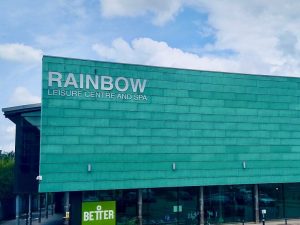
Epsom Baths Hall continued to host entertainment after the Stones, including a performance by Genesis in 1972. Its popularity eventually declined as alternative venues opened and leisure habits changed. The hall closed in 1989; the original baths complex was demolished in 2001 and replaced by the present Rainbow Leisure Centre.

Nothing visible at the modern centre readily tells visitors that one of the most famous bands in the world once performed there—twice—on a wooden floor constructed above the municipal pool.

What is still missing are the human memories: who queued at the Baths Hall box office, who danced at the front, what the band sounded like through the hall’s public-address system, and whether anyone kept a ticket, photograph or autograph.

Epsom and Ewell Times would be delighted to hear from readers who attended either concert—or whose parents, relatives or friends remembered the Rolling Stones’ two visits to Epsom Baths.

Epsom and Ewell History Explorer is the definitive guide to all things historical and more. Run by dedicated volunteers.

Epsom Playhouse remains one of the regions premier venues for tribute bands including rock-and-roll.


Readers bemoan Council’s feet-dragging on twinning Epsom with Bucha

Letter to the Editor

Dear Editor,

Very disappointed with Epsom and Ewell Council, this would have been a simple arrangement. I myself stayed in the borough of Bucha only a few weeks ago on my way to Odesa. I was only a few miles from the area occupied by the Russians, they were only stopped by the Ukrainians destroying the bridge. Imagine living in Epsom and enemy forces occupying Ewell killing people in the streets. Shame on the council members voting against this.

Yours faithfully,

Richard Gough


Dear Editor,

As a Ukrainian, I want to sincerely thank the people of Epsom and Ewell for everything they have done to support Ukraine over the past more than four years. Your kindness, generosity and the incredible humanitarian support you have provided have meant more than words can express.

Humanitarian aid has saved lives. But today, a statement of friendship and solidarity matters too. It tells Ukrainians that we have not been forgotten and that we are not standing alone.

The war has not become easier. Every day people continue to die, and cities continue to be attacked. We all hope this war ends in Ukraine, because if Russian aggression is not stopped here, its consequences will not stop at Ukraine’s borders.

Thank you for speaking up, for raising these issues, and for continuing to stand with Ukraine. It means more to us than you may ever know.

Yours faithfully,

Natalia Pankratova

.

.

.

.

.

.


Councillors dispute significance of EEBC’s complaint rate

Alan Stanton Licence details

Epsom and Ewell recorded Surrey’s second-highest rate of upheld Local Government and Social Care Ombudsman complaints during 2025/26 — although officers and some councillors argued that the numbers were too small to indicate a systemic problem.

The Ombudsman received 18 complaints concerning EEBC, up from 15 in the previous year. Two were recorded as upheld, producing a rate of 2.4 upheld complaints per 100,000 residents. Only Spelthorne, at 2.8, had a higher rate among Surrey’s borough and district councils.

At last night’s Audit and Scrutiny Committee meeting Cllr Alex Coley (Independent Ruxley) asked why Epsom and Ewell’s rate appeared markedly worse than most neighbouring authorities.

Cllr Steve McCormick (Conservative Woodcote and Langley) asked what weaknesses in the Council’s first and second-stage complaints processes were causing cases to reach the Ombudsman and what service improvements would be put in place before the transfer to East Surrey Unitary Authority.

Assistant Director Andrew Bircher rejected the suggestion of systemic failure. He said the actual number of complaints was very low and that one of the two cases was classified as upheld even though the Ombudsman had not opened a full investigation. In that case, the Council had already accepted the complaint and taken satisfactory remedial action.

“I don’t see that there is an issue to be concerned about here as we transition into the new East Surrey authority,” he said.

Cllr Robert Leach RA Nonsuch) agreed that percentages based on one or two cases could be misleading. “When you’re dealing with very small numbers, you really have to have a viability threshold,” he said. “This is probably something barely worth reporting.”

Refuse, rodents and reasonable adjustments

The first upheld case concerned repeated accumulations of refuse and fly-tipping near a resident’s home, causing a rodent problem.

Following the Council’s own stage-two investigation, it apologised and agreed to double waste collections and inspections, make the location a priority site and increase the presence of uniformed officers.

The Ombudsman decided that no further investigation was required because the Council had already remedied the injustice. Its system nevertheless recorded the complaint as upheld.

The second case concerned the Council’s requirement that reports of planning breaches be submitted online or on a specified form.

The Ombudsman found that, after the complainant explained difficulties using their hands, the Council should have asked whether a reasonable adjustment was required. Its failure to do so caused uncertainty, although the Ombudsman could not say that an adjustment would necessarily have been granted.

The Council subsequently contacted the complainant and reminded officers of their anticipatory duty under the Equality Act.

Eleven data breaches

The report also disclosed 11 data breaches since the committee’s February meeting.

Nine involved email. Two were reported to the Information Commissioner’s Office, which took no further action beyond providing general advice.

The Council had also been notified of two complaints to the ICO concerning its responses to Freedom of Information requests. At the time of the committee meeting, both were still awaiting allocation to an investigator.

Under the new data legislation, residents will generally be required to complain to the Council about its handling of personal information before taking the matter to the ICO.

Mr McCormick asked how the Council could guarantee that complaints about its own conduct would be investigated objectively and whether the financial and staffing implications had been calculated.

Mr Bircher said the Council’s Business Support Team would provide an independent review through its existing two-stage complaints procedure. He could not say how the workload would be measured or reported under the new unitary council. “I dare say that this annual complaints report won’t come to this committee next year because it won’t exist,” he said.

The committee noted the report.

Sam Jones – Reporter

Image: Alan Stanton Licence details


Epsom and Ewell Council admits homelessness pressure is “getting worse” despite action

Geograph Britain and Ireland | Licence details Creator: Evelyn Simak | Credit: Evelyn Simak Copyright: © Evelyn Simak and licenced for reuse under cc-by-sa/2.0

Epsom and Ewell Borough Council’s homelessness expenditure remains at its maximum risk rating despite additional staff, fraud investigations, government funding and the implementation of a homelessness action plan.

The Council’s year-end performance report recorded a £410,000 adverse budget variance for 2025/26, with net expenditure of £10.679 million against an approved budget of £10.269 million.

The overspend was driven primarily by temporary accommodation costs. It would have been higher without treasury income approximately £100,000 above forecast and around £200,000 of additional income from property leases completed later than anticipated.

Councillor Steve McCormick (Conservative Woodcote and Langley) told the Audit and Scrutiny Committee 16th July that those gains had effectively masked what would otherwise have been a £710,000 operational overspend.

The number of homelessness applications rose by 82.6% during the year to 623. The number of households in nightly-paid accommodation remained above target and was 5.5% higher than at the equivalent point a year earlier.

The corporate risk of homelessness spending exceeding its budget carries an inherent score of 16 and, unusually, remains at 16 even after the Council’s controls are taken into account.

Mr McCormick asked whether that meant the controls were ineffective or that external pressures had simply overwhelmed what the Council could do.

Assistant Director Andrew Bircher said: “Notwithstanding all these actions that we seem to be taking in order to try and reduce the amount of homelessness, we’re not seeing that come to pass. In fact, we’re seeing the number of nightly paid and the homelessness numbers increasing. If it was getting better, I think we would see our residual risk lower, but what we’re seeing is it’s not getting better; it’s getting worse.”

He distinguished between making prudent financial provision for the costs and successfully reducing the underlying demand. “The fact that we might be able to cope with that doesn’t mean that it isn’t still a risk,” he said.

Where will the missing £650,000 come from?

Cllr Alex Coley (Independent Ruxley) agreed that officers had undertaken a considerable amount of work. He said almost every action within the homelessness and rough-sleeping strategy was marked green or completed, with modular housing the main exception. Without that work, he estimated annual costs could already have reached around £2 million.

However, he questioned whether the budget figures matched the scale of the known pressure. “The allocation of funding to temporary accommodation was significantly short of the money we spent in the last year, which is £1.4 million,” he said. “I think we’ve only allocated something like half of that, so £750,000. There is a question, isn’t there: where’s the other £650,000 going to come from?

“People might reasonably ask: did we actually set a balanced budget back in February?”

Three modular homes nearly two years late

The Council’s modular-homes programme remains more than three months off track against an original completion date of July 2024.

Only one location, providing three homes, was found to be viable. Progress has since been delayed by a requested land tribunal hearing, and the performance report supplied no new completion date.

Mr McCormick questioned why the tribunal risk had not been anticipated and what alternative rapid-delivery housing schemes were being pursued. Officers were unable to answer at the meeting and said a response would be obtained from the relevant service.

Financial position “unsustainable” without reorganisation

The Annual Governance Statement contained a candid warning from the Head of Paid Service that, although EEBC remained relatively financially stable, its position would be unsustainable over the longer term without local government reorganisation.

Mr McCormick asked whether that meant the Council might otherwise have faced a Section 114 financial emergency.

Mr Bircher said EEBC was in a better position than many neighbouring authorities but had previously relied upon reserves to balance its budget. “Clearly, use of reserves year after year is not a sustainable position,” he said.

Without reorganisation, the Council would have needed to consider substantial transformation and change programmes. He said the efficiencies expected from creating the East Surrey Unitary Authority would perform some of the function that a separate savings programme would otherwise have been required to achieve.

Property problem arises for third time

Without disclosing details discussed at a separate exempt meeting, Cllr Coley also challenged the red-rated risk attached to the Council’s property portfolio.

He said a problem involving the Council’s investment company had now arisen for a third time and would cost more than six figures. Previous advice had said doing nothing was not an option, but the problem had nevertheless been allowed to recur. “I would like to know what the control is so it doesn’t happen a fourth time,” he said.

Mr Bircher agreed the risk register should be updated with new mitigation but declined to bring a separate report back to the committee.

Mr McCormick noted that the Council described its approach as “treat” while both the inherent and residual property risk remained at 12. He asked what active measures had been taken to prevent commercial tenants defaulting. That question was also taken away for a later response.

ICT and other services off target

The Council’s 2024/25 ICT roadmap, originally due for completion in March 2025, remains off track. Its IT service-interruption risk remains high, with ageing components and dependence on outside suppliers identified as continuing threats.

Although new firewalls had been installed and other network work was progressing, Mr McCormick asked why the cyber-security response-plan review had slipped to September 2026 and whether investment might become redundant when systems were combined under the new unitary council.

Other significantly off-target indicators included long-term sickness absence and the proportion of parking penalty appeals answered within ten working days, which had fallen from 100% to 63%.

Mr Bircher said parking staff were diverted at the financial year-end to time-critical work such as permit and garden-waste renewals. The Council had chosen not to fund temporary extra capacity, although its response times remained better than the statutory requirement.

“When someone is accountable, they do not”

Many detailed questions were left unanswered because the heads of the relevant services were not at the meeting.

Mr McCormick asked how councillors and the public could be assured that written answers would subsequently be provided and published. Mr Bircher said it would be disproportionate to require every head of service to attend in case a question arose and that Democratic Services had a good record of recording questions and obtaining later answers.

Cllr Coley contrasted the attendance with a Strategy and Resources meeting two days earlier, at which the Chief Executive, Section 151 Officer, Monitoring Officer and senior property officers were present.

“The public and members might get the impression that when somebody wants something, everyone shows up, and when someone’s accountable, they do not,” he said.

The committee noted the performance and risk report.

Sam Jones – Reporter

.

Related reports:

Epsom’s homelessness crisis

What are the solutions to Epsom’s homeless crisis?

Council grapples with rising cost of homelessness

Micro-homes for a macro-problem?

Did a fair view prevail on Epsom’s modular homes for the homeless?

Epsom housing project in access gridlock

Pods off in bricks grant for Epsom homeless

Stoneleigh library flats for homeless

Do good intentions square with homeless savings?

Image: Geograph Britain and Ireland | Licence details Creator: Evelyn Simak licenced for reuse under cc-by-sa/2.0


Epsom’s scrutiny committee slams Dallen’s urgent £500K Rainbow approval

Creative Commons CC0 1.0 Universal Public Domain Dedication

Epsom and Ewell Borough Council’s Audit and Scrutiny Committee has formally concluded that the process used for the confidential £500K Rainbow Leisure Centre urgent decision did not follow the Council’s stated procedure and was not justified by the information presented to councillors.

The finding came at the end of a lengthy and at times heated debate on Thursday 16 July over Urgent Decision 158, which was signed off by Cllr Neil Dallen (RA Town) as chair of the Strategy and Resources Committee, in December 2025 without first obtaining the approval of his Committee.

Councillor Chris Ames (Labour Court) proposed that the committee record:

“The process followed for Urgent Decision 158 did not follow the correct stated procedure and was not justified according to the information put before this committee.”

The proposal was carried.

The committee separately backed a recommendation from Councillor Alex Coley (Independent Ruxley) that, where a matter of significance is known about in advance — such as proposed expenditure exceeding £50,000 or a change to the Council’s constitution — the first action should be to schedule a committee meeting.

As Audit and Scrutiny cannot itself alter the constitution, the proposal is expected to go to the Standards and Constitution Committee.

Months of warning or sudden urgency?

The Council’s report stated that a decision was needed by 17 December to progress negotiations with the new Rainbow Leisure Centre operator. The next scheduled Strategy and Resources Committee meeting was not until 27 January 2026.

Officers said that failure to resolve the matter could have caused the contract to collapse, leading to the loss of management fees, a need to retender, the Council having to maintain the centre without an operator and uncertainty for staff.

However, the Council’s constitutional test is not simply whether a decision is required before the next scheduled committee meeting. An urgent decision may be used only where delay would seriously prejudice the Council or public interest and it is not practicable to convene a quorate meeting in time.

Cllr Ames said the same problem could be seen in the explanations given for several other urgent decisions.

“The next scheduled meeting is irrelevant,” he said. “What matters is: could a quorate meeting of the relevant decision-making body be brought forward to take this decision?”

Assistant Director of Corporate Services Andrew Bircher acknowledged that some of the explanations in the annual report did not fully reflect the constitutional test.

“It would be better on this report had we been able to identify that,” he said, adding that future reports would set out the position more clearly.

Cllr Coley said the Rainbow difficulties had been apparent months before UD158 was signed and that there had been ample opportunity to arrange a special committee meeting.

He described what had happened instead as “sofa-style governance”, with discussions taking place among senior officers, lead councillors and the Residents’ Association group before opposition councillors were informed.

“The process here is a committee meeting should have been organised,” he said. “Instead, what happened was a lot of talking behind closed doors.”

He said RA councillors had been shown the issue in early December, approximately four weeks before opposition councillors were given access to it.

Cllr Ames said the timetable appeared to have been “artificially managed” to create urgency and avoid a committee decision.

Chair Cllr Steve Bridger (RA Stamford) repeatedly attempted to restrict discussion to the decision-making process rather than the underlying Rainbow dispute. He also said the officers needed to answer many of the questions were not present and asked members to submit further questions in writing.

Cllr Ames sought a commitment that the answers would be published, arguing that otherwise residents might conclude that the Council was trying to avoid explaining what had happened to public money.

Who decided the document was exempt?

A second dispute concerned who decided that UD158 and its contents should be withheld from the public.

The committee report stated that Chief Executive Jackie King, acting as the Council’s “proper officer”, had made the exemption decision after considering its commercial sensitivity.

Cllr Ames repeatedly asked whether there was any contemporaneous written record of that decision or of the required balancing of the public interest in secrecy against disclosure.

Mr Bircher said the Chief Executive had confirmed by email that she authorised the exempt treatment and that the matter had been discussed at meetings of the Strategic Leadership Team.

He acknowledged that there was no separate record in the leadership team’s meeting notes, but said the Chief Executive had agreed that future exemption decisions would be evidenced on the relevant committee report or urgent decision form.

The Council’s legal adviser, Deborah Davis, said the exemption decision did not necessarily have to be recorded in writing. Someone did, however, need to have made the decision after considering both the relevant legal exemption and the public-interest test. Recording the decision and naming the proper officer would be good practice, she said.

Cllr Coley told the committee that, at a group leaders’ meeting in early January, the Chief Executive had said she had been on leave and that Deputy Chief Executive Vicky Potts had prepared and signed the urgent decision.

He questioned when the Chief Executive had subsequently decided that the document should be exempt and whether an exemption could properly be applied retrospectively.

Mr Bircher responded that the Chief Executive had been aware of the circumstances through leadership team discussions and was satisfied that the matter should be treated as commercially sensitive.

Ms Davis advised that leaked information does not automatically cease to be exempt. The Council could continue to treat it as confidential until an authorised decision was made that disclosure was now in the public interest.

£500,000 Rainbow background

Epsom and Ewell Times has previously reported that the confidential urgent decision approved by Cllr Neil Dallen (RA Town) authorised access to Council reserves of up to £500,000 in connection with disputed dilapidations discovered during the change of leisure centre operator.

Former operator GLL has said it was unaware of any legal claim and handed the building back in the condition required by its agreement. The Council has acknowledged that it holds no record of routine landlord inspections over the operator’s lengthy tenure.

UD158 has therefore become central not only to the financial dispute but also to questions over how the Council monitored one of its largest public assets and why councillors and residents were given so little contemporaneous information.

A written public statement read at the start of Thursday’s meeting accused the Council of six months of “procedural silence” and urged the committee to demand answers over whether defects had been concealed, missed by consultants or allowed to develop through a failure of landlord oversight.

Despite the Audit and Scrutiny committee’s investigation and debate on the Urgent Decision on the Rainbow Leisure Centre the public are still in the dark about how the dilapidations estimate (if accurate) arose in the first place.

Wider transparency failures

The Rainbow discussion was not the meeting’s only dispute over withheld information.

At the beginning of proceedings, Cllr Ames challenged an exempt internal-audit appendix because the agenda did not state that the public-interest test had been applied.

Ms Davis agreed that such a statement should have appeared. Mr Bircher apologised for the omission, and the restricted appendix was withdrawn because neither the Chief Executive nor Monitoring Officer was present to confirm the exemption decision.

Cllr Ames noted that he had raised exactly the same problem four months earlier.

The committee later amended the Council’s Annual Governance Statement to recognise the “urgent need” to deliver a previous Full Council resolution establishing a process for publishing urgent decisions.

Cllr Coley said the Council had reduced its use of urgent decisions from 22 in the previous reporting year to six, but that uploading six decision forms should not present an insurmountable resource problem.

“We have agreed it is going to be delivered,” he said. “The decision is to do it, not to investigate it.”

Sam Jones – Reporter

.

Related reports

The Man Who Signed It, Chaired It, and Wouldn’t Explain It: Six Months of Silence Over Rainbow’s £500,000 Bill

Epsom & Ewell Council blocks release of Rainbow Leisure Centre condition papers

Epsom Council Rainbow Centre secrecy row deepens over “pre-election silence” advice

No end to Epsom’s Rainbow Leisure Centre controversy

Dalton and Dallen double-down disclosure denial

Epsom and Ewell Council transparency row erupts as Council backs publication of urgent decisions

“It’s my meeting”: Cllr Dallen stops questions about his role in alleged Rainbow “cover-up”

Cllr Dallen accused of £1/2m Epsom and Ewell Council “cover-up”

Epsom’s Rainbow Leisure Centre Places new operators


Epsom and Ewell Council’s final spending spree?

Ewell Village

Nearly £4.92 million of infrastructure and community-project funding has been approved by Epsom and Ewell Borough Council despite a resident’s detailed appeal for the decision—or at least funding for a new Hogsmill footbridge—to be deferred.

The Strategy and Resources Committee approved five strategic Community Infrastructure Levy projects and eight neighbourhood schemes by six votes to one abstention at its meeting on Tuesday 14th July.

CIL is money raised from property development and intended to provide infrastructure required to support growth. The Council had approximately £5.04 million of unallocated strategic CIL and £1.13 million of unallocated neighbourhood CIL available at the beginning of the process.

The projects funded

The strategic allocations were:

£1 million for the Local Cycling and Walking Infrastructure Plan, conditional upon at least £1 million in match funding;

£114,000 for earth bunding and green-infrastructure work at ten open-space sites vulnerable to unauthorised vehicle access;

£144,000 for a new footbridge across the Hogsmill River;

£1 million for initial community sports infrastructure at Hook Road Arena, conditional upon at least £1 million match funding; and

£2 million for Ewell Village public-realm improvements.

The neighbourhood awards included improvements to Ebbisham Sports and Social Club; tennis and pickleball courts at Poole Road and Gibraltar Recreation Ground; play equipment at St Martin’s School; a Scout tomahawk range; modernisation of the Epsom Beekeepers’ classroom; the Glyn Hall replacement project; and the final phase of a Scout headquarters redevelopment.

A correction made during the meeting reduced the published neighbourhood total from £668,871 to £660,911. Together with the £4.258 million strategic allocation, the corrected package amounted to £4,918,911.

The Council stressed that funding would ordinarily be released only after projects had been completed and that applicants remained responsible for obtaining planning permission, landowner approval and other necessary consents.

Stovell asks councillors to wait

Resident Kristy Stovell had sent councillors and Epsom and Ewell Times an eight-page evidence review before the meeting.

Her primary request was for the whole CIL item to be deferred until the next ordinary committee meeting. As a minimum, she asked councillors to remove the £144,000 Hogsmill bridge allocation from the package pending publication of further information.

Her analysis did not allege that every scheme was unsuitable. Instead, it argued that councillors were being asked to approve almost £4.93 million without complete applications, comparable cost plans, individual scoring, supporting assessments or CIL Working Group records being publicly available in one accessible place.

She noted that all five strategic schemes had been classified as “essential but not time critical”, which she argued allowed time for a short deferment.

Among the concerns raised were the absence from the public pack of full applications and supporting evidence; a lack of published Working Group papers and minutes; inconsistent identification of applicants; incomplete financial comparisons; and reports recording no equality, environmental, safeguarding or crime-and-disorder implications for projects that included a river crossing, earthworks, highways schemes, school play equipment and a Scout tomahawk range.

She asked for the full applications, detailed project costs, previous awards, match funding, Stage One assessments, point-by-point Stage Two scores and Working Group attendance, voting and declarations to be published before a final decision.

Bridge evidence questioned

Ms Stovell’s three-minute public statement concentrated on the proposed Hogsmill footbridge.

She said: “I am not opposing accessibility or the principle of providing safe and inclusive routes. I am asking the committee not to approve a substantial award before the proposal’s financial, environmental, accessibility and delivery evidence has been published and properly examined.”

She said the public documents did not clearly identify the applicant, the precise bridge location, a completed design, the full project cost or the additional design and planning funding required.

She also questioned whether the published material demonstrated a continuous accessible route for wheelchair and mobility-scooter users.

“The project was assessed as essential but not time critical,” she said. “There is therefore no demonstrated need to approve it tonight before the missing information has been supplied.”

She asked councillors to decline the recommendation or defer it until the location, design, complete costs, dependencies, environmental effects and whole-route accessibility had been evidenced and published.

Her longer review noted that the bridge application had been submitted before the Environment Committee selected a bridge option on 30th June. It also questioned the absence of an exact location plan, completed design, environmental and hydrological evidence, and clear maintenance and liability arrangements.

Members asked to trust the Working Group

In the Chair, Cllr Hannah Dalton (RA Stoneleigh) told the committee that it was the final CIL funding round and warned: “If we remove this item, we also lose the funding.”

She said councillors had appointed a cross-party Working Group to examine the applications and “there’s got to be some trust that our colleagues took the time to go through that detail”.

An officer said the Working Group had access to the full bids and supporting information and held four meetings during June to undertake the Stage Two assessments.

Councillor Steve McCormick (Conservative Woodcote and Langley) asked where the minutes of those meetings were and whether members could review them. The officer replied that the scores and decision-making were recorded in what he described as a comprehensive spreadsheet.

Councillor Kate Chinn (Labour Court) said that although councillors were being asked to trust the Working Group, it would have been helpful to see more detail, including the locations of the ten sites covered by the £114,000 green-infrastructure bid.

She also questioned why neighbourhood bids could fail where planning permission was missing while the strategic bridge bid could proceed without permission.

An officer explained that the adopted protocol did not require strategic applicants to have all permissions in place at the application stage, although no project could begin and no money would be released without the necessary approvals.

“A rock and a stepping stone”

The committee also wrestled with whether the proposed footbridge was intended to replace the existing stepping stones.

The published project description stated that the bridge would “replace unsafe stepping stones”. Yet Cllr Dalton said at the meeting that the two issues should be treated separately and proposed removing those words.

Councillor James Lawrence (Independent College) pointed out that the Environment Committee had acknowledged that the Environment Agency would remove the stones and had approved a new bridge as an alternative crossing.

“That reads like ‘replace’ to me,” he said.

Councillor Phil Neale (RA Cuddington) said the Working Group had considered only the bridge but had found itself “between a rock and a hard place—or a rock and a stepping stone”.

He strongly supported the bridge, while suggesting that if the Environment Agency removed the stones, campaigners might put new ones back.

Chief Executive Jackie King clarified that the Environment Agency owned the riverbed and banks but apparently not the stepping stones themselves. Their ownership—and therefore liability—remained uncertain.

She said members had responded to the strength of public feeling by separating construction of the bridge from decisions about the stones.

The committee amended the description to read: “Construction of a new footbridge across the Hogsmill River, providing a safer, more inclusive river crossing.” The words saying it would replace the stones were deleted.

The £144,000 figure was also clarified as including a 20 per cent contingency on an estimated £120,000 construction cost.

Questions over Surrey funding

Several councillors questioned how much Surrey County Council was contributing to the larger schemes.

Councillor John Beckett (RA Auroil) said the Council was being asked to fund £1 million towards cycling and walking infrastructure even though highways were a county responsibility.

He said Surrey appeared not to have “any skin in the game”, although officers explained that Surrey had funded much of an earlier phase and that the Epsom and Ewell contribution was intended to unlock funding from bodies such as Active Travel England.

On the £2 million Ewell Village scheme, Cllr Beckett described Surrey’s approach as presenting the borough with “this kind of fait accompli”.

Officers said Surrey had already spent money progressing the design, while rising material costs had increased the sum required.

Funding approved

No councillor formally moved Ms Stovell’s requested deferment, either for the full package or for the Hogsmill bridge alone.

The committee approved all thirteen recommended awards by six votes to one abstention, subject to the revised bridge wording and corrections to the published figures.

The decision commits the CIL money to the projects, but applicants will still have to secure the relevant permissions and deliver their schemes before receiving payment. The new East Surrey authority will assume responsibility for administering and monitoring CIL expenditure from April 2027.

Sam Jones – Reporter

.

Related reports

Last round of developers’ funds in Epsom and Ewell to be spent

Epsom & Ewell Borough Council invites bids for local infrastructure projects

Ewell village set to improve

Ewell’s sporting ambition for Gibraltar Rec hits the rocks

Epsom & Ewell Council greenlights local projects

“Garden of Eden” coming to West Ewell as wetlands plan is approved


Bucha Ukraine “ducks missiles while Epsom Council mucks about”

Bucha_main_street_after_Russian_invasion_of_Ukraine Creator: Oleksandr Ratushniak Copyright: Attribution 4.0 International (CC BY 4.0)

A proposal for Epsom and Ewell Borough Council to support in principle a twinning arrangement with Bucha in Ukraine was defeated only after Strategy and Resources Committee Chair Councillor Neil Dallen (RA Town) used his casting vote against it.

The vote at the committee’s meeting on Tuesday 14th July was tied, with three councillors supporting the declaration and three opposing it. Cllr Dallen then exercised the Chair’s casting vote, saying: “It’s going to leave it to me, and I will vote against that.”

The rejected wording would have approved “in principle the objective of establishing a twinning arrangement between Epsom and Ewell and the City of Bucha in Ukraine”.

The committee did agree that its Working Group should continue examining who could initiate and administer the borough’s existing twinning with Chantilly and, if approved in principle at some future point, any relationship with Bucha, and how both might continue after Epsom and Ewell Borough Council disappears in April 2027.

However, it rejected the declaration of friendship its supporters had sought.

“Bucha is waiting patiently”

Earlier in the meeting Roy Deadman, Chair of Surrey Stands With Ukraine and a committee member of the Bucha Epsom Association, spoke during the public-participation session.

He told councillors: “Bucha is waiting patiently for a clear response from this borough.”

Mr Deadman accepted that local government reorganisation raised practical questions about who would administer a twinning relationship after April 2027. But he argued that those questions did not prevent the Council giving immediate support to the principle. “There is a distinction between approving a principle and settling every future administrative detail,” he said.

“This is not a financial commitment. The report itself says there are no immediate financial implications, nor would there be a practical burden falling upon this Council.”

He said the day-to-day relationship could be developed by volunteers through the Bucha Epsom Association, involving schools, charities, cultural groups and residents. “Bucha is not asking Epsom and Ewell for a blank cheque,” he said. “It is asking for friendship.”

Mr Deadman warned that the real risk was not acting too quickly but that “repeated referral, further delay and a general offer of friendship is allowed to wither”.

He asked the committee to recommend that Full Council support twinning in principle, leaving the formal structure to be resolved later.

The Mayor of Bucha, Anatoliia Fedoruk, has expressed a wish for Epsom and Ewell to become the Ukrainian city’s first twinning partner in the United Kingdom. Local volunteers have sent substantial humanitarian support to Ukraine, while Ukrainian families have been welcomed into the borough.

Epsom and Ewell MP Helen Maguire had also written to committee members supporting the proposal. Cllr Dallen summarised her position at the meeting as supporting “twinning between Epsom and Ewell and Bucha”. Her letter highlighted the 100 year Partnership Agreement between the United Kingdom and Ukraine, signed in January 2025, which envisages partnerships at local levels.

Chinn: offer “the hand of friendship”

Councillor Kate Chinn, (Labour Court), proposed the amendment giving support in principle.

She questioned why the Bucha proposal had become tied so closely to the existing Chantilly arrangement, saying a constituted community organisation already existed locally with strong links to Bucha.

Cllr Chinn said Epsom and Ewell’s relationship with Ukraine was “really quite special”, referring to the welcome given to Ukrainian families and the cultural contribution they had made locally.

“We are a very fortunate generation that we haven’t been in that place where we are under attack,” she said. “I really think it’s important that we offer the hand of friendship to Bucha.”

Responding to suggestions that twinning might be an inappropriate distraction for a city at war, she said: “It’s Bucha who want this. Bucha want it very much, and they want it to happen as soon as possible. It’s not Epsom and Ewell imposing their twinning on the town, and maybe it is in times of conflict when you do need the hands of friendship and support the most.”

Warning against the “long grass”

Councillor Steve McCormick, (Conservative Woodcote and Langley Vale), seconded Cllr Chinn’s amendment and warned that the borough was running out of time before its abolition.

“We do run the risk of just running out of time and just kicking this can down the timeline,” he said. He described approval in principle as “a good positive first step of action, rather than just delay, delay, delay and delay”.

“There’s work to be done, but we can get this done,” he said. “If we kick it into the long grass, it’s never going to get done before this Council basically wraps up.”

Councillor James Lawrence (Independent College) also argued that it should be for Bucha to decide how it used its own resources.

“If they wish to pursue twinning with us, then I would let them be the final arbiters of that decision, rather than us try and second-guess their resourcing,” he said.

He noted that there was no legal requirement for one single twinning association to manage every relationship for the same geographical area. The Council’s Monitoring Officer confirmed that this was a matter of “custom and practice” rather than a legal obligation.

Opposition during wartime

Councillor Phil Neale (RA Cuddington) said he supported Ukraine and had contributed financially, materially and voluntarily. Nevertheless, he questioned whether twinning was appropriate during the war.

“At the moment, it’s totally irrelevant, and it will be totally lost with LGR,” he said. He suggested that twinning should wait until peace returned and the rebuilding of Ukraine was under way.

Councillor John Beckett (RA Auriol) said he was uncomfortable approving the principle without first understanding possible costs and demands on Council officers. “If we were to approve this in principle, what would be the costs? What would it actually take? Have we got the officers to actually deal with it?” he asked.

Cllr Chinn responded that councillors had repeatedly been assured the relationship would not consume Council resources. Chief Executive Jackie King confirmed that the present Chantilly arrangement required the Council to do little more than put its name to the charter, saying nothing had changed in that respect.

The committee report itself said there were no immediate financial implications and no anticipated Section 24 implications if a Bucha twinning agreement proceeded. It acknowledged that any later commitment of Council resources would have to be identified, costed and separately approved.

Principle rejected, process continues

After the tied vote and Cllr Dallen’s casting vote rejected support in principle, councillors approved further investigation.

The Working Group must now clarify who could initiate and administer the Chantilly and Bucha arrangements and how they could continue after “vesting day” on 1st April 2027. It must return with another report to a future committee meeting.

Lionel Blackman, Director of Surrey Stands With Ukraine, commented after the vote: “Extremely disappointing. Bucha ducks missiles while Epsom Council mucks about with meetings and petty analysis. Twinning with Bucha has been on the agenda for over a year now. Anybody’s guess what motivates Councillors to kill off this initiative and why they want to bury it in endless committee meetings.”

He added: “With the rejection of a simple and cost free statement of support for twinning in principle, we will be lucky if we maintain Bucha’s preference for Epsom in all of the United Kingdom. Probably, since World War Two there has been no comparable volunteer community effort experienced in our Borough as that of the support for Ukraine. Demonstrated by sending so far in excess of £5 million of humanitarian aid.”

The result leaves the machinery of the proposal uncertain without any statement of support its local advocates had requested.

Sam Jones – Reporter

.

Related reports

Appeal to twin Epsom with Bucha in Ukraine

Epsom celebrates Ukrainian culture at Festival of Friendship

Epsom and Ewell’s four year commitment to Ukraine

Epsom on road to twin with world-famous Ukraine town of Bucha

Epsom MP leads cross-party delegation to Ukraine to examine impact of explosive weapons

Image: Days after the liberation of Bucha 31.03.2022: Creator: Oleksandr Ratushniak. Copyright: Attribution 4.0 International (CC BY 4.0).

[Ed. note: Today Bucha has physically recovered but its people remain scarred by the Russian atrocities that became infamous worldwide.]

If you wish to support Ukraine see www.surreystandswithukraine.org.uk


The Man Who Signed It, Chaired It, and Wouldn’t Explain It: Six Months of Silence Over Rainbow’s £500,000 Bill

Cartoon of Dallen outside Rainbow centre as a policeman telling public to move along.

Six months after Epsom and Ewell Borough Council quietly authorised the use of its reserves to cover a dilapidations bill of up to £500,000 at the Rainbow Leisure Centre, the six basic questions this paper put to the Councillor who approved that decision remain unanswered. Not because the council disputes the facts. Not because litigation prevents comment. But because, first, it said the matter was commercially sensitive; then, once an election was called, it said the law forbade a response; and now that the election is over, it has offered residents a statement about gym upgrades instead.

The common thread through every stage of this story is one councillor: Neil Dallen (RA Town), Chair of the Strategy and Resources Committee, who signed off the original urgent decision, chaired the meeting where questions about it were cut off, and has twice found a procedural reason not to say how the bill arose.

A smooth handover, on paper

Rainbow Leisure Centre transferred from its operator of 22 years, GLL, to Places Leisure on 1 October 2025. The council’s own account, recorded in the Urgent Decision document later obtained by this paper, describes an unremarkable changeover: no break in service, a deal offering “significantly more income than the Council had been receiving,” and a pre-handover check by an external consultant intended to confirm the building “would be handed back in good condition.” That check, the document specifies, “was not an invasive analysis.”

Within weeks, Places identified a long list of problems: faults in fire alarms, lifts, seating, glazing, sanitaryware, ventilation, damp, possible roof cracks, and machinery officers now describe as at “end of life.” Some were flagged as health and safety risks requiring immediate action.

December: a £500,000 estimate, marked not for publication

On 17 December 2025, under the reference DEC 158, the council took an Urgent Decision — a mechanism used when a matter cannot wait for the ordinary committee cycle — authorising its Section 151 officer to finalise dilapidations negotiations with Places. The document, marked “OFFICIAL SENSITIVE – NOT FOR PUBLICATION” and exempted under paragraph 3 of Schedule 12A to the Local Government Act 1972, put the likely cost at up to £500,000, to be met initially from the council’s dilapidations reserve and recovered from GLL only “in due course” — with the same document conceding the council “must accept that it will not be able to recover the Places claim in its entirety.” Cllr Dallen was consulted as committee chair and recorded his view in two words: “Happy to support.”

The decision stayed confidential until this paper obtained and published it in January.

January to March: leak, backlash, and the first stonewall

The story prompted sharp criticism from opposition councillors, who accused the ruling Residents’ Association of secrecy and complacency. The council’s public response — attributed to Dallen and Cllr Clive Woodbridge (RA Ewell Village)— framed the transfer as “an exciting new chapter” and declined to discuss “terms and financial arrangements” as commercially sensitive. GLL, for its part, maintained it had fixed everything flagged by the pre-handover survey and handed the building back to the required standard.

This paper submitted a Freedom of Information request on 13 January seeking the lease’s inspection clauses, any log of landlord inspections or condition surveys since 2003, records identifying the backlog and its cost, and evidence of when councillors were first told. The council took over two months to respond, and released only a handful of lease clauses.

At the Strategy and Resources Committee on 27 January, Cllr Chris Ames (Labour Court) pressed Dallen, as chair, on why the decision had been kept confidential and whether a public-interest test had ever been carried out. Dallen confirmed he had supported both the decision and its confidential status, then closed the matter down: “It is my meeting… I have made a decision there is going to be no further comments.”

The survey that two accounts can’t both describe

A letter to this paper from Cllrs Ames and James Lawrence (Independent College), following the Audit and Scrutiny Committee’s March meeting, surfaced a direct conflict in how the council has characterised the pre-handover survey. The Assistant Director for Corporate Services told that committee that consultants Carter Jonas had been commissioned to carry out “a very detailed survey of the whole leisure centre.” But in June 2025, recommending the Places contract to the Strategy and Resources Committee, the same officer described the exercise as a stock condition report commissioned merely to “inform the procurement process,” on the basis that the council “has been very satisfied” with how the centre had been run and that it was, “overall,” in good condition.

Both descriptions cannot comfortably be true of the same piece of work — and neither sits easily with the Urgent Decision document’s own characterisation of the survey as “not an invasive analysis.” This paper has been unable to establish which account is accurate, because the council has refused to release the survey itself, citing legal professional privilege.

April and May: an election as a shield

As the 7th May East Surrey Unitary Council elections approached — in which Dallen was himself a candidate — the council declined to answer a detailed list of questions this paper put to him on 24 March, citing Section 2 of the Local Government Act 1986, which bars councils from publishing material designed to influence political support. Independent expert opinion obtained by this paper, from Nathan Elvery, former Chief Executive of Croydon Council, concluded the questions posed were “factual in character” and that a response “would not constitute political publicity within the meaning of the Act” — the council, he noted, was “not being asked to promote a political position; it is being asked to account for its stewardship of public funds.” Cllr Hannah Dalton (RA Stoneleigh) relied on the same provision to avoid unrelated questions about a separate governance matter.

A subsequent FOI request established that the decision to invoke Section 2 in Dallen’s case involved the Chief Executive, the Monitoring Officer, senior communications officers, and Dallen himself — yet the council said it held no record of the legal or governance advice behind that decision. The guidance document it pointed to as its basis, meanwhile, explicitly permits councils to continue normal business and to publish factual information during an election period.

Dallen finally responded on 18 May, twelve days after polling. The response answered none of the substantive questions this paper had posed two months earlier about how the dilapidations arose; it repeated that “details relating to terms and financial arrangements are commercially sensitive.”

June: privilege claimed, release refused

On 18 June the council upheld its refusal to disclose the 2025 inspection report or any related backlog, dilapidation or financial exposure documents, now citing Section 42 of the Freedom of Information Act — legal professional privilege — on the basis that litigation was “a live issue” and the council was “already talking to our lawyers.” This paper’s request for internal review had argued the exemption was being applied as a blanket, rather than document by document, and that routine inspection and survey material does not become privileged merely because litigation is later contemplated. The council’s review upheld the original refusal in full. This paper is now preparing a complaint to the Information Commissioner’s Office.

29 June to 6 July: the same six questions, and no answers

With the election well behind it, this paper wrote to Dallen again on 29 June, posing six direct questions: did GLL hide the dilapidations; did the handover survey fail to report them accurately; is the scale of the dilapidations agreed by the council; did they arise in the gap between survey and occupation; is there another explanation; and which parties are under consideration for legal action. The council’s communications team acknowledged the request that evening and asked for a deadline — a response was received on 6 July, attributed to Dallen. It addressed none of the six questions. It described the transfer as “the beginning of an exciting new chapter,” referenced planned investment in the gym, studios and changing rooms, and reiterated that financial arrangements remain commercially sensitive.

Ames states: “”The holes in the administration’s story are so big they do not need an expert survey to locate them. It is obvious that it used the urgent decision process to cover up its own incompetence and negligence and that it has continued the cover-up ever since. When the issue comes before the Audit and Scrutiny Committee next week, I expect the administration to use every trick in the book – plus a few new ones – to hide the truth from residents, but I and other councillors are determined not to let this happen.”

Where this stands

Four explanations remain on the table for how a “very detailed” — or, on the council’s alternative account, non-invasive — pre-handover survey and an uneventful transfer became a £500,000 liability within three months: that GLL was not straight about the building’s condition; that the council failed to inspect or enforce its rights as landlord across more than two decades; that the survey’s scope was too narrow to catch what mattered; or that Places has overstated what it found. Each implicates a different party, and each is precisely why the underlying documents matter.

What is not contested is the pattern: a councillor who authorised the spending, chaired the meeting where it was challenged, and has since given two different procedural reasons — commercial sensitivity, then election law — for not answering the same six questions about how it happened.

Residents who ultimately fund the shortfall are still waiting for a plain account of why.

Sam Jones – Reporter

.

Related reports:

Epsom & Ewell Council blocks release of Rainbow Leisure Centre condition papers – 2 July 2026

Epsom Council Rainbow Centre secrecy row deepens over “pre-election silence” advice – 23 June 2026

No end to Epsom’s Rainbow Leisure Centre controversy – May 2026

Dalton and Dallen double-down disclosure denial – 30 April 2026

Epsom and Ewell Council transparency row erupts as council backs publication of urgent decisions – 17 March 2026

“It’s my meeting”: Cllr Dallen stops questions about his role in alleged Rainbow “cover-up” – 23 February 2026

Cllr Dallen accused of £1/2m Epsom & Ewell Council cover-up – 14 January 2026


Free bus travel for children across England this August

Children outside a bus with thumbs up

Children aged five to 15 in England will be able to travel free on local buses throughout August as part of a Government summer cost-of-living support package.

The free travel offer will run from 1 August to 31 August and is intended to help families reduce the cost of summer holiday journeys to parks, museums, beaches, cinemas, theatres and other attractions.

The Department for Transport says the scheme will apply to local bus services in England. Families are already able to benefit from free travel for children under five across the main bus operators.

Roads Minister Simon Lightwood visited Bath on Thursday 9 July to meet local leaders and bus companies ahead of the scheme’s launch.

The measure forms part of the Government’s “Great British Summer Savings” scheme, which also includes temporary reductions aimed at cutting the cost of children’s meals, cinema and theatre tickets, and admission to family attractions such as theme parks, adventure centres and soft play venues.

Transport Secretary Heidi Alexander said:

“Great British Summer Savings means more people can be excited about getting out and about this summer, whether it’s seeing the Roman Baths, learning something new at the Science Museum, or falling asleep on the bus ride home after a day riding rollercoasters at Alton Towers.

“I know that the cost of living is a concern for households across the UK, which is why we’re cutting the cost of the day-to-day, with free bus travel for children this summer and the £3 bus fare cap helping more families make the most of the small plans that make life enjoyable.”

The Government says the free children’s travel offer comes alongside the extension of the £3 bus fare cap until March 2027, and follows the first rail fare freeze in 30 years.

Ministers say they are also investing £3 billion nationally to improve bus services and support local leaders and operators in delivering more reliable services.

Helen Godwin, Mayor of the West of England, said:

“I am so excited that Kids Go Free is back again. We know what a massive impact this has had for families in the West, helping kids explore the best of the West and putting money back in parents’ pockets.

“I am thrilled that the Government has seen how successful our scheme has been, and that Kids Go Free is going national for August. This will give West Country families the chance to explore even further.”

VisitEngland Director Andrew Stokes said:

“It’s fantastic to see free bus travel for children as the summer holidays get underway, supporting families to get out and explore the outstanding attractions and destinations across England in a stress-free and environmentally friendly way.

“Whether enjoying a trip to our stunning seaside destinations, beautiful countryside or our vibrant city attractions, there is so much to discover during the summer across England. I know our tourism and hospitality businesses will be very pleased to see you.”

Editor’s note:

The free bus travel scheme applies to children aged five to 15 in England during August 2026. It should be checked locally whether any particular operator or route is excluded before travel.


Surrey County Council Chair opens new Sensory Services Centre in Ashtead

Christine and Tim Hall Cutting Ribbon

A new centre designed to support people with sight and hearing loss across Surrey has officially opened in Ashtead, strengthening services for thousands of residents living with sensory impairments.

The centre, operated by Sensory Services by Sight for Surrey, was officially opened last week by Councillor Tim Hall MBE, Chair of Surrey County Council, alongside Christine Wilmshurst, Chair of Trustees at Sensory Services by Sight for Surrey, during a special event attended by staff, volunteers, supporters and local partners.

Located at Bridgehead House, which is owned and was refurbished by Surrey County Council, the new facility will provide an accessible and welcoming hub where residents who are blind, partially sighted, Deaf, hard of hearing, or deafblind can access information, advice, specialist support and community activities.

The centre has been designed to enhance the charity’s ability to deliver services across the county and meet growing demand, helping people maintain their independence, wellbeing and social connections.

Tim Hall, Chair of Surrey County Council, said: “It was a pleasure to officially open this fantastic new facility. Sensory Services by Sight for Surrey provides invaluable support to residents across the county, and this new centre will strengthen the charity’s ability to make a positive difference in the lives of people with sensory impairments and their families.

“We are proud that Surrey County Council has supported this project through the refurbishment of Bridgehead House, creating a modern and accessible space that will benefit residents for many years to come.”

Christine Wilmshurst, Chair of Trustees at Sensory Services by Sight for Surrey, said: “The opening of our new Ashtead centre represents an exciting new chapter for the charity. It is a truly transformational time, and we could not have done it without the leadership, passion, dedication and hard work from everyone involved in the project. We are committed to ensuring that people living with sight and hearing loss have access to the support, resources, and opportunities they need to live independently and confidently.

“This centre will be a place where people can find practical help, social connection, and a strong sense of community.”

The opening reflects a shared commitment between Surrey County Council and Sensory Services by Sight for Surrey to improve accessibility, reduce isolation and empower people to live full and independent lives.

Sinead Mooney, Surrey County Council’s Deputy Leader and Cabinet Member for Adult Social Care, added: “The team at Sensory Services by Sight for Surrey do a fantastic job advocating for and supporting people who have sensory needs.  As a valued partner delivering services, they make a real difference every day, and we were pleased to work with them to refurbish Bridgehead House and turn it into a centre that will meet the needs of the people they support for many years to come.

“This work is another example of how we are making sure Surrey is fit for the future and passing on a strong legacy of support.”

Each year, Sensory Services by Sight for Surrey supports more than 8,500 children and adults through specialist advice, rehabilitation services, assistive technology support, advocacy, social groups and wellbeing programmes.

For more information about Sensory Services by Sight for Surrey and the services available at the new Ashtead centre, visit www.sightforsurrey.org.uk

Surrey County Council

Image: Christine and Tim Hall Cutting Ribbon


Epsom Playhouse to embrace heat pumps and trees to be felled – a planning committee’s night’s work

Epsom Playhouse with solar panels

Last night Councillors unanimously approved the council’s own application to replace ageing air-conditioning plant at Epsom Playhouse with a modern heat pump system, in a decision expected to cut the theatre’s reliance on fossil fuels.

The scheme, brought to committee because the council itself is the applicant, will see five redundant roof-mounted air conditioning condensers and a gas-fired boiler removed from the roof of the Ashley Avenue theatre and replaced with six air source heat pumps and four condenser units. The new equipment will sit within a 1.8-metre acoustic screen to control noise.

Presenting the report, a planning officer told the committee the works would modernise the Playhouse’s building services and “contribute towards the council’s net-zero objectives, and reduce the building’s reliance on fossil fuels.” Because the theatre adjoins the Grade II listed 47-51 South Street and sits next to the Epsom Town Conservation Area, officers had assessed the impact on the setting of those heritage assets, concluding it would cause “less than substantial harm” — but that this harm was outweighed by the public benefit of the energy efficiency improvements.

The council’s Environmental Health Officer raised no objection, subject to a condition requiring a report confirming noise from the new plant does not exceed 37 dB — measured at the nearest habitable window, at neighbouring properties including 39 South Street.

Cllr Alison Kelly (LibDem Stamford) asked officers whether any images were available of how visible the new acoustic screening would be from street level. The officer explained that although the fencing would stand 1.8 metres high in total, most of it would sit behind the existing roof parapet, meaning only around 1.3 metres would be visible — and only from the Ashley Avenue side of the building, a route she described as “a public thoroughfare, but not well used.”

As a verbal update, members were told Surrey County Council’s Highway Authority had raised no objection, and the scheme had received support from the Theatres Trust.

Following the questions, the application was approved unanimously subject to the conditions and informatives set out in the officers’ report — including a requirement that the equipment be removed within a month of any future cessation of use, to protect the setting of the neighbouring listed building.


Drummond Gardens: committee refuses to fell veteran oak and three poplars, approves loss of six other protected trees

The most contentious item of the evening concerned an application to fell ten trees protected by Tree Preservation Orders at Drummond Gardens, a 1930s apartment block off Christ Church Mount, after the block’s managing agents argued the trees were causing subsidence damage to the building.

The application sought consent to fell four English oaks within the private grounds of Drummond Gardens, and six Lombardy poplars in the adjoining, council-owned Long Grove Park. Following a lengthy and detailed presentation from the council’s Tree Officer, members voted to approve felling of six of the ten trees, refuse felling of the remaining four, and instead require substantial crown reduction pruning of those four as a compromise measure.

A long-running subsidence dispute

The officer explained that Drummond Gardens has “a long history of building movement,” with cracking on the building’s west-facing wall having worsened in recent years, most severely around flats 26 to 31. A potential insurance claim was first notified to the council in 2020, but was deferred at the time because the trees involved were protected and there was insufficient evidence — including missing structural engineering and level-monitoring data — to justify their removal. That evidence has since been gathered, including a structural engineer’s report, drainage surveys, and building level monitoring carried out between 2021 and 2024.

He told members the building’s foundations are shallow — between 45 and 68 centimetres deep in most places, save for a section towards the south-west corner that was partially underpinned to a depth of two to three metres in 1995. He explained that foundations of this shallow depth are “inadequate by modern standards” on clay soil, particularly where trees are nearby, though he noted that “many properties with shallow foundations on clay coexist with trees without suffering subsidence.”

Root samples recovered during site investigations were not starch-tested, meaning there is no scientific confirmation of whether they were alive at the time they were dug up — a gap in the evidence that came up more than once during member questions.

Tree-by-tree recommendations

The assessment, illustrated with photographs of each tree, distinguished between:

  • Oaks T5 and T6 — two middle-aged oaks close to the point of greatest recorded building movement. Mr Young said these were “clearly implicated in causing subsidence damage,” noting that even after a neighbouring oak was removed in 2020, level monitoring still showed a seasonal pattern of movement associated with these two trees. Because they are still young enough to grow significantly larger, he judged the future risk to be high and recommended felling.
  • Oak T12 — a small, suppressed specimen tucked behind the veteran oak, recommended for felling as being of low amenity value.
  • Oak T9 — a “transitionary veteran” oak estimated to be around 160 years old, likely a survivor of the field-boundary hedgerow that predates Drummond Gardens itself. Mr Young recommended this tree be retained, explaining that because the tree pre-dates the building, its long-term extraction of moisture from the clay soil may already have caused the ground — and the building above it — to settle to a lower level than it would otherwise sit at. Felling the tree now, he warned, risks the reverse effect: the ground swelling back upwards (“heave”) as the soil rehydrates, potentially causing fresh damage. He noted the tree shows signs of naturally “retrenching” — dying back at the crown and roots as it ages — which may explain readings showing the building had actually risen slightly over the past winter. His recommendation was crown reduction rather than felling.
  • Lombardy poplars T22, T23 and T24 — recommended for felling. These are the three poplars closest to the corner of the building where subsidence has been recorded, and Mr Young noted they also have decay at old “topping” points from previous pruning, reducing their safe life expectancy and increasing the risk of branch failure onto the more open part of the garden nearby.
  • Poplars T20, T21 and T25 — recommended for retention with substantial crown reduction (cutting back the canopy by around a third), rather than felling. Mr Young said building movement at this end of the site was slight, “within building tolerance,” and that there was no clear evidence any single poplar was responsible for seasonal movement.
Member questions

Before discussion began, Chair Cllr Clive Woodbridge (RA Ewell Village) noted for the record that he — and, he believed, other members — had been contacted directly by the Drummond Gardens Property Group, but stressed the committee was approaching the item “with an open mind.”

Cllr Neil Dallen (RA Town) asked whether the council would be financially liable if the committee’s decision were followed but further damage subsequently occurred. Head of Development Management and Planning Enforcement, confirmed that in principle it could be, “but they would need to do additional work to prove that.” Cllr Dallen also queried how much weight the committee should give to the council’s financial exposure in reaching what would normally be a purely planning judgement. The officer confirmed this was a legitimate material consideration in this case, given “the financial risk to the council… could be significant, depending on the extent of works that are required to the building.”

Cllr James Lawrence (Independent College) questioned the internal consistency of the recommendation, noting that Oak T9 sat close to boreholes where oak roots had been recovered — comparable evidence, he suggested, to that used to justify felling T5 and T6 — and that T9 did not show the hollowing typically associated with veteran trees. He also queried whether the level of crown reduction proposed for the poplars was proportionate, given it would need to be repeated regularly and would itself reduce the trees’ amenity value. Mr Young responded that the key distinction was vigour: T5 and T6 remain in active growth and have significant capacity to expand their root systems further, whereas T9, as an ageing tree past its physiological peak, was more likely to be naturally reducing its water demand rather than increasing it. He added that without DNA root testing, it was not possible to say definitively which poplars’ roots lay beneath the building, and that felling all six risked being “quite a scorched earth approach.”

Cllr Alison Kelly asked what risk of heave would arise if the committee took a “wholesale” approach and approved felling of all ten trees, and whether that would carry legal liability. The tree officer explained the heave risk applied specifically to the veteran oak, T9, because of its age relative to the building, but not materially to the younger oaks or the poplars, which post-date or are roughly contemporary with the building’s construction and would not have caused the ground to subside below its original level.

Cllr Robert Leach (RA Nonsuch) praised the report as “an excellent, well-written report, well-researched, well-argued, factually based,” noting that his initial assumption — that the tree officer was simply recommending wholesale felling — had not survived a proper reading of the evidence. Vice-Chair Cllr Phil Neale (RA Cuddington) echoed the praise for the report’s thoroughness, and asked whether it was coincidental that the two highest-value trees on the council’s own amenity valuation (T9 and T20) were also the two recommended for retention. Mr Young said the correlation was not the basis for his recommendation; rather, T20 and the other retained poplars back onto a more sheltered part of the group, whereas T22–T24 sit closer to an open area of garden where a falling branch would have nowhere else to land.

Responding to a question from the Chair about future monitoring, the officer confirmed that if building movement continued despite the works being carried out, officers would review whether other, currently unimplicated trees might be responsible. He confirmed that ongoing level monitoring would be carried out by the private landowner’s own structural engineer, not the council.

Decision

The committee voted to approve the officers’ recommendation in full: refusing consent to fell Oak T9 and Poplars T20, T21 and T25, on the grounds of insufficient evidence of a direct causal link to the subsidence and the harm their loss would cause to environmental quality and amenity; and approving felling of Oaks T5, T6 and T12 and Poplars T22, T23 and T24, together with crown reduction works to the four retained trees, subject to conditions.

Officers’ report put a figure on what was at stake: felling all ten trees would have represented a loss of public amenity valued, using the industry-standard CAVAT (Capital Asset Value for Amenity Trees) methodology, at £954,480. The committee’s part-refusal reduces that loss to £387,818.


Upcoming applications

Members briefly noted a report listing applications likely to come before the committee in September, including a called-in application at Langley Bottom Farm concerning a variation to affordable housing obligations, a residential care home proposed south of Oak Glade, and a 48-dwelling scheme across two flat buildings at Swail House, Ashley Road. A site visit to Swail House has already been requested and will be arranged ahead of that meeting.

Cllr Alison Kelly raised a query about tree and ground-levelling works she had observed while cycling past a site off Christ Church Road, near Oak Glade, asking whether it involved any protected trees. An officer said she understood the activity related to dormouse survey work, which requires regular checking of monitoring tubes, though officers agreed to look into the specific site and confirm whether any tree works taking place required scrutiny.

Sam Jones – Reporter

.

Related reports:

Epsom Playhouse gets a 40 year uplift

Our Star shines on Epsom Playhouse


Residents invited to help shape New East and West Surrey council brands

Residents from across Surrey are invited to get involved to help shape the brand identities of the new East and West Surrey councils.

These councils will need to create their own distinct brand identities, to help everyone recognise who is delivering local services from April 2027.

The new brands will be created at no cost by designers working in councils across Surrey. To help inform these designs, residents, businesses, council staff, partners and community groups across Surrey to have a say on the future visual identities of the new East Surrey and West Surrey councils.

This is the first phase of a wider programme of engagement to help shape the new councils.

A survey has been created for people to share their views. This will be available to complete in the 52 libraries across the county to ensure a broad range of voices are heard. We are asking residents to share your views on:

*           What makes our area unique?

*           What are you most proud of?

*           What should your future council’s look and feel reflect?

Insights gathered from the survey will be used to help create the new logos and brands for East Surrey and West Surrey Councils.  This means that each brand will reflect the distinct views of the people in each area.

Residents have until 3 August to complete a short survey, more information can be found on https://www.surreylgrhub.gov.uk/your-future-surrey

Councillor Steve Wotton, the Leader of East Surrey Shadow Authority said: “We are committed to making East Surrey a place where people thrive. There is a lot to do, but this is a real opportunity to take a new approach, designing a council that is open, transparent and genuinely focused on delivering outcomes for residents, businesses and communities. Creating a new brand identity for East Surrey is an important step as we move forward. This engagement is about understanding what people like about where they live and what makes their communities unique. I would encourage residents, businesses, partners, colleagues and community groups to take part and help shape a brand that truly reflects East Surrey.”

Councillor Paul Follows, the Leader of West Surrey Shadow Authority added: “Our focus remains on creating a council that delivers high-quality services, provides value for money and meets the needs of residents, businesses and communities across west Surrey. This engagement is an opportunity for people across West Surrey to help define how we present ourselves as a new council. We’re not asking for views on logos or designs, but on what really matters to our communities – the character, feel and identity of the area. By taking part, residents can shape the new West Surrey brand and ensure this is a people’s brand. We are also committed to keeping costs to a minimum, so I am delighted that the new brand will be created in-house, with designers working in all councils.”

Surrey County Council