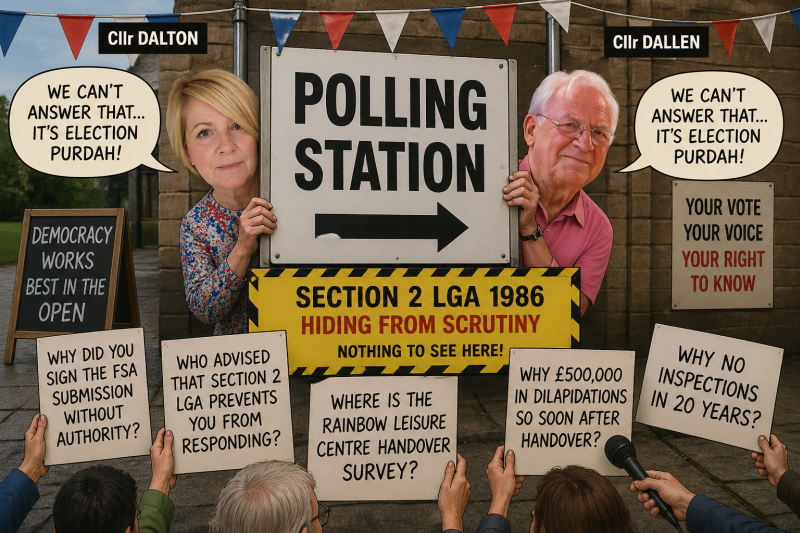

Dalton and Dallen double-down disclosure denial


Two senior Residents Association Epsom and Ewell Borough Council figures have refused to answer questions from Epsom and Ewell Times, both claiming pre-election restrictions under the Local Government Act 1986 — prompting fresh concerns over transparency and accountability at a time when public scrutiny is arguably most important.
Cllr Neil Dallen (RA Town Ward) is standing with his daughter Lucie McIntyre for election to the East Surrey Unitary Council in the West Ewell Division and Cllr Hannah Dalton (RA Stoneleigh) is standing in the same 7th May election in the Ewell Village, Stoneleigh and Nonsuch Division.
In both cases, Section 2 of the Act — which prohibits councils from publishing material designed to influence support for a political party — has been relied upon to justify a refusal to respond. However, expert advice provided to Epsom and Ewell Times indicates that the provision is directed at political publicity, not factual explanations of decisions already taken, and does not require councils or councillors to remain silent when asked legitimate questions about the use of public powers and resources.
Rainbow Leisure Centre: £500,000 repairs and unanswered questions – the case concerning Cllr Neil Dallen
The first case concerns the Council’s handling of the Rainbow Leisure Centre following a change of operator in October 2025.
A confidential urgent decision taken in December stated: “The costs of the dilapidations are not yet fully known… However, an estimate is that this could cost up to £500k.”
The same document recorded a wide range of issues affecting the building, including fire alarms, lifts, ventilation, damp and possible roof defects, with some matters raising health and safety concerns requiring immediate action.
Such costs are not unusual over the lifetime of a large public building. But they are typically managed through regular inspection and timely maintenance. When issues are identified early, they can be addressed incrementally and at lower cost. When they are not, problems can accumulate — and costs can escalate sharply.
The central question therefore remains: how did a building that had just been handed over from one operator to another without closure come to present a potential £500,000 repair liability within weeks?
Conflicting accounts of the building’s condition
The former operator, Greenwich Leisure Limited (GLL), has maintained that the building was handed back in the condition required under its contract. It stated that the Council commissioned a full survey prior to handover, that all identified works were completed, and that these were signed off on the Council’s behalf.
GLL has further confirmed that the Council provided a condition survey to all tenderers as part of the tender process.
In contrast, the incoming operator, Places Leisure, identified extensive defects shortly after taking over, including issues said to affect the safe operation of the building.
Either the building was handed over in an acceptable condition following survey and sign-off, or significant defects existed which were not addressed and may have been present for some time.
No inspection records despite long-standing rights
In response to Freedom of Information requests, the Council confirmed that it held contractual rights to inspect the building throughout GLL’s 22-year tenure.
However, it also stated that it holds no inspection or survey reports prior to 2025.
If accurate, that absence of records raises further questions about how any accumulating defects — if they existed — were monitored, recorded or addressed over such a prolonged period.
The missing survey and disputed confidentiality
At the centre of the dispute lies the condition survey said to have been carried out prior to handover.
The Council has refused to disclose that survey, citing legal professional privilege and the possibility of litigation. Yet the same document was provided to tenderers, including GLL, during the procurement process.
GLL has indicated that it has access to the survey but has declined to provide it to Epsom and Ewell Times.
This leaves a situation in which a document said to be too sensitive for public disclosure appears to have been shared among commercial parties — raising questions as to whether the exemption is being applied too broadly.
If the survey identified the defects now being asserted, questions arise as to why the incoming operator proceeded with the contract before those issues were resolved. If it did not, questions arise as to whether the survey was incomplete or inaccurate, and who was responsible for its preparation.
Competing explanations
A number of explanations remain possible.
It may be that the former operator’s account is correct and the current dispute reflects differing interpretations of the building’s condition.
It may be that defects accumulated over time and were not identified or addressed due to a failure to exercise inspection rights effectively.
It may be that the survey itself failed to identify the true condition of the building.
Or it may be that the scale of dilapidations has been overstated or differently assessed by the new operator, which is carrying out repairs in return for a reduced management fee shortly after securing the contract through a competitive tender process.
At present, none of these explanations has been confirmed, and key documents remain undisclosed.
Refusal to answer questions
Epsom and Ewell Times put a series of questions to the Council and to Cllr Neil Dallen, Chair of the Strategy and Resources Committee, who supported the urgent decision and its initial classification as confidential.
The response received stated: “We cannot provide any further response as we are within the pre-election period and must follow restrictions governed by Section 2 of the Local Government Act 1986.”
Epsom and Ewell Times submitted a Freedom of Information request seeking to establish who advised that Section 2 applied in these circumstances. At the time of publication, no response had been received within the statutory timeframe.
Second case: Dalton and the FSA submission
A similar position has been taken by Cllr Dalton in relation to a separate matter concerning the signing of a submission connected to proposals for a new tier of local governance, referred to as an FSA (Foundation Strategic Authority).
Questions were put to Cllr Dalton as to the basis on which the submission was signed by her as leader of the ruling Residents Association group and whether it had received the necessary Council authority. Those questions have not been answered, with reliance again placed on alleged pre-election restrictions.
Expert advice
Expert advice provided to Epsom and Ewell Times by Nathan Elvery, former Chief Executive Officer of Croydon Council and now Director of Imagine Public Services Ltd, states: “The questions posed… are factual in character… A factual response explaining what occurred and why would not constitute political publicity within the meaning of the Act… The Council is not being asked to promote a political position; it is being asked to account for its stewardship of public funds.”
He added that reliance on Section 2 in such circumstances risks appearing as “a mechanism to avoid scrutiny during a period when accountability arguably matters most.”
The same advice notes that Section 2 applies to councils as corporate bodies and does not impose a personal duty of silence on councillors responding to press enquiries about decisions they have supported.
Transparency or silence?
The common thread in both cases is the use of Section 2 of the Local Government Act 1986 to justify a refusal to engage with questions about decisions already taken.
The law requires councils to avoid political publicity. It does not require them to avoid explaining themselves.
At a time when significant public decisions are under scrutiny — including those involving large sums of public money — the question for residents is whether the current approach reflects appropriate caution, or an avoidance of accountability.

Related reports:
“It’s my meeting”: Cllr Dallen stops questions about his role in alleged Rainbow “cover-up”.
Cllr Dallen accused of £1/2 m Epsom & Ewell Council cover-up
Epsom’s Rainbow Leisure Centre Places new operators
Epsom and Ewell Council transparency row erupts as council backs publication of urgent decisions
Another Epsom and Ewell Borough Council cover-up of criticism?
Devolution or dilution? And who decides?
Cllr Dalton seeks another layer of local government