New Gatwick wetland aims to reduce flood and drought risks


A new wetland capable of holding up to 600,000 litres of water has been created near Gatwick as part of efforts to make the Upper Mole catchment more resilient to flooding, heatwaves and prolonged dry weather.
The South East Rivers Trust has completed the latest phase of a project using natural measures to slow, store and filter water before it travels downstream.
Across two sites, the environmental charity has created the wetland and reconnected 100 metres of river with its natural floodplain.
The wetland will collect rainfall and surface water, releasing it gradually downstream. Restoring the connection between the river and its floodplain will also give water more space to spread out and be held temporarily during periods of heavy rain.
The measures are intended to ease pressure on downstream communities when rainfall is intense, while keeping more water in the landscape during hot and dry periods. The restored areas should also provide new and improved habitats for wildlife.
The work was funded by London Gatwick through its Decade of Change sustainability programme, a strategy covering 10 environmental and social priorities up to 2030.
The latest phase, delivered between July 2025 and June 2026, included:
- Installing more than 50 “leaky barriers” to slow the movement of water;
- Planting a 100-metre hedgerow containing 400 native trees;
- Bringing two more landowners into the catchment project; and
- Monitoring rainfall, river levels and water clarity to study how water moves through the landscape.
Leaky barriers are carefully positioned structures made from natural materials such as branches and logs. Under normal conditions, water can continue to flow through them, but during heavier rainfall they slow the flow and hold back some of the water temporarily.
George Biggs, project officer at the South East Rivers Trust, said the recent spell of hot and dry weather illustrated one side of the challenge facing the area.
“During the current hot and dry weather, it can be difficult to imagine how quickly heavy rainfall can create problems for our rivers and local communities,” he said.
“The Upper Mole responds very rapidly when it rains, with water moving quickly through the catchment. By restoring wetlands, reconnecting rivers with their floodplains and installing leaky barriers, we can give that water more space and more time.
“These measures help create a healthier, more resilient landscape that is better prepared for both very wet and very dry conditions. They also provide valuable new habitats for wildlife.”
The Upper Mole is particularly responsive to rainfall because of its clay soils, modified river channels and surrounding urban development. Heavy rain can move rapidly downstream, increasing the risk of flooding and placing additional pressure on water quality and river habitats.
Natural flood management seeks to tackle those problems nearer their source by working with the landscape to slow, store and filter water.
Mark Edwards, head of sustainability at London Gatwick, said: “This important initiative, delivered in partnership with the South East Rivers Trust, is a vital part of London Gatwick’s Decade of Change sustainability programme.
“This partnership is a great example of bringing together technical expertise, landowners and local knowledge to deliver practical measures that support biodiversity, water quality and climate resilience.
“It demonstrates how London Gatwick can support enhancements to the local area outside the airport.”
Further restoration work is now being planned across the Upper Mole catchment. Proposals include restoring an old pond so that it can store more water and support biodiversity, installing additional leaky barriers and designing another wetland to improve water quality and availability.
The partners also intend to extend the project into another of the Upper Mole’s six waterbodies, continue monitoring the measures already installed and hold community engagement days about the river and natural flood management.
The project initially concentrated on the headwaters of the River Mole, including Baldhorns Brook near Rusper. Its longer-term ambition is to expand throughout the Upper Mole catchment and demonstrate how nature-based measures could help restore other urban river headwaters across the South East.
Monitoring equipment is recording rainfall, river levels and turbidity – a measurement related to water clarity – so that the Trust can assess how the catchment and the completed interventions respond to wet weather.
Further information about the Gatwick Airport Natural Flood Management Project is available from the South East Rivers Trust.
.
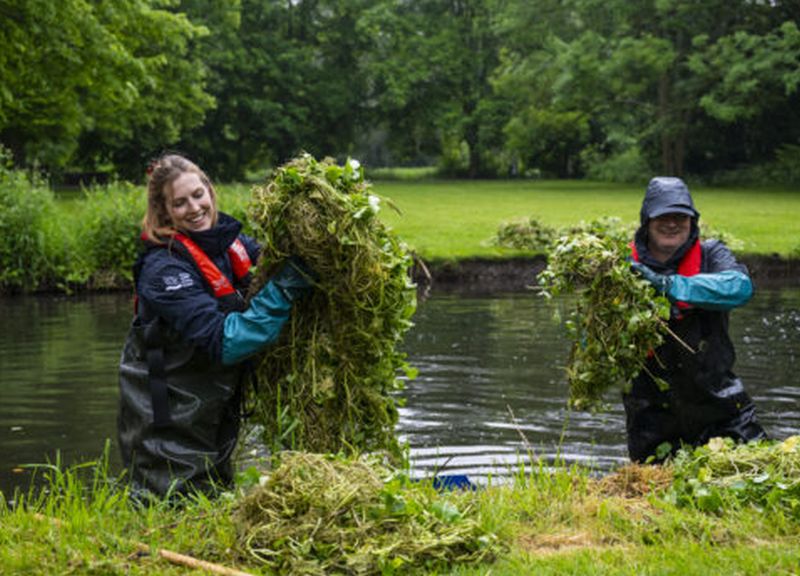
Photo: Weed clearing – courtesy South-East Rivers Trust