
May’s heat infuses Epsom and Ewell Council Chamber with leadership closely contested


On one of the hottest days of the year, with councillors and guests in Epsom Town Hall using agenda papers as improvised fans, Epsom & Ewell Borough Council held what was in effect the beginning of its final chapter — the Annual Council meeting that will oversee the borough’s last year before abolition under local government reorganisation.
The evening of 26th May combined civic ceremony, nostalgia, political tension and procedural wrangling, culminating in a knife-edge vote for Council leadership and a heated row over the Council’s constitution.
Councillor Lucy McIntyre (RA) was elected Mayor for what will be the borough’s final mayoral year, with veteran Independent councillor Julie Morris chosen as Deputy Mayor.
McIntyre, among the younger and longer-serving members of the chamber, described the appointment as “particularly special because this borough really has always been my home”, speaking movingly of family ties, her late brothers, and the borough’s impending disappearance into the new East Surrey Council.
“This will be the final mayoral year of Epsom and Ewell in its current form, as we know it,” she said. “It makes it even more of an honour and a privilege to serve you all.”
Her chosen charities include Fab for Epsom & Ewell, Girlguiding Epsom District and Sunnybank Trust, with ten principal events planned during the roughly ten months remaining before the borough’s end. “The countdown has already begun,” she told the chamber, “because after all, it’s the final countdown — so let’s make it unforgettable.”
Outgoing Mayor Councillor Robert Leach offered a characteristically humorous farewell, reflecting on a year that took him from the Derby and Buckingham Palace to community groups, Ukrainian refugees, disability charities and opening Primark.
“It has been a great honour to be the mayor of the borough for the last year,” he said. “This was a position I had not expected and… not one that I sought.” He praised the borough’s “more than 100 charities and voluntary groups”, remarking that a mayoral visit “means so much to the people”, and expressed hope that some civic role might survive local government reorganisation.
But the political temperature rose sharply when councillors turned to the appointment of Council Leader.
Councillor Hannah Dalton (RA), the incumbent leader, was nominated by Councillors Liz Frost and Christine Cleveland. Frost urged members to back continuity in the borough’s final year.
“This… is going to be the last year of the council,” she said. “It is really, really important that we all pull together… and leave the council in a good position.”
Cleveland praised Dalton’s work through “very turbulent times” in local government and added: “It would be really nice to end our time in Epsom with a female leader of the council as well.”
The challenge came from Independent councillor Alex Coley, once a prominent Residents’ Association figure before breaking away from the ruling group.
Nominating Coley, Councillor Kate Chinn (Labour Court) launched a stinging critique of the outgoing year.
“Last year this council agreed strategic priorities,” she said. “It’s safe to say these did not go according to plan.”
She referred to “a committee meeting where the leader of the council [was] absent from a vote to fund a strategic priority” and another where “an RA CIL (Community Infrastructure Levy) bid was proposed and not voted through by the RA members.”
“If the leader stays the same, these priorities will not be worth the paper they are written on,” she argued. “We need a new leader… one who will deliver and work across all political groups… As long as this ship is still afloat, we must look after it. But it’s time for a new captain.”
The most striking intervention came from RA Councillor Kim Spickett.
Visibly framing her choice as a painful one, she revealed the intensity of lobbying behind the scenes.
“The choice today… has been very difficult for me,” she said. “I’ve had a lot of calls, I’ve had a lot of messages, and I’ve had a lot of pressure put on me. I’m not happy about it. It’s made me very sad.”
Declaring pride in the borough and its people, she nevertheless backed Coley as the person to steer the authority through its closing months.
“We need the proven leadership of a councillor who’s dedicated to delivery and puts outcomes first… somebody I’m proud to call my friend.”
“Delivery is what we need to set this community up for success… and I believe Alex will deliver.”
The vote that followed demonstrated just how finely balanced the chamber had become.
Dalton survived — but only narrowly.
The official tally: 15 votes for Hannah Dalton, 14 for Alex Coley.
Having retained the leadership by a single vote, Dalton struck a conciliatory note.
“Being leader is never easy, and you’re not going to take everybody with you all of the time,” she said. “I’d say the last year to 18 months has been the hardest it has ever been.”
She acknowledged the challenge of leading a Residents’ Association group that, she insisted, operates without a formal whip: “Whatever they do say, they do not have a political whip, and they discuss everything.”
In remarks that reflected the strains of both local government reorganisation and evident political divisions inside the chamber, she appealed for unity.
“We’ve got to deliver a lot. We need stability. We need to get to the end of next March in one piece, without ripping each other apart, or leaving this council in a really bad way.”
“We’ve been here for 90 years, we’ve done an incredible job together. Let’s keep it together, just for the last ten months.”
If the leadership contest exposed the chamber’s political fault-lines, the next item — approval of the Council’s constitution — produced a procedural clash that left tempers noticeably frayed in the overheated room.
Mayor McIntyre announced that a late proposal concerning the constitution would not be accepted, ruling that substantive constitutional changes required proper routing through the Standards and Constitution Committee, officers, or a formal motion process.
Councillor Chris Ames (Labour) objected fiercely.
“As might have been predicted, the administration has sought to close down debate about this,” he said.
“We’re going to be asked to agree a constitution that we should know is defective.”
Denying that he had proposed a constitutional amendment, Ames said he had merely sought to highlight concerns. “The usual procedural shenanigans that we get here doesn’t surprise me one bit,” he said. “It’s absolutely disgraceful. It’s the typical corruption of this administration.”
Councillor James Lawrence (Independent) followed with his own criticism, citing what he said were deficiencies in the complaints process as described across the Council’s constitution, operating framework and website.
He argued that a councillor complaints procedure was either missing or unclear, describing a complaint against him that had remained unresolved for months.
But when Lawrence attempted to continue, the Mayor curtailed him.
“The meeting this evening is for a civic event,” she said, directing him instead toward the processes set out elsewhere in the Council framework.
Lawrence pushed back, asking: “Can you point in the constitution why I can’t speak?”
The exchange carried a certain irony: debate was being restricted on the basis of the meeting’s civic character while the approval of the constitution itself remained a formal agenda item before members.
When the vote finally came, the constitution was approved 15 votes to 9.
The meeting then moved on to committee appointments and other routine business without further fireworks.
Yet for a council entering its final year of existence, the evening had already revealed much: pride in civic tradition, uncertainty about the future, visible political strains — and a leadership retained by the narrowest of margins in a chamber made short-tempered by heat, history and the approaching end of the borough council era.
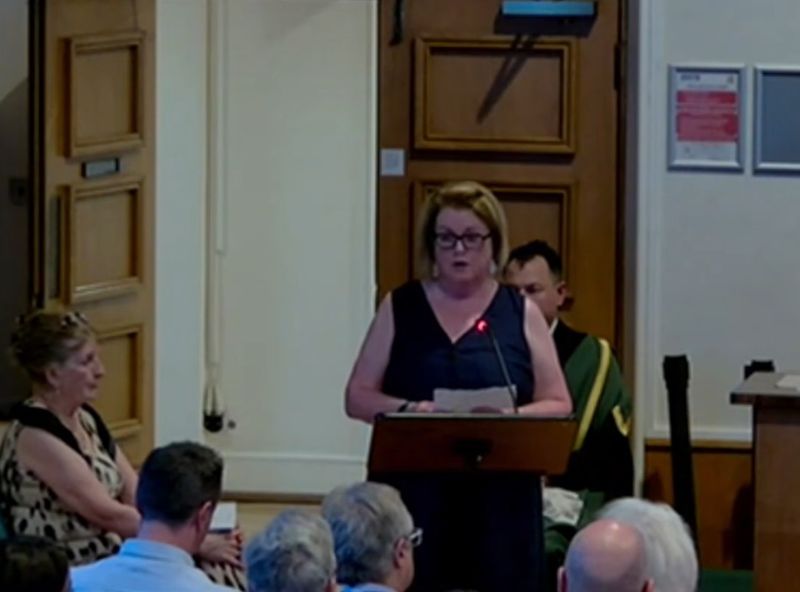
Image: Cllr Kim Spickett addresses the Council – Epsom and Ewell Borough Council YouTube
.
.
.