

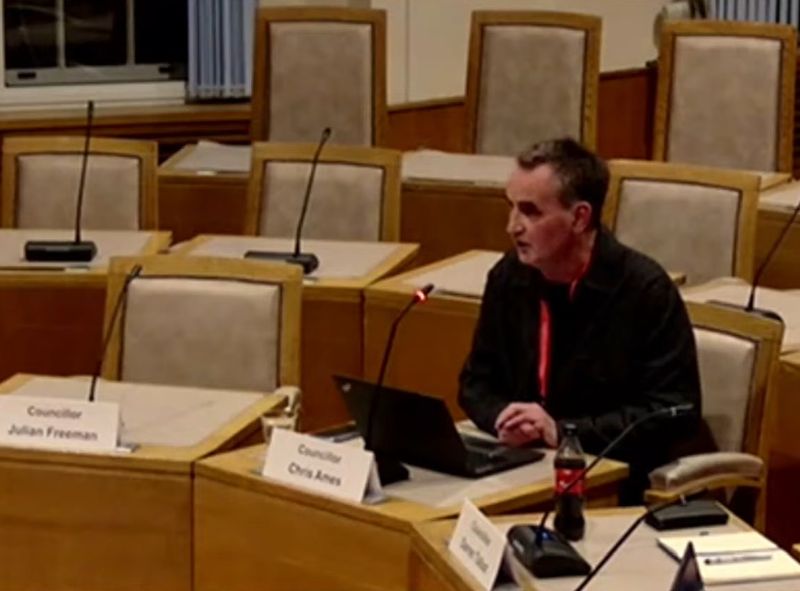
Epsom Councillor claims he is being silenced for his transparency concerns


A meeting of Epsom and Ewell Borough Council’s Standards and Constitution Committee on 15th January exposed sharp tensions over councillors’ scrutiny rights and the handling of Code of Conduct complaints, following an unusually fraught exchange between a senior councillor and the committee chair.
Cllr Chris Ames (Labour Court) claims that his raising of concerns about Council transparency has stimulated official complaints against him inhibiting him further from holding the Council to account.
Councillor declares interest — and raises alarm
Early in the meeting, Councillor Chris Ames (Labour Court) declared a personal interest in the final agenda item reviewing Code of Conduct complaints, confirming he was the subject of two live complaints and would withdraw when the item was reached.
In an extended statement, Councillor Ames told the committee that he had chosen to be transparent because the complaints were already referenced in the report and likely to give rise to “public speculation”.
He said: “Both complaints are effectively that I raised concerns about transparency failings at the council… I don’t believe it’s appropriate to use a code of conduct complaint to censor councillors’ concerns”.
Councillor Ames also argued that there appeared to be no clear written procedure for councillors who are the subject of complaints, beyond guidance aimed at complainants. He said this lack of clarity was itself a governance issue the committee should be concerned about.
The Chair, Councillor John Beckett (RA Auriol) intervened to halt the statement, telling him: “This is not really the time and place to discuss the actual complaints against you.”
Councillor Ames responded that being required to recuse himself before any complaint was resolved was already preventing him from fulfilling his role: “On the basis of a complaint, this essentially has the effect of censoring me as a councillor.”
Constitution update prompts wider scrutiny debate
The committee later considered an update to the Council’s Constitution, including changes to the Scheme of Delegation that governs what decisions officers can take without councillor approval.
Officers introduced a late addendum, explaining that an internal audit had identified an error in the Constitution. A requirement for an annual report to Audit and Scrutiny on “significant delegated decisions” was being corrected to refer instead to “urgent decisions”, a defined category already used in practice.
The Monitoring Officer stressed the change was technical: “We’re literally just recognising a defined term of decisions that don’t exist for one that does. There will be no changes to the process.”
However, Councillor Ames used the discussion to raise broader concerns about scrutiny being weakened in practice. He argued that councillors’ existing rights to request scrutiny of delegated decisions were routinely ignored. Referring to the Constitution, he said: “There is a right for a councillor here to request that decisions taken by officers under delegated powers are scrutinised… but it doesn’t appear to express a right for that scrutiny then to take place.” He also mentioned: “Councillor Chinn (Labour Court) and I have been warned to be circumspect about what we can and can’t say in public about the scheme of delegation. It’s been declared to be an exempt issue.”
He proposed amending the wording to make clear that such requests must be heard by the Audit and Scrutiny Committee, warning that without this, councillors’ rights existed “for no effect”. Councillor Ames went further, accusing the administration of blocking scrutiny: “All of the attempts at calling in are being blocked… The main object of the administration seems to be to stop the public finding out quite how bad they are by preventing things being aired in public.”
Proposal deferred, constitution changes approved
Officers advised that the proposal should be referred to the Constitution Working Group, made up of political group leaders, rather than debated fully on the night. Councillor Ames’s amendment failed to attract a seconder but was formally referred to the working group at his request.
The committee then unanimously agreed to recommend the constitutional updates — including the late correction — to Full Council.
Code of Conduct complaints: eight cases, two ongoing
After Councillor Ames left the meeting, the committee considered the report on Code of Conduct complaints.
Officers confirmed that eight complaints were assessed as valid between December 2023 and December 2025. Six had been resolved, with two still ongoing. No councillors were named, with officers citing the need for fairness and natural justice.
The report was noted without debate.
Why this matters
While much of the meeting dealt with technical governance changes, the exchanges revealed deep unease about transparency, scrutiny and the use of conduct complaints, particularly as the Council approaches local government reorganisation.
Whether Councillor Ames’s concerns lead to stronger scrutiny powers — or remain unresolved — now rests with the Constitution Working Group.

Cllr Ames at the meeting: EEBC YouTube channel