

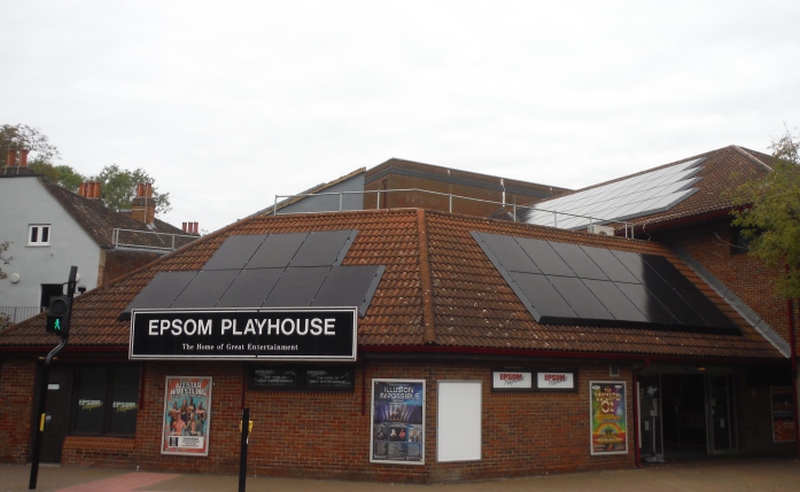
Epsom Playhouse to embrace heat pumps and trees to be felled – a planning committee’s night’s work


Last night Councillors unanimously approved the council’s own application to replace ageing air-conditioning plant at Epsom Playhouse with a modern heat pump system, in a decision expected to cut the theatre’s reliance on fossil fuels.
The scheme, brought to committee because the council itself is the applicant, will see five redundant roof-mounted air conditioning condensers and a gas-fired boiler removed from the roof of the Ashley Avenue theatre and replaced with six air source heat pumps and four condenser units. The new equipment will sit within a 1.8-metre acoustic screen to control noise.
Presenting the report, a planning officer told the committee the works would modernise the Playhouse’s building services and “contribute towards the council’s net-zero objectives, and reduce the building’s reliance on fossil fuels.” Because the theatre adjoins the Grade II listed 47-51 South Street and sits next to the Epsom Town Conservation Area, officers had assessed the impact on the setting of those heritage assets, concluding it would cause “less than substantial harm” — but that this harm was outweighed by the public benefit of the energy efficiency improvements.
The council’s Environmental Health Officer raised no objection, subject to a condition requiring a report confirming noise from the new plant does not exceed 37 dB — measured at the nearest habitable window, at neighbouring properties including 39 South Street.
Cllr Alison Kelly (LibDem Stamford) asked officers whether any images were available of how visible the new acoustic screening would be from street level. The officer explained that although the fencing would stand 1.8 metres high in total, most of it would sit behind the existing roof parapet, meaning only around 1.3 metres would be visible — and only from the Ashley Avenue side of the building, a route she described as “a public thoroughfare, but not well used.”
As a verbal update, members were told Surrey County Council’s Highway Authority had raised no objection, and the scheme had received support from the Theatres Trust.
Following the questions, the application was approved unanimously subject to the conditions and informatives set out in the officers’ report — including a requirement that the equipment be removed within a month of any future cessation of use, to protect the setting of the neighbouring listed building.
Drummond Gardens: committee refuses to fell veteran oak and three poplars, approves loss of six other protected trees
The most contentious item of the evening concerned an application to fell ten trees protected by Tree Preservation Orders at Drummond Gardens, a 1930s apartment block off Christ Church Mount, after the block’s managing agents argued the trees were causing subsidence damage to the building.
The application sought consent to fell four English oaks within the private grounds of Drummond Gardens, and six Lombardy poplars in the adjoining, council-owned Long Grove Park. Following a lengthy and detailed presentation from the council’s Tree Officer, members voted to approve felling of six of the ten trees, refuse felling of the remaining four, and instead require substantial crown reduction pruning of those four as a compromise measure.
A long-running subsidence dispute
The officer explained that Drummond Gardens has “a long history of building movement,” with cracking on the building’s west-facing wall having worsened in recent years, most severely around flats 26 to 31. A potential insurance claim was first notified to the council in 2020, but was deferred at the time because the trees involved were protected and there was insufficient evidence — including missing structural engineering and level-monitoring data — to justify their removal. That evidence has since been gathered, including a structural engineer’s report, drainage surveys, and building level monitoring carried out between 2021 and 2024.
He told members the building’s foundations are shallow — between 45 and 68 centimetres deep in most places, save for a section towards the south-west corner that was partially underpinned to a depth of two to three metres in 1995. He explained that foundations of this shallow depth are “inadequate by modern standards” on clay soil, particularly where trees are nearby, though he noted that “many properties with shallow foundations on clay coexist with trees without suffering subsidence.”
Root samples recovered during site investigations were not starch-tested, meaning there is no scientific confirmation of whether they were alive at the time they were dug up — a gap in the evidence that came up more than once during member questions.
Tree-by-tree recommendations
The assessment, illustrated with photographs of each tree, distinguished between:
- Oaks T5 and T6 — two middle-aged oaks close to the point of greatest recorded building movement. Mr Young said these were “clearly implicated in causing subsidence damage,” noting that even after a neighbouring oak was removed in 2020, level monitoring still showed a seasonal pattern of movement associated with these two trees. Because they are still young enough to grow significantly larger, he judged the future risk to be high and recommended felling.
- Oak T12 — a small, suppressed specimen tucked behind the veteran oak, recommended for felling as being of low amenity value.
- Oak T9 — a “transitionary veteran” oak estimated to be around 160 years old, likely a survivor of the field-boundary hedgerow that predates Drummond Gardens itself. Mr Young recommended this tree be retained, explaining that because the tree pre-dates the building, its long-term extraction of moisture from the clay soil may already have caused the ground — and the building above it — to settle to a lower level than it would otherwise sit at. Felling the tree now, he warned, risks the reverse effect: the ground swelling back upwards (“heave”) as the soil rehydrates, potentially causing fresh damage. He noted the tree shows signs of naturally “retrenching” — dying back at the crown and roots as it ages — which may explain readings showing the building had actually risen slightly over the past winter. His recommendation was crown reduction rather than felling.
- Lombardy poplars T22, T23 and T24 — recommended for felling. These are the three poplars closest to the corner of the building where subsidence has been recorded, and Mr Young noted they also have decay at old “topping” points from previous pruning, reducing their safe life expectancy and increasing the risk of branch failure onto the more open part of the garden nearby.
- Poplars T20, T21 and T25 — recommended for retention with substantial crown reduction (cutting back the canopy by around a third), rather than felling. Mr Young said building movement at this end of the site was slight, “within building tolerance,” and that there was no clear evidence any single poplar was responsible for seasonal movement.
Member questions
Before discussion began, Chair Cllr Clive Woodbridge (RA Ewell Village) noted for the record that he — and, he believed, other members — had been contacted directly by the Drummond Gardens Property Group, but stressed the committee was approaching the item “with an open mind.”
Cllr Neil Dallen (RA Town) asked whether the council would be financially liable if the committee’s decision were followed but further damage subsequently occurred. Head of Development Management and Planning Enforcement, confirmed that in principle it could be, “but they would need to do additional work to prove that.” Cllr Dallen also queried how much weight the committee should give to the council’s financial exposure in reaching what would normally be a purely planning judgement. The officer confirmed this was a legitimate material consideration in this case, given “the financial risk to the council… could be significant, depending on the extent of works that are required to the building.”
Cllr James Lawrence (Independent College) questioned the internal consistency of the recommendation, noting that Oak T9 sat close to boreholes where oak roots had been recovered — comparable evidence, he suggested, to that used to justify felling T5 and T6 — and that T9 did not show the hollowing typically associated with veteran trees. He also queried whether the level of crown reduction proposed for the poplars was proportionate, given it would need to be repeated regularly and would itself reduce the trees’ amenity value. Mr Young responded that the key distinction was vigour: T5 and T6 remain in active growth and have significant capacity to expand their root systems further, whereas T9, as an ageing tree past its physiological peak, was more likely to be naturally reducing its water demand rather than increasing it. He added that without DNA root testing, it was not possible to say definitively which poplars’ roots lay beneath the building, and that felling all six risked being “quite a scorched earth approach.”
Cllr Alison Kelly asked what risk of heave would arise if the committee took a “wholesale” approach and approved felling of all ten trees, and whether that would carry legal liability. The tree officer explained the heave risk applied specifically to the veteran oak, T9, because of its age relative to the building, but not materially to the younger oaks or the poplars, which post-date or are roughly contemporary with the building’s construction and would not have caused the ground to subside below its original level.
Cllr Robert Leach (RA Nonsuch) praised the report as “an excellent, well-written report, well-researched, well-argued, factually based,” noting that his initial assumption — that the tree officer was simply recommending wholesale felling — had not survived a proper reading of the evidence. Vice-Chair Cllr Phil Neale (RA Cuddington) echoed the praise for the report’s thoroughness, and asked whether it was coincidental that the two highest-value trees on the council’s own amenity valuation (T9 and T20) were also the two recommended for retention. Mr Young said the correlation was not the basis for his recommendation; rather, T20 and the other retained poplars back onto a more sheltered part of the group, whereas T22–T24 sit closer to an open area of garden where a falling branch would have nowhere else to land.
Responding to a question from the Chair about future monitoring, the officer confirmed that if building movement continued despite the works being carried out, officers would review whether other, currently unimplicated trees might be responsible. He confirmed that ongoing level monitoring would be carried out by the private landowner’s own structural engineer, not the council.
Decision
The committee voted to approve the officers’ recommendation in full: refusing consent to fell Oak T9 and Poplars T20, T21 and T25, on the grounds of insufficient evidence of a direct causal link to the subsidence and the harm their loss would cause to environmental quality and amenity; and approving felling of Oaks T5, T6 and T12 and Poplars T22, T23 and T24, together with crown reduction works to the four retained trees, subject to conditions.
Officers’ report put a figure on what was at stake: felling all ten trees would have represented a loss of public amenity valued, using the industry-standard CAVAT (Capital Asset Value for Amenity Trees) methodology, at £954,480. The committee’s part-refusal reduces that loss to £387,818.
Upcoming applications
Members briefly noted a report listing applications likely to come before the committee in September, including a called-in application at Langley Bottom Farm concerning a variation to affordable housing obligations, a residential care home proposed south of Oak Glade, and a 48-dwelling scheme across two flat buildings at Swail House, Ashley Road. A site visit to Swail House has already been requested and will be arranged ahead of that meeting.
Cllr Alison Kelly raised a query about tree and ground-levelling works she had observed while cycling past a site off Christ Church Road, near Oak Glade, asking whether it involved any protected trees. An officer said she understood the activity related to dormouse survey work, which requires regular checking of monitoring tubes, though officers agreed to look into the specific site and confirm whether any tree works taking place required scrutiny.

.
Related reports: