

Surrey astrophysicists explore ultra-black satellite coating to protect night sky


A satellite coating made from one of the world’s darkest materials could help tackle a growing threat to astronomy, according to new research led by astrophysicists at the University of Surrey.
With as many as 60,000 satellites projected to orbit Earth by 2030, scientists are seeking ways to reduce their brightness in the night sky.
In a new study published in the Monthly Notices of the Royal Astronomical Society, researchers demonstrate how Vantablack® 310 – an ultra-black coating developed by University of Surrey spinout Surrey NanoSystems, which co-authored the paper – could help reduce light pollution from satellites in low Earth orbit.
The growing number of satellites already in orbit has raised concerns among scientists and stargazers. Reflected sunlight from spacecraft can create bright streaks and flares that interfere with telescope observations and large-scale surveys of the night sky.
This can make it more difficult to detect faint objects, including asteroids, distant galaxies and other important astronomical phenomena.
To tackle the problem, the research team measured how Vantablack® 310 reflects light under a range of illumination and viewing conditions. They then used those laboratory measurements to simulate how a coated satellite surface would appear from the ground.
The simulations showed that the coating could make satellite surfaces significantly fainter, bringing their brightness close to the limit recommended by the International Astronomical Union for protecting astronomical observations.
The findings suggest that ultra-black coatings could provide a practical way to reduce the impact of future satellites on astronomy and the night sky.
Astha Chaturvedi, lead author of the study and a postgraduate researcher at the University of Surrey, said: “The night sky is one of humanity’s oldest windows into the universe, but it is becoming increasingly difficult to see things.
“Our results show that relatively simple material choices could make a meaningful difference to how satellites affect astronomical observations without requiring major changes to mission design.”
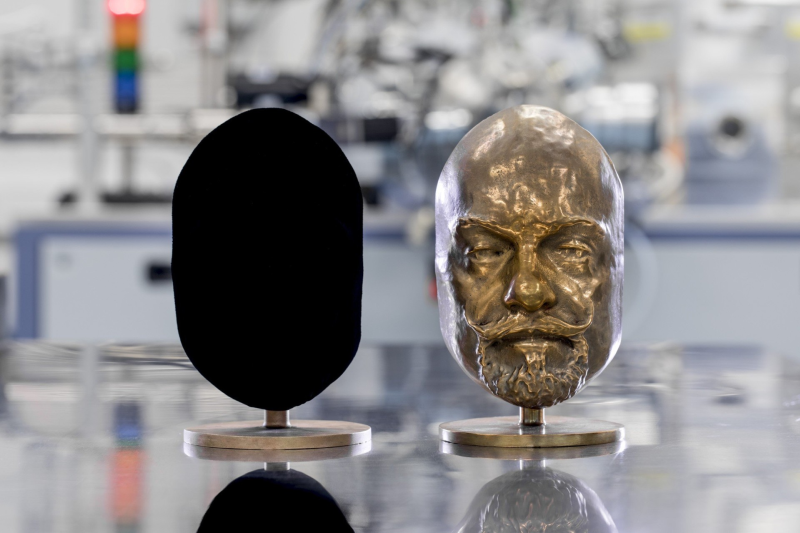
Vantablack® 310 reflects only around two per cent of incoming light. The small amount of light it does reflect is distributed more diffusely, reducing the bright flashes commonly produced by reflective satellite surfaces.
Dr Noelia Noël, co-author of the study and Senior Lecturer in Astrophysics at the University of Surrey, said: “Space is becoming increasingly crowded, creating challenges not only for astronomers but for everyone who values an unspoilt night sky.
“What is encouraging about this research is that it moves us beyond simply identifying the problem and towards developing practical, evidence-based solutions.
“As an astrophysicist at Surrey, I am particularly proud that a potential solution to this astronomical challenge has emerged from pioneering materials research at our own University. Vantablack® technology grew from work involving my colleague Professor Ravi Silva and was developed and commercialised by Surrey NanoSystems, demonstrating what can be achieved when astrophysics, engineering and industry work together.”
James Whitfield, Applications Scientist at Surrey NanoSystems and co-author of the study, said: “Satellite constellations offer enormous benefits, but their growing brightness presents a challenge for ground-based astronomy.
“Vantablack® 310 combines ultra-black performance across a wide range of viewing angles with the durability needed for low Earth orbit. We are proud to work with the University of Surrey to help protect the night sky while supporting innovation in satellite technology.”
The team is now preparing for an in-orbit demonstration aboard the Jovian-1 CubeSat mission, a student-led satellite programme involving the universities of Surrey, Portsmouth and Southampton.
The demonstration will test both the coating’s performance in the space environment and whether the resulting change in brightness can be measured from the ground.
The wider Light Pollution and Sustainable Space initiative, led by Dr Noël, was named Best Sustainable Project at the University of Surrey’s 2026 Sustainability Awards, recognising its systematic approach to reducing satellite brightness through material design.
The work has also reached the international stage, with lead author Astha Chaturvedi invited to present the research at the United Nations Workshop on Dark and Quiet Skies in Vienna. Dr Noël has also highlighted the wider challenge of satellite light pollution and the need to protect the night sky through her TEDx talk.
Two identical bronze casts – one has been coated with Vantablack® 310 (Credit: Surrey NanoSystems)