
Time for Cllr Dallen to drop his taxpayer funded complaint?


A few minutes of video from an Epsom and Ewell Borough Council meeting have now generated an external investigation, a legal adviser’s attendance at the Town Hall and a standards hearing that could not get past a basic question: which rules is the Council using?
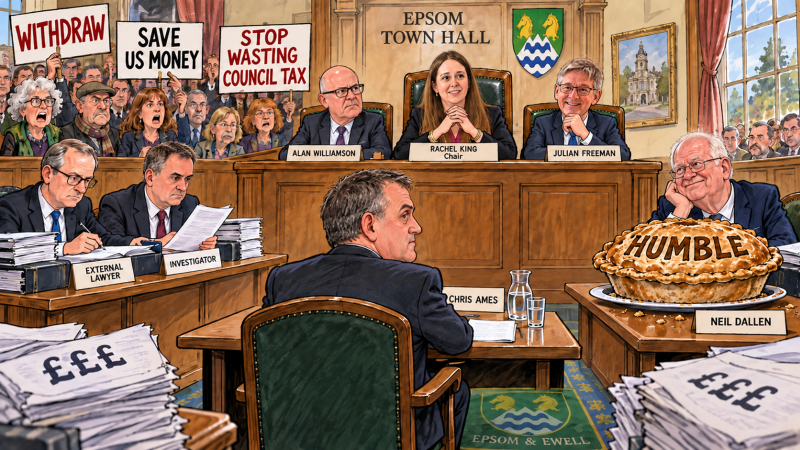
Councillor Neil Dallen (RA Town) complained that Councillor Chris Ames (Labour Court) had failed to treat him with respect during a heated exchange about the Rainbow Leisure Centre in January. An external investigator recommended a finding against Ames. But at a preliminary hearing on 22 September, the panel made no finding on his conduct. Instead, it heard a sustained challenge to the Council’s handling of the complaint and paused proceedings to consider it.
The question for Cllr Dallen is whether he still wants taxpayers to fund the pursuit of his complaint. He is entitled to make one. He is also free to withdraw it.
The rules the Council used in 2019
The Council’s own papers for its February 2019 standards hearing provide a striking point of comparison. This being the only other hearing of the committee on a complaint against a councillor since 2015. That hearing’s officer report said the Council had approved a process for investigating complaints in July 2012. It attached a document headed Arrangements for dealing with standards allegations under the Localism Act 2011 and identified it as the procedure for investigating and determining the complaint. The eventual decision recorded that the Independent Person’s views had been sought and taken into account.
The 2012 document remains in that publicly available hearing pack. It says the Independent Person’s views must be considered before a decision on whether a councillor breached the Code and on any action to follow. It also gives a councillor the right to require a further hearing sub-committee to review a sanction.
Yet the officer report prepared for the Ames hearing did not mention that document or explain whether it had ever been withdrawn or replaced. It instead pointed to provisions of the Constitution and guidance for people making complaints, while acknowledging that the arrangements it identified did not provide a standards hearing procedure. Officers asked the three-member panel to adopt a newly proposed procedure or amend it for fairness.
That omission is extraordinary. If the Council used the 2012 arrangements at its last publicly documented hearing in 2019, what changed, who approved the change and when? Those questions should have been answered in the report placed before the panel.
Safeguards missing from the proposed procedure
The differences matter. The proposed 2026 procedure does not expressly require the Independent Person’s views to be sought before the panel decides whether the Code was breached. It says there is no right of appeal, without preserving the sanction review set out in the 2012 arrangements. It also offers a wider list of actions, ending with “any other sanction” considered appropriate in consultation with the Independent Person.
A hearing panel appointed to determine one councillor’s complaint has not been shown to have power to replace the Council’s standing complaints arrangements or expand the sanctions it may impose. The 2012 arrangements were approved by the Council. If different standing arrangements have since been made under a valid delegation, the Council should identify the decision. Adopting new rules in the middle of Ames’s case cannot substitute for showing which rules lawfully applied when the complaint was handled.
At the hearing, Ames and his Labour Party legal representative, Matthew Burn, repeatedly asked for that answer. The external legal adviser to the panel argued that the Council’s arrangements need not be contained in one document: in his view, they could be found across the Constitution, delegations and published guidance. But he could not identify when the complaints leaflet on which Ames said the Monitoring Officer had relied was adopted. He accepted that a clear, consolidated document would help the Council. The adviser’s position was that the Council nevertheless had sufficient arrangements and powers to investigate the complaint. The panel did not resolve that disagreement.
Nor was this a question sprung on officers at the Town Hall. Ames and Burn said they had been seeking an explanation for months. Monitoring Officer Piero Ionta and his deputy did not attend to give one. The panel’s chair, Councillor Rachel King, eventually called a pause so members could consider what they had heard.
How much has this cost?
The Council’s hearing report confirms that it commissioned an external investigation and instructed an external adviser for the panel. It says the bills will be met from corporate reserves but gives no amount, stating that final invoices had not arrived. EET has also sought cost information from the Council without obtaining a figure. Officer preparation and attendance have not been costed publicly either.
CH&I Associates director Alex Oram declined to tell Epsom and Ewell Times his firm’s fees or hourly rate. He confirmed that the rate was no more than £100 an hour, but would not say whether it was below £50. A representative of the Norwich-based firm also travelled to attend the Epsom hearing in person.
Could the total already be as much as £5,000 once external fees, travel and officers’ time are counted? That is a question, not an established estimate: without invoices and a record of staff time, we cannot calculate the total. The Council should publish what it has spent so far and the anticipated cost of any further hearing, including additional external advice.
A complaint born of unanswered Rainbow questions
The underlying incident is recorded on the Council’s meeting video. Ames was asking who had decided to keep confidential an urgent decision concerning up to £500,000 of potential repairs at the Rainbow Leisure Centre. Dallen had supported that decision and was chairing the meeting when Ames questioned it. Dallen stopped further discussion, saying, “It is my meeting” and failed to stand aside for his vice-chair to rule on the matter. Ames called him “arrogant” and alleged a “cover-up”.
Ames has since said he regrets using “arrogant” and should instead have raised a formal point of order about Dallen continuing to chair that item. The investigator recommended a finding that Ames had failed to show respect, while recognising that he was pursuing a genuinely held argument about transparency. The investigator did not decide whether his questions about the Rainbow decision were right. The hearing panel has not determined the complaint.
Speaking after the preliminary hearing, Ames said he was grateful that the panel did not press ahead without clarity about the applicable arrangements. He accused the administration of spending taxpayers’ money pursuing a “low-level complaint” while his complaint about Dallen’s conduct at the same meeting had been rejected. Those are Ames’s criticisms, not findings by the panel.
The recorded exchange will still be there if a properly constituted panel is asked to judge it. First, the Council needs to explain why its 2019 hearing used arrangements absent from the 2026 report, what authority supports the proposed replacement and what this process has cost. Dallen, meanwhile, has a simpler decision: is continuing this complaint a proportionate use of public money?
Related reports
- Epsom’s Rainbow questions persist as £4.7m revamp advances – 21 September 2026
- Epsom & Ewell Council refuses to explain complaints disparity – 25 August 2026
- Epsom’s scrutiny committee slams Dallen’s urgent £500K Rainbow approval – 17 July 2026
- The Man Who Signed It, Chaired It, and Wouldn’t Explain It: Six Months of Silence Over Rainbow’s £500,000 Bill – 11 July 2026
- “It’s my meeting”: Cllr Dallen stops questions about his role in alleged Rainbow “cover-up” – 23 February 2026