

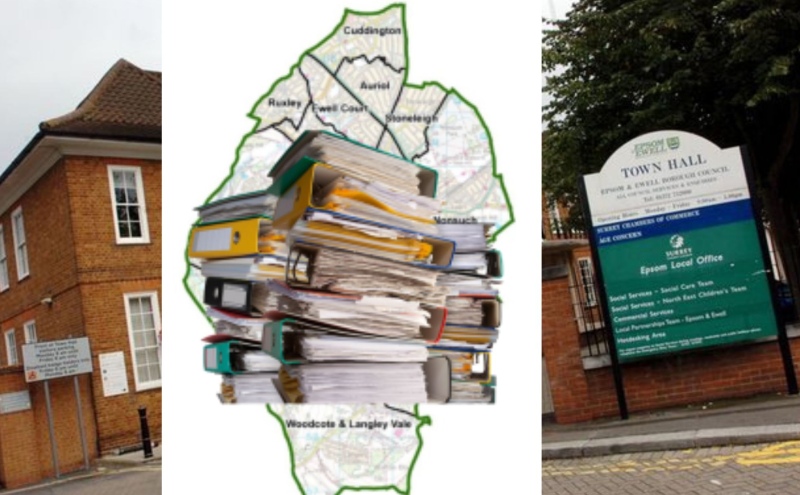


By Tim Murphy, CPRE Surrey (Campaign to Protect Rural England)
You might think that the Borough’s councillors, officers and, indeed, residents have had enough of Local Plan preparation over the last few years. Several versions of the draft Epsom and Ewell Local Plan have been produced, at least four rounds of public consultation have been held, and very considerable costs have been incurred in terms of time and money.
We are now at the point where a Planning Inspector, appointed by Whitehall, has indicated that the Local Plan might be sound, as long as four substantial areas of Epsom and Ewell’s highly performing Green Belt – Horton Farm, the Hook Road Arena, Downs Farm, and part of Priest Hill close to Ewell East Station – are turned into housing estates. The public consultation on the Inspector’s proposed Main Modifications to the draft Local Plan closes on 14th December; please respond.
Another Local Plan – and the threat of intervention
Now comes the first unbelievable fact! The Government has told the Council that they must begin work immediately on a new Plan – to be called the Epsom and Ewell Local Plan Review – or they will consider using their intervention powers and take over the process themselves! Why? Because the draft Local Plan would meet less than 80% of Whitehall’s housing target for the Borough.
A few numbers are in order here. Over recent years about 200 additional homes have been approved each year in Epsom and Ewell, including the final stages of the redevelopment of the Hospital Cluster area at Horton. This number is unsurprising given that there is little previously built on land in the Borough that can be redeveloped and nearly all the open space outside the Borough’s built-up area comprises what is recognised as highly performing Green Belt.
The draft Local Plan, incorporating the Main Modifications, would provide, on average, for a little under 350 additional homes each year, not far short of double the annual figure that has been achieved in recent years. However, Whitehall calculated not long ago that just short of 600 houses should be provided each year in Epsom and Ewell. This would be nearly three times the number approved recently and is the figure against which the draft Local Plan is being assessed by the Government’s Planning Inspectorate.
Housing targets approaching 900 homes a year
Now comes the second unbelievable fact! Earlier this year, Whitehall recalculated the housing target for Epsom and Ewell and came up with a number of just under 900 – yes 900 – additional homes to be built in the Borough each year. This is the figure against which the Epsom and Ewell Local Plan Review – the new iteration of the Local Plan – will be assessed. Given that there are vanishingly few sites within the built-up area that could be developed, just about all this new housing would have to be built on the Borough’s Green Belt, unless we are to lose our local parks and school playing fields. Whatever areas of open space would be left, the character of the Borough would be changed for the worse and for ever.
How are the housing targets calculated?
Where do these housing targets come from? They used to be calculated by local planning authorities themselves, taking account of local needs, locally calculated growth rates, and environmental and planning constraints such as Green Belt. Not any more! For a few years now the figures have been presented to local authorities by Central Government and local communities are expected to comply.
The calculation of the target has two elements. One is the size of the existing housing stock. The other is an ‘affordability uplift’ and it is this that results in places such as Epsom and Ewell having to try to accommodate such absurdly high targets. Whitehall compares local house prices with locally paid wages. The greater the discrepancy, the higher the housing target on the assumption that, if more houses are built, their prices will fall!
There is no evidence that our housing market works like this. Rather than sell houses at low prices, house builders will simply hold on to land until they can achieve the highest market price and protect their profits. House prices in Epsom and Ewell are high because many of their occupants are commuters to the capital, especially the City of London and Canary Wharf where salaries are, typically, much higher than those paid locally. The Whitehall housing target formula, unbelievably, takes no account of this.
What happens when East Surrey takes over?
We now come to the last unbelievable fact. Epsom and Ewell, as a local authority, will not exist after 31st March next year. Nevertheless, the Government has told the Borough that this is not a reason to delay beginning work on the new Plan! In practice, most of the work on the Plan will be the responsibility of the new East Surrey Unitary Authority. Will the new authority simply adopt the housing targets of the five existing districts that will make up East Surrey? The targets of the other four authorities (Elmbridge, Mole Valley, Reigate and Banstead, and Tandridge) are also unrealistically inflated. Will the new Unitary Authority challenge the figures? Will it take a more strategic approach to accommodating more people in East Surrey? At this juncture, we simply do not know.
Welcome to the unbelievable world of Local Plans in 2026!
Tim Murphy, CPRE Surrey (Campaign to Protect Rural England)