

Fly-tipping in Epsom and Ewell: footpaths bear the brunt


Six in ten fly-tips reported in Epsom and Ewell are dumped on footpaths and bridleways, official figures show, and the borough’s true total is higher than the statistics suggest. The Council has confirmed to the Epsom and Ewell Times that fly-tips its own street-cleaning crews clear are not counted.
Epsom and Ewell Borough Council recorded 452 fly-tipping incidents in 2024/25, up 7% on 423 the year before, according to figures published by the Department for Environment, Food and Rural Affairs (Defra) in February 2026.
That works out at 5.4 incidents per 1,000 residents, a quarter of the England average of 21. But the low figure comes with a large caveat. Epsom and Ewell is one of only 25 councils in England that report to Defra only the fly-tips logged by members of the public.
Asked why, the Council told EET: “We currently report only cases logged through My Council Services (MCS). Fly-tipping is collected as part of routine street cleansing, but is not yet included in our data collection methods. We are working to develop a way to record all incidents.”
The Council gave no date for the change. Until it happens, waste that crews spot and clear on their rounds does not appear in the borough’s official count.
Across England, councils dealt with 1.26 million fly-tips in 2024/25, up 9% on the year before.
Footpaths bear the brunt
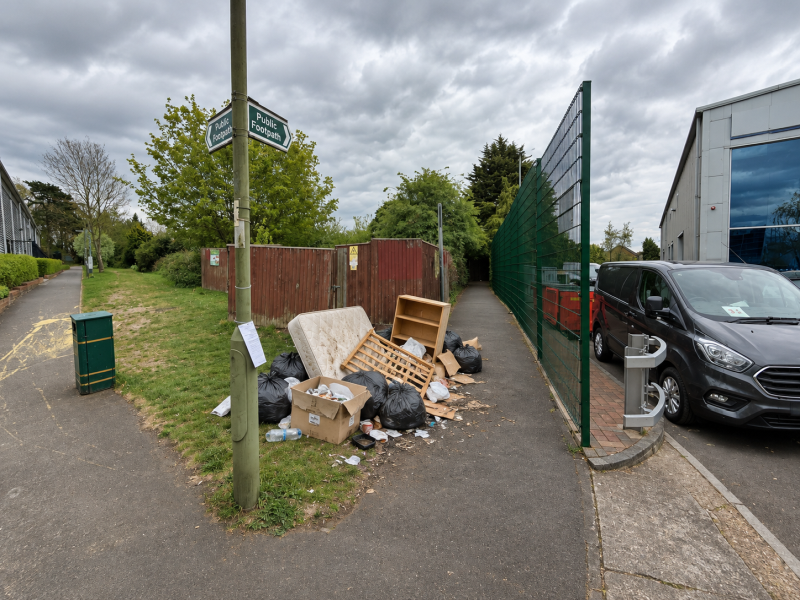
Of the 452 incidents, 280 (62%) were on footpaths and bridleways. Nationally, footpaths account for about one fly-tip in five. In Epsom and Ewell, only 16 incidents (3.5%) were recorded on roads and pavements, against about a third across England. Council land accounted for 93 (21%).
The footpath share has climbed steadily: 40% in 2022/23, 55% in 2023/24 and 62% in 2024/25.
EET asked which footpaths and bridleways were worst affected. The Council did not name any, saying only that the figure reflects “the locations recorded by the teams when collecting fly-tipping reported by the public, through the council’s website”. Nor did it say whether the surveillance cameras placed at hotspots in 2023, including Old London Road, Hook Road and Christ Church Road, are still in use.
What is being dumped
The loads are mostly substantial. 266 incidents (59%) were the size of a small van load, nearly double the national share of 31%, and a further 37 were transit-van sized. The largest dumps have disappeared, however: for the third year running, the borough recorded no fly-tips of tipper-lorry size, as EET has previously reported.
Household waste made up just over half of what was dumped. Unwanted fridges, washing machines and other “white goods” featured in 41 incidents (9%), almost twice the national rate. Other electrical items appeared in 22, and there were smaller numbers of tyres, building rubble and garden waste, plus one case of asbestos.
How the borough compares
On paper, Epsom and Ewell has one of the lowest fly-tipping rates in Surrey. Neighbouring Reigate and Banstead recorded 3,363 incidents, or 21.1 per 1,000 residents, the highest in the county. But every other Surrey district counts all fly-tips, including those found by council crews, so the comparison flatters Epsom and Ewell.
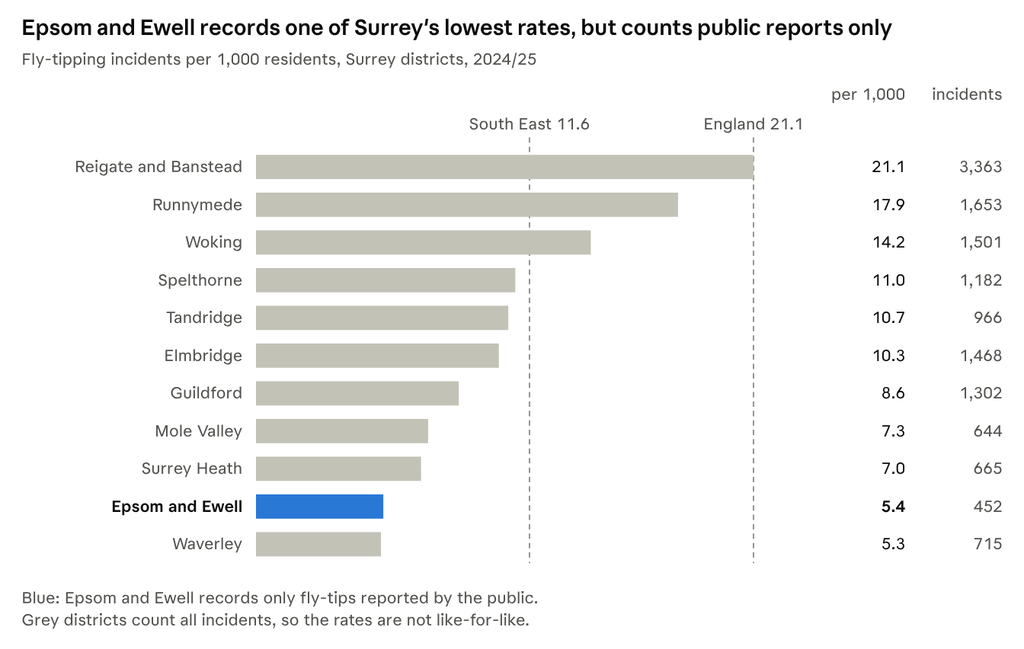
Source: Defra local authority fly-tipping data, 2024/25, published 25 February 2026
Few fines, and a prosecution missing from the figures
The Council took 438 enforcement actions in 2024/25. Almost all of them (416) were investigations. It issued four fixed penalty notices (three for fly-tipping and one to a householder who passed waste to an unlicensed carrier), sent eight warning letters and carried out ten duty of care inspections. Across England, fixed penalty notices make up about one in eight enforcement actions; in Epsom and Ewell it was fewer than one in a hundred.
Asked why so few investigations led to a fine, the Council said a fixed penalty is offered “as an alternative to prosecution where appropriate”, and that in some cases it goes straight to court. It added: “Any prosecution for fly-tipping must satisfy both the evidential and public interest tests. Criminal proceedings can only be pursued where sufficient admissible evidence exists to provide a realistic prospect of conviction. While the council investigates all reported fly-tipping incidents, this evidential threshold cannot always be met.”
The official return for the year shows no prosecutions. That is incomplete. In March 2025 the Council’s own magazine, Borough Insight, reported that a man who dumped waste in the World’s End area in February 2024, and ignored a fixed penalty notice, had pleaded guilty and been ordered to pay £2,330 in fines, costs and surcharge. The Council has confirmed to EET that the case, covering one fly-tipping offence and two of failing to cooperate, was heard on 10 February 2025, within the 2024/25 reporting year, and “was not included in the 2024/25 Defra return”.
The Council did not state the level of its fly-tipping fixed penalty, instead referring EET to a committee paper. Councils can set the penalty between £150 and £1,000.
Nor could the Council say what clearing fly-tips cost in 2024/25. It explained that dumped waste “is collected alongside other street-cleansing materials, so actual collection costs are combined with wider street-cleansing costs rather than recorded separately for each fly-tip”.
How to report fly-tipping
Because only public reports are counted, every report helps build an accurate picture of where fly-tipping happens in the borough.
- Online: use the Council’s form at epsom-ewell.gov.uk/fly-tipping. The Council aims to clear fly-tips within three working days where practical.
- By phone: 01372 732000.
- Blocking a road: contact Surrey County Council Highways on 0300 200 1003.
- On private land: clearing the waste is the landowner’s responsibility.
Householders can also avoid being fined themselves. If you pay someone to take your rubbish away, check they hold a waste carrier’s licence and ask for a waste transfer note, which you should keep for two years. If your waste is later found dumped, you can be held responsible.
About the figures: Incident and enforcement figures are from Defra’s Fly-tipping statistics for England (published 25 February 2026) and its local authority data, compiled from councils’ own returns. Surrey comparisons draw on the same data as republished by policestatistics.co.uk. Council comments were provided by Epsom and Ewell Borough Council in response to questions from EET on 18 November 2026.
Sources
- Fly-tipping statistics for England (Defra landing page)
- Fly-tipping statistics for England, 2024 to 2025 (Defra release)
- Defra local authority data, 2012-13 to 2024-25 (ODS)
- policestatistics.co.uk: Epsom and Ewell fly-tipping
- policestatistics.co.uk: fly-tipping by council
- EET: major incidents disappear in Epsom and Ewell (27 Feb 2026)
- EET: Fly-tipping in Epsom and Ewell part of national problem (8 Jul 2025)
- Borough Insight: fly tipper ordered to pay over £2,000
- EEBC: fly-tipping