Epsom and Ewell Times

ISSN, LDRS and IMPRESS logos

How Green is My Mole Valley?

Box Hill Surrey

All green belt sites could be removed from Mole Valley’s plan for homes following proposed changes to planning at central government level. A specially-called meeting of the district council will be held this month to discuss asking the government inspector looking at the authority’s local plan her opinion on removing the sites.

The council’s local plan, which sets out where and when 6,000 homes will be built in the district up to 2037, was put on hold in December when Michael Gove announced changes to housing targets at central government level.
A consultation is now running on plans to update the National Planning Policy Framework, closing on March 2.
The council’s leader Councillor Stephen Cooksey (Lib Dem, Dorking South) said along with four other members of the council’s cabinet, he had called for an extraordinary meeting of the council on January 16.

The council will be asked to consider seeking the inspector’s view on removing all green belt sites from the draft local plan. While many of the new homes were planned for towns like Dorking and Leatherhead, green belt sites had been released to ensure the authority could reach its housing targets set by central government.
Residents and councillors had raised concerns about developments in rural areas as well, and the impacts they could have on communities, roads and infrastructure.

The council’s cabinet member for planning, Cllr Margaret Cooksey (Lib Dem, Dorking South) said changes to planning policy removed the “central direction” of housing numbers and the need to develop the green belt in order to meet them. She added: “If the inspector agrees with our proposed process, as we hope she will, this can be achieved by introducing a major modification, which would allow the plan to proceed to the next stage of consultation on all the proposed modifications.”

BBC Local Democracy Reporting Service

[Ed: Epsom and Ewell Times hope to bring you an update on the position with Epsom and Ewell’s Local Plan next week as we await news from the Borough Council.]


Epsom Hospital multi-storey car park rises

Hospital planned car park

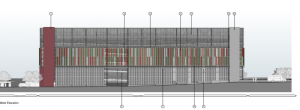
A Planning Inspector has allowed Epsom and St Helier Trust to go ahead with a 6 level car park at Epsom General Hospital. Despite the plans rejection by local councillors and over 100 local objectors resisting. In a key section of the published decision (6th December) the Inspector stated:

“Overall, the institutional character of the hospital site strongly contrasts with the character of neighbouring residential areas. Accordingly, the wider hospital site, including the appeal site is appropriately recognised in the 2008 Environment Character Study 2008 as having its own unique character (Area 35E). This area is described as having a low sensitivity to change and relatively low ratings in terms of townscape quality and value. The proposed multi-storey car park would be notably taller than the immediately adjacent elements of the hospital building and would form a new, sizeable and somewhat bold structure at the edge of the wider hospital site. In many respects the proposed design is honest, reflecting that it would be a structure which results from its function. The design and scale, however, would be compatible with the wider utilitarian character of the hospital site within which it would be principally read. It would readily relate to the scale and height of the taller buildings on the hospital site including the consented backdrop of the Guild Living scheme. Accordingly, the multi-storey car park would appear as a logical and coherent consolidation of the built form in the unique host character area.”

In short, the implication is that as the hospital site is as a whole rather ugly, more ugliness is not objectionable. The Inspector goes on to observe:

“Despite the proposed height and massing there are relatively few public perspectives in which the proposed structure would be readily experienced. The principal ones would be from the site frontage to the hospital complex on Dorking Road and across the open sports ground from Woodcote Road. The proposed structure would also be highly visible from the public footpath connecting Dorking Road to Woodcote Road where it passes adjacent to the appeal site. However, in all of these places the multi-storey car parking building would be primarily experienced in the context of the adjacent modern, large hospital buildings described above. In those main views from Dorking Road and Woodcote Road it would be seen at some distance, dissipating any visual effects arising from its bulk and height at the edge of the hospital site. For users of the footpath adjacent to the site there is scope to install hedging along the boundary as part of the landscaping for the appeal site, as found elsewhere on the path, mitigating to some degree the visual effects from the proximity of the height and scale of the structure.”

While acknowledging that there would be harm to neighbouring conservation areas he stated: “The scale of harm, however, would be significantly moderated by the existing impact of the hospital buildings on the setting of these conservation areas. The existing hospital complex would form the principal context and backdrop in which the car park structure would be experienced in the limited public views identified from within the Conservation Areas”.

On the question of encouraging commuting by car there appears to be a paradox. The Inspector stated “Overall, the modest uplift in total parking provision would not be excessive or unduly encourage significant or unnecessary additional car-based trips to the hospital.” [Emphasis supplied.] He goes on: “In the round the appeal proposal would generate environmental benefits over existing conditions in terms of reducing queue lengths and associated emissions and through the significant provision of vehicle charging points as part of the necessary transition to a lower carbon future.”

To read the full appeal decision Click HERE

Related reports:

Epsom Hospital car park appeal

Epsom Hospital’s multi storey carpark wrong on many levels?


Epsom bus fares being capped at £2

E9 bus Epsom

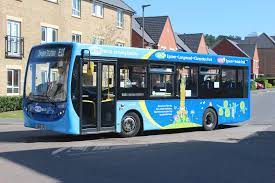
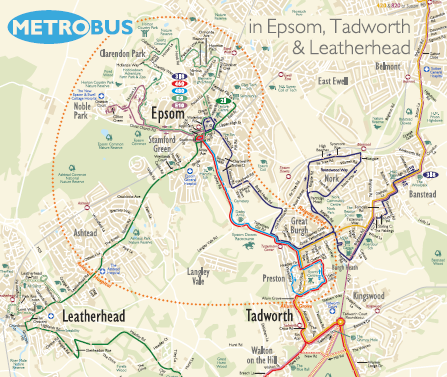
Epsom’s main bus operator Metrobus joins nine other bus operators across the county in signing up to the Department for Transport’s £2 bus fare cap scheme announced 19 December 2022. The Epsom buses include numbers 318, 460, 480 and the E9 and 10.

From 1 January to 31 March 2023, a single bus journey will cost no more than £2 on selected routes across Surrey, helping people to save money and use their car less. With an average single local bus ticket costing £2.80, passengers are expected to save almost a third of the ticket price per journey.

Operators taking part so far are:

  • Compass operating in Cranleigh, Dorking, Godalming, Guildford, Redhill and Reigate
  • Stagecoach operating in Camberley, Farnham, Guildford, Haslemere, Hindhead, Woking
  • Metrobus operating in Banstead, Caterham, Epsom, Horley, Leatherhead, Lingfield, Redhill and Reigate
  • Falcon operating in Addlestone, Byfleet, Chertsey, Cobham, Epsom, Esher, Leatherhead, Molesey, Sheerwater, Staines, Walton, Weybridge and Woking
  • Waverley Hoppa operating in Godalming and Guildford
  • Thames Valley Bus operating in Camberley
  • Surrey Connect (Mole Valley DDRT) operating in Leatherhead and Dorking
  • East Surrey Rural Transport Partnership operating in Tandridge
  • First operating in Staines and Egham
  • Southdown operating in Caterham, Horley, Lingfield Oxted, Redhill and Reigate

Matthew Furniss, Cabinet Member for Transport, Infrastructure and Growth said: “We welcome this scheme which will help our residents to take the bus at a significantly reduced price, at a time when many are facing pressures from the rising cost of living.

“The bus industry is also facing a challenging time, resulting from the drop in passenger numbers and rising costs following the COVID-19 pandemic, so we hope that this scheme will also encourage new and old passengers to get back on the bus.

“We are currently investing £50m to improve bus services and grow patronage. This will see more zero emission buses, more real time passenger information and more measures to help buses run to time. When this £2 flat fare scheme ends, we will introduce a half fare scheme for young people aged 20 and under to further encourage bus usage.

“With transport accounting for 41% of carbon emissions in Surrey, it is hoped that cheaper bus travel will also lessen the need to travel by car for some journeys.”

POSTED BY SCC ⋅ DECEMBER 20, 2022


All change in Surrey’s County Town?

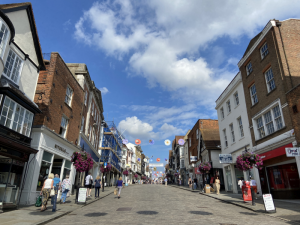
Guildford high street. Credit: Emily Coady-Stemp

Guildford town centre is going through some huge changes, with developments taking place on the sites of some former big names and plans to open up the riverside. The LDRS* has broken down the areas which will see new homes built, and how the town centre will be changing over the coming years.

Guildford’s town centre masterplan sets out the future vision for the town, including developing the town’s underused sites around North Street and hundreds of new homes. New homes in the town have been put forward as the more sustainable option, with shops, facilities and public transport all within walking distance and a need in the area for lower-priced homes. But the amount of affordable housing has been an issue on some developments, with developers citing rising construction costs and lengthy planning processes meaning schemes are no longer able to offer high numbers of affordable homes, if any.

We round up some of the biggest developments below and how they will change the face of Surrey’s county town.

Debenhams
A planning application for nearly 200 homes on the former Debenhams site was narrowly approved by councillors on November 22. The development will see the old store knocked down and two new buildings replacing it alongside shops, a riverside walkway and possibly a boutique cinema. Councillors approved the controversial plans by six votes to five, debating the limited amount of affordable housing and the flood risk, with the Environment agency ultimately satisfied with measures put in place to reduce the risk of flooding. This site will be a key part of the town centre redevelopment and opening up the riverside for the public.

Train station
In February 2018, planning permission was granted on appeal for developer Solum’s £150million regeneration of the land around Guildford Station. The borough council had refused the application because of concerns about the development’s impact on the Grade II* listed St Nicolas Church, among other things. The Station Quarter when complete will include a new station building, more than 400 homes, as well as shops and office space. The developer’s website highlights £25million of station improvements including a multi-storey car park and new plaza with shops and cafes.

Old Orleans restaurant
The former restaurant next door to the Odeon cinema is currently empty and the council, as the owner of the site, has no current plans to lease it out. Councillor Tim Anderson (Residents for Guildford and Villages, Clandon and Horsley), the authority’s lead councillor for assets and property, said it would not be cost-effective to lease it in the short-term while there were plans to develop the building. He added: “The full plan for the Bedford Wharf area, including this site, forms part of the emerging town centre masterplan, Shaping Guildford’s Future. Proposals are that the land will support a wide mix of uses. It will support the town centre with new homes, jobs, community and service spaces.”

North Street
The area around North Street has been called the “poor relation” to the town’s picturesque high street – just don’t call them cobbles. The redevelopment of land around the bus station, including the refurbishment of the bus station itself, could bring nearly 500 new homes and part-pedestrianise North Street. Plans originally put forward in December 2020 included 700 homes, this has steadily been reduced after public consultations, as has the height of the buildings in the scheme. The tallest building has been reduced from 14 to 13 storeys and the second tallest from 10 to nine storeys. A video on the developer’s website shows public squares, restaurants, and new shops and cafes as part of the plans, which should be considered by the council’s planning committee in January 2023.

Wisley airfield
While it’s not within Guildford town centre, the proposed new town which may be built on the former Wisley Airfield could still have an impact. Campaigners have raised concerns about how local village roads will cope with traffic from the residents of the proposed 1,700 homes. The new town would be around a 20 minute drive down the A3 from Guildford, and a similar distance from Woking. The site is also just over a mile from the A3’s junction 10 with the M25, where junction upgrade works have started.

It may be just another reason to look again at Guildford MP Angela Richardson’s calls for the A3 to tunnel under Guildford to help with traffic and pollution, as she called for in Parliament in December.

An outline application for the plans will come to the council’s planning committee in 2023.

North street “fly through” video by developers: https://www.northstreetregeneration.co.uk/virtual-flythrough.html
Solum webpage on station development: https://www.solum.co.uk/development/guildford/

*Epsom and Ewell Times BBC partner – Local Democracy Reporting Service.

Related reports:

Tunnel vision for Surrey’s A3?

Housing plan flying in the face of opposition


Giraffes adapt from Serengeti to Surrey vegetation

Chessington giraffe

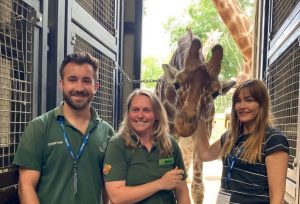
Surrey County Council has partnered with Chessington World of Adventures Resort to help provide additional food for the Giraffes over the winter months. Surrey’s countryside estates team regularly coppice the council’s woodlands as part of essential habitat management on Surrey’s countryside sites. Chessington have been working with them to coppice hazel, chestnut and other local tree species within Norbury Park near Dorking to feed their herd of Giraffes. 

During the autumn and early winter, the hoofstock team at Chessington made regular visits to Norbury Park where they cut back browse (leaves, shoots and branches). The team transport the browse back to the Zoo where they chop into smaller pieces and store in airtight containers which are then placed in freezer storage. This enables an ongoing stock of fresh food to feed the giraffes throughout the winter months.

The 1,340-acre Norbury Park is part of a European Special Area of Conservation (SAC) within the Surrey Hills Area of Outstanding Natural Beauty (AONB) and forms part of Surrey County Council’s countryside estate which comprises over 10,000 acres open for public access.

Marisa Heath, Surrey County Council Cabinet Member for the Environment comments: “We are delighted to partner with Chessington to benefit not only the endangered Giraffes, but also the wildlife in Surrey. Coppicing areas of land on Norbury Park helps to improve the health and biodiversity of the woodland by opening it up to the sunlight, which allows a wider range of plants to flourish. We hope to extend this partnership with Chessington to benefit other parts of Surrey’s countryside estate.” 

Rebecca Apperley-Gawn, Senior Hoofstock Keeper comments: “It’s been great to partner up with the countryside estates team at Surrey County Council. Norbury Park is closely located to our Zoo so it’s great to keep food miles down and the browse fresh for our herd. The Giraffe spend up to 75% of their day eating and it is vital for their diet that we include fresh food particularly during the long winter months. We look forward to continuing with this partnership over the coming years”.

As well as providing feed for the Giraffes, the Chessington team also took back to the Zoo the stems of coppiced material to make additions to animal enclosures and entertain the Rhinos who love to push them around their enclosures!

For information on Surrey County Council’s countryside sites, visit the website.


Let’s not forget Surrey successes!

Stars in Surrey Awards

Teams and individuals who do outstanding work on behalf of the people of Surrey have been celebrated at the first Stars in Surrey award ceremony. In part sponsored by Epsom based firm Atkins

The event – funded through sponsorship – saw standing ovations, laughter and some tears last week.

Winners included County Council staff who look after young people in care, help elderly people live at home for longer, keep Surrey’s libraries thriving and encourage more people to access the countryside.

There was also special recognition for people doing extraordinary things at partner organisations like Ukraine UK Unity Woking.

Founder of Ukraine UK Unity and winner of ‘The Make It Happen Community Hero Award (Empowering Communities)’, Irina Garmash Creeger, said: “It was an emotional and very inspirational night. It felt like I was sharing a room with superheroes & each nominee had special superpower.

“I was pleasantly surprised, overwhelmed & honoured to receive the Award. Although the award was given to me as an individual, I wanted to share it with the incredible multicultural strong team of volunteers at Ukraine UK Unity.

“Our efforts have been stellar, our commitment is unquestionable, and our goals for the future will always involve spreading kindness, compassion and hope, and sharing in all that we have and know with people in need.”

Leader of the Council Tim Oliver, who presented an award, said: “Stars in Surrey really was a wonderful way to pay tribute to some incredible people and teams who work in many different ways to benefit Surrey.

“Everything we do as a council is driven by our ambition that no one is left behind here, and the stories from the Stars in Surrey Awards are all a great reflection of that work.

“I’d like to say a big thanks to the sponsors of the event too that made it possible, and for everyone who nominated their Surrey heroes.”

The final award presented on the night was the People’s Choice Award, that received 1,200 votes, and was won by Christy Niven, a Specialist Speech & Language Therapist in the Children, Families and Lifelong Learning directorate.

The event was sponsored by Atkins, Pick Everard, Concerto, Vail Williams, Tile Hill and Impower.

Here is the full list of winners:

  • Award for Outstanding Customer Service – Claire Hodgson, Trading Standards Specialist, Buckinghamshire and Surrey Trading Standards
  • Team Award for Innovative Working – South-West Asylum Care Leavers’ Team, Children, Families and Lifelong Learning
  • Championing Equality, Diversity and Inclusion Award – Funke Adelekun, Principal Project Manager, IMP Major Projects
  • Greener Future Champion Award (Enabling a Greener Future) – Sharon Newton, Resource Manager, Children, Families and Lifelong Learning
  • Young employee of the Year Award – Durante Cartwright, Weekend Library Assistant at Camberley Library, Customer and Communities​​​​​​​
  • Frontline Worker of the Year Award (No One Left Behind) – Jo Ellis, Occupational Therapist Assistant, Elmbridge Locality Team, Adult Social Care and Integrated Commissioning

Nominated by Amy Watts: “Jo is the hardest working person that I know and her dedication to her role and supporting vulnerable adults and children is something to be admired… One (urgent welfare visit) that sticks into my mind where the gentleman was really, really vulnerable, due to Jo’s willingness to go the extra ten miles they managed to keep him home and safe… I couldn’t think of anyone better to receive Frontline Worker of the Year.”

  • Entrepreneurial Person or Team of the Year Award (creating a sustainable economy) – Caroline Price, and Helen Delatouche, Countryside Team, Environment, Transport and Infrastructure
  • The Make It Happen Community Hero Award (Empowering Communities) – Irina Garmash-Creeger, Ukraine UK Unity Woking

Nominated by David Meller: “On the fourteenth of March this year the UK opened its borders to Ukrainian refugees through the Homes for UK scheme… Irina stepped in to really make it happen for our community. She matched hosts with refugees, she set up the hub where refugees could get support on administration matters when they arrived… I think she is really one of Surrey’s brightest stars.”

  • The Jacqueline Foglietta unsung hero Award – Andy Baldwin, Support Worker, Leaving Care Teams, Children, Families and Lifelong Learning
  • People’s Choice Award – Christy Niven, Specialist Speech & Language Therapist, Children, Families and Lifelong Learning

Surrey County News.


School transport failings lead to foodbanks…

Children and bus stop

Families were pushed to using food banks and suffered an impact on their mental health when Surrey County Council-funded school transport was not provided for their children.
Surrey County Council carried out a review into the school transport “failure” after nearly 150 families, many with children with additional needs, were left without a way to get their children to school at the start of term.
Alongside the authority’s internal review, Family Voice Surrey carried out its own, including a survey which heard from 290 families about the impacts of children not being provided with transport to and from school.
The survey showed that 71 per cent of those who responded had experienced challenges with home to school transport during the autumn term and that 19 per cent of children and young people were unable to attend school or college on the first day.
Leanne Henderson, the organisation’s participation manager, said they heard from “desperate” families every year about issues with school transport, often right at the end of August, when transport had not been confirmed for the start of the school term.
She also raised concerns about the communication that came from the authority, with many families waiting a long time for contact from the council.
The approach of the council had been “very inconsistent” she told a meeting of the authority’s children, families, lifelong learning and culture select committee on Thursday (December 15).
Ms Henderson said: “We had some families that told us they had to use food banks because they were so financially disadvantaged due to not being able to transport their child to school, and that was really quite worrying.”
She also told the meeting that the organisation was “shocked” that 86 per cent of respondents said the situation had adverse effects on their mental health and well being, and increased anxiety.
More than a third of respondents reported financial issues.
She said: “They were the two elements that really hit home and made us wonder: ‘Why has this happened? What is going on?’”
The meeting heard that at least six factors had led to a backlog of cases at the start of the school year, including an increase in applications, a policy change earlier in the year and a lack of resources.
Ms Henderson said she could see council staff were “totally overwhelmed”, saying she could see from both sides in talking to the families affected and those working at the council.
She said: “I could see the team and I really felt for them.
“They were doing the absolute best that they could do under really difficult circumstances.”
The council’s report listed 50 recommendations to ensure the issues would not be repeated next year, and there were recommendations in the Family Voice Surrey report.
Councillor Clare Curran (Conservative, Bookham and Fetcham West), the authority’s cabinet member for education and learning said she had also been “swamped” by emails on the matter.
She said the review that had been carried out was a “substantial piece of work” and not a “five-minute fix”.
The council spends more than £50m a year on helping children and families get to school, which Cllr Curran told the meeting is a fifth of the entire net budget for children and families.
Cllr Curran added: “I don’t underestimate the task at hand, I don’t underestimate the work that needs to be done.
“But I’m confident that we are going to get it done and next September families, children and young people won’t suffer the failure that there was in September this year.”
ENDS


Gove gives pause for thought on Local Plans?

A Surrey council has paused its plan for 6,000 homes after central government changes which could mean lower housing targets. Mole Valley District Council has paused its local plan saying it would be “unwise” to carry on with the process in the face of potential changes at a national level.

The authority released some green belt sites in the district for new homes, in a plan that was examined by government inspectors between January and October.

Image: Councillors-and-residents-concerned-about-Mole-Valley-Local-Plan. Emily Coady-Stemp

A local plan sets out a council’s policies and sites for homes and infrastructure, with Mole Valley’s setting out plans until 2037. Changes from central government are expected to be announced before Christmas, with Secretary of State for Levelling Up, Housing & Communities and Surrey Heath Michael Gove outlining in a letter earlier this month (December 5) that more control should be given to councils and local communities.

Councillor Margaret Cooksey, cabinet member for planning on the district council, said the council would pause its local plan process until it had a better understanding of what government was saying. Cllr Cooksey (Lib Dem, Dorking South) said in a statement the decision had not been taken lightly and given the progress made during an “exhaustive” examination of the plan, that pausing the plan is not what the council wanted to do. She added: “However, it would be unwise to carry on when we are not sure what the wider national planning policy situation is so we have committed to wait until such time that the Inspector can advise us on what should be done next. We had been due to consult with stakeholders on the modifications proposed by us and the Inspector in January. We remain hopeful that clarity will be provided and we will take the best course of action for our residents.”

Mole Valley’s only Green councillor, Lisa Scott (Charlwood) said she wanted clarification on what “pause” actually meant, calling for the plan to be “fully reviewed” when national policy had been revised. She said: “We wholeheartedly welcome the change in housing numbers required by government, which was leading to huge green areas being sacrificed to questionable house building targets and are very pleased to see that the local plan has been paused.” But she raised concerns about areas of green belt still being included in the submitted plan, claiming some had been been “significantly expanded” from the public consultation stage, so residents could not have their comments considered by the council.

She said possible changes also meant more brown field sites could be included and the types of homes could be reassessed, with terraces and town houses being more efficient to heat and cool than detached homes.

A letter from Michael Gove sent on December 5 said the changes would mean communities would “have a much more powerful incentive to get involved in drawing up local plans”. While he said planning would always start with a number of homes required in an area, though it should be and “advisory starting point” and not a mandatory figure. He added: “It will be up to local authorities, working with their communities, to determine how many homes can actually be built, taking into account what should be protected in each area – be that our precious green belt or national parks, the character or an area, or heritage assets.”

The majority of homes in the local plan as it stands would be built in Leatherhead and Dorking but there was also concern about communities in rural areas being “ruined” in areas such as Hookwood where more than 550 homes were planned over four sites.

At the February meeting of the council where members voted to submit the plan, the administration promoted its maintaining of 99.3 per cent of the district’s green belt in the local plan.

Related reports:

Epsom and Ewell last in Local Planning

MP’s housing solution for Epsom and Ewell

Labour Councillor moves on housing

Local Plan Battle: early skirmishes on Downs Farm


1000 Surrey children wait for special needs plans

Surrey County chamber

A senior Surrey councillor admits it is “not good enough” that nearly 1,000 children with special educational needs in Surrey are waiting for an education plan. Nearly a third of those have been waiting more than the statutory 20-week limit for a Education Health and Care Plan (EHCP), with a shortage in educational psychologists among the reasons the council put forward for the backlog.

Surrey County Council’s cabinet member for education and learning said nationally for 60 per cent of children being assessed for an EHCP it was being done within the 20-week period. Clare Curran (Conservative, Bookham and Fetcham West) added: “Clearly it is not only a situation that prevails here in Surrey. Notwithstanding the national situation, I admit that it’s not good enough and not one that we would expect or want for our young people.”

An EHCP is put together by a council for children to outline what help they may need at school to support them with their special education needs and disabilities. There are 988 active EHCP requests at the council, of which 284 were known to be over the 20-week period, according to meeting documents.

Cllr Curran explained to a meeting of Surrey’s council on Tuesday (December 13) that a shortage of educational psychologists meant a mandatory part of the EHCPs could not be completed, which was contributing to delays. She said recruiting and training up caseworkers had been a focus, and the workforce was now around 80 per cent staffed across the county.

Her answers came in response to a question put forward by Lance Spencer (Liberal Democrat, Goldsworth East and Horsell Village) who said families were being “left behind” by the council and asked what was being done to reduce the “excessive delays”. Cllr Curran said that the council’s ambition was to achieve “better timeliness” by the end of the year in completing EHCP plans. She added: “I know the situation is not good. I know we are not achieving the level of service that we would want to for our children and young people. We are doing our very best to address that and make sure that things improve.”

In a written response, the council denied that parents threatening legal action sped up the time scales for getting an EHCP in place. Cllr Spencer’s written question read: “It would appear that where the parents threaten legal action that the EHCP timescales are reduced” and asked for the number of parents who had written threatening legal proceedings.

A written response said data was not collected at the council in that way, adding: “This process is not influenced by the threat of legal proceedings.”

The meeting heard that the issues impacting the outstanding EHCPs were also a factor in nearly a fifth of annual reviews not being carried out within six months of their due date.

A question put forward by Catherine Baart (Green, Earlswood and Reigate South) asked for an update on annual EHCP reviews at the authority. The response in meeting documents showed that at the start of term, 59 per cent of plans had an up-to-date annual review in place or were due within the next month, being 6,445 of the 10,963 plans in place. There were also 4,517 plans that were overdue a review, of which 1,849 were more than six months overdue.

Documents said the availability of staff over the summer had played a part in fewer annual reviews being completed on time, and that an improvement should be seen by the end of the autumn term. Cllr Curran said she did not know if there was a target within the department for completing reviews on time, but that the service was prioritising reviews for children who were vulnerable, including those looked after by the county council or on child protection plans.

Councillors also raised the issue of home to school transport in Surrey, described as “the biggest concern of many of our residents” by the Green Party Group leader on the council.

The council’s leader, Cllr Tim Oliver (Conservative, Weybridge) apologised in October for a backlog in sorting school transport for some of the county’s most vulnerable children, when more than 150 families were left in limbo at the start of term.

Jonathan Essex (Redhill East) called on the council to look in its review at the views put forward Family Voice Surrey which had spoken to 290 families as part of its own review.

Cllr Nick Darby (Dittons and Weston Green Residents, The Dittons) told the meeting the internal review listed more than 50 recommendations for the council, which he described as “a terrible indictment of the situation”. He said the school transport was “best described as a shambles” and questioned the creation of a new board to oversee progress being made up of officers and cabinet members, many of them previously involved in the process.

On Thursday (December 15) a meeting of the council’s children, families, lifelong learning and culture select committee will consider the council’s review of what happened at the start of the school year.



Do good intentions square with homeless savings?

Homeless person in sleeping bag in doorway

Epsom & Ewell Borough Council has launched its Homelessness and Rough Sleeping Strategy, setting out how it intends to meet the needs of residents who are homeless or at risk of homelessness over the next five years.

The Strategy details the Council’s strategic vision and key objectives to address homelessness within the borough. It focuses on a commitment to preventing homelessness at an earlier stage, and the importance of working with partners across all sectors to develop an integrated approach to tackling homelessness and rough sleeping.

A detailed review of homelessness in Epsom & Ewell was undertaken to inform the strategy, which helped to establish the extent of homelessness in the area, identify future trends and any gaps in the service currently being provided.

The Strategy identifies six key objectives which emphasise the importance of early intervention and prevention, as well as the development of new affordable housing in helping to meet the need of homeless people:

  1. The early identification, intervention & prevention of homelessness
  2. Reduce Rough Sleeping
  3. Increase accommodation options including social rented, private rented, supported and move on accommodation and in-borough temporary accommodation
  4. Improve the Health & Wellbeing of homeless people
  5. Ensuring sufficient support is available for homeless people
  6. Partnership working
Alex Coley
Cllr Coley

Cllr Alex Coley, (Residents Association – Ruxley Ward) Chair of the Community and Wellbeing Committee, said: “The impact of homelessness cannot be underestimated. A home keeps you warm and safe, but it is so much more than just a roof. Homelessness leads to a significant reduction in emotional wellbeing, self-identity, social inclusion and life opportunities. Reducing homelessness in Epsom & Ewell will benefit everyone who lives in the borough.

“Over the past year we have expanded the Private Sector Leasing scheme, acquired an additional 14 emergency accommodation placements, and secured additional funding to enhance the East Surrey Outreach Service, who work with rough sleepers, but there is much more to be done. This Strategy will allow us to build on this progress to fully address the challenges local homeless people are facing, and ensure better outcomes for all.”

Commenting on the strategy Cllr Julie Morris (LibDem College Ward) said “We are particularly concerned with the increase in single people with mental health issues who require homes, so the integrated approach is really key here.  There’s a shortage of homes for families with children and private landlords can help here. There are some incredibly dedicated council officers who are charged with implementing this strategy and councillors will support them as much as they can.”

  • The Homelessness Act 2002 places a duty on every local authority to develop and publish a Homelessness Strategy, setting out how the local authority intends to tackle and prevent homelessness in their area.
  • The strategy must be based on a review of all forms of homelessness within that local authority’s area and should be reviewed at least every five years. The Council carried out six weeks consultation between 12 July and 23 August 2022 with a range of stakeholders, service users, staff and residents.
  • Central to reducing homelessness within the borough is increasing the amount of affordable housing available. The Council is currently developing a Draft Local Plan which is due to go out for public consultation on 1 February 2023, and proposals for affordable housing in the borough will form part of the Plan.
  • In Epsom & Ewell and nationally the 3 main causes of homelessness are:
    • Asked to leave by family and friends
    • Termination of Assured Shorthold tenancies
    • Domestic Abuse
  • The full strategy can be found here:

https://epsom-ewell.gov.uk/residents/housing/homelessness

Information provided by Epsom and Ewell Council. Cllr Morris quote obtained by Epsom and Ewell Times. Other parties were invited to comment.

Related reports:

Council targeting the homeless

Simone Pellegrino 

In a vote dominated by abstentionism, a service-specific savings target of £243k to offset this year’s potential overspending for homelessness, was approved by Epsom and Ewell Borough Council last Tuesday. … READ MORE