

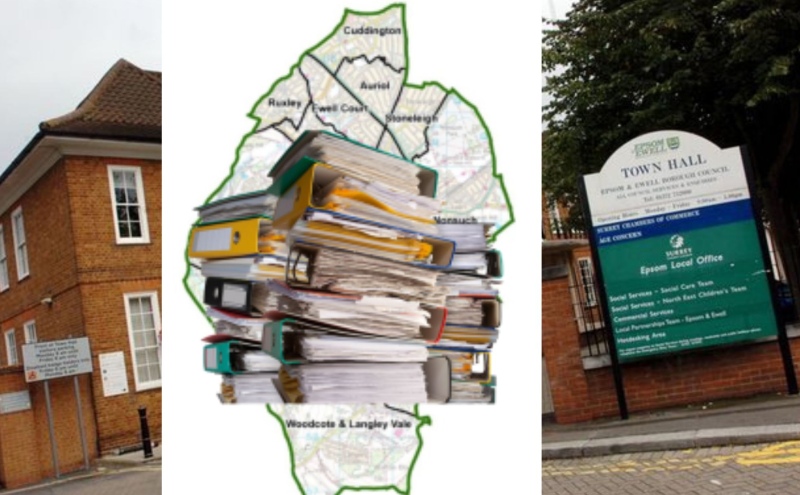
East Surrey seeks planning head start as Epsom faces two Local Plans at once


East Surrey’s incoming council has urged ministers to let it begin preparing a Local Plan before it takes over next April, highlighting a problem already confronting Epsom and Ewell: being required to start another plan while still struggling to complete the current one.
In a letter to Housing and Planning Minister Matthew Pennycook MP, cllr Bradley Nelson (LibDem Dorking), the shadow council’s executive member for strategic planning and growth, has asked for arrangements allowing the new authority to begin plan-making preparations before 1 April 2027.
East Surrey will replace Epsom and Ewell, Elmbridge, Mole Valley, Reigate and Banstead, and Tandridge councils. Its press release warns that requiring those authorities to continue separate planning processes, while their successor cannot formally begin a plan for the whole new area, risks duplication and wasted resources.
For Epsom and Ewell, the request follows months of controversy over Green Belt development, councillor scrutiny and the cost of preparing a plan that will outlive the council responsible for it.
Five councils and competing timetables
The five authorities are at different stages. Mole Valley adopted its Local Plan in December 2024, while the others are progressing existing plans or beginning work under the new planning rules. Epsom and Ewell faces both processes simultaneously.
Cllr Nelson said: “The challenge is that the councils which currently hold planning responsibilities are being asked to continue, or in some cases start work on plans that they may not ultimately be able to complete, while East Surrey Council cannot formally begin the process until it becomes a vested authority.”
He added: “We believe there is an opportunity to make better use of the period before April 2027 by allowing preparatory work to begin sooner. This could help avoid duplication, make the best use of public resources and enable the new council to progress plan-making at the earliest opportunity.”
The shadow council says it wants a single Local Plan to guide housing, employment, infrastructure and environmental protection across East Surrey. Nelson’s letter also identifies rail capacity and sewage treatment as constraints on growth.
Epsom’s long road to a plan
Epsom and Ewell’s current examination follows an already protracted process. The council paused preparation in March 2023 before voting to resume it that October. Its 2022–2040 Local Plan was eventually submitted for examination on 10 March 2025, shortly before a national transitional deadline.
Submission did not end the disputes. EET has reported repeated challenges over additional evidence submitted during the examination and whether elected members had sufficient opportunity to scrutinise it.
At an extraordinary council meeting on 21 July 2026, a motion seeking greater committee oversight was defeated by 15 votes to 12, with three abstentions. Proposed amendments seeking an independent governance review were ruled out of order. The disagreement concerned the use of delegated powers and democratic oversight as well as the planning merits of development sites.
On 22 September, the Licensing and Planning Policy Committee recommended, by six votes to three, that Full Council approve consultation on the Inspector’s proposed modifications. These include 12 additional urban sites and four additional Green Belt sites, with proposals for at least 530 homes at Downs Farm and 275 at Priest Hill.
As EET reported on 25 September, that recommendation was a further step towards consultation, rather than approval to adopt the plan. The Inspector must consider consultation responses before issuing a final report, and Full Council would still have to decide on adoption if the plan is found sound.
Why another plan is required
The requirement to begin a second plan stems from national reforms and higher assessments of housing need.
Government rules require certain authorities whose plans were submitted under transitional arrangements, but provided for less than 80 per cent of the newly calculated housing need, to start again under the new system while their existing plans continue.
Epsom and Ewell is explicitly listed among those authorities. Its deadlines were to publish a notice of intention by 30 June 2026 and a “Gateway 1” readiness assessment by 31 October. That assessment starts the new system’s 30-month plan-making timetable.
In an August letter to the council, the Ministry of Housing, Communities and Local Government acknowledged the resource pressures involved in producing two plans simultaneously. It nevertheless rejected impending reorganisation as a reason to defer the new work and reiterated the deadlines.
The financial implications are substantial. EEBC’s September committee report estimated that taking the new plan through to adoption would cost approximately £1 million, plus officer time. No budget had been allocated.
The report also recorded earlier allocations for the existing plan of £75,000 in 2019, £712,000 in 2021 and £629,000 in 2023. These are funding allocations, rather than a statement of final expenditure.
The committee voted seven to two for officers to seek discussions with East Surrey’s chief executive and planning executive member about how to proceed, with the outcome to return to a future meeting.
National pause offers Surrey no reprieve
The Government’s wider pause and review of local government reorganisation does not extend to Surrey.
Planning guidance updated on 24 September expressly confirms Surrey’s exemption. It also says councils must continue plan-making even where they cannot complete adoption before their successor authority becomes operational.
The same guidance exposes the difficulty behind East Surrey’s request. A plan for the new unitary area cannot begin until that authority is operational, although existing councils can collaborate on joint plans, shared evidence and cross-boundary issues beforehand.
Ministers intend to introduce transitional regulations covering unfinished plans, existing adopted plans and the timetable for new unitary-wide plans. However, the guidance describes itself as a statement of intention, rather than finalised policy.
East Surrey’s press release says further details and timings remain unconfirmed. Nelson has requested a meeting with ministers and officials.
Housing need remains urgent
The argument over duplication comes against a stark local record. EET’s latest report on the September committee meeting recorded just 37 homes completed in Epsom and Ewell during 2025–26, none affordable, and an inability to demonstrate a five-year housing land supply.
Cllr Julian Freeman (LibDem College) described the consequences for younger residents: “My own children can’t even imagine owning their own home.”
East Surrey’s intervention therefore raises a practical question: how can councils meet urgent housing needs while spending money on overlapping plans during their final months?
The request does not itself remove EEBC’s obligations or halt its current examination. It asks ministers to make the transition work more efficiently. For Epsom and Ewell residents, the test will be whether that produces a clearer, properly scrutinised route to homes and infrastructure—and a credible explanation of what the additional planning work will cost.

.
Related reports
- Epsom and Ewell’s New Local Plan sites advance amid clash over scrutiny and cost — 25 September 2026. epsomandewelltimes.com
- East Surrey is still going ahead – so what happens next? — 25 September 2026. so what happens next?
- Plans for East Surrey Council continue to progress — 14 September 2026. epsomandewelltimes.com
- The shake up of Epsom and Ewell’s local government: was it all a waste of time as Rayner puts pause on LGR elsewhere? — 7 September 2026. epsomandewelltimes.com
- Bitter exchanges in Epsom and Ewell Council Chamber on Local Plan oversight — 22 July 2026. epsomandewelltimes.com