Epsom and Ewell Times

ISSN, LDRS and IMPRESS logos

Local democracy to be energised?

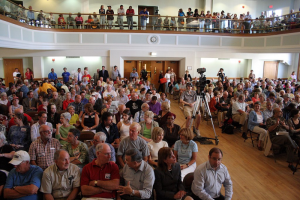
A packed Council meeting

Epsom and Ewell Borough Council has taken a significant step forward in opening up its committees to public participation. Under a new constitution the public now have the right to ask questions at committees on topics on the agenda! The previous constitution prohibited this.

Last night at a meeting of the Full Council a new constitution was adopted. After a year of weekly Friday night meetings and a Byzantine network of committees and sub-committees beavering away, the fruits of a cross-party effort were approved. Cllr Liz Frost (RA Woodcote Ward) was widely credited for her leadership of the initiative.

The end result is admittedly a somewhat labyrinthine set of documents: annexes within appendices within operating frameworks within a constitution. But, hey ho – the public now have clearer rights and Epsom and Ewell Times has extracted what you really need to know:

CLICK HERE for the key rules about public questions and public statements allowed at most committees of the Council. Note that these rules do not apply to meetings of the Full Council.

Will we now see more public participation at Council meetings, as illustrated in our accompanying image from Conneticut USA? (Happens to bear a slight resemblance to our own Town Hall Chamber). In contrast there were no members of the public attending last night’s Council meeting.

Image: Sage Ross CC BY-SA 3.0

Related reports:

Local Audit meet: unexpectedly interesting…

Council Committees: Everything you need to know


Your right to ask questions at Council

The public may not ask questions at Full Council meetings. Only most committees.

Annex 4.5 – Protocol for Members of the Public Speaking at Committees

  1. Questions and statements from the public
    1.1. At ordinary meetings of the council’s committees and sub-committees, up to 30 minutes will be
    set aside for questions and statements:
    i. On matters within the terms of reference of the body in question.
    ii. From any member of the public who lives, works, attends an educational establishment, or who
    owns or leases land in the Borough.
    1.2. This protocol is not applicable to advisory panels, regulatory committees, Epsom Walton Downs
    Conservators and Epsom Walton Downs Consultative Committee.
    1.3. The topic of the question or statement may not relate to:
    i. Specific planning or licensing cases, …….
    ii. The personal affairs of an individual.
    iii. A matter which is exempt from disclosure or confidential under the Local Government Act 1972.
    1.4. Questions and statements which in the view of the Chair are defamatory, offensive, vexatious or
    frivolous will not be accepted.
    1.5. Each question or statement will be limited to 3 minutes in length.
    1.6. This protocol does not cover questions and statements from the public for meetings of the
    Planning Committee or licensing sub-committees, which are not permitted……….. For the avoidance
    of doubt, questions and statements from the public relating to planning or licensing committees
    matters can only be made at those specific committees with the consent of the Chair of that
    committee.
  2. Procedure for Questions
    2.1. The chair of the committee shall indicate the item on the agenda at which questions may be put
    by individual members of the public. Questions are welcomed from the members of the public and
    must satisfy the conditions below.
    2.2. All questions must consist of one question only they cannot consist of multiple parts. This does
    not preclude a member of the public from asking another question on a separate topic, time
    permitting.
    2.3. A person who wishes to ask a question must submit their question in writing (either in hard copy
    or by email) to the Democratic Services Manager at democraticservices@epsom-ewell.gov.uk. The
    written question must arrive by noon on the third working day before the day of the meeting.
    2.4. The member of the public submitting a question must set out:
    i. the wording of the question they wish to ask.
    ii. an address, email address or telephone number at which they can be contacted before and after
    the meeting.
    iii. The details of where they live, work, attend an educational establishment, own or lease land in the
    Borough.
    2.5. Following receipt of a written question, the Democratic Services Manager will ensure that the
    member of the public asking the question is contacted and told whether their request complies with
    the conditions above. If contact details are not readily identifiable or have not been supplied, the
    question will not be accepted even if in all other respects it is valid.
    2.6. At the committee meeting, questions must be addressed to the Chair of the relevant committee
    / sub-committee. The Chair will invite the questioner to put the question at the meeting.
    2.7. The Chair may decline to answer a question, may give an answer orally at the meeting or may
    provide a written reply. If available, the questioner will be supplied with a written answer before the
    meeting.
    2.8. Questions regarding items on the agenda for the meeting may not receive an answer, as the
    matter will not yet have been considered.
    2.9. At the meeting the Chair will ask the questioner if the response answers their concern or if they
    wish to ask one supplementary question. If a supplementary question is asked, it must arise from the
    reply given. The Chair may decline to answer a supplementary question or invite other councillors or
    officers of the relevant body to contribute to a response.
    2.10. If a member of the public wishes to ask more than one question, their second question shall be
    taken after all other individuals who wish to ask a question have been given the opportunity to do so.
    As an alternative to submitting a written question, a member of the public may address a meeting of
    a committee or sub-committee for up to three minutes.
    3.1. A person wishing to make a statement at a meeting must provide written notice (via hard copy or
    email) including a summary of the subject matter, to the Democratic Services Manager. The written
    notice must arrive by noon one working day before the day of the meeting.
    3.2. Speakers may not engage in further debate once their statements have been made

Can Epsom and Ewell get more dense?

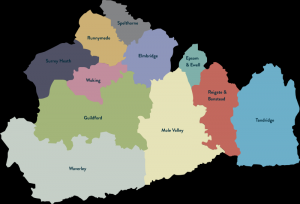
Borough map of surrey

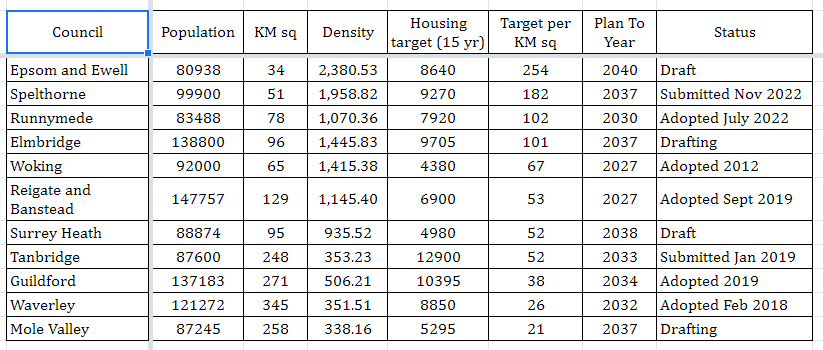
Exclusive to the Epsom and Ewell Times we report on the housing targets of every Surrey borough council. Epsom and Ewell is the smallest borough in Surrey with the highest density of population. Yet aims to have the highest density of new housing, according to the draft Local Plan, out now for consultation.

The table below contains the population stated in a Local Plan, if evident in the document. Otherwise the latest population figure from Wikipedia is used.

Table comparing housing plans of Surrey Boroughs

The Local Plans vary in the period covered and some are in drafting flux. The table provides the average per annum new build over a 15 year period for each Council as far as stated or indicated.

Many plans were submitted or adopted before Michael Gove, Secretary of State for Levelling Up, Housing and Communities, indicated November 2022 that “Housing targets remain, but are a starting point with new flexibilities to reflect local circumstances” and “If we are to deliver the new homes this country needs, new development must have the support of local communities. That requires people to know it will be beautiful, accompanied by the right infrastructure, approved democratically, that it will enhance the environment and create proper neighbourhoods. These principles have always been key to our reforms and we are now going further by strengthening our commitment to build the right homes in the right places and put local people at the heart of decision-making.”

The table above does not reflect many variables that may justify different housing targets. For example areas designated as areas of special scientific interest or areas of outstanding natural beauty. Also, there are many demographic variables: distribution of the ages of populations, family sizes and average incomes.

Furthermore, the mix of different housing types of the new builds envisaged in the plans vary from one Council to another. Big houses, small houses or flats etc.

However, the table does provide a broad overview.

Epsom and Ewell’s Draft Local Plan states: “The housing need for Epsom and Ewell generated by the standard method is 576 dwelling per annum, which equates to 10,368 dwellings over the Local plan period. The Councils Housing and Economic Development Needs Assessment (2022) confirms there is no justification to increase the housing need figure over that generated by the standard method.”

“The council considers that the scale of unmet development / housing needs in the borough that would result from pursuing a brownfield only approach provides the exceptional circumstances and justification to make changes to the Green Belt boundaries in the borough.”

You can meet planning officers of Epsom and Ewell Council at the following times and discuss the draft Local Plan.

Monday 13 February 14:30 – 19:30 Bourne Hall, Azalea Room

Thursday 16 February 12:00 – 17:00, Ashley Centre, Central Square

Tuesday 21 February 14:30 – 19:30, Bourne Hall, Azalea room

Wednesday 22 February 10:30 – 15:30, Community & Wellbeing Centre, Sefton Road

Saturday 25 February 11:00 – 16:00, Ashley Centre, Central Square

Tuesday 28 February 10:30 – 15:30, Community & Wellbeing Centre, Sefton Road

How you can express your views on the Local Plan can be seen HERE.

See today’s editorial

Related reports:

Green-belters belted up and beltless

Local Plan battle heating up?

Green-belters seeing red on Local Plan?

Lessons for Epsom in Mole Valley’s “shouty” Local Plan struggle?

Crucial month for local Local Plans?

Gove gives pause for thought on Local Plans?

Local Plan Battle: early skirmishes on Downs Farm

MP’s housing solution for Epsom and Ewell


Blot on Epsom Downs horizon to grow no more?

Woking from Epsom Downs

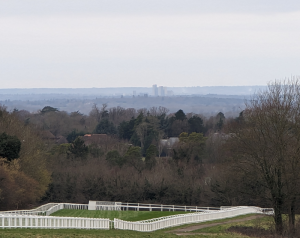
Ever wondered where are those tower-blocks on the west horizon from Epsom Downs? Our LDRS journalist reports on Woking Council’s consideration of the height of its buildings:

Plans to limit high-rise development in Woking is akin to slamming the stable door shut after the horse has bolted, Surrey County Council’s ex-head of planning has said. On Thursday February 2, Woking Borough Council’s executive committee agreed to press ahead with its goal to create a masterplan that would “provide a long-term vision” for the town centre’s skyline.

It continues work that began in 2021 that included a six-month consultation which garnered more than 850 responses from about 450 individuals and organisations. According to council documents, though, there remain several legal issues the borough must overcome before it adopts the full masterplan, including the fallout of the Planning Inspectorate decision on the Crown Place from December 3 2022 that granted planning permission three towers of  23, 25 and 28 storeys respectively.

The appeal decision has had a “clear implication” for the Masterplan, the report read, “in that it has changed the nature of the townscape” and that “as a minimum, the design principles for this site, including what prospective heights may be appropriate, will need reconsidering.”

Furthermore, the report states, during the public consultation phase, Woking Borough Council received representations from developers regarding the possibility of legal challenges if it were to be adopted.  There is also the financial risk with officers identifying “significant” cost implications and suggesting the only way to “avoid unnecessary additional expense to the taxpayers purse” is not to proceed to adopt the Town Centre Masterplan in its current draft form.

This has caused the council to seek legal advice on how to proceed. Whether the masterplan can ever have the impact the council desires – fewer high rises in the town centre is debated.

Catriona Riddell is a former head of planning at Surrey County Council and current director at Catriona Riddell & Associates. She said: “Woking is a very tiny, very constrained borough with a lot of debate about how high up the developments go. Anywhere from Surrey you can see Woking. Some love it, some hate it. It’s very much Marmite.
“The Government is trying to help local authorities restrict the number of high rises but with Woking, it is going to be difficult as it already has so many. The local plan is in place in Woking and is up to date – that’s what developers will look at. Any supplementary planning won’t have the same status. Developers are used to playing this game. It’s going to be difficult for the council to change this.”

According to council papers, the masterplan will establish an “overarching vision for the town centre to enable designled, sustainable development, such as building new homes, cultivating a thriving retail and business environment and strengthening Woking’s cultural and leisure offer”. 

The report said that the “ambition and need for a clear and robust plan to guide development in the town centre, to give certainty to developers wishing to invest, and provide officers with an effective tool to assess planning applications and defend decisions on appeal remains”. 

This, Ms Riddell says, may be the best way for the authority to move forward. She added: ‘It will be about how to make the area a good place to live and work and the only way is through a masterplan so they are right to go ahead with it but it will be difficult with developers looking to build highrises. It will be very difficult for the council to argue its out of character. Woking has changed massively over the years, that horse has bolted.”


2023/2024: average of £50 more to pay Surrey County Council

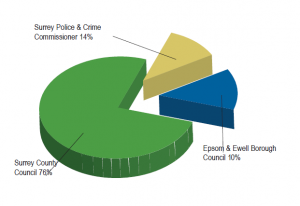
Council tax pie chart for Epsom

Surrey residents will pay nearly £50 a year more to the county council for its share of council tax from April.
The 2.99 per cent increase was confirmed at a full meeting of the authority on Tuesday (February 7) though opposition parties did not vote for the budget.

The raise, which is less than the 4.99 per cent councils can increase bills by without a referendum, is made up of 0.99 per cent on the core bill, and two per cent which will go towards adult social care. It will mean the average band D property will pay 94p per week, or £48.69 per year, more from April.

Surrey’s district and borough councils are still to confirm their increases.

The council’s Conservative leader, Tim Oliver (Weybridge) told the meeting the rise came in the context of the cost of living crisis, inflation and interest rates all impacting the council as well as Surrey residents. He added: “Everything we do has simply become more expensive to deliver. That can be seen in our budget papers, showing increased spending in almost every area.” Cllr Oliver said it was a “challenge” each year to deliver a balanced budget which nonetheless “prioritised those most in need of help and support but equally recognising that residents don’t always see or access many of our services“.

He said a “caring and democratic society” expected that people who needed to could turn to their local council for support, and pointed to nearly half of the council’s budget going on adult social care “looking after people with disabilities or extra needs as they get older”. The rise, he said, was less than inflation and less than in many other parts of the country.

But opposition group leaders on the council pointed to problems with the council’s home to school transport arrangements, families going to tribunals for SEND support and cuts to budgets.

Cllr Will Forster (Lib Dem, Woking South) highlighted £30m of cuts to adults and children’s social care, where “efficiencies” had been found in the budget. He said: “This budget has the wrong priorities. Rather than protecting services that vulnerable people rely on, they are targeted for cuts.”

The Lib Dem group also called on the council to spend some of its £150m of reserves, or savings, on highway repairs, saying residents wouldn’t understand why the council was “squirrelling” away money it could spend on improving the roads.

Residents’ group leader, Cllr Nick Darby (Dittons and Weston Green Residents, The Dittons), said £11m spent on an IT project that was still not operational, anger from residents over a proposed Guildford road closure and the “shambles” of school transport issues were signs of poor communication and consultation at the council. He said there was a need to “acknowledge problems, recognise them and then deal with them” adding that “not everything” in the budget was wrong.

Cllr Darby told the meeting: “On the one hand, we can and do provide figures which balance. It’s more difficult to fulfil our duty to residents by spending their money well, putting them first, especially the vulnerable.” He also repeated his call for a rethink of council tax bands, which would need to be done at central government level.

See below for a full breakdown of how much council tax money will be going to Surrey County Council from April:

Band A – £1,116.72 per year
Band B – £1,302.84 per year
Band C – £1,488.96 per year
Band D  – £1,675.08 per year
Band E – £2,047.32 per year
Band F – £2,419.56 per year
Band G – £2,791.80 per year
Band H – £3,350.16 per year

Related reports:

Surrey County Council sets 23/24 budget

Surrey County Council proposes 2023/24 budget


Will Cathedral repairs threaten Canadian WW1 memorial?

Guildford Cathedral aerial view

Plans to build 124 homes on undeveloped woodland next to Guildford Cathedral will threaten a memorial to Canada’s First World War military sacrifice, a preservation society has warned. Guildford Cathedral needs to carry out an estimated £3.2million in repairs, but unlike other cathedrals in the UK, it says, has “never possessed endowments of any significance and has always struggled to fund repairs to the Grade II* listed building”.

Image: Grahame Larter

To solve the issue, the cathedral sold a parcel of land to developers which, it says, will “enable the endowment to be secured for the cathedral which is vital for its survival” and secure its long-term maintenance.

The issue, says the Vimy Foundation, which oversees the public historical resources and modern perspectives on Canada’s participation in the First World War, is that land is a memorial to the 650,000 Canadians and Newfoundlanders who fought in Europe during the First World War, 66,000 of whom lost their lives.

Writing to Guildford Borough Council’s planning committee, the foundation said: “This undeveloped wooded area was created on the initiative of R.B. Bennet, prime minister of Canada from 1930 to 1935, who lived near Guildford, to provide a place for reflection and remembrance of Canada’s contribution during the conflicts that shook the first half of the 20th century.”

They added: “While understanding the needs of the Guildford community, The Vimy Foundation wishes to reaffirm its commitment to the preservation of memorial sites honouring Canada’s fallen soldiers. In recognition of the bravery and sacrifice of these men and women, their memory must continue to be honoured. The Vimy Foundation calls on decision-makers, Guildford Cathedral, Guildford Borough Council and developers, to preserve the commemorative and memorial dimension of this site and will support initiatives in this direction.”

There are currently seven homes on the site and used by staff cathedral staff. It is designated as open space as part of the Cathedral land but earmarked for 100 homes within the council’s local plan.  

A previous planning application to build 134 homes on the slopes of the cathedral was turned down, despite officer recommendations, by Guildford’s planning committee. Background papers to the application said it was due to the plans being “poor quality and out of character with the surrounding area”.

This led to the cathedral working with developers Vivid to carry out what it described as a “comprehensive review” that included “extensive work to address the reasons for refusal in the 2015 scheme”. The new plans would demolish the existing staff buildings to create 124 homes, 44 of which would be affordable. Cathedral staff would have use of 13 dwellings, with the remaining 111 consisting of 19 one bed units, 61 two-beds, 28 three-beds and three four-bed homes.

Matt O’Grady, chief operating officer at Guildford Cathedral, said: “The Charity Commission, the regulatory body responsible for these matters, was given the full details of the gift of land, including all associated historical correspondence. After a thorough assessment the commission approved schemes allowing the cathedral to sell the relevant land – allocated in Guildford’s Local Plan – for development.  R Bennet will always be acknowledged as the generous donor who enabled land to be purchased from the Earl of Onslow. 

“His contribution is commemorated in a ledger stone on the south elevation of the Cathedral and the protection of this is encapsulated in the Cathedral’s Grade II* listing and in the Care of Cathedrals Measure 2011. The Grade II* listed Guildford Cathedral doesn’t benefit from a large income in the same way as many English cathedrals; because it is relatively new, it doesn’t have any historic endowments. The sale of land to Vivid for new homes will safeguard the long-term future of the building. 

“The income generated will be used to create an annual endowment that will provide for the long-term repair, maintenance, and improvement of the cathedral.  The cathedral is proud of its community links and believes very strongly that it should play a part in contributing to new homes in Guildford.”

The latest neighbourhood consultation expired in January.  A date has yet to be set for the matter to appear before committee.


Surrey County Council sets 23/24 budget

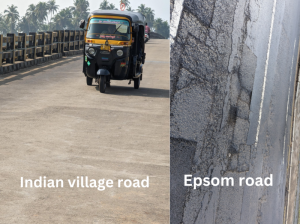
Indian road compared to Epsom road

A councillor who visited rural India paused his tour to take photos of the roads because they were “in better condition than Surrey’s”. The Labour group leader on Surrey County Council said he visited the state of Karnataka last month and on a visit to a village school, stopped to take a photo of the road.

Councillor Robert Evans (Labour, Stanwell and Stanwell Moor) told a meeting of the council on Tuesday (February 7) that his host had asked him what was wrong with the roads there. He told the meeting he had replied: “Nothing, to the contrary. I just wanted photographic evidence that the road surfaces here in rural India are better than in many parts of Surrey.”

Cllr Evans also said his Stanwell residents asked him why roads in what he called the “forgotten part of Surrey” were worse than in other parts of the county. He told the meeting: “I actually tell them they’re not, they are pretty bad everywhere.”

In the meeting, councillors voted through the authority’s budget for 2023/24, though without the support of the opposition. The county council’s share of council tax will increase by 2.99 per cent from April, which means an increase of 94p per week, or £48.69 per year on the average band D property.

This is less than the 4.99 per cent which the government says councils can increase council tax by without a referendum, though Slough, Thurrock and Croydon councils were this week given permission to raise council tax by 10 and 15 per cent to help pay off huge borrowing costs.

The district and borough councils in Surrey, as well as the Police and Crime Commissioner, will also add their shares to the bills that will be paid by residents. Surrey’s £1.1billion budget, which includes spending of more than £400m on adult social care and £249m on children, families and lifelong learning was described as a “good and fair” budget by the council’s leader.

Cllr Oliver (Conservative, Weybridge) pointed to the council’s “ambitious” capital programme which included highways maintenance as well as low emission buses, flood alleviation measures, independent living facilities for the elderly and more accommodation in the county for looked after children.

A cabinet meeting last week heard that more government funding was needed in Surrey for repairs on the county’s 3,000 miles of roads. The Liberal Democrat group leader called on the council to spend money the council had in reserves rather than “cutting spending on roads and services for vulnerable people”. Cllr Will Forster (Woking South) said Surrey’s roads were “completely falling apart”. He pointed to a highways budget that he claimed would be less than £30m by 2024/25, compared to nearly £70m in the 2023/24 budget. He said: “That is not acceptable. Our residents would find that appalling.”

But another councillor said it would be “bonkers” to spend the council’s savings on road repairs or other projects.
Cllr Edward Hawkins (Conservative, Heatherside and Parkside) said he supported the budget and looking to the situation in the Ukraine, Turkey and Syria, that it was important not to spend money that had been put aside.
He told the meeting: “It’s bonkers to spend the money that you put aside for a rainy day, when we really don’t know what’s coming around the corner.”

The meeting opened with a minute’s silence for the dog walker who was killed in Caterham in January, the Epsom College head and her family who were found dead on Sunday (February 5) as well as those affected by earthquakes in Turkey and Syria.

Related Reports:

Don’t blame us for potholes say Surrey’s highway authority.

Surrey County Council proposes 2023/24 budget

Going potty about pot-holes?


Local Audit meet: unexpectedly interesting…

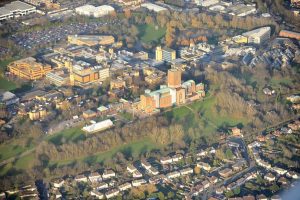
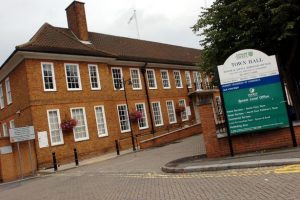
Epsom and Ewell Town Hall

When is a question not a question? This issue was the subject of heated discussion at the 2nd February meeting of the Epsom and Ewell Borough Council’s Audit and Scrutiny Committee. Former Stamford Ward councillor Previn Jagutpal, who resigned his seat in December, used the council’s procedures to ask a question at the start of the meeting: “When an outside agency such as … the Local Government Ombudsman [LGO] makes a determination about the functioning of this council, what is the process for the Chair of Scrutiny … to be informed?”

The chair, Cllr. Steve Bridger (RA, Stamford Ward), referred the question to a legal officer attending the meeting. “I believe the process,” the officer reported, “is that there’s going to be an annual report which will come to the committee which reports on any decisions made by the Ombudsman.”

Invited to ask a supplementary question, Mr. Jagutpal, then asked the Chair if he was “satisfied that all communications from outside agencies such as … the LGO in your 4 years as Chairman of this committee have followed that process and you have been informed of all such decisions?”

The Chair was again prompted. “You will receive a written answer in due course,” he said.

Mr. Jagutpal then requested to ask a second question. However, the officer ruled that his supplementary question was his second question. Mr Jagutpal argued that, according to the council’s constitution, a question followed by a supplementary question is one question, then a second question may be asked. But the officer responded that “You have asked a second question. There are no further questions we can answer tonight.”

“Are you going to deny me my constitutional right?” Mr Jagutpal asked. “As far as tonight, that’s it in terms of questions,” ruled the officer and Mr. Jagutpal left the council chamber.

Cllr. David Gulland (Lib Dem, College Ward) wanted to discuss the matter further “Obviously that question and the answers raised further questions in many of our minds,” he said and asked if the committee could discuss the matter.

Another pause from the chair was followed by “No, we continue with the agenda.”

But Cllr Gulland was not so easily put off. During the course of the evening he asked many other questions relating to the information being provided to the Committee and the Council’s internal processes. But he left his most damning speech for the final agenda item.

“Under the constitution,” he argued, “the monitoring officer is meant to report to all councillors on any breach of regulation or of data protection or where the ombudsman has reported it to us … I had to go and look for it, [but] I’ve found the letter of 20th July 2022 from the ombudsman to our interim chief executive, a public document, [which says that] ‘during the year your council failed to respond in time to our correspondence during three investigations. On each occasion, we had to escalate the matter internally and were forced to consider issuing a witness summons and a public report for non-compliance. Such delays in our investigation undermine our role and can result in further distress to complainants.’

“There’s a big elephant in the room,” Cllr. Gulland continued, “that our processes are not working and, more importantly, this committee has not been told about that. I would welcome comments from the chairman or the officer about my comments on the ombudsman and also about data protection issues.”

Again, it was the officer who responded. “You are referring to an old letter from the ombudsman,” he said, the letter being barely more than six months old. “I’m very happy to look into that. We’ll come back to you on issues about data protection.”

The July 2022 letter from the LGO acknowledges the challenges faced by local councils coping with pandemic working practices and the impact on services. The LGO seeks to encourage and assist EEBC in improving its procedures.

Meanwhile, members of the public and possibly even members of the committee may remain in the dark about possible breaches of regulations.

When is a question not a question? You decide. These are the relevant paragraphs from the council’s constitution:

1.9 At the Meeting the Chair/Chairman will ask the questioner if the response

answers their concern or if they wish to ask one supplementary question. If a

supplementary question is asked, it must arise from the reply given.

1.11 If a member of the public asks or wishes to ask more than one question, their

second question (written or oral) shall be taken after all other individuals who

wish to ask a question have been given the opportunity to do so.

Related Reports:

Man wrongly labelled ‘vexatious complainant’ by Epsom and Ewell Council


Don’t blame us for potholes say Surrey’s highway authority.

Pothole in Woodcote Road Epsom

The state of Surrey’s roads is “no fault of the county council” its cabinet has heard, as councillors vowed to put more pressure on central government for highways funding. In what the council’s leader called “pothole season”, the problems facing the repair of the county’s roads were set out at a meeting of the authority’s cabinet on Tuesday (January 31).

Approving the budget for the next year, ahead of full council voting on it, cabinet agreed a 2.99 per cent increase to the authority’s council tax share, or 94p per week for residents. This will be alongside any increases to come from Surrey’s 11 districts and boroughs and a proposed £15 increase per year for the Police and Crime Commissioner.

Cabinet members agreed a final budget for the council in 2023/24 of £1.1billion, an increase of £61.4m from 2022/23. The council tax increase will be made up of a 0.99 per cent increase in the core council tax and a 2 per cent increase in portion that is spend on adult social care.

In terms of the budget for roads in Surrey in 2023/24, the meeting heard that the budget was being set in the context of “hyper-inflation”, seeing an increase in the cost of bitumen of nearly 30 per cent over the past year.
Councillor John O’Reilly (Conservative, Hersham), chairman of the communities, environment and highways select committee, pointed to three central government cabinet ministers being Conservative MPs, including the chancellor Jeremy Hunt, the MP for South West Surrey.

He said he hoped a central government review into highways funding was carried out earlier than next year, adding: “The state of our roads, through no fault of this council, do require not just pothole filling but resurfacing.” Cllr O’Reilly told the meeting: “I’m sure we’ll put as much of our influence as we possibly can on central government to address these issues of funding for highways, particularly potholes.”

Speaking before the meeting, Cllr Tim Oliver (Conservative, Weybridge), the council’s leader, said despite seeing more traffic than other areas, the county council got the same level of funding from central government. He said the potholes were a national problem, made worse at this time of year by the freezing weather in what he called “pothole season”. But he added that additional investment from the council had paid off and led to fewer potholes, with 32,000 being filled last year compared to 75,000 the year before.

He told the LDRS: “We need the government to give us some one-off money for potholes.”

Council will meet to approve the budget in full on Tuesday (February 7).

Related Reports:

Going potty about pot-holes?

Surrey County Council proposes 2023/24 budget

Senior local Councillor slams Surrey’s budget consultation


No Crawleys for Surrey’s Downton Abbeys

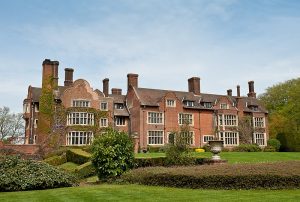
Headley Court

A lack of “Downton Abbey” type families to occupy abandoned mansions led to 112 homes at Headley Court (near Epsom) get the green light last night. The Mole Valley green belt site has previously been used by the Ministry of Defence,  Help for Heroes and as a covid testing centre. It could now be turned  into 12 two-bed homes within the converted mansion, with further 97 two-bed homes and three one-bed residents on the grounds.

Image: Headley Court mansion: Graham Harrison MoD

They were approved by a vote of 12 in favour and zero against. with three abstentions, by Mole Valley’s Development Management Committee on Wednesday, February 1. Attached to the approval was a list of conditions, including that homes should only go to people aged over 60 and assessed as requiring a care package, to make a publicly accessible restaurant and library available on site, as well as to agree to a travel plan.
The travel plan would include an on-call bus service and car club. 

The green belt site does not require special circumstances as it is considered to be previously developed land, the committee heard. There is currently an ongoing appeal of a previously rejected planning application on the site, due to be heard in May, and a decision on whether to pursue that matter will be taken in due course by developers Audley Group.

Questions raised during the meeting surrounded public access, environmental protection matters and parking, with Councillor Tim Hall, who abstained in the vote, saying the plans were “not quite there” particularly as the current bus to the site only ran once every two hours.

The meeting began with chair Cllr David Preedy announcing an interest in the matter and leaving the chamber. As a ward member, a letter was read on his behalf where he highlighted issues of parking while deputy Rosemary Hobbs oversaw the discussion.

The site was formerly part of a larger parcel of land that had used by the Ministry of Defence (MoD) from the 1950s to 2018 and since subdivided and sold to different owners. The  mansion house has been vacant since the departure of the MoD with the Jubilee Complex gardens used by the NHS and Surrey County Council during the pandemic.

Cllr Helyn Clack said: “We’ve been through a lot of papers for Headley Court  and a lot of changes.
“It’s a very historic site not just in its past but the very recent past. Its held very dearly in the heart of residents across the whole of mv and wider still because of the work that it did for Help for Heroes, the Afghanistan war and also what it has done more recently supporting the NHS throughout the pandemic. Across the whole of Mole Valley there are lots, particularly in rural areas, of large country houses originally built in the late 19th century or 18th century,  and then become completely unable to be used for their original purpose. You see them everywhere.

“We’ve had them here to discuss being converted into something where they can maintain their facial value but also be of use to the community going forward. We certainly wouldn’t want to see Headley Court left unoccupied or abandoned and people who want to go visit it are going to be able to do so in this plan.  The fact that hundreds, maybe thousands of people will visit this site when it’s finished – it will be a memorial site, not just to the veterans who were mended here but also to the pandemic.”

She added that she was banking on the new residents demanding and setting up their own residents association
Cllr Clack said: “We don’t still have the sort of Downton Abbey type families anymore who can run these huge estates. It’s a shame the MOD pulled out, it was a wonderfully loved site.”

She had trust in the planning regulations to deliver on what they were asking for and to not let that not fall by the wayside because it’s ‘too difficult to do’.

A further item on the agenda, to grant listed building consent to develop the site, was approved unanimously.