Epsom and Ewell Times

ISSN, LDRS and IMPRESS logos

A sign of no signs to come on ULEZ?

Traffic jam

Surrey councillors say they could stop TfL (Transport for London) putting signs on the county’s roads ahead of the planned ULEZ (Ultra Low Emissions Zone) expansion. Surrey County Council’s leader said the authority would “stand its corner” on the expansion “blindly going ahead” as he called for more conversation between the London Mayor’s office and the authority.

The ULEZ sees drivers of certain cars charged £12.50 per day to enter it, and is currently in place in central London where Transport for London (TfL) claims there has been a reduction in nitrogen dioxide pollution by nearly half.
The zone is set to cover all of greater London from August, meaning it will border Surrey in council areas such as Elmbridge, Epsom and Ewell, and Spelthorne.

But Councillor Matt Furniss (Conservative, Shalford), the county council’s cabinet member for transport, infrastructure and growth, told a cabinet meeting on Tuesday (January 31) that TfL would need a legal agreement with the council to put anything on the county’s roads.

Cllr Furniss said he had written to the Mayor of London and TfL, setting out the council’s “absolute disappointment” that the plan would go ahead without “meaningful conversation” on how Surrey residents would be affected. He said he had told officers to stop any discussions on the location of signs on the county’s roads until “a grown up conversation has happened between the two authorities on mitigating the disruption and the financial cost to Surrey residents.”

The council’s leader, Cllr Tim Oliver (Conservative, Weybridge), said “any conversation would be a good start” claiming there had been “no dialogue at all”. He told the meeting: “We do have the legal opportunity to prevent the Mayor of London putting signage on our highways and we will forcefully make that point to them. We will stand our corner on this.”

Surrey’s councils were given the chance to respond to a consultation on the ULEZ expansion in 2022, with Elmbridge, Tandridge and Spelthorne, among others, submitting responses. They called variously for a delay to the expansion, an expansion of the scrappage scheme offered to London residents to include Surrey car owners and the expansion of the zone 6 Oyster card zone.

Cllr Furniss said the county council had put forward ten points to TfL that should be considered if the scheme were to go ahead. These included exemptions for taxis and key workers, corridors to NHS facilities near the border and extensions to public transport into Surrey, among others.

The expansion is due to come into place from August 29 this year.

Related reports:

ULEZ will come to Epsom and Ewell borders

Yet more on ULEZ….

More on Epsom and Ewell and Surrey and ULEZ

Council’s last minute opposition to ULEZ extension.


Surrey County Council proposes 2023/24 budget

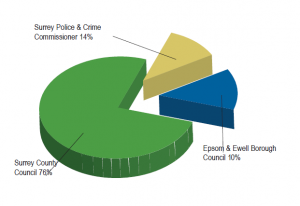
Council tax pie chart for Epsom

Surrey County Council is planning to restrict a rise in Council Tax to 2.99% in the current budget plans for 2023/24. The council’s Cabinet agreed the draft budget today outlining the planned rise, which is lower than the vast majority of other councils in the UK and far lower than the rate of inflation.

Surrey County Council spends just over £1bn a year on delivering vital services such as Adult Social Care, Children’s Services, maintaining roads and pavements, Surrey Fire & Rescue Service, libraries, countryside management and public health.

Image: council tax pie chart: EEBC 2022/2023

The budget also outlines the council’s five-year capital investment plan that will deliver more school places and improved school buildings, increased support for children with additional needs, road improvements, big infrastructure projects like in Farnham town centre, the River Thames flood defence scheme, grant funding community projects and increasing recycling capacity across Surrey.

Tim Oliver, Leader of the Council, (Conservative) said: “This budget is about protecting the services that the people of Surrey rely on, while being mindful of the huge pressures household budgets are under at the moment. The rise in the cost of living, inflation and interest rates have all impacted the council as an organisation, as well as our residents. Everything we do has simply become more expensive to deliver. However, we have worked hard over the last five years to ensure our finances are in a solid and stable state.

“We think it is important to only levy the absolute minimum we need to meet increased costs, in order to protect the money in people’s pockets as much as possible. “We are making the decision to face this financial challenge in the fairest way possible, balancing our needs and ambitions with the immediate cost of living impact on our residents.”

The budget will go before a Full Council meeting on Tuesday 7 February to be ratified.

The full details of the proposed 2023/24 budget can be found here.

Notes:

This list shows the Council’s budget plan for next year by each service area, and an indication of how much that is in terms of average Council Tax*.

Adult Social Care – Looking after people with disabilities, severe needs, and as they get older.

£439.7m per year (That is equivalent of £668.66 of annual Council Tax for a Band D property)

Public Service Reform & Public Health – Working closely with our NHS partners to help people live healthier lives and keep them safe and well.

£36.6m per year (That is equivalent of £55.66 of annual Council Tax for a Band D property)

Children, Families & Lifelong Learning – Giving young people the best start in life, with additional care for those who need it and supporting education providers.

£254.8m per year (That is equivalent of £387.48 of annual Council Tax for a Band D property)

Environment, Transport & Infrastructure – Improving our roads and public transport, managing our countryside, and tackling the climate emergency.

£152.8m per year (That is equivalent of £232.37 of annual Council Tax for a Band D property)

Surrey Fire & Rescue Service – Keeping residents safe and responding to emergencies

£38.7m per year (That is equivalent of £58.85 of annual Council Tax for a Band D property)

Customer and Communities – Helping local communities thrive, providing libraries, registrations, customer services and funding grants.

£18.9m per year (That is equivalent of £28.74 of annual Council Tax for a Band D property)

Prosperity, Partnerships and Growth – Working with businesses and other partners to help grow Surrey’s local economy

£1.6m per year (That is equivalent of £2.43 of annual Council Tax for a Band D property)

Communications, Public Affairs & Engagement – Making sure residents are well informed, can access services, and that Surrey’s collective voice is heard.

£2.2m per year (That is equivalent of £3.35 of annual Council Tax for a Band D property)

Resources – Things like Surrey Crisis Fund, school meal provision, administrative support, IT, legal services, and management of council buildings to keep services running smoothly.

£79.3m per year (That is equivalent of £120.59 of annual Council Tax for a Band D property)

Central Income and Expenditure – Putting money into savings to help protect services in future, and repayments on borrowing used for our investment programme

£76.9m per year (That is equivalent of £116.94 of annual Council Tax for a Band D property)

*For illustrative purposes, this represents the total budget split by the Band D council tax value. Some areas are funded by specific restricted grants, which are not reflected here. This is the County Council’s Band D figures only and does not include amounts raised by District & Borough Councils, Surrey Police or Parish Councils.

Surrey County Council news service.

Related Reports:

Senior local Councillor slams Surrey’s budget consultation

Budget Report: More council tax for Epsom and Ewell

Great expectations on Surrey’s tax?

Banding against Surrey’s top value homes?

Balancing the Borough’s Books


Green-belters belted up and beltless

Horton Farm Epsom

Epsom and Ewell Borough Council’s (EEBC) Licensing and Planning Policy Committee voted unanimously yesterday (30 January) to publish its Draft Local Plan for public consultation, after the chairman rebuffed claims that councillors had not been given enough time to read it. The decision followed public opposition to suggestions of Green Belt development in the borough, including a petition with over 2,000 signatures.

Image – Google – Horton Farm, Epsom in Green Belt, that could get 1500 houses.

The meeting opened with questions from the public. The chair, Councillor Steven McCormick (RA – Woodote Ward) told the committee that members of the public could not ask questions directly related to the meeting’s agenda items. This is in the Council’s Standing Orders. Steve Gebbett, who has been campaigning to protect the borough’s Green Belt, said: “My belt’s a bit too tight. I hope you don’t mind me taking off my green belt.” In a symbolic gesture, he placed a green belt on a table, where it remained for the remainder of the meeting.

He asked: “Does the committee ever refer significant issues that affect the whole borough to the whole council?” Mr Gebbett then described a situation in which “councillors go home and tell their loved ones their legacy is: honey, I shrunk the greenbelt”.

Councillor Julie Morris (Liberal Democrats, College Ward) asked the committee: “Am I the only person who hasn’t seen this document before? Have you all been discussing it for a long time? The assembled public might think we’ve been cooking it up for months. But we haven’t.” Councillor McCormick told her that they’d tried “to be open and transparent with the whole process.” He added that there had been many member briefings throughout the summer and autumn, and several statements to full council with opportunities to ask questions.

He also said that the Draft Local Plan had been presented to all members to be discussed in December, and said to Councillor Morris: “Maybe you missed some of those meetings?” Councillor McCormick added: “It’s strange to disperse the idea that it has happened behind closed doors. I’m quite disappointed Councillor Morris, I’m afraid.” Councillor Morris said that she meant that she had not seen the whole document together previously.

Councillor McCormick responded: “The items were presented on 7 December to all members. You’ve had ample opportunity to come forward to seek clarification.” Councillor Neil Dallen (Residents’ Association, Town Ward) said he had “sympathy” with Julie Morris’ comments, adding: “This is the first time we’ve seen the 200-page document. Most of it we have covered in different places at different times. I can’t say there’s parts I wasn’t aware of. I still think there’s bits missing.”

The Draft Local Plan sets out planning policies and sites that may be developed in the Borough up until 2040. It includes nine sites for potential development, on which it proposes that a significant proportion of its housing requirement will be built.

Four of these sites are in the town centre, on previously developed – ‘brownfield’ – land. However, the Council has said that they would be unable to meet housing requirements within urban areas alone. The Draft Local Plan states: “Whilst these sustainable locations are our preferred locations for new development, they do not deliver adequate housing to meet our social responsibilities for providing housing, in particular affordable housing.” Therefore, the other sites put forward for development are located outside of the town centre and on Green Belt land.

Green Belt land includes areas of countryside that are protected from development in order to prevent urban sprawl and encourage development within existing built-up areas. National planning policy requires that Green Belt boundaries are only amended “in exceptional circumstances”.

In the Draft Local Plan, the council says that it “considers that the scale of unmet development / housing needs in the borough that would result from pursuing a brownfield only approach provides the exceptional circumstances and justification to make changes to the Green Belt boundaries in the borough.”

The Draft Plan also states that: “Through the release of less than 3.6% of the borough’s Green Belt, the council will be able to deliver an additional 2,175 dwellings over the plan period”.

Under the proposals, sites removed from the Green Belt for development would include:

  • Land at West Park Hospital (for 150 homes)
  • Horton Farm (for 1,500 homes)
  • Land at Chantilly Way (for 25 homes)
  • Land Adjoining Ewell East Station (for 350 homes)
  • Hook Road Arena (for 150 homes)

The National Planning Policy Framework (NPFF), which the Local Plan should generally adhere to, is undergoing consultation, including on a revision that states that: “Green Belt boundaries are not required to be reviewed and altered if this would be the only means of meeting the objectively assessed need for housing over the plan period”.

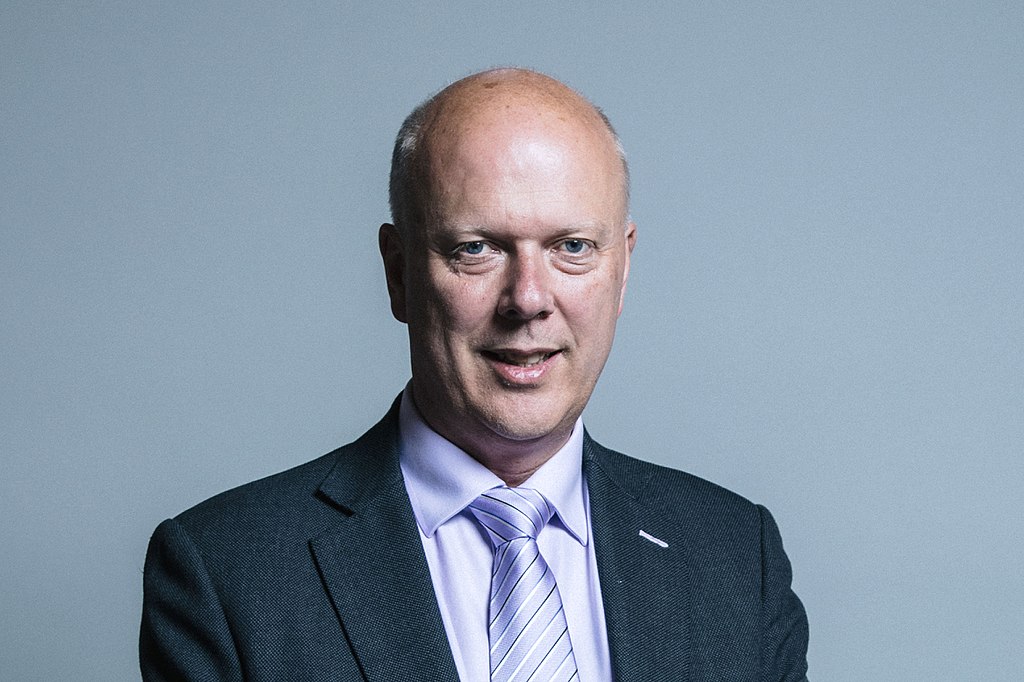
Chris Grayling MP

Mr Chris Grayling, MP for Epsom and Ewell, told the Epsom and Ewell Times: “The Borough’s proposal to simply build houses on 135 acres of green belt land, and not make any attempt to pursue the redevelopment of Kiln Lane and Longmead as a way of strengthening both the Borough’s economic future and meeting its housing need is a failure of momentous proportions.”

Mr Grayling has put forward his own proposals for development [reported in the Epsom and Ewell Times] on the Kiln Lane and Longmead estates. He told the Epsom and Ewell Times: “The kind of development that I proposed is happening elsewhere, but the Council thinks it is too difficult to do here. I think that is a cop out, and the result will be a massive loss of our green spaces in the area and real damage to biodiversity. It’s always easier just to build on a green field. But easy does not mean best.”

The Draft Local Plan, in reference to residential development on the Kiln Lane and Longmead estates, states that: “longer term opportunities for intensification for mixed use could be explored in time”.

The Council has said: “The Local Plan needs to protect our attractive and valued environment whilst reconciling the need to accommodate our development needs. The balance between protecting our environment and enabling development and supporting infrastructure, is at the centre of our spatial strategy.”

The borough’s housing need was calculated using the “standard method” in national planning guidance. The need was calculated as 576 dwellings per annum, equating to 10,368 dwellings over the Local Plan period. The Draft Local Plan, however, states: “Taking into account the borough’s constraints, the council is not planning on meeting its local housing need figure.” Instead, it has set a housing requirement of 5,400 dwellings over the Local Plan period.

Under another proposed addition, the NPFF will strengthen its existing point that local housing need is an advisory starting point for setting a local housing requirement. In an email on behalf of CPRE, (The Council for the Protection of Rural England), Surrey, to the Licensing and Planning Policy Committee, Mr Tim Murphy said that there was “no justification” for increasing the number of homes in the borough by 5,400. He said that the standard method used to calculate housing need “relies on household projections from 2014 which are now widely recognised as significantly inflating household growth in areas such as ours”.

The Council’s Planning Policy Manager told the committee that there is “already an existing need in the borough” and that as of June 2022, there were 1,200 households on the list for affordable housing. He added: “We have a significant need for affordable housing in the borough, including for homelessness and people in temporary accommodation.”

However, the committee rejected a motion, proposed by Cllr Kate Chinn (Court Ward, Labour), to ensure that 40% of all new developments exceeding 10 units included affordable housing.

Councillors also raised questions in the meeting as to whether the Draft Local Plan could be altered following the public consultation. Councillor Morris asked whether, if a large number of people came forward to oppose Green Belt development, this would form part of the “evidence base” required for Local Plan policies.

The Council’s Interim Director of Environment, Housing and Regeneration, responded: “It is the content of responses, and what new evidence and information they direct us towards, not about the number of responses received, or the number of times something is said.” She said that the council would be required to provide a statement on the consultation, with key issues that were raised, and how they were addressed with changes to the Plan.

Councillor Morris said: “We’ve taken an awfully time to get this far; I’d hate to see it abandoned. So much of the document is really really important. There are bits that are just not right. If I were to support it, it would not be that I support the content, but the concept of it going forward to public consultation.” She added: “Green Belt has become massively important. […] Keeping hold of what we’ve got has become the name of the game recently.”

Councillor Dallen added: “Can I request that we don’t have 200 pages to go through in one night in future?” Councillor McCormick responded: “It’s noted. We’ll try to do better next time.”

Just before the vote, Councillor Morris said: “I am somewhat reassured that there can be significant change if this document goes ahead. I expected to want to vote against. I felt we hadn’t given it enough thought and time.” She added: “This is clearly controversial. A lot of people are not happy about this.”

After almost two hours, councillors voted unanimously to go ahead with the Draft Local Plan. Public consultation will commence today at noon and conclude on 15 March. Go to Epsom and Ewell Times Official Notices page to see how you can respond.

After the meeting Cllr Steven McCormick, Chair of the Licensing and Planning Policy Committee, said: “We believe the Draft Plan provides a proactive framework for the borough to grow in a strong and positive way, so everyone will have the opportunity to live in an affordable, vibrant area with a growing economy. “The Draft Local Plan is our starting point and we strongly encourage local people to help shape the final Plan by responding to the consultation.”

[Ed: Even if the Green Belt proposals are removed after public consultation this Draft will still be of value in Planning Appeals pursued by Green Belt developers in the future].

Related reports:

Local Plan battle heating up?

Green-belters seeing red on Local Plan?

Lessons for Epsom in Mole Valley’s “shouty” Local Plan struggle?

Crucial month for local Local Plans?

Gove gives pause for thought on Local Plans?

Local Plan Battle: early skirmishes on Downs Farm

MP’s housing solution for Epsom and Ewell


Micro-homes for a macro-problem?

Modular house

Epsom and Ewell Borough Council is planning to purchase movable micro homes for families needing temporary accommodation in the borough. In a report to the Strategy & Resource Committee on 26th January, officers stated that demand in the borough for temporary accommodation is acute. They plan initially to purchase three family micro homes at a cost of £435,000. The homes, which boast exceptional energy efficiency, will be constructed off site and craned into position. They have a 50 to 60 year life span, come fully furnished and can be moved to another site if required. Several councils, from Cornwall in the west to Southend in the east, have already developed schemes with similar units.

Subject to planning permission, which will be applied for in the next three months, the units will be located on a brownfield site near the Kiln Lane Sainsbury’s. The Council has already secured a £75,000 grant from the Brownfield Land Relief Fund to assist with the preparation of the site for development.

The report was greeted with enthusiasm by councillors. “It looks a progressive and radical solution,” said Councillor Alan Williamson (RA, West Ewell Ward), “and it’s to be commended. I would like to see this as the basis for further developments in the borough.”

The interest was so great that one officer suggested arranging some tours before the homes are occupied.

Councillor Kate Chinn (Labour, Court Ward) was also wholehearted in her support. “Anything that stops families being separated, moving out of the borough, being able to remain with their support networks is fabulous,” she said.

After the meeting the Council issued a press release confirming:

Epsom & Ewell Borough Council has submitted a planning application to create three new temporary homes to house local families at risk of homelessness.

The proposal is in response to the acute demand for temporary accommodation in the borough, particularly for family-sized homes. It forms an important contribution to the Council’s recently launched Homelessness and Rough Sleeping Strategy, which includes the objective to increase accommodation options in the borough including temporary accommodation.

The proposal makes use of brownfield land alongside Fairview Road in Epsom and was approved by the Strategy & Resources Committee on Thursday 26 January. The proposal will now go through the due planning process and if approved, work will start in March 2023.

Alongside providing life-changing support to the families who will make use of the homes, investment in the properties will lead to savings for the Council over time, as the cost of the development is offset by rental income and a reduction in the need for expensive nightly paid accommodation. The Council has also been successfully awarded funding of £75,000 from the Department for Levelling Up, Housing and Communities’ Brownfield Land Relief Fund, to be invested in this project.

The homes are pre-fabricated and built offsite to provide an innovative, attractive and low-cost housing solution. They are at the forefront of energy efficient design and provide safe, welcoming spaces for families.

Cllr Neil Dallen, Chair of the Strategy & Resources Committee, said: “I am delighted that this key project has been approved by Committee, and that its importance has been emphasised by the level of funding we have received from central government. The impact of homelessness cannot be underestimated, and increasing temporary accommodation provision for local families will have a positive impact not only on those being housed, but on the borough as a whole.

“This will now progress through the planning process and we will await the outcome with interest.”


Surrey Council stretches Epsom & Ewell Council resources

Parking ticket

At Thursday 26th January meeting of the Strategy and Resources Committee of Epsom and Ewell Borough Council eagle-eyed financial expert Cllr David Gulland (Lib Dem, College Ward) spotted a loss of £250,000 in the borough council’s on-street parking income.

A council officer explained that , although highways are Surrey County Council’s (SCC) responsibility, they had previously contracted Epsom & Ewell Borough Council (EEBC) to do the enforcement of on-street parking. EEBC already had their own enforcement officers managing the off-street carparks, so economies of scale could be realised by doing them both together. EEBC used to collect nearly £400K from on-street parking permits and enforcement notices.

But now SCC has unilaterally decided to end that contract and put it back out to a private sector contractor, so EEBC can no longer benefit from the on-street parking income or the economies of scale. Officers are doing all they can to reduce the cost and minimise the loss of income, he insisted.

Cllr Gulland was unimpressed with SCC’s actions. “I think we should note that for possible action at county council election time,” he suggested.

Related Stories:

Local Parking (enforcement) Wars opinion piece by Cllr Eber Kington

Private Public Parking Penalisers Surrey County Council privatises parking enforcement


Pay rises for Epsom and Ewell Borough Council

Epsom and Ewell Town Hall Building

At Epsom and Ewell’s Strategy and Resources committee meeting on 26th January, councillors discussed rates of pay in the forthcoming year – for staff, for the Chief Executive and for themselves. Most staff will receive a capped 3% cost of living pay increase. This is a result of the Council’s Employee Pay and Reward Procedure 2020-24, a four year pay deal agreed at the beginning of that period. This compares with a Consumer Price Index rise of 10.5% for the 12 months ending in December 2022.

This compares with a proposed increase for the Chief Executive of the borough of at least 15%, a figure which made Cllr Kate Chinn (Labour, Court Ward) feel “uncomfortable”. The top of the salary range for the Chief Executive will become £143,376 in the 2023/4 year.

A council officer explained that a review of pay for Chief Officers had been undertaken some years ago, but that the Chief Executive’s pay had been excluded from that review. Following an external benchmarking exercise, “this is a catch-up exercise,” she said. Nevertheless, “for the staff to get 3% because of the agreement that they’re in and the chief exec to get 15 to 16%, it does feel quite difficult,” Cllr Chinn complained.

Cllr. Eber Kington (RA, Ewell Court Ward) took comfort from the gender pay gap which continues to be negative, showing that women employed by the local authority earn on average more than men. This is primarily due to the majority of front-line operatives being male and senior management roles being held by a significant proportion of women. “This does suggest that this is an organisation to which woman feel comfortable applying and where they wish to stay and seek promotion within the organisation,” said Cllr Kington. “I think that is something we ought to be proud of as a local authority.”

However, the issue that provoked the most councillor participation was their own pay. The motion that councillors were asked to vote on suggested that their allowances should mirror the staff pay award and rise by 3% in 2023/24, with an independent Remuneration Panel determining the increase in 2024/25.

Cllr David Gulland (Lib Dem, College Ward) felt “personally unhappy in voting any increase for the councillors” in the current environment.

However, the meeting’s chairman, Cllr Neil Dallen (RA (Town Ward), pointed out that the last two independent remuneration panels had recommended a considerable increase in councillors’ allowances, but the council had voted at the time not to accept those recommendations, otherwise allowances would now be much higher than they are.

Councillor Alan Williamson (RA, West Ewell Ward) agreed. “There is a widening gap between this authority and other districts around Surrey,” he argued. “In future fiscal years, we should get back on track in line with the independent recommendations.”

“We have bills,” said Councillor Monica Coleman (RA, West Ewell Ward), “and some of us have to decide if we’re going to be councillors or get a job. There are some occasions when I have to decide whether to work or go to a meeting and sometimes work rules because that pays my bills.”

A sentiment that was echoed by Councillor Chinn. “A really good overhaul of the allowances would be very welcome,” she said, “ and looking at allowances for things like carers, transport, child-minding …. to enable as many people as possible to become councillors.”

The basic allowance for a councillor will rise to £4,031.70 in 2023/24. Some posts such as committee chairs and vice chairs receive additional allowances.

Related reports

Balancing the Borough’s Books


Grants to save energy…. time running out

Man fitting solar panels on roof

Surrey residents have just three weeks left to apply for a grant to help make their home warmer and more energy efficient, ahead of applications closing on Friday 17 February 2023.  

People living in hard to heat homes and on lower incomes, could receive grants between £10,000 and £25,000 to improve insulation and install renewable technology – helping to save energy, reduce emissions and combat rising energy prices. Improvement measures include loft insulation, cavity and external wall insulation, underfloor insulation, and renewables, such as solar electricity panels. 

Residents can check if they are eligible by visiting the Action Surrey website – www.actionsurrey.org, or by calling them on 0800 783 2503.

Marisa Heath, (Englefield Green, Conservative) Cabinet Member for Environment at Surrey County Council said: “We know this is a challenging time for many and we’re really pleased to be offering this funding to our residents who need our support the most.  

“Improving the energy efficiency of homes in Surrey will also help us achieve our goal to be a net zero county by 2050.  “I encourage residents to check if they are eligible as soon as possible.” 

So far, over £1.5m has been allocated across the county to fully fund over 250 energy efficiency improvements. Funding has been awarded through central Government to Surrey County Council, leading on behalf of the local authorities across the county. The project will be delivered and managed by Action Surrey – an energy efficiency advice service set up in partnership with all Surrey local authorities. 

Keep up to date on progress towards our target of making Surrey net zero by 2050 and find out what you can do to help. Sign up to our Greener Matters newsletter to get updates here: Our climate change newsletter – Surrey County Council (surreycc.gov.uk)

Surrey County Council news service


The Surrey levels mean no level funding?

levelling up

The allocation of levelling up funding from central government was announced last week, with more than 100 projects given a share of £2.1billion. But no funding was given to Surrey’s councils, with one of the county’s proposed projects being improvements to Caterham town centre and flooding measures.

Three bids were put in across the county in total, with the other two being for better cycling and walking routes to the east of Woking and a new health centre in Sheerwater. Overall, government figures show £672m was allocated to develop better transport links, £821m for community regeneration and £594m to restore local heritage sites across the country.

More than £200m was given to councils in south east England, including £45m to Kent County Council for more border control points and traffic improvement measures at Dover and £20m each for improvements to Folkestone and Sheerness town centres.

Over the border in Hampshire, Rushmoor Borough Council was also awarded £20m for a state-of-the-art leisure centre, library and cultural space in Farnborough to help tackle high levels of obesity, inactivity, and poor mental health in the area. But Surrey’s councils were not awarded any cash, with only three bids being put in between the county council and the 11 district and borough councils.

We break these down in detail below, including the cash that was asked for, and those councils which did not bid for funding.

Unsuccessful bids:
Surrey County Council’s £12m bid to improve walking, cycling and bus routes to the east of Woking would have created better connections to the town centre, and were part of wider plans to improve sustainable travel options in the county. The scheme would have seen improved footpaths, cycle paths and tracks, more secure bike parking and e-bike charging stations and proposals to fund a trial e-cargo bike hire scheme for businesses and residents. Bus improvements would have included better accessibility, real-time information and bus stops with living roofs.

A county council spokesperson said: “Whilst our bids in the latest round were not successful, we will continue to work closely with government to identify and access funding for the vital work we are doing to ensure no one in Surrey is left behind.”

Woking Borough Council also put in a bid for £3.8m for a ‘health and community campus’ in Sheerwater.
A £492m project is already underway to regenerate the area, which the council said is the second most deprived area in the county. The campus would have given residents access to maternity clinics, chiropody, disability support, GP services, dentistry, parenting support and nursery care.

The council said it should have a “significant and positive impact on some of the borough’s most vulnerable and harder to reach residents”. In response to the bid being unsuccessful, Cllr Will Forster (Liberal Democrat, Hoe Valley), the council’s deputy leader, said given the area being the second most deprived in Surrey, the council felt they had “a strong case”. He said the council was “disappointed” to have missed out on the latest round of Levelling Up funding. Cllr Forster added: “The next phase of the Sheerwater Regeneration Project has already commenced and we remain committed to working with partners to develop the new health and community campus and delivering the much needed facilities.”

Tandridge District Council’s application for £8.7m would have meant money being put towards regenerating Caterham, including new flood measures to help with the regular flooding there. The East Surrey MP, Claire Coutinho, thanked the district council for its work in putting together the bid, and said she was “disappointed” the money was not awarded. She added: “I will work with Tandridge District Council and central government to explore all future funding opportunities, to make sure that East Surrey gets the funding it needs to improve our towns and villages.”

The leader of the council, Councillor Catherine Sayer (Independents and OLRG Alliance, Oxted North & Tandridge), said: “We are extremely disappointed our bid for funding was unsuccessful. We planned to use this funding to regenerate Caterham, boost the local economy, attract more people to work, visit and live in the area and introduce much needed flood alleviation measures. This would build on the work we’ve already done to improve Caterham Valley town centre.” She said a lot of time and hard work had been put into the bid, and said the council would look for feedback on the application and appeal the decision if possible. Cllr Sayer added: “We will also consider another bid when government confirms details of the third round of funding.”

Councils which did not apply for the funding:

The other district and borough councils did not apply for levelling up funding, though some have bid for and received central government funding in the form of the UK Shared Prosperity Fund. These included a £1m award to Elmbridge Borough Council to be used for the Walton Playhouse and in playgrounds, and the same amount to Runnymede Borough Council which it will use for transforming Chertsey high street and grants for new businesses.

The full list of councils which did not make a bid for Levelling up funding were:

Reigate & Banstead Borough Council
Spelthorne Borough Council
Mole Valley District Council
Elmbridge Borough Council
Runnymede Borough Council
Surrey Heath Borough Council
Epsom & Ewell Borough Council
Guildford Borough Council
Waverley Borough Council

Related reports:

Surrey County Council on the level.


Remembering the victims of genocide

Epsom Clock Tower in purple

Epsom & Ewell Borough Council will carry out a number of activities to mark Holocaust Memorial Day on Friday 27 January. Holocaust Memorial Day is a time to remember the six million Jews murdered during the Holocaust, the millions of other victims of Nazi persecution and those killed in the more recent genocides in Cambodia, Rwanda, Bosnia and Darfur.

The Council will light up the clocktower in Epsom Market Place in purple in memory of the victims of the Holocaust and genocide worldwide.

The Mayor, Councillor Clive Woodbridge, will give a speech which will be available to view on the Council’s YouTube channel from Friday – https://www.youtube.com/channel/UC0UGt6AEUCYhS3gjs4jEsyg.

An exhibition will take place at Bourne Hall, Ewell, looking at the history of the Holocaust and linking it to local stories from the Borough. Visitors will be able to place LED candles on the shrine as a mark of respect.

Virtual candles can also be lit by visiting www.illuminatethepast.org.

To learn more about the Holocaust and genocide, please visit www.hmd.org.uk.

Epsom and Ewell Borough Council

Related article:

Flight of refugees: history repeating?


Local Parking (enforcement) Wars

Eber Kington by a double yellow line

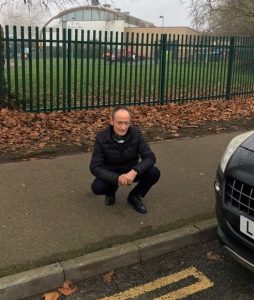
An opinion piece from Cllr Eber Kington: This week SCC announced a seven-year contract worth £96.5 million, with private company Marston Holdings Ltd, for parking and traffic enforcement. In April, SCC will be centralising parking enforcement, a service which currently is managed by Surrey’s Borough and District on behalf of the County.

Image: Cllr Eber Kington on patrol

The accompanying comments to the announcement, made by the Kevin Deanus, Cabinet member for Highways
and Community Resilience, promise much. But residents need to be aware, SCC does not have a great track
record when it comes to taking back decision making and centralising services previously provided by the Borough Council on behalf of the County.

When SCC took back the maintenance of highway verge trees the policy became one of no maintenance unless a
tree is diseased, dying or dead. And no longer will SCC automatically replace a tree lost to our urban streets.
Instead, our residents have to pay £25 just to get a location looked at. £25 which is not refundable and, as often
is the case, ends with the site being declared as unsuitable for a tree.

In April, SCC is also taking back the cutting of verges. The 6 to 8 seasonal cuts by the Borough Council, recognising
seasonal weather conditions, will be reduced a standard county-wide cut of 4. Hardly an upgrade on what has
gone before. And will SCC be pro-actively managing overhanging branches in our urban alleyways? My concern is
that SCC does not even realise it’s a job to be done.

And the abolition of Local Committees and centralisation of highway decisions. Now residents have no public
meeting to ask questions of Highway Officers, petitions are determined at SCC’s HQ in Reigate by council officials
or a SCC Cabinet Member, and road safety schemes are decided by a Cabinet Member rather than local County
Councillors.

So, what will this £96.5 million contract mean? Kevin Deanus, Cabinet member for Highways and Community
Resilience, said: “The new contract will mean that Surrey County Council can more directly and consistently
manage on street parking enforcement across the county, helping to tackle inconsiderate parking and make
parking restrictions more effective.”

We all want safe and considerate parking, and there has to be a penalty for those who do neither. But that £96.5
million contract has to be paid for somehow. Will we see parking meters introduced where currently there are 1
hour or 2 hour waiting limits? Will additional yellow lines, designed to push drivers into paid for parking spaces,
be introduced. Will the new system be flexible enough to ensure that our local primary schools are visited
regularly to manage dangerous parking and idling cars? And will Residents Parking Zone Permit charges go up
once again.

Personally, I’m not sure that SCC’s desire for consistency and effectiveness in parking enforcement also equates
to fairness in delivery and a recognition of local needs, and it won’t be just another way to make our residents
pay.

County Councillor Eber Kington

Eber Kington is a former Mayor of Epsom and Ewell. He represents the Epsom and Ewell Borough Council Ward of Ewell Court Ward and on the County Council of Surrey he serves the ward of Ewell Court, Auriol & Cuddington.

Related stories from Epsom and Ewell Times:

Private Public Parking Penalisers

A Greener Future in Partial Sight As Verges To Be Left Unmown